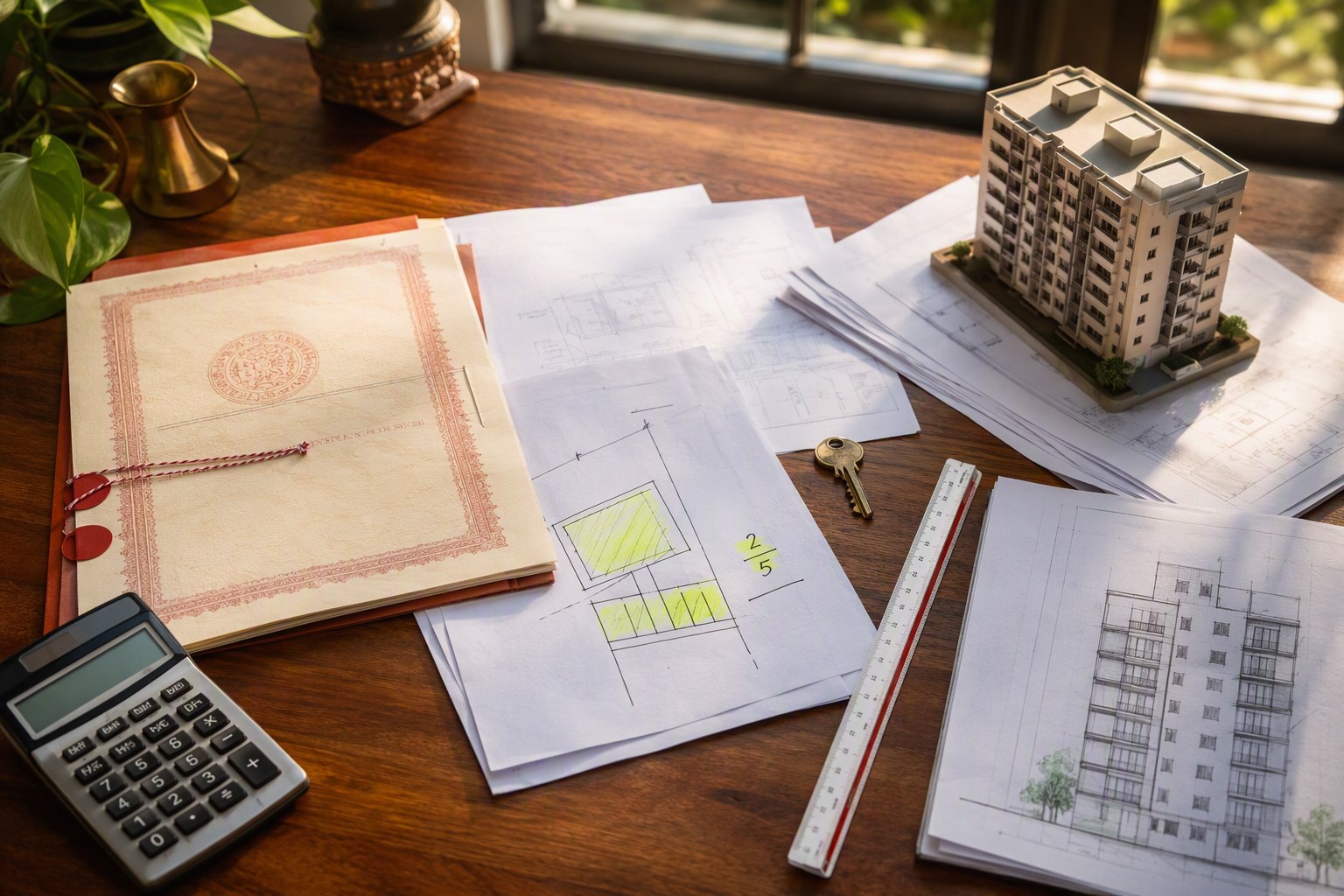



Telangana Plot Shortlist: Start With the Prohibited Check
Telangana Plot Shortlist work should begin with one uncomfortable number: 3,076,153 prohibited properties are recorded under Section 22-A as per latest IGRS data available to us. In simple buyer language, that means a plot can look attractive on paper, sit near a growing Hyderabad corridor, have a neat boundary stone, and still be blocked for registration because the survey number is flagged in government records.
That is why I tell buyers not to begin with price, east-facing sentiment, highway distance, or brochure layout. Start with the survey number. Start with the village. Start with the mandal. Then run the prohibited property check. Only after that should a plot enter your shortlist.
In Hyderabad and surrounding Telangana growth belts, most plot mistakes happen before the legal opinion stage. The buyer first falls in love with a location, pays a token, and only then asks someone to verify. By that time, the seller is pushing for agreement, the broker is saying “sir, all registrations are happening nearby”, and the buyer is emotionally invested. A Section 22-A surprise at that point is painful.
Our practical rule: if the survey number cannot pass a prohibited property check, it should not be in your Telangana plot shortlist at all.
Why Telangana Plot Shortlist Must Start With Section 22-A
Section 22-A entries are not small technical issues. They can stop registration at the Sub-Registrar Office. A property may be treated as prohibited due to government land claims, assigned land restrictions, endowment land issues, waqf-related entries, ceiling matters, court or departmental restrictions, or other notified reasons. The exact reason must be checked against the specific survey number and village record.
The key point is this: the SRO does not care that you liked the layout entrance arch or that the seller promised “clear title”. If the survey number is in the prohibited list, the registration process can hit a wall.
We have seen this across Hyderabad’s active outer markets: Shankarpally, Moinabad, Gandipet, Shamshabad, Maheshwaram, Hayathnagar, Abdullapurmet, Ghatkesar, Medchal, Dundigal Gandimaisamma, Patancheru, and nearby gram panchayat belts. I am not saying every plot in these locations is risky. Far from it. Many are clean and well-documented. But these are the very areas where buyers often shortlist fast because the growth story is strong. Fast shortlisting without survey-number verification is where the damage starts.
Use the Section 22-A Prohibited Property Check before you ask for discount, before you compare two ventures, and before you send advance money. If the seller does not share survey number, village, mandal, and document chain, that itself is a signal.
Telangana Plot Shortlist: What the 30.76 Lakh Count Tells Buyers
The number 3,076,153 is not just a database figure. It reflects the scale of property restrictions that buyers must take seriously in Telangana. A buyer may feel, “My plot is only a small 200 square yards, why worry so much?” But prohibited status is not decided by your plot size. It flows from the survey number, land classification, and government record trail.
Many plotted developments are carved from agricultural survey numbers. In older villages around Hyderabad, one survey number may have changed hands several times, gone through family partitions, GPA transactions, conversion attempts, layout approvals, and sale deeds. If any part of that underlying land is affected by a restriction, the buyer must know before shortlisting.
In our experience, buyers usually ask these questions first:
- How far is it from ORR?
- Is it near a proposed road?
- Is the plot east-facing?
- What is the final price?
- Will the builder give loan support?
These questions are valid, but they are second-stage questions. The first-stage question is sharper: Is this survey number clean for registration?
For that, combine three quick checks: prohibited property status, survey number identification, and SRO mapping. Start with Section 22-A Prohibited Property Check, then use the Survey Number Finder if the location details are unclear, and confirm jurisdiction through Find Your SRO Office. This sequence saves time and arguments.
Do Not Shortlist a Plot Without Village, Mandal and Survey Number
A common Hyderabad plot advertisement says “near Shankarpally”, “close to Tukkuguda”, “beside upcoming development”, or “near Pharma City side”. These location tags are marketing language. For legal checking, they are incomplete.
You need the following minimum details:
- Village name as per revenue records, not just the nearby famous locality.
- Mandal name, because the same-sounding village names can create confusion.
- Survey number and sub-division number, if applicable.
- Extent of land from which the plot is carved.
- Layout approval details, if it is an approved plotted layout.
- Link documents showing how the seller got title.
- Latest pahani / Dharani record reference, where relevant.
If a seller says, “Sir, survey number we will give after token,” please slow down. A genuine seller may not immediately share every private document on WhatsApp, but the basic survey number and village should not be treated like a secret. Without that, you cannot check Section 22-A status, market value, EC, or jurisdiction.
For apartment buyers, a flat number and RERA registration may be enough to start screening. For plot buyers, the survey number is the centre of the file. Everything else sits around it.
How to Build a Safer Telangana Plot Shortlist
I prefer a simple three-bucket method for plot shortlisting. It is practical, especially for buyers comparing Hyderabad outskirts where every second venture claims future appreciation.
Bucket 1: Reject immediately
Put the plot in this bucket if the seller is not sharing survey number, the village name is vague, or the survey number shows a prohibited entry. Also reject if the layout approval story keeps changing from “HMDA” to “gram panchayat” to “regularisation in process”. A serious buyer should not become the test case for someone else’s documentation gap.
Bucket 2: Keep under verification
This bucket is for plots where the basic details are available, and the prohibited property check does not raise an immediate red flag, but title chain, EC, land use, layout approval, access road, or mortgage status still needs checking. Many good plots sit in this bucket for a few days while documents are reviewed.
Bucket 3: Shortlist for negotiation
Only plots with clean initial checks should reach this stage. Here you can discuss final price, payment schedule, registration timeline, possession, boundary marking, and development works. By this time, the conversation is stronger because you are not negotiating blindly.
Use Property Verification Tool to organise the early screening. Then run Encumbrance Certificate Search and, where needed, EC Analyzer to understand transaction history. For a plotted layout promoted as a regulated project, check RERA Project Lookup also.
Section 22-A Is Not the Only Check, But It Comes First
A clean prohibited property result does not automatically mean “buy without worry”. It only means one major registration blocker may not be visible in that check. You still need title verification, EC review, land classification, layout approval, approach road clarity, mutation flow, and physical possession check.
But Section 22-A comes first because it is a gatekeeper. If the gate is closed, there is no point polishing the rest of the file. You can spend money on legal opinion, site visits, soil tests, Vastu consultation, and bank processing, but if the SRO cannot register due to a prohibited entry, the deal is stuck.
Here is how I would sequence it for a typical open plot near Hyderabad:
| Stage | Buyer action | Why it matters |
|---|---|---|
| 1 | Collect village, mandal, survey number | Without these, legal screening is guesswork |
| 2 | Run Section 22-A check | Filters registration-blocked survey numbers early |
| 3 | Confirm SRO jurisdiction | Helps verify registration and EC records correctly |
| 4 | Check EC and link documents | Shows transaction chain, mortgages, and past transfers |
| 5 | Check market value / guideline value | Helps estimate stamp duty and detect odd pricing claims |
| 6 | Verify land use and layout approval | Confirms whether the plotted use is legally supported |
| 7 | Visit site with documents in hand | Matches paper details with ground reality |
For guideline value, use Market Value / Guideline Value Search. For registration cost planning, use the Stamp Duty Calculator. If the plot is part of a larger development where road width or land use matters, keep Road Width Check and Land Use Zone Finder in your checklist.
Hyderabad Locality Names Can Mislead Plot Buyers
One reason buyers miss prohibited checks is the way land is marketed. A venture may be advertised as “near Kokapet”, but the revenue village may be in a different mandal belt. Another may say “Shamshabad side”, but the exact village and SRO could change the legal trail. “Near Financial District” sounds premium, but for a plot document, the exact survey number matters more than the sales label.
This is especially relevant in locations where Hyderabad’s urban edge blends with revenue villages. Think of Mokila and Shankarpally side, Gandipet and Narsingi belt, Tukkuguda and Maheshwaram side, Ghatkesar and Bibinagar direction, Patancheru and Sangareddy growth line, or Medchal and Kompally surroundings. Buyers often compare them as lifestyle or investment zones. Government records do not work that way. They work by village, mandal, survey number, extent, classification, and SRO.
In our experience, the best buyers are not the ones who know every future road rumour. They are the ones who can ask the broker calmly: “Please send village, mandal, survey number, layout approval copy, and link document list. I will review and revert.” That one sentence changes the tone of the deal.
What If a Plot Shows in the Prohibited List?
If a survey number appears in the prohibited property list, do not panic, but do not proceed casually. First, confirm that the village, mandal, and survey number were entered correctly. Small spelling or sub-division confusion can happen. Then ask the seller for documentary clarification. A proper seller should be able to explain the nature of the entry and provide relevant records, not just verbal assurance.
In some cases, buyers may be told that the issue is “old”, “will be removed soon”, or “registrations are happening through another route”. Treat such statements carefully. Unless there is clear official record and a competent professional has reviewed it, avoid paying advance. If the plot is genuinely clean, the seller should have no issue waiting for a basic check.
Here is my blunt view: a buyer should not fund the seller’s legal clean-up. If the land needs correction in government records, let the seller resolve it before asking market price from you.
Why Token Advance Before Prohibited Check Is Risky
Token advance is where many buyers lose bargaining power. The amount may be small compared with the final plot value, but emotionally it locks the buyer into the deal. After paying, buyers start adjusting their standards: “Maybe this small issue is manageable”, “Maybe the lawyer is being too strict”, “Maybe we should not lose this location”.
That is not how land buying should work. A plot is not a phone booking. It is a legal asset tied to government records, family title, revenue classification, local access, and registration rules.
Before token, insist on:
- Survey number and village confirmation
- Section 22-A prohibited property check
- Basic EC review
- Seller identity and title flow
- Layout approval status
- Clear refund terms if verification fails
If the seller is genuine, these checks should not offend them. If they are offended, that is useful information for you.
Build Your Telangana Plot Shortlist Like a File, Not Like a Wish List
A wish list says: east-facing, near ORR, peaceful location, future growth, good price. A file says: village, mandal, survey number, SRO, title chain, EC, pahani/Dharani reference, layout approval, land use, road access, prohibited check, market value, and registration cost.
Both are needed. But the file must lead the wish list. Otherwise, buyers end up comparing dreams, not properties.
For a serious shortlist, create one row per plot and keep these columns:
- Marketing name of venture or seller
- Actual village and mandal
- Survey number and plot number
- SRO jurisdiction
- Section 22-A status
- EC status
- Layout approval type
- Land use observation
- Guideline value checked or not
- Documents pending from seller
- Your decision: reject, verify, negotiate
This method sounds simple, but it filters noise very quickly. In one evening, you may realise that half your WhatsApp forwards do not even have proper survey details. Good. Those were not real shortlist items anyway.
Final Buyer Take: No Survey Number, No Shortlist
The Telangana plot market rewards patience. Hyderabad’s expansion is real, and good land parcels do exist across the city’s western, southern, northern, and eastern corridors. But the same market also carries documentation risk, especially where buyers rely on locality branding instead of revenue records.
With 3,076,153 prohibited properties recorded under Section 22-A as per latest IGRS data available to us, the message is clear: do the prohibited check before shortlisting, not after negotiating. Ask for village, mandal, and survey number. Verify the SRO. Check EC. Confirm guideline value. Study land use and layout approval. Then talk price.
That order may feel slow for one day. It can save you years of stress.
Frequently Asked Questions
What is a Section 22-A prohibited property check in Telangana?
It is a check to see whether a property or survey number is listed as prohibited for registration under Section 22-A. If a survey number is flagged, the SRO may not allow normal registration unless the issue is legally resolved.
Should I check Section 22-A before paying token advance for a plot?
Yes. In our view, this check should happen before token advance. Once money is paid, buyers often feel pressured to continue even when documents show risk. Ask for village, mandal, and survey number first.
Is a clean prohibited property result enough to buy a plot?
No. It is only the first filter. You should still verify title chain, EC, land classification, layout approval, SRO jurisdiction, road access, and seller rights before finalising the purchase.
What details are needed to check a plot properly in Telangana?
At minimum, collect the village name, mandal name, survey number, plot number, seller details, link documents, layout approval copy, and SRO jurisdiction. Without survey number, a plot should not enter your shortlist.
Why do Hyderabad plot ads mention locality but not survey number?
Locality names are easier for marketing. Legal records work differently: they depend on village, mandal, survey number, extent, and SRO. A buyer should always move from marketing location to revenue details before making a decision.