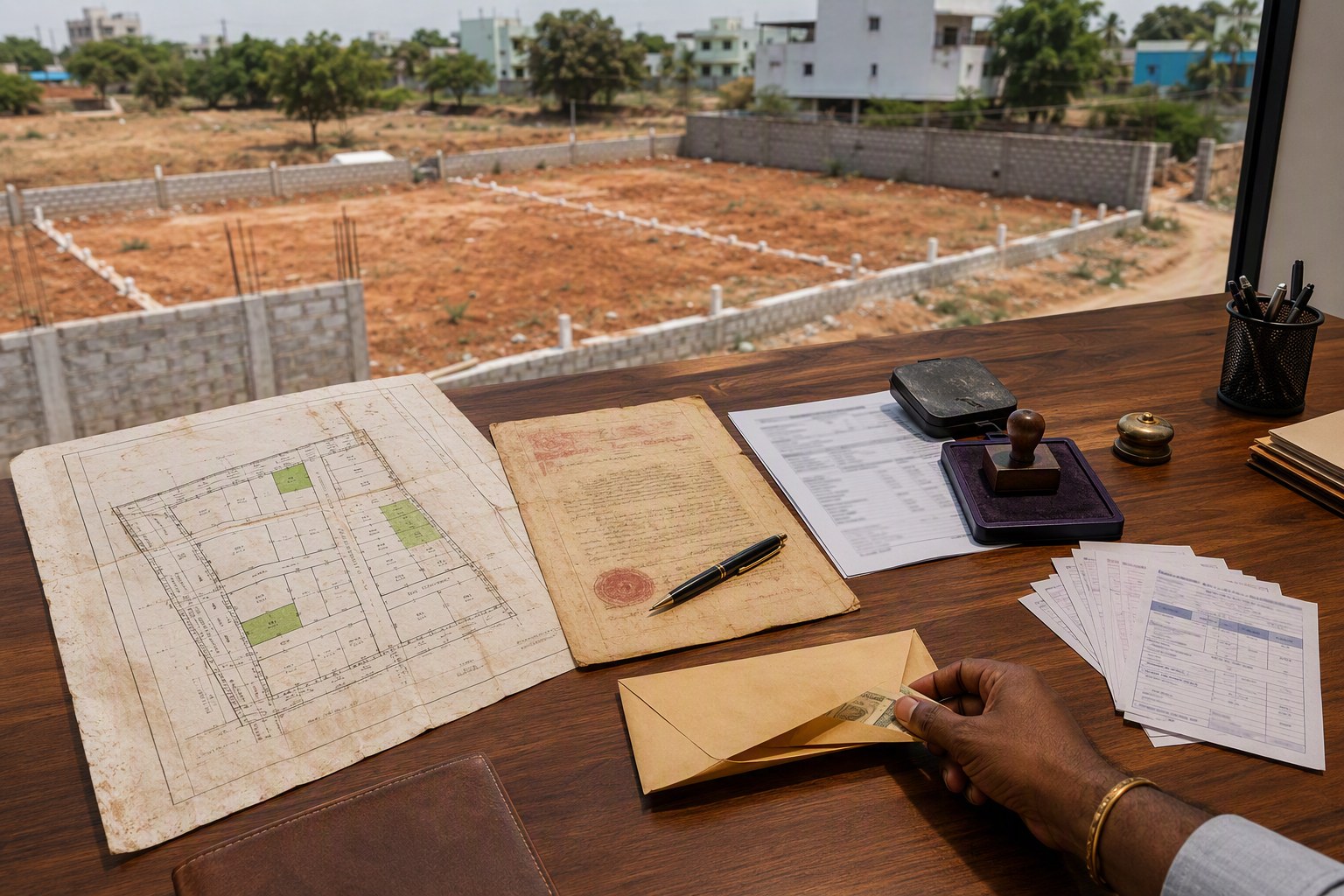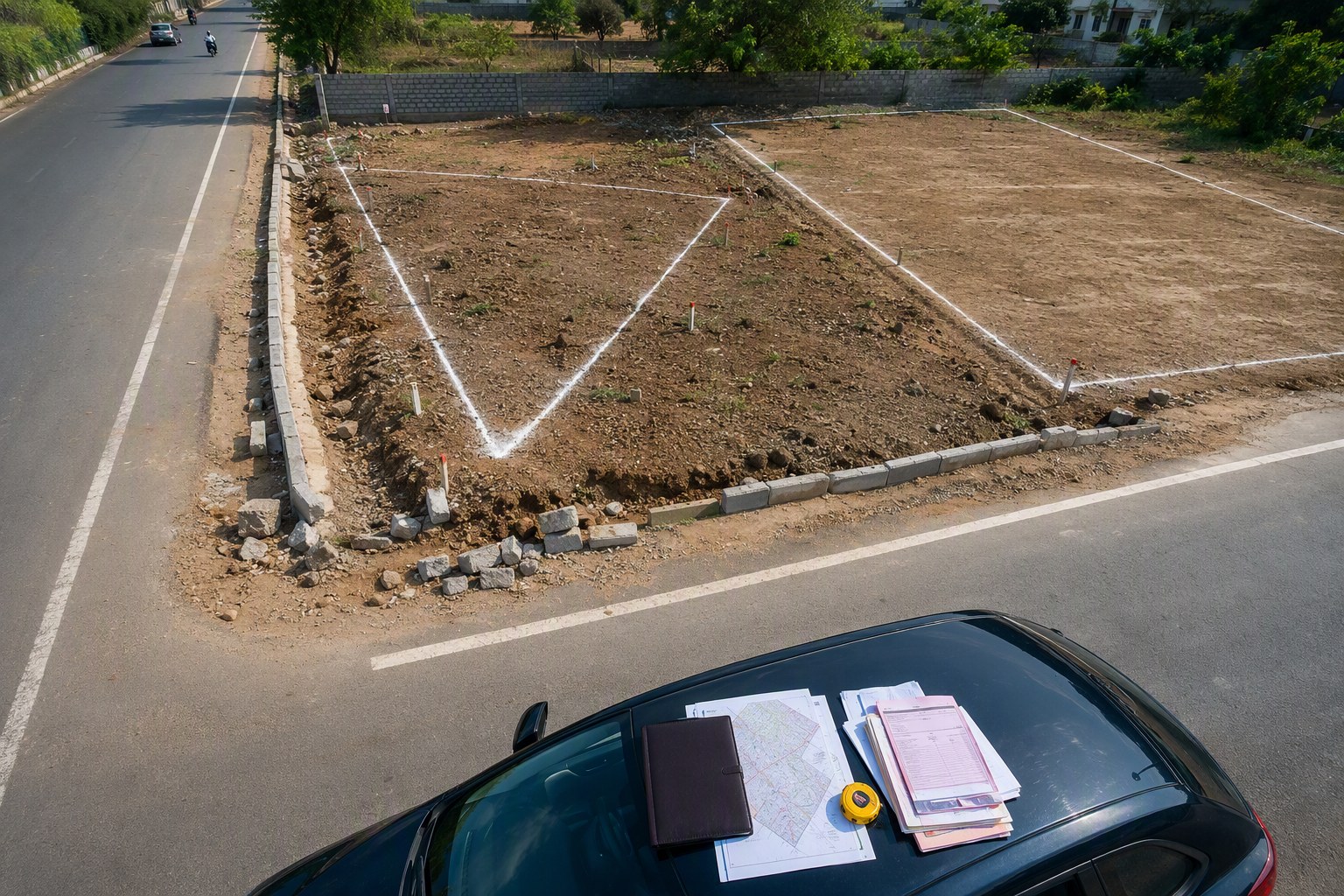



Telangana Auction Plot vs Resale Plot: Quick Answer for Investors
Telangana Auction Plot vs Resale Plot risk is not a simple “government is safe, private seller is risky” story. In our experience, auction plots usually carry lower seller-identity risk but higher document-interpretation and possession-condition risk. Resale plots carry higher chain-title, EC, family-claim, mortgage, and Section 22-A risk. The risk that costs more depends on what you fail to price before paying money.
If you are buying in Hyderabad or around it — say Kokapet, Narsingi, Tellapur, Mokila, Shankarpally, Adibatla, Maheshwaram, Ghatkesar, Medchal, Bachupally, Patancheru or Shamshabad — the first job is not bargaining. The first job is checking whether the plot can be legally transferred, physically possessed, and later sold without a fight at the SRO.
My practical view: an auction plot can hurt you if you assume the auction notice answers every legal question. A resale plot can hurt you if you believe a clean-looking sale deed is the full story.
Before committing bid money or token advance, use the Encumbrance Certificate Search, Section 22-A Prohibited Property Check, Property Verification Tool, Market Value / Guideline Value Search, and Find Your SRO Office. These checks will not replace a local advocate, but they will stop many avoidable mistakes.
Telangana Auction Plot vs Resale Plot: What Are You Actually Buying?
An auction plot is usually offered through a public authority, bank, financial institution, development body, or government-linked process. The sale may happen through e-auction, sealed bidding, or a public notice process. The buyer is attracted by formal paperwork, public announcement, and the feeling that the property has passed some institutional filter.
A resale plot is bought from an existing private owner. That owner may be an original allottee, layout developer, farmer-converted-land owner, family member, GPA holder, legal heir, or investor. In Hyderabad’s active corridors, resale plots move quickly because people want ready locations, known neighbours, existing roads, and faster registration.
The key difference is this: auction plots reduce some human uncertainties, while resale plots give you more room to negotiate and inspect history. Neither is automatically safe. The risk is only visible when you put legal title, possession, EC, 22-A, layout approval, land use, SRO jurisdiction, and future resale together.
Where this comparison matters in Telangana
This question comes up often in mandals like Gandipet, Serilingampally, Rajendranagar, Shankarpally, Moinabad, Patancheru, Sangareddy, Maheshwaram, Shamshabad, Kandukur, Medchal, Dundigal, Ghatkesar, Hayathnagar, Ibrahimpatnam, and Yadagirigutta-side growth pockets. These areas have mixed property histories: old agricultural survey numbers, converted layouts, HMDA/DTCP permissions, gram panchayat legacy layouts, assigned land concerns, court cases, road-widening issues, and changing land use.
That is why a plot may look attractive on ground and still get stuck at registration or resale. The costliest risk is not always the one visible at site. Many times, the expensive risk is hidden in a record entry.
Telangana Auction Plot vs Resale Plot: Risk Comparison Table
| Risk Area | Auction Plot | Resale Plot | Investor View |
|---|---|---|---|
| Seller identity | Usually clearer if the auctioning authority is genuine and the notice is properly issued. | Needs full verification of owner, heirs, GPA, company authority, and previous deeds. | Resale usually needs deeper seller-side checking. |
| Title chain | May be limited to auction papers and earlier mortgage/allotment documents. | Requires parent documents, link documents, mutations, pahani/adangal references where applicable. | Resale title risk can be expensive if old documents are missing. |
| Possession | Can be tricky if the property is sold on “as is where is” basis. | Can be checked physically with neighbours, boundaries, fencing, and local records. | Auction possession risk is often underestimated. |
| Encumbrance Certificate | Must be checked before bid and again before registration. | Must be checked for full chain and not just recent years. | EC risk applies to both, but resale needs more interpretation. |
| Section 22-A | Should still be checked. Auction does not automatically erase prohibited status. | Critical check, especially for old survey numbers, assigned land, endowment, government, ceiling or dispute entries. | 22-A risk can stop registration itself. |
| Layout approval | Depends on auctioning body and plot origin. | Must verify HMDA/DTCP/municipal approval and deviations. | Unapproved layout risk affects resale value and building plan. |
| Price discovery | Bidding may push price beyond comfort if competition is high. | Negotiation possible, but asking price may include local hype. | Do not price only emotion; check ready reckoner and market evidence. |
| Exit risk | Future buyer will ask for auction sale certificate, registration, possession record, and approvals. | Future buyer will ask for full chain title and clean EC. | Buy what you can resell cleanly. |
Legal Risk: Which Costs More?
In a resale plot, legal risk is usually wider. You are not just verifying today’s seller. You are verifying how the seller got the property, whether previous transfers were valid, whether family members had rights, whether minors were involved, whether any GPA was alive and valid, and whether any mortgage or court matter exists.
For example, in a resale plot near Mokila or Shankarpally, the land may have started as agricultural land in a survey number, later converted into plotted development, then sold through multiple registered deeds. Each link matters. If one link is weak, your registered sale deed may not protect you fully from a future claim.
In an auction plot, legal risk is narrower in some cases but sharper in others. Bank auctions, for instance, may transfer the secured creditor’s interest, but the buyer must study the auction terms carefully. Some auction notices put the duty of due diligence fully on the bidder. If there are property tax dues, society dues, physical occupants, litigation, or title objections, the buyer may have to spend time and money after winning the bid.
My opinion is simple: resale legal risk is more common, auction legal risk is more painful when ignored. In resale, you can often walk away before paying token if papers are weak. In auction, once you bid and win, your flexibility reduces.
Documents to check for auction plots
- Auction notice and terms of sale.
- Sale certificate draft or conveyance process.
- Earlier title documents available with the authority or bank.
- Possession status and physical handover process.
- Pending dues or claims mentioned in the notice.
- EC before auction and before registration.
- Survey number, plot number, layout approval, and SRO jurisdiction.
Documents to check for resale plots
- Parent deed and link documents.
- Latest sale deed or gift/partition/release deed, as applicable.
- EC covering the relevant title period.
- Pattadar passbook, pahani/adangal or Dharani references where applicable.
- Layout approval from HMDA, DTCP, municipality, or competent authority.
- Property tax or vacant land tax details, where applicable.
- Identity, PAN, address, marital/family confirmations, and legal heir records where needed.
For survey-level clarity, use the Survey Number Finder. For registration jurisdiction, check the SRO Village Directory or Find Your SRO Office.
Possession Risk: Auction Plot vs Resale Plot
Possession is where many auction buyers get surprised. The file may look clean, the public notice may look official, and the price may look tempting. But if the site is occupied, fenced by someone else, under local dispute, or not clearly demarcated, the buyer’s money gets locked in a practical problem.
We have seen investors visit auction properties only after getting emotionally attached to the bid. That is the wrong order. Visit first. Check access road. Speak to nearby owners. Match plot boundaries with layout plan. Look for physical markers. Ask whether anybody is using the land. In places like Maheshwaram, Adibatla, Kandukur, Moinabad and Shankarpally, ground reality can differ from paper measurements if old boundaries were never properly fixed.
In resale plots, possession risk is easier to read if the seller is cooperative. You can insist on site visit, boundary marking, neighbour confirmation, and possession handover clause in the sale deed. Still, do not take fencing as proof of title. Fencing proves control, not ownership.
How to price possession risk
- If possession is not clearly available, treat it as a major discount factor.
- If boundaries are unclear, budget time for survey and demarcation before registration.
- If access road is disputed, do not assume future buyers will accept it.
- If the auction notice says “as is where is”, read that line very seriously.
- If neighbours mention dispute, pause the transaction till documents support the seller’s claim.
For road and site context, investors can also use Road Width Check, Land Use Zone Finder, and Geo Insights before final negotiation.
EC Risk: Why a Clean EC Is Not Always Enough
An Encumbrance Certificate is necessary, but it is not a magic certificate. It records registered transactions available in the registration system for the searched period and property description. If the survey number, plot number, boundaries, village name, or SRO selection is wrong, the result may mislead you.
For resale plots, EC must be read with link documents. If a sale deed refers to a parent document, that parent document must match the chain. If there is a mortgage, release deed should be traceable. If there is a court attachment, agreement of sale, development agreement, or cancellation deed, it must be understood before payment.
For auction plots, EC should be checked at two stages. First, before bidding. Second, before registration or final payment. Why? Because records can change, corrections can appear, or old entries may need interpretation. A bidder who checks only once may miss later developments.
Use the Encumbrance Certificate Search and then run the result through EC Analyzer. If the property has loan history, check CERSAI Charge Check as well.
Section 22-A Risk: The Costliest Registration Shock
Section 22-A prohibited property risk is one of the biggest reasons Telangana plot buyers should slow down. According to government records available in our database, there are 3,076,153 prohibited property entries under Section 22-A. That number alone should make any buyer cautious before assuming that every plotted land parcel is freely registerable.
Section 22-A entries may relate to government land, assigned land, endowment land, wakf-related claims, ceiling surplus, court restrictions, and other prohibited categories, depending on the record. The exact reason must be verified for the specific survey number and village.
This risk is particularly serious in resale plots because many buyers search only by plot number. But prohibited lists often operate at survey number or land classification level. A layout may have plot numbers, but the underlying survey number history still matters.
Auction buyers should not skip this check either. A public auction does not automatically mean the property is free from every prohibition. If the plot sits in a survey number affected by restriction, the SRO process can become difficult unless the authority has clear legal power and supporting orders.
Before paying, use the Section 22-A Prohibited Property Check. If the result raises doubt, do not rely on verbal assurances from brokers, field staff, or even the seller’s clerk. Ask for written clarification from the competent authority or take legal opinion.
Price Risk: Auction Premium vs Resale Overpricing
Auction pricing creates a different psychology. When several bidders compete, people stop thinking like investors and start thinking like winners. That is dangerous. Your bid must include all hidden costs: stamp duty, registration charges, legal review, site demarcation, pending dues, possession effort, and resale discount if the file is complicated.
Resale pricing has another problem. Sellers often quote based on nearby rumours, not registered market evidence. In localities like Tellapur, Kokapet, Narsingi, Bachupally, Kompally, Patancheru, Ghatkesar and Adibatla, asking prices can move faster than paperwork quality. A plot with weak title should not command the same value as a clean, approved, easily registerable plot.
Use the Market Value / Guideline Value Search to check ready reckoner value and SRO basic value context. Use the Stamp Duty Calculator before comparing total acquisition cost. If you are comparing land plus construction potential, the FSI/FAR Calculator and Composite Value Calculator can help you think beyond plot rate alone.
How I would adjust price for risk
- Clean title, clear possession, approved layout, no 22-A concern: price can be compared with active local market.
- Minor document gaps but fixable before registration: negotiate and hold payment till documents are produced.
- Unclear possession: treat as a high-risk purchase, especially in auction cases.
- EC mismatch or missing link deed: do not pay token until corrected or legally explained.
- 22-A doubt: pause. This is not a “we will manage at SRO” issue.
Which Risk Costs More in Telangana?
If I have to choose, resale plots usually carry higher legal-document risk, while auction plots can carry higher post-purchase operational risk. For an investor, the costliest risk is the one discovered after payment.
In resale, the expensive mistakes are usually missing legal heirs, defective GPA, old mortgage, wrong survey number, unapproved layout, or 22-A issue. These can affect registration, bank loan, building permission, and future resale.
In auction, the expensive mistakes are usually possession disputes, unclear liability for dues, litigation not understood properly, or overbidding without calculating total cost. The auction route may look official, but the buyer’s due diligence burden remains heavy.
For Hyderabad investors, the best approach is not to label one as safe and the other as unsafe. Put both through the same checklist. If the auction plot passes title, possession, EC, 22-A, layout, and pricing checks, it can be attractive. If the resale plot has clean chain documents and immediate possession, it may be safer than a troubled auction property.
Telangana Auction Plot vs Resale Plot: Final Investor Checklist
- Identify exact village, mandal, survey number, plot number, extent, and boundaries.
- Check SRO jurisdiction before assuming where registration will happen.
- Verify EC with correct property identifiers.
- Run Section 22-A prohibited property check at survey number level.
- Confirm layout approval and land use.
- Visit site before payment, not after.
- Check access road, boundary stones, neighbouring claims, and possession.
- Calculate stamp duty and registration cost before comparing prices.
- Take written legal opinion for auction conditions or complex resale chains.
- Keep payment linked to document milestones, not verbal promises.
In our market, patience saves more money than aggressive bargaining. A buyer who spends time on EC, 22-A, SRO, pahani, Dharani references, layout approval and possession will usually avoid the worst traps. A buyer who rushes because “rate will increase” may end up holding a plot that nobody else wants to touch.
Frequently Asked Questions
Is a Telangana auction plot safer than a resale plot?
Not always. Auction plots may reduce seller-identity risk, but possession, auction terms, dues, litigation and Section 22-A checks still matter. Resale plots need deeper title-chain verification.
What is the biggest risk in buying a resale plot in Hyderabad?
The biggest risk is usually defective title chain — missing link documents, family claims, GPA issues, mortgages, wrong survey number, or prohibited property status under Section 22-A.
Should I check EC before bidding for an auction plot?
Yes. Check EC before bidding and again before registration or final payment. Use the correct village, survey number, plot number and SRO details to avoid misleading results.
Can Section 22-A stop registration of a plot?
Yes. If the property falls under a prohibited category, registration can be refused or delayed. Telangana government records in our database show 3,076,153 prohibited property entries, so this check is essential.
Which tools should I use before buying an auction or resale plot?
Start with EC search, Section 22-A prohibited property check, guideline value search, SRO finder, survey number finder and property verification. For development plans, check land use, road width and FSI/FAR also.