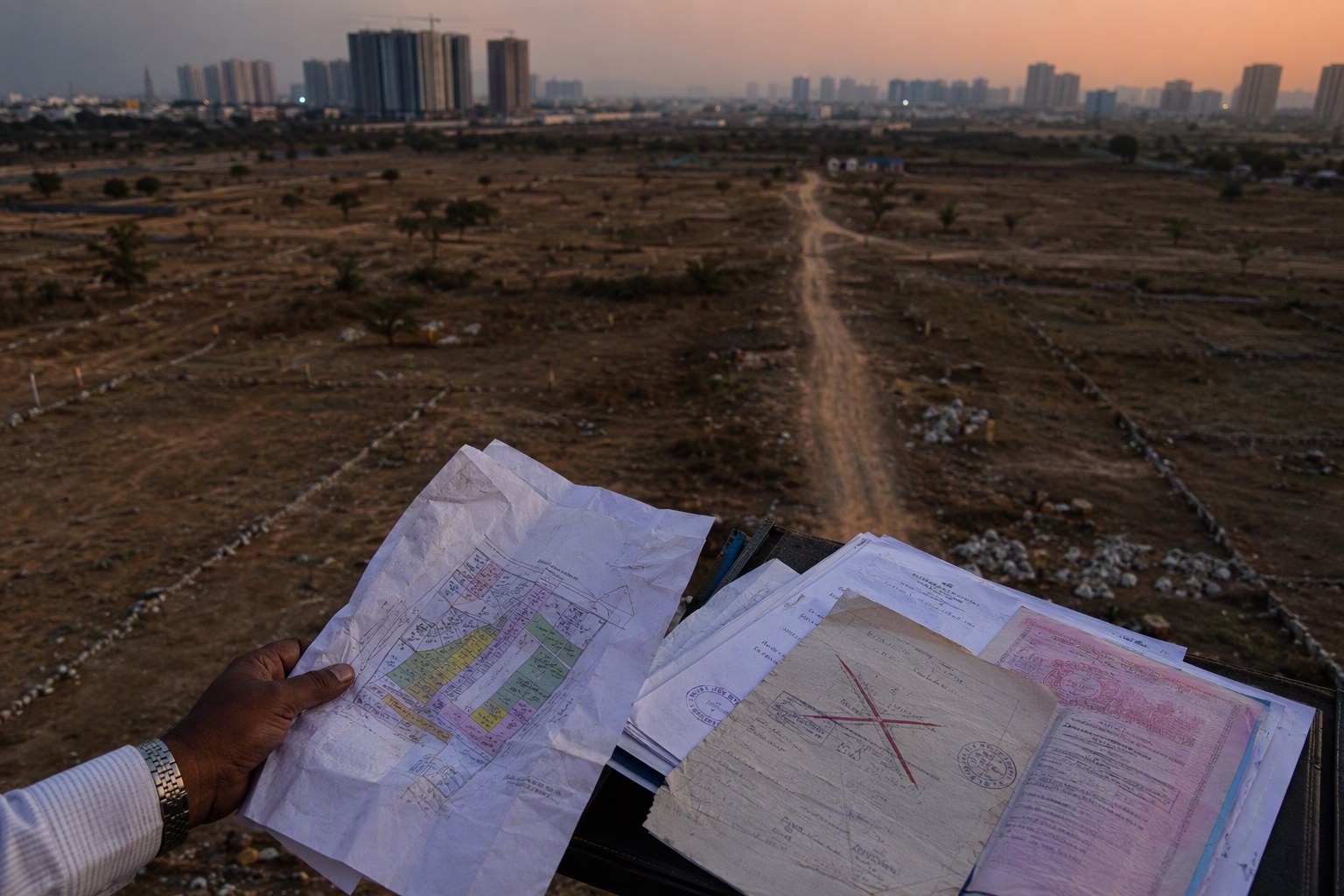
Private Layout Roads are becoming a serious pricing issue in Telangana’s plotted land market. Investors are still checking pahani, Dharani entries, EC and guideline value, but many are treating the approach road as a comfort point. That is risky. In private layouts around Hyderabad’s growth corridors, access can decide whether a plot is bankable, buildable, saleable and defensible in a dispute.
The short answer is this: if the road is not clearly transferred, approved, physically available and legally connected to a public road, the plot should carry a discount. Not a polite discount. A real investor discount.
We have seen this pattern in Shankarpally, Mokila, Moinabad, Chevella, Patancheru, Dundigal-Gandimaisamma, Ghatkesar, Maheshwaram, Adibatla, Yacharam, Kadthal and Shadnagar side transactions. The land may look clean. The venture brochure may show wide internal roads. The seller may say, “Sir, everyone is using this road only.” But when resale time comes, the buyer’s lawyer asks one simple question: who owns the road?
Private Layout Roads are now an exit-risk issue, not just a convenience issue
In Hyderabad outskirts, the road question has moved from “Can my car go inside?” to “Can I prove permanent legal access?” That shift matters for investors because plotted land returns are realised only when there is a clean exit. If the next buyer, banker or builder finds uncertainty in access, the negotiation changes immediately.
A private layout road may fall into different buckets. It may be part of an approved layout and gifted to the local body. It may be shown in a developer’s plan but not properly handed over. It may be a passage over another survey number. It may be a kacha road being used informally by neighbouring owners. It may even pass through land that has a dispute, government claim, assigned land issue or Section 22-A concern.
That last point is not theoretical. The Verified database records 3,076,153 prohibited properties under Section 22-A. This does not mean every private road is prohibited land. It means investors cannot casually assume that every approach strip shown on Google Maps is legally safe. In Telangana, one survey number can change the entire story.
Before paying token advance, check the property through the Property Verification Tool, run a Section 22-A Prohibited Property Check, and confirm the road’s survey number through the Survey Number Finder. These are not clerical steps. They directly affect pricing.
Private Layout Roads: what exactly can go wrong?
Access disputes rarely start dramatically. They start with a gate, a stone, a compound wall, a new owner, a family partition or a village-level objection. Many investors realise the problem only when they try to sell.
In our experience, these are the common road risks in private layouts:
- Road not gifted to the local body: The layout plan shows internal roads, but the road portion is still in the developer’s or landowner’s name.
- Approach road over private patta land: The layout is accessible only through another person’s land, without a registered right of way.
- Mismatch between plan and ground: The approved plan shows one access, but buyers are using another informal route.
- Missing link road: Internal roads exist inside the layout, but there is no legally established connection to a public road.
- Boundary and survey disputes: Road alignment cuts through survey boundaries that were never properly demarcated.
- Revenue classification issue: The path may pass through land recorded differently in revenue records, creating objections later.
- Mortgage and bank concern: Lenders may hesitate when access is based only on usage and not on documents.
The key point is simple: an investor buys future liquidity. If access cannot be explained in documents, liquidity takes a hit.
Why road access affects land value even when the plot papers look clean
Many buyers focus only on the plot’s sale deed, link documents and EC. That is necessary, but not enough. A clean plot inside a weak-access layout is like a flat in a building where the staircase belongs to someone else. The asset may exist, but use and resale become uncomfortable.
The ready reckoner or guideline value gives a government value reference. It does not certify that a private road is legally available. Check the current registration market value through the Market Value / Guideline Value Search, but do not stop there. Guideline value is one input. Access risk is another input.
Similarly, an EC search tells you registered transactions and encumbrances relating to the property searched. If the road lies in another survey number and you never check that survey number, the EC of your plot may not reveal the road problem. Use the Encumbrance Certificate Search for the plot and, where possible, for the road-bearing survey number also.
This is where many small investors lose bargaining power. They say, “The EC is clean.” The buyer’s advocate replies, “Access is not clear.” Both statements can be true.
Private Layout Roads and mandal-level reality around Hyderabad
The risk is not the same across all locations. In denser municipal areas, road ownership and maintenance are often easier to verify because the layout may have passed through a stronger approval and handover process. In fast-growing peri-urban mandals, older farm conversions, unapproved plotting, family lands and informal passages are more common.
Take Shankarpally mandal. Investors like Mokila, Kondakal, Shankarpally town side and villages connected towards the western corridor because the IT belt influence is visible. But the popularity of a zone does not automatically clean up every private layout road. A good approach from the main road can still depend on one disputed strip.
In Maheshwaram and Adibatla belt, growth expectations around logistics, aerospace and work locations have pulled attention to plots. There also, investors should separate location story from document story. A layout near a known road is not the same as a layout with legally recorded access to that road.
In Ghatkesar, Keesara, Medchal, Dundigal-Gandimaisamma and Bachupally side transactions, the issue can appear in another way. Urban pressure is high, village roads are widening in some pockets, and old pathways are being used as approach roads. The question is whether the specific layout access is recorded, approved and transferable.
On the southern side, in Shadnagar, Kadthal, Kandukur, Yacharam and surrounding mandals, large land parcels are split, marketed and resold frequently. Here, investors should be extra cautious about road alignment, survey boundaries and whether internal roads have been lawfully carved out.
My view is blunt: if the seller cannot show road title, approval trail or a registered access right, the buyer should not price the plot like a clean layout plot.
Documents investors should ask for before pricing a private layout plot
Do not depend only on site visits. A beautiful mud road after rains or a freshly laid approach road can give false confidence. Ask for documents and match them with ground position.
| Document or check | What to verify | Why it matters for exit |
|---|---|---|
| Approved layout plan | Whether the road shown on plan matches the road used on ground | Future buyers compare plan, site and title chain |
| Gift deed or handover proof | Whether internal roads were transferred to panchayat, municipality or relevant authority | Public ownership reduces later blocking risk |
| Link documents | How the layout land was acquired and divided | Gaps in parent title can affect roads and plots |
| EC for plot and road survey number | Charges, sales, court-related entries or inconsistent ownership | Road land may have a different history from the plot |
| Dharani and pahani references | Revenue classification and survey-level details | Revenue mismatch creates legal and registration anxiety |
| Road width and physical access check | Whether actual access supports intended use and approval needs | Resale buyers look at usability, not brochure promise |
For a quick first cut, use the Road Width Check. If construction is part of the investment plan, use the FSI/FAR Calculator to understand whether the access and local planning context support the expected built form. If the layout is presented as an approved gated plotted project, check the project through RERA Project Lookup wherever applicable.
How Private Layout Roads should change your pricing model
Investors usually price plots using locality, road-facing advantage, distance from main road, development activity, registration value and resale demand. Road risk must sit inside that model as a separate deduction factor.
I would divide private layout access into four practical categories:
- Clean public access: Road is part of an approved layout, handed over or clearly under public control, and matches ground reality.
- Documented private access: Road is private, but access rights are recorded clearly through registered documents.
- Usage-based access: People are using the road, but paperwork is weak or incomplete.
- Disputed or unclear access: Seller cannot establish legal connection from public road to the plot.
Only the first category deserves full clean-layout pricing. The second may be acceptable if documents are drafted properly and reviewed by a competent property lawyer. The third needs a meaningful discount because exit will depend on buyer confidence. The fourth should be treated as a high-risk purchase, unless the buyer has the patience and ability to cure the defect.
Do not confuse market excitement with legal quality. A plot near Tellapur, Mokila, Adibatla or Shadnagar may attract enquiries because the location name is strong. But a weak road will still come up during due diligence. Serious buyers are not paying only for coordinates. They are paying for certainty.
Private Layout Roads, SRO registration and the false comfort of sale deeds
Many buyers assume that once the SRO registers a sale deed, the property is safe. That is a dangerous assumption. Registration records the transaction based on documents presented. It is not a full legal guarantee that every access path, layout condition and ground boundary is perfect.
Before registration, identify the correct jurisdiction using the Find Your SRO Office. Then check whether the survey numbers, village name, mandal and extent match across sale deed, EC, Dharani references and layout plan. Even small inconsistencies can become painful when the road is not straightforward.
Where the approach road is in another survey number, ask how that road survey number appears in records. If the seller says, “This is common road,” ask for the document that makes it common. If they say, “Panchayat road,” ask for proof. If they say, “All owners agreed,” ask whether that agreement is registered and binds future owners.
Verbal assurances are cheap in land transactions. Registered rights are what survive when people change, land prices rise and neighbours become less friendly.
Red flags that should slow down the transaction
A few warning signs are common across Telangana private layout deals. If you see these, slow down and verify before paying advance.
- The seller avoids sharing the approved layout plan.
- The approach road is different from the road shown in the plan.
- The road passes through land that is not part of the layout parent survey numbers.
- There is a gate controlled by a neighbouring owner or farmhouse.
- The internal road exists only as a soil path without document support.
- The layout has multiple sale deeds but no clear common-area transfer.
- Neighbours give different versions about who owns the road.
- The broker says the road issue will be solved after registration.
The last point is especially important. Problems that are not solved before registration usually become costlier after registration. Once the seller receives full payment, your negotiating strength reduces sharply.
How to protect yourself before buying in a private layout
Start with the survey number, not the brochure. Confirm village, mandal, SRO, parent documents and the exact access line from the nearest public road. Walk the route physically. Speak to neighbouring owners, but treat their statements as leads, not proof.
Next, compare four layers: revenue record, registration record, approval plan and ground reality. All four should tell the same story. If one layer is missing or contradicting the others, price the risk or walk away.
For investors buying multiple plots, keep monitoring the asset after purchase. Road disputes may arise later due to fencing, new development or family partition in adjoining lands. The Property Change Tracker can help investors stay alert to changes that may affect their holding. If you are calculating total acquisition cost, use the Stamp Duty Calculator before finalising cash flow.
If you plan to hold for resale, maintain a due diligence folder. Keep copies of the layout plan, road-related documents, EC, pahani references, tax receipts if applicable, legal opinion and site photographs. When you sell, this folder becomes your confidence document. It can reduce buyer anxiety and shorten negotiation time.
The investor takeaway on Private Layout Roads
Private layout access is not a side issue. It sits at the centre of land value. In Telangana’s active plotted markets, buyers are becoming sharper. Banks are cautious. Lawyers are asking better questions. Government records are easier to cross-check than before. A weak-access plot may still sell in a hot market, but it will usually face harder questions and weaker bargaining power.
My practical advice: price the road before you price the plot. If the access is clean, it supports value. If the access is documented but private, examine the wording carefully. If the access is only by habit, discount heavily. If access is disputed, do not treat it as an investment unless you are prepared for legal work, time loss and an uncertain exit.
A plot is not just a piece of land inside four boundaries. It is a legally reachable asset. Without secure access, even a good locality name can become a difficult holding.
Frequently Asked Questions
Are private layout roads legal in Telangana?
They can be legal if the layout approval, ownership, handover and access rights are properly documented. The problem starts when roads are only shown on a brochure or used informally without registered support.
Is a clean EC enough to confirm road access?
No. A clean EC for your plot does not automatically prove that the approach road is legally available. If the road falls in another survey number, that survey number also needs checking.
Should I pay full market price for a plot with usage-based road access?
In our view, no. If access is based only on usage and not on documents, investors should price in resale risk, bankability risk and possible dispute risk.
What should I check before buying in a private layout near Hyderabad?
Check the approved layout plan, road handover or access documents, EC, Dharani and pahani details, Section 22-A status, survey boundaries, SRO jurisdiction and physical road position on site.