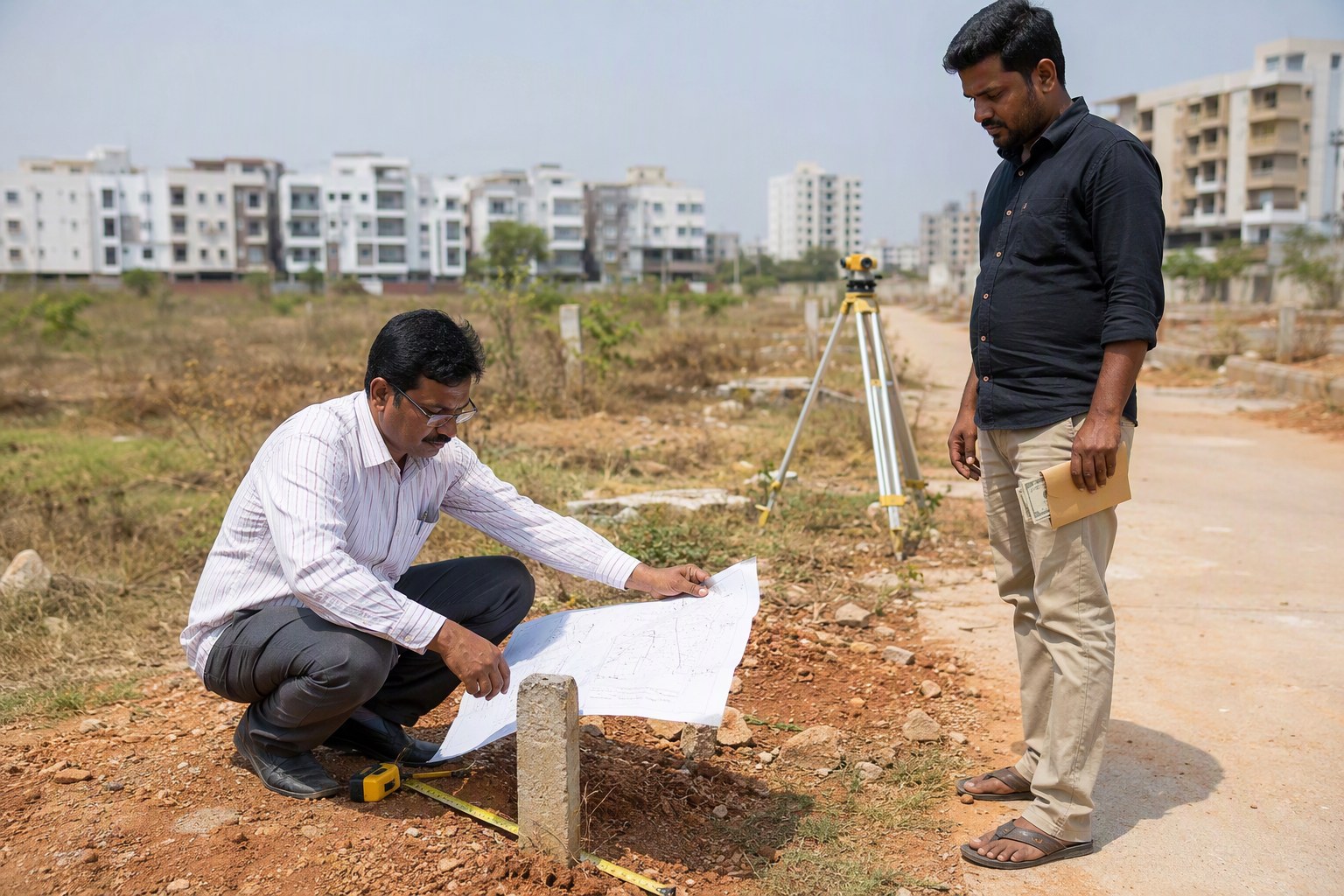
Telangana FMB Sketches Before Plot Token: The surveyor's first warning
Telangana FMB Sketches should be checked before paying even a small plot token, not after signing the agreement. That is the clear view from a licensed surveyor we spoke to for this news-style expert interview. His point is simple: an Encumbrance Certificate can show registered transactions, but it will not stand on the ground and tell you whether the plot corners, survey boundaries, access road and extent are actually matching.
Across Hyderabad's outer growth belt — Mokila, Shankarpally, Kollur, Tellapur, Patancheru, Bachupally, Dundigal, Adibatla, Tukkuguda, Maheshwaram, Ghatkesar and Medchal — buyers often rush to pay token after seeing EC, link documents, pahanis and a layout copy. In our experience, that is exactly where many plot mistakes start. The missing step is not glamorous. It is a ground survey with FMB reference.
The concern is not theoretical. Verified.RealEstate's database context shows 3,076,153 prohibited properties under Section 22-A records. A plot buyer cannot assume that every attractive parcel near an ORR exit, proposed road, villa cluster or upcoming corridor is clean only because the seller is confident. Document checks and ground checks have to travel together.
For a first-level check, buyers can use the Encumbrance Certificate Search, Survey Number Finder, Section 22-A Prohibited Property Check and Property Verification Tool. But the surveyor's message is blunt: digital checks are not a substitute for measuring the land on site.
Why Telangana FMB Sketches matter more than a neat seller file
FMB means Field Measurement Book. In simple terms, it is the measurement sketch maintained in revenue records for a survey number or sub-division. It helps identify the shape, boundaries, measurements and relationship with neighbouring survey numbers. In Telangana land buying, especially for agricultural land converted or marketed as plots, the FMB sketch is one of the most practical tools for connecting paper with soil.
The surveyor told us, "An EC tells you about registered documents. It does not tell you whether the stone on ground is in the correct place. If the buyer has seen only EC and link papers, he has seen only one side of the story."
This is a common issue in peri-urban Hyderabad. A seller may have title. The land may not be under dispute in the Sub-Registrar Office records. But the plotted area being sold can still have a mismatch in extent, boundary, access, road width or physical location. A buyer may think he is purchasing a west-facing plot in one survey number, but the pegs on ground may be touching another survey number. Once token is paid, the buyer's bargaining strength reduces.
We have seen this in fast-moving localities around Shankarpally mandal and Patancheru side, where buyers are attracted by villa developments and plotted layouts. Similar caution is needed in Maheshwaram, Kandukur, Shamshabad, Ghatkesar and Medchal mandals, where land parcels may have old family partitions, private roads, nala edges, assigned land concerns or sub-division confusion.
Telangana FMB Sketches are not the same as layout brochures
Many buyers confuse a marketing layout plan with an FMB sketch. They are not the same. A layout brochure is usually prepared to sell plots. An FMB sketch comes from field measurement records. A sanctioned layout plan, if applicable, is another document altogether. Each has a different purpose.
| Document | What it shows | What it may not show |
|---|---|---|
| EC | Registered transactions, mortgages or transfers recorded through registration | Ground boundary, actual possession, encroachment or physical access |
| Pahani / Dharani record | Revenue entry, pattadar details and land classification as available in records | Exact plot pegs, internal layout roads or on-site measurement mismatch |
| FMB sketch | Survey measurements, shape and relation with adjoining survey numbers | Whether current pegs on ground were placed correctly unless verified on site |
| Layout copy | Plotted arrangement, roads and amenities as proposed or sanctioned | Whether the underlying survey land and on-ground occupation match perfectly |
The surveyor's view is that no single document can be treated as final. "I tell buyers to carry the FMB, old sale deed schedule, latest pahani, village map reference and layout copy to the site. Then measure. If the seller says measurement is not needed, that itself is a signal to slow down," he said.
This advice is particularly relevant where sellers use phrases like "HMDA proposed area", "near ORR", "future growth location" or "ready for registration". Those words do not confirm boundaries. A ready reckoner or guideline value check through Market Value / Guideline Value Search can help you understand government value reference, and Find Your SRO Office can help identify the correct registration office. Still, neither will show if the plot corner has shifted by local adjustment.
What the licensed surveyor checks before advising token payment
We asked the surveyor what he checks when a buyer calls before paying token. His answer was practical, not legal-heavy.
- Survey number identity: The first task is to confirm that the plot being shown actually falls in the claimed survey number and village.
- FMB measurements: The FMB sketch is compared with the physical boundaries, stones, fencing and neighbouring lands.
- Extent match: The area mentioned in the sale deed or agreement draft is compared with what is available on ground.
- Road access: The approach road is checked for width, continuity and whether it is public, private, layout road or only a temporary passage.
- Boundary risk: The surveyor looks for nala edges, tank buffer concerns, hill slope, government land edge, railway or road widening impact where visible.
- Neighbour confirmation: Adjacent landholders, farmers, caretakers or layout staff can reveal practical disputes that papers may not show.
- Sub-division clarity: If the land is part of a larger survey number, sub-division and demarcation should be clearly understood.
In places like Mokila and Kollur, buyers often see plot boards and assume the internal roads are final. In Adibatla and Tukkuguda, they may trust the growth story around employment zones and the airport side. In Bachupally and Dundigal, they may focus on apartment and villa demand. These market drivers are real discussion points, but land measurement remains basic hygiene.
"A buyer should not ask the surveyor to confirm only after token. Once money is paid, the buyer starts adjusting to the seller's version. Measurement before token keeps the discussion clean," the surveyor said.
EC is useful, but Telangana FMB Sketches answer a different question
The Encumbrance Certificate is still a key document. Nobody should ignore it. It can show registered sale deeds, gift deeds, mortgages and other transactions recorded in the registration system. Our EC Analyzer can help buyers read an EC more carefully instead of just checking whether a seller's name appears.
But EC has limits. It is not a land measurement certificate. It does not confirm whether a private layout has properly marked every plot as per the underlying survey. It does not tell whether the approach road shown by the seller is legally available for your plot. It does not settle boundary disputes with neighbouring pattadars.
The surveyor put it this way: "EC is like reading the history of registered papers. FMB and ground survey are about where the land sits. Both are needed."
This distinction matters for open plots more than many first-time buyers realise. In an apartment purchase, the unit is within a sanctioned building, and buyers still must check RERA, building permissions, undivided share and association issues. For open plots, the buyer is directly exposed to survey number accuracy, access, land classification, conversion status and boundary marking. Use RERA Project Lookup for registered projects where applicable, but do not assume every plotted sale is protected in the same manner.
Section 22-A, Dharani and ground reality: one check is not enough
Telangana buyers have become more aware of prohibited property issues after repeated experiences at SRO counters and Dharani-related checks. The number in our database context is large: 3,076,153 prohibited properties under Section 22-A records. This does not mean every land parcel near Hyderabad is risky. It means buyers must not treat a seller's oral assurance as verification.
Section 22-A checks are especially relevant for assigned lands, government lands, endowment lands, wakf-related concerns and other categories restricted from registration as per applicable records. A buyer should check before token, not on the registration morning. The Section 22-A Prohibited Property Check is a useful starting point for that risk.
Still, even a clean prohibited-property check does not replace measurement. A land parcel may be registrable, yet the plot being shown may be wrongly marked. A seller may own land in the village, but the exact plot position offered to you may overlap with a neighbour's claim. This is why a surveyor keeps returning to the same line: match records with ground.
What buyers in Hyderabad outskirts should do before token
Before paying token in any mandal around Hyderabad, keep the process disciplined. Do not let urgency, weekend site visits or "another buyer is ready" pressure decide the purchase.
1. Collect the exact survey details
Ask for village name, mandal, survey number, sub-division if any, plot number, extent, link documents, current pattadar details and layout approval details where applicable. If the seller avoids survey number discussion and only talks about landmark-based location, pause the deal.
2. Check EC and registration trail
Use the Encumbrance Certificate Search and verify whether the transaction chain broadly supports the seller's claim. If there are gaps, old unregistered partitions, GPA-based history or unclear family transfers, get legal review before token.
3. Check prohibited property status
Run a Section 22-A check and confirm whether any restriction appears in government-related records. If the land is near government land, tank land, assigned land clusters or old village commons, take extra care.
4. Get FMB and arrange ground measurement
Ask for the FMB sketch and conduct a physical survey. If the seller has no FMB, request it through proper channels or ask a licensed surveyor to advise the next step. Do not accept only a Google pin or brochure map.
5. Confirm road and land use
For plots, road access is value. A plot without clear access can become difficult to use, mortgage or resell. Use Road Width Check and Land Use Zone Finder as part of your early screening. For construction potential, FSI/FAR Calculator may help understand broad development parameters, subject to local rules and approvals.
6. Compare government value reference
Do not rely only on market talk from brokers. Ready reckoner or guideline value reference from the concerned SRO area should be checked through Market Value / Guideline Value Search. The actual market price may differ, but guideline value helps you understand registration value context and stamp duty planning through the Stamp Duty Calculator.
Where Telangana FMB Sketches prevent expensive mistakes
The biggest advantage of FMB-based measurement is not academic accuracy. It prevents expensive surprises. In our experience, buyers discover issues like these only when they measure:
- The plot shown on site is slightly shifted from the approved layout position.
- The internal road is narrower on ground than what buyers assumed from the plan.
- The total extent available in the block is less than what multiple buyers were told.
- Part of the land falls in a neighbouring survey number.
- Boundary stones were placed by the seller's team without formal measurement.
- A pathway used for access is not clearly part of the saleable layout.
- Old agricultural bunds or nala edges affect the usable shape.
These are not small matters. Even if the seller is genuine, a mistake in measurement can create years of tension with neighbours, future buyers, banks and municipal authorities. If the buyer is planning a house, wrong measurement can affect setbacks, compound wall planning and building permission discussions. If the buyer is investing for resale, the next buyer may raise the same issue and negotiate hard.
The surveyor said, "People bargain on price for days, but they do not spend enough time checking the land. In plots, measurement is part of price negotiation. If the land on ground is not clear, the rate discussion itself is incomplete."
Our view: token payment should follow verification, not emotion
Hyderabad's land market rewards speed, but it punishes carelessness. I would not pay token for an open plot in Shankarpally, Maheshwaram, Ghatkesar, Patancheru or any other active belt without seeing survey details and arranging ground verification. A clean EC is good. A confident seller is helpful. A known broker may reduce coordination pain. None of these replaces FMB-backed measurement.
The sensible order is simple: identify the property, collect documents, run basic digital checks, inspect the site, verify FMB and boundaries, then discuss token. If the seller is genuine, he should not object to a buyer measuring before payment. If he objects strongly, ask why.
Use online tools for early filtering: Survey Number Finder, Property Verification Tool, Property Change Tracker and SRO Village Directory. Then bring in a local surveyor and, where needed, a property lawyer. For Telangana plots, that combination is far safer than EC-only buying.
The surveyor's closing advice stayed with me: "If the buyer cannot identify the exact land today, he should not pay for it today." That is the cleanest rule for any plot token decision.
Frequently Asked Questions
Should I check Telangana FMB Sketches before paying token for a plot?
Yes. FMB sketches and ground measurement should be checked before token payment, especially for open plots in Hyderabad outskirts. EC and seller papers alone do not confirm physical boundaries.
Is an Encumbrance Certificate enough to buy a plot in Telangana?
No. EC is useful for checking registered transactions, but it does not confirm survey boundaries, road access, encroachment, ground possession or correct plot location.
What should a surveyor verify on site?
A surveyor should verify survey number identity, FMB measurements, plot extent, boundary stones, neighbouring survey numbers, access road and any visible mismatch with layout or sale deed schedule.
Why is Section 22-A check needed before plot token?
Section 22-A records can include prohibited properties where registration may be restricted. Verified.RealEstate database context shows 3,076,153 prohibited properties, so buyers should check before paying token.
Can I rely on a layout brochure instead of FMB?
No. A layout brochure is not the same as an FMB sketch. The FMB helps connect survey records with the physical land, while a brochure mainly shows the plotted marketing or layout arrangement.