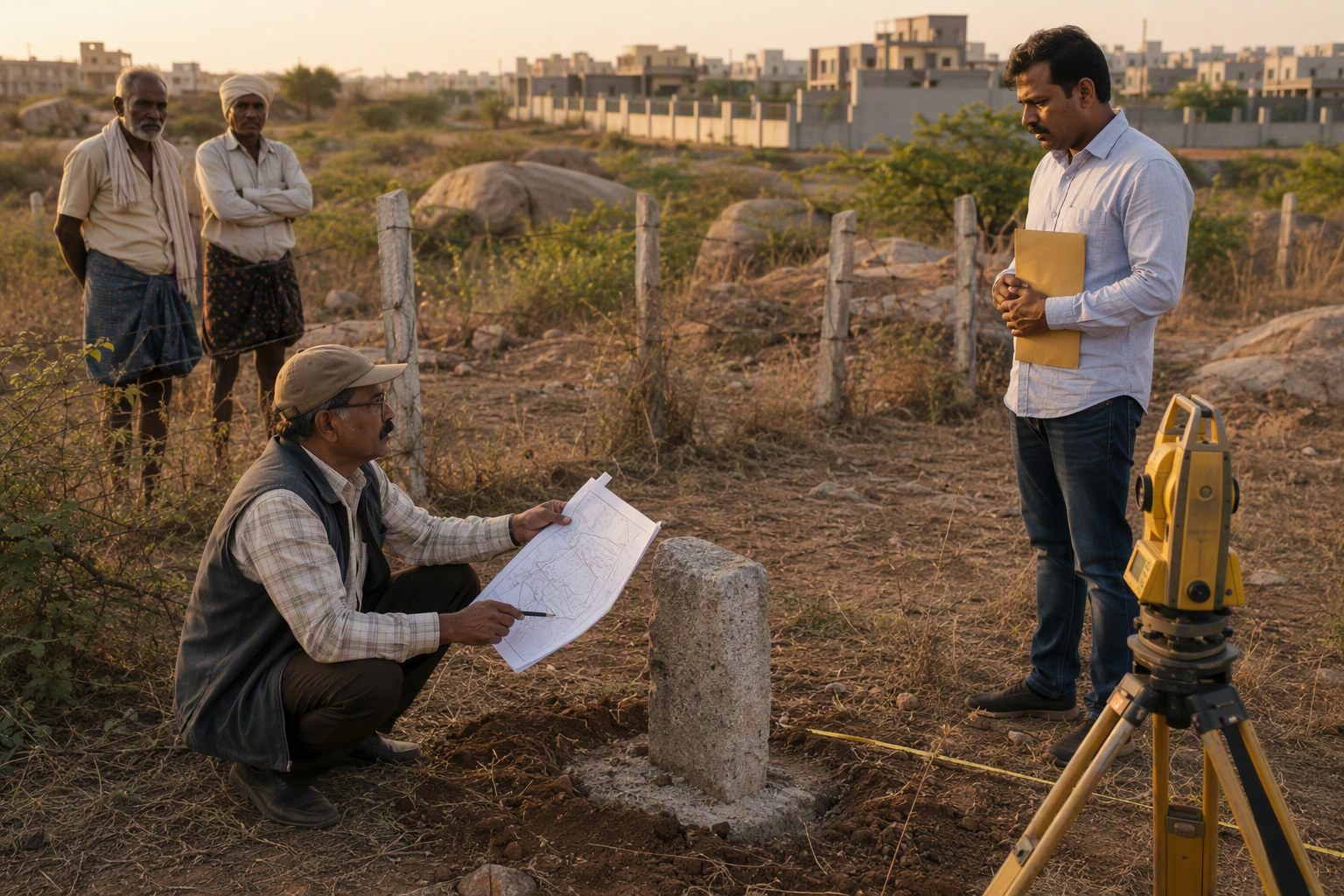



Registrar’s Story: One Village Name That Changed a Plot Deal
A senior registration professional in Telangana once told me a line that stayed in my head: “Survey number is not alone. It lives inside a village.” That sentence sounds simple, but it can decide whether a buyer pays advance peacefully or stops the deal at the chai shop itself.
This story is based on an anonymised conversation with a former registration-side officer and two local due diligence practitioners who work around Hyderabad outskirts. Names and some identifying details are changed, because the point is not to expose one seller or one broker. The point is to show how a small village-name mismatch can change the entire due diligence route before payment.
The case was a plotted land deal near the Hyderabad growth belt. The buyer was an IT employee, the seller was a local pattadar family, and the broker was confident. The survey number was clear, the extent was matching on paper, and the seller had old link documents. The price negotiation also reached the usual dramatic stage: “Sir, tomorrow morning token ichesthe, we will block it for you.”
Then one village name spoiled the mood.
“The buyer was checking Survey No. 118. In the sale deed draft, the village name was one thing. In the old document, it was another. In the revenue copy, it was written slightly differently. Everyone said it is the same area only. But for registration and land verification, ‘same area only’ is not enough.”
The mismatch that looked harmless
In this case, the difference was not even dramatic. Think of the kind of confusion Telangana buyers see often: old gram panchayat name versus present municipal limits, hamlet name versus revenue village, mandal reorganisation, spelling variation in English, or a village that shares a boundary with another village having similar survey number series.
The buyer’s draft mentioned one village. The earlier sale deed had a nearby village name. The pahanies and mutation references pointed to a different revenue village spelling. The broker’s defence was classic: “Sir, old documents lo ala untundi. Now all merged. No issue.”
The registrar-type professional in our discussion smiled when he narrated it. Not because it was funny, but because he had seen many buyers almost miss this issue. A buyer usually checks seller name, survey number, extent, EC, and market value. Village name is treated like address decoration. That is a mistake.
In Telangana land records, a survey number gets its legal meaning inside a specific revenue village and mandal. Survey No. 118 in one village is not automatically the same as Survey No. 118 in the next village. Even when the land is physically nearby, the record trail can separate like two lanes after a junction.
Why village name matters before paying advance
Advance payment creates pressure. Once token is paid, the buyer’s questions become “delay tactics” in the seller’s eyes. The broker starts saying other parties are waiting. Family members ask why you are doubting after giving money. That is why village-name verification should happen before the first non-refundable payment.
In this story, the buyer had not yet paid. That one fact saved him bargaining power.
The former registration professional explained it in plain language: the Sub-Registrar Office registers documents based on jurisdiction, document presentation, stamp duty, identity, and compliance checks. But registration is not a guarantee that your chosen land parcel is risk-free. A wrong or confused village reference can still pass through earlier documents and create future trouble during resale, bank loan, layout approval, mutation, or a court dispute.
That is also why smart buyers now use multiple checks together. On Verified.RealEstate, a buyer can start with Sro Village Directory to identify the village-SRO connection, use Survey Number Finder for survey-level orientation, run Ec Search for transaction trail, and screen risk through Prohibited Property Check. Our bb_prohibited_properties context carries 3,076,153 records for screening, but no database replaces reading the village name carefully across documents.
The interview: what the registrar noticed first
I asked him what triggered doubt in that file. His answer was very local: “The boundaries were speaking a different language.”
In the latest draft, the north boundary was shown as a road. In the previous deed, the same side was shown as land of another pattadar. In the revenue village map reference, the road seemed to fall on the edge of a neighbouring village. None of these alone proved fraud. But together, they made the officer ask for proper clarification.
He said the most dangerous files are not the obviously fake ones. They are the files where 80% looks correct and 20% is casually explained away. Buyers get comfort from the 80%. Due diligence is about respecting the 20%.
“If the village name changes, don’t shout fraud immediately. First ask: is it a spelling issue, jurisdiction change, old hamlet name, municipal conversion, or a different parcel? The answer decides the next step.”
That is a fair point. In Telangana, many areas around Hyderabad have changed administratively over time. Gram panchayats became municipalities. Mandals were reorganised. Layouts got marketed using famous nearby names. Brokers also use brand-friendly location names. A plot advertised as “near Shankarpally” or “Kollur side” may sit in a revenue village that has a less familiar name. Marketing geography and registration geography are not the same.
The due diligence turn: from excitement to verification
The buyer’s family initially felt the issue was small. The land was visible. The seller was local. The price was attractive. The approach road existed. Why worry about one word?
Then their legal adviser asked one direct question: “If tomorrow you sell this plot, what village will you write in the sale deed?”
That changed the discussion. If the buyer could not answer confidently today, the next buyer’s lawyer would create the same problem later. Banks may also ask for consistent title flow. Layout and land-use checks may depend on the correct village. Market value and stamp duty guidance also depend on proper location tagging. A wrong village name can affect the Guideline Value reference and stamp duty working through a Stamp Duty Calculator.
The buyer then paused payment and asked the seller for supporting records. That pause is the hero of this story.
What they checked next
The team did not rely on one document. They created a document comparison sheet. This is a practical habit every plot buyer should copy.
| Document or check | What they looked for | Why it mattered |
|---|---|---|
| Latest sale deed draft | Village, mandal, survey number, extent, boundaries | This becomes the buyer’s registered record if not corrected |
| Previous link deeds | Whether village name changed across ownership chain | Title flow must be explainable, not just available |
| EC | Transactions under correct SRO and property description | A clean EC with wrong description is not full comfort |
| Revenue references | Pattadar name, survey number, village, classification | Revenue identity helps confirm the land parcel |
| Village/SRO mapping | Correct registration jurisdiction | Wrong jurisdiction can create avoidable registration doubts |
| Physical boundary visit | Roads, neighbouring owners, stones, local name usage | Ground reality should support paper reality |
They also checked whether the land had any prohibition or restriction signals. Buyers often remember EC but forget prohibited property screening. A survey number or part of it may attract restrictions due to government land claims, assigned land issues, endowment, wakf, ceiling, litigation entry, road-widening impact, water body concerns, or other local reasons. Not every concern appears in one place. Use Verify My Land when you want a wider land-check workflow instead of only one search.
What the seller said
The seller was not necessarily cheating. This is the part buyers must understand. Many families have inherited land through older documents with inconsistent English spellings. Some old deeds use local pronunciation. Some mention a hamlet that later got recorded under another revenue village. Some layouts use venture names that hide the original village. A mismatch can be innocent.
But innocent does not mean ignorable.
In this story, the seller first became irritated. “Our family has owned this land for years. Nobody asked like this.” That is a common reaction. The broker also pushed the buyer to pay a refundable token and continue verification after that. The buyer refused. Good decision.
After two days, the seller produced a clarification trail: older link deed copies, revenue extracts, and a local explanation showing that one name was a hamlet/locality reference while the revenue village was different. The team then compared boundaries and survey references. The mismatch was partly explainable, but not fully. One earlier document still described the property in a way that could be read as falling in the adjacent village.
At that point, the buyer had three choices: walk away, renegotiate with conditions, or proceed only after rectification/clarificatory documentation and stronger legal comfort.
The registrar’s opinion on rectification
I asked the registration professional whether a rectification deed solves such issues. His answer was cautious.
A rectification deed can correct mistakes in a registered document when parties agree and the correction reflects the true intention. But it is not magic. If the mismatch reveals that the property itself was wrongly identified, then a simple correction may not be enough. If earlier parties are unavailable, dead, or disputed, rectification becomes harder. If the issue affects title, boundaries, government classification, or third-party rights, buyers need legal advice, not only registration formatting.
His blunt line: “Rectification is for mistakes. It is not for manufacturing title.”
That is exactly how buyers should look at it. If the seller says, “We will correct after your advance,” be careful. The correction should be part of pre-payment conditions, or at least part of a tightly drafted agreement with clear refund rights. Use a proper agreement draft through a lawyer; a basic format from Document Generator can help organise clauses, but plot-specific legal drafting still matters.
Where many Hyderabad-outskirts buyers go wrong
Hyderabad buyers are emotional about land. Tell someone “HMDA side”, “future growth”, “ORR access”, “near pharma corridor”, “Shankarpally belt”, “Maheshwaram side”, “Yadadri route”, and the discussion quickly moves to appreciation. Appreciation is not a title document.
Village-name mismatch is common in the areas where urban expansion meets old revenue records. A project may be sold with a famous locality name while the revenue village is different. A broker may show one Google pin, while the document belongs to a parcel two kilometres away. A layout boundary may touch one village, but some plots fall in another. If you are buying open plots, this is not academic. It affects due diligence, value, approvals, and resale confidence.
I have seen buyers spend more time checking clubhouse elevation than checking the village in the link deed. For apartments, the risk pattern is different because project approvals, RERA details, and sanctioned plans come into play. For open plots, the land identity is the foundation. If village, survey number, extent, and boundaries do not sit together properly, the rest of the story becomes shaky.
For plotted ventures, check if the project needs RERA registration and search through Rera. For land-use understanding, use Landuse Zone Finder. If internal roads are being promised, Road Width Check can help you frame better questions. These checks do not replace official permissions, but they reduce blind spots before you pay.
A simple pre-payment checklist
Here is the checklist I would use if a village-name mismatch appears before paying token or advance:
Write the exact village name from every document: sale deed draft, link deed, EC, revenue record, layout plan, and tax/reference papers.
Check mandal and district along with village. Same or similar village names can exist in different administrative contexts.
Confirm the SRO jurisdiction using Find Your Sro or Sro Village Directory.
Compare survey number, sub-division number, extent, and boundaries. Do not isolate one field.
Ask whether the name difference is due to spelling, hamlet/locality usage, municipal merger, mandal change, or actual parcel confusion.
Get seller’s written explanation with supporting documents. Oral broker explanation is not enough.
Run EC and title flow checks under the correct property description. Use Ec Analyzer to review patterns after you obtain EC details.
Screen for restrictions through Prohibited Property Check.
Visit the site with a local survey-aware person. Speak to neighbouring owners if possible.
Do not pay non-refundable advance until the mismatch is explained to your lawyer’s satisfaction.
How the deal ended
The buyer did not buy immediately. That may sound anti-climactic, but in real estate journalism, the safest ending is often boring. He asked the seller to clean up the document trail and provide a lawyer-reviewed explanation. The seller agreed to some conditions but resisted others. The buyer finally walked away because the price advantage was not worth the future resale doubt.
Was the land bad? Not necessarily. Was the seller dishonest? Not proven. But the buyer’s risk appetite changed. That is the real lesson. Due diligence is not only about finding fraud. It is about deciding whether the remaining doubt is acceptable for your money, your family, and your holding period.
The registrar’s closing comment was sharp: “A buyer thinks registration day is the main day. Actually, the main day is the day before advance.”
I agree. Once money leaves your account, your negotiating strength reduces. Before payment, you can ask slow questions. You can insist on documents. You can walk away without drama. Use that power.
My take for Telangana plot buyers
If a village-name mismatch appears, do not panic and do not ignore it. Treat it as a yellow signal. Slow down. Build a paper trail. Match village, mandal, SRO, survey number, extent, boundaries, land classification, EC history, and approval context. If the seller is genuine, they should also want a clean sale deed. Clean documents help both sides.
Never buy only because the location name sounds hot. Buy because the land identity is clear. In Telangana, one village name can change the SRO route, the guideline value reference, the EC search path, the land-use reading, and the title explanation. That is not a small spelling issue. That is the address of your ownership.
My professional advice is simple: before paying advance for any plot, read the village name aloud from every document. If you hear two names, stop and verify. That five-minute habit can save months of regret.
Frequently Asked Questions
Can a small village-name spelling difference affect a plot purchase?
Yes. Sometimes it is only a spelling variation, but sometimes it points to a different revenue village or wrong property description. Check survey number, mandal, SRO, boundaries, and link documents before paying advance.
Should I pay token advance if the seller says the village mismatch will be corrected later?
Avoid non-refundable payment until the issue is explained in writing and reviewed by your lawyer. If you still proceed, your agreement should clearly mention correction obligations and refund rights.
Is EC enough to confirm the correct village and survey number?
No. EC is useful for transaction history, but it must be read with sale deeds, revenue records, boundaries, SRO jurisdiction, and land restriction checks. A clean EC alone does not prove that every description is correct.
What tools can help me check village and land identity in Telangana?
You can use Sro Village Directory, Find Your Sro, Survey Number Finder, Ec Search, Verify My Land, and Prohibited Property Check. These tools help you organise questions before legal review.
Does a rectification deed solve a wrong village name in an old sale deed?
It may solve a genuine clerical mistake when parties agree and the true property identity is clear. If the mismatch affects title, boundaries, or parcel identity, legal advice and stronger documentation are needed.