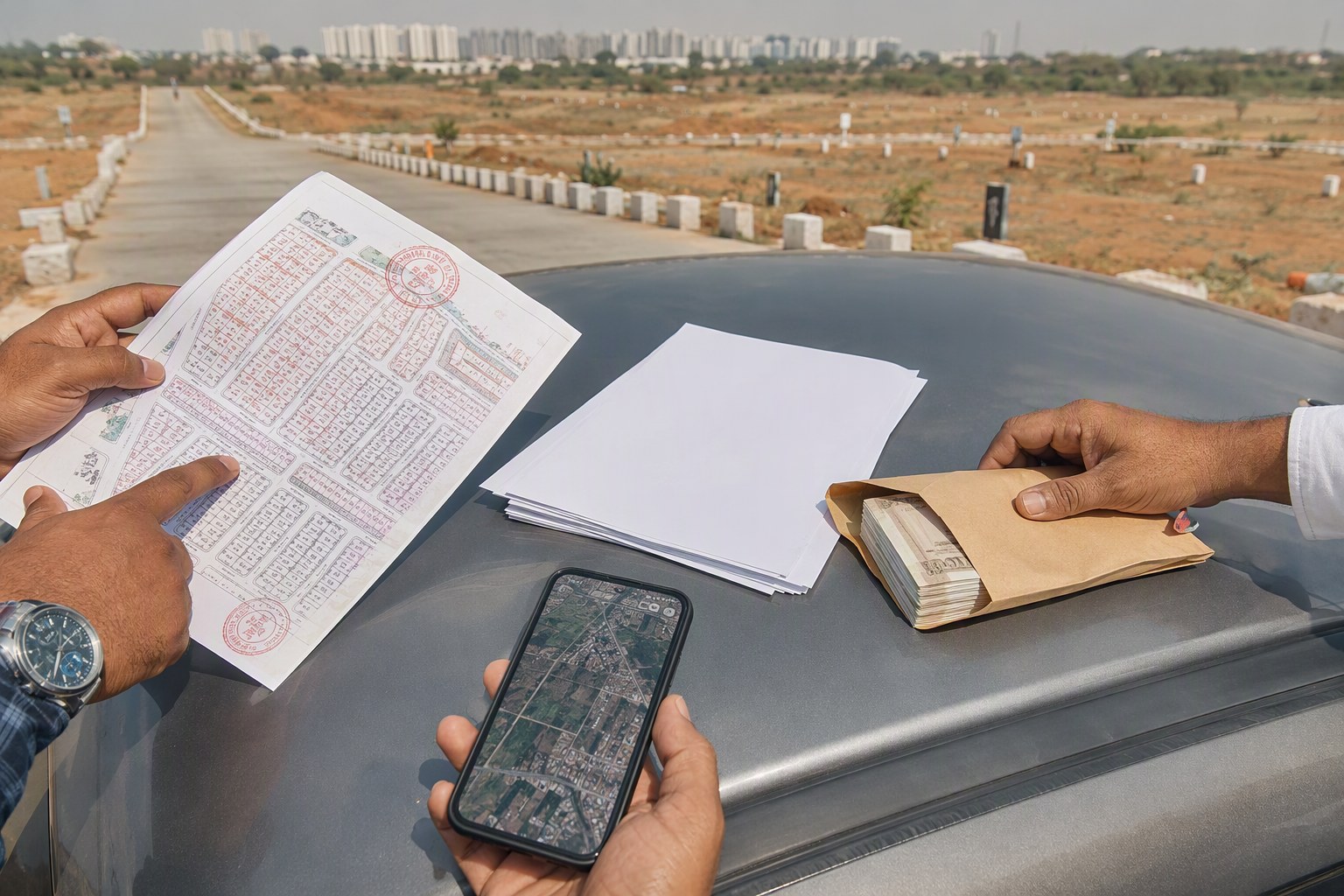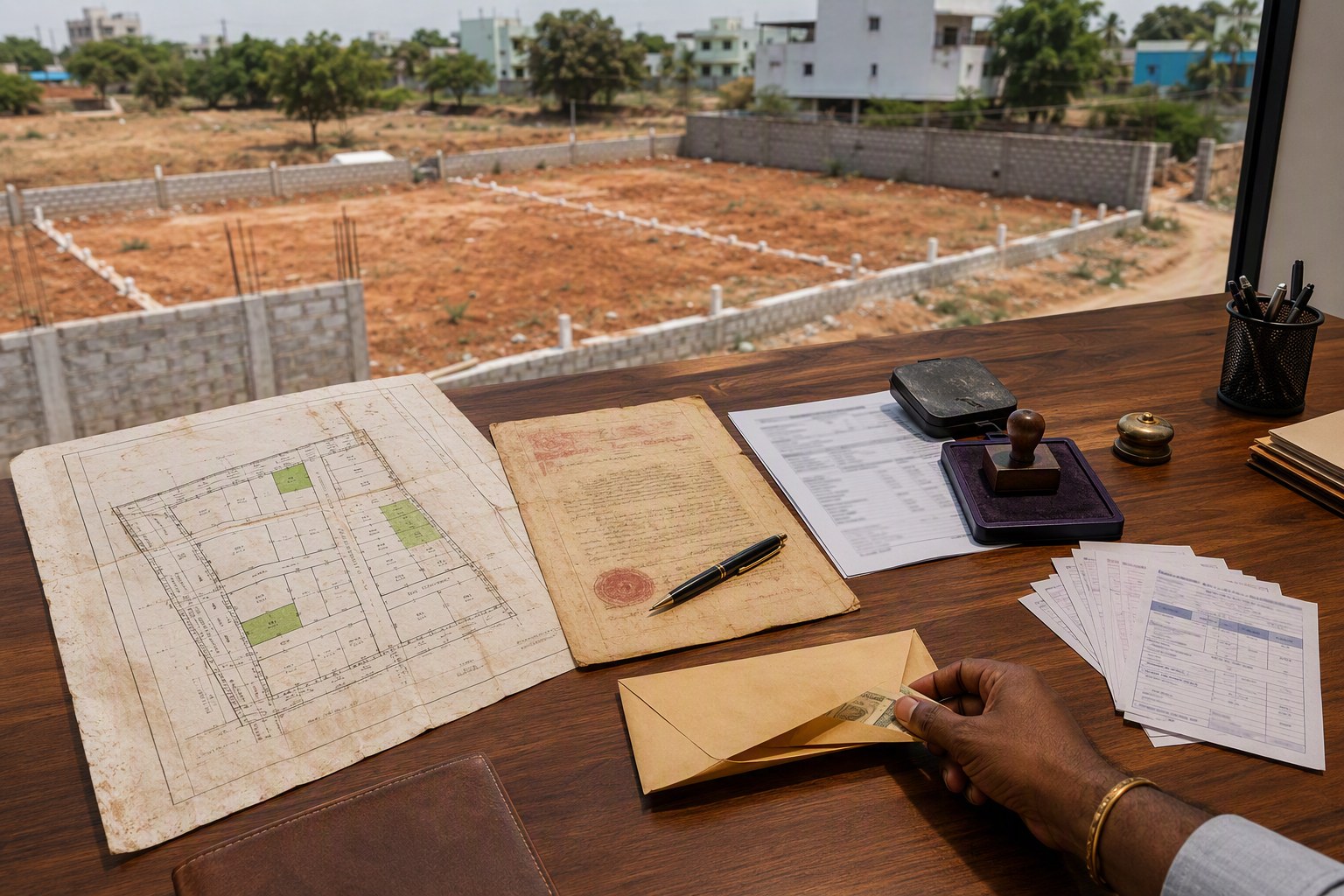



Hyderabad RERA vs Non-RERA Projects: The Investor Answer First
Hyderabad RERA vs Non-RERA Projects is not a small technical debate. For an investor, it is the difference between buying with disclosed approvals, timelines and promoter accountability, or buying with heavier self-verification and higher exit risk. In our experience across Hyderabad, RERA-registered projects generally age better for resale comfort, home loan acceptance and buyer confidence. Non-RERA projects can still work, especially completed flats, small layouts, resale homes or older independent houses, but only when title, permissions, land status and registration trail are checked properly.
The short answer is this: if you are buying an under-construction apartment in Kokapet, Narsingi, Tellapur, Miyapur, Bachupally, Kompally, Uppal or Pocharam, a RERA number should be treated as basic hygiene. If you are buying a non-RERA property, price discount alone should not excite you. You must verify EC, survey number, pahani, land use, SRO records, Section 22-A status, building permission and mutation trail before paying token advance.
Our view is simple: RERA reduces unknowns. It does not remove every risk. Non-RERA increases the work on the buyer. It does not automatically mean bad property.
Hyderabad RERA vs Non-RERA Projects: Side-by-Side Investment Comparison
| Factor | RERA-registered project | Non-RERA project | Investor reading |
|---|---|---|---|
| Basic disclosure | Project details, promoter, approvals, sanctioned plans, completion date and updates are filed with RERA. | Disclosure depends on builder and buyer effort. | RERA gives a cleaner starting point. |
| Under-construction risk | Lower, because timeline and complaint route exist. | Higher, especially if approvals or funding are unclear. | For new flats, RERA usually wins. |
| Resale comfort | Future buyers and banks can check project credentials faster. | Resale buyer may ask more questions and negotiate harder. | RERA projects often age better in the secondary market. |
| Due diligence load | Still required, but easier to organise. | Heavier due diligence needed across land, SRO, municipal and revenue records. | Non-RERA demands patience and paperwork. |
| Loan acceptance | Usually better if project is approved by banks. | Can be difficult if permissions, title or occupancy documents are weak. | Bankability affects exit value. |
| Price advantage | Premium may be higher in branded projects. | May look cheaper at entry. | Discount is useful only if risk is priced correctly. |
Hyderabad RERA vs Non-RERA Projects: What RERA Actually Covers
In Telangana, RERA registration is generally required for real estate projects where the land area exceeds 500 square metres or the number of apartments exceeds eight, including all phases. This matters in Hyderabad because many serious apartment projects in Gachibowli, Financial District, Kondapur, Puppalaguda, Manikonda, Narsingi, Kollur, Tellapur, Miyapur and Bachupally easily cross these thresholds.
A RERA-registered project normally gives you access to the project registration number, promoter name, approved plan details, carpet area, proposed completion date, common area disclosures and periodic updates. Before shortlisting, investors should run the project through the RERA Project Lookup. I would not rely only on a brochure PDF or a sales executive's WhatsApp message.
RERA also brings discipline in advertising. The builder cannot casually sell a different product from what is registered. If the promised handover date keeps moving, the buyer has a formal complaint forum. That alone improves the investment quality, because future resale buyers also prefer assets with a documented project trail.
But RERA is not a magic stamp. It does not guarantee that prices will rise. It does not mean every flat will have perfect ventilation, good association management or zero maintenance disputes. It is a regulatory filter, not a profit guarantee.
Where Non-RERA Projects Still Appear in Hyderabad
Non-RERA properties are common in several practical situations. A completed old apartment in Himayatnagar, Vidyanagar, Malkajgiri or Dilsukhnagar may not have active RERA registration because it was built before the law applied. A small standalone apartment with fewer than nine units may fall outside RERA. Independent houses in Sainikpuri, Alwal, Vanasthalipuram, Beeramguda or Boduppal may be non-RERA by nature. Gram panchayat-era layouts around the ORR belt also come into resale without a RERA story.
These properties can be good investments when bought right. We have seen older flats near Metro corridors perform steadily because rental demand is strong. A well-located non-RERA resale flat in Ameerpet or Begumpet may beat a shiny but delayed far-out project if the buyer has checked title and building records properly.
The trouble starts when non-RERA is used as a cover for weak approvals. Some projects are marketed as villas, gated community plots or pre-launch apartments without clear land conversion, layout approval, building permission or sale deed structure. In fast-growing pockets like Shankarpally, Mokila, Patancheru, Adibatla, Tukkuguda, Maheshwaram and Kandukur mandal, buyers should be extra alert because land values have moved quickly and documents sometimes lag behind marketing.
Transparency: Why RERA Usually Ages Better
Investment value is not only about today's purchase price. It is about how easily the next buyer can understand what you own. RERA projects create a documented trail. A buyer in 2029 checking your flat in Narsingi can see the project registration, completion commitment, promoter details and sometimes the approval flow. That reduces friction.
For a non-RERA property, the next buyer may ask for more documents: link documents, EC for 30 years, sanctioned plan, occupancy certificate, mutation, tax receipts, society NOC, UDS calculation, parking allotment, water connection proof and litigation declaration. None of this is wrong. It just means the resale process becomes slower.
Use the Encumbrance Certificate Search before you fall in love with a discount. An EC helps you see registered transactions, mortgages, releases and transfers. For land or plotted development, also verify survey details through the Survey Number Finder. In Telangana, the survey number is not a casual field in a form; it is the backbone of land identification.
Due Diligence in Telangana: RERA Number Is Only Step One
Whether RERA or non-RERA, do not skip Telangana-specific checks. The state has a large pool of restricted and sensitive land entries. As per the database fact we track, 147,934 properties are listed under prohibited properties linked to Section 22-A. That number alone should make every investor slow down before paying cash token or signing an unregistered agreement.
Section 22-A properties can include government land, assigned land, endowment land, wakf-related entries, court-affected land and other prohibited categories. If a land parcel falls in this list, registration may be blocked or legally risky. Before buying land in outskirts like Shamshabad mandal, Maheshwaram mandal, Shankarpally mandal, Moinabad mandal, Medchal mandal or Keesara mandal, use the Section 22-A Prohibited Property Check.
For apartments, buyers often assume land checks are the builder's problem. That is a weak approach. The undivided share of land is part of your ownership. If the parent land has a cloud, your flat can face resale and loan issues later.
A sensible due diligence sequence looks like this:
- Check the RERA registration using the project name and promoter name.
- Verify land survey numbers, pahani or revenue trail where applicable.
- Search EC for the parent land and the flat, not just the latest sale deed.
- Check whether the property is affected by Section 22-A prohibited entries.
- Confirm SRO jurisdiction through the Find Your SRO Office.
- Compare government market value using the Market Value / Guideline Value Search.
- Check stamp duty outgo through the Stamp Duty Calculator.
Resale Comfort: The Real Test After Five Years
Every investment should be judged by exit quality. In Hyderabad, resale buyers have become sharper. A buyer in 2014 may have accepted verbal assurances. A buyer in 2026 asks for RERA, OC, EC, UDS, parking proof, maintenance history, association corpus and loan closure letters. That change is good for the market.
RERA projects in established micro-markets usually enjoy cleaner resale conversations. Take a completed apartment in Kondapur or Gachibowli with RERA registration, occupancy certificate, bank approvals and active society. The resale buyer's lawyer can close checks faster. Banks are also more comfortable when previous loan approvals exist in the same project.
Non-RERA resale can still work very well in mature neighbourhoods. A 15-year-old flat in Somajiguda, Tarnaka, Habsiguda or Banjara Hills may not need RERA to prove its worth. The building exists, occupancy is visible, residents are living there, and rental demand is known. Here the key checks are title, structural condition, association disputes, parking and redevelopment potential.
The weakest category is neither old nor properly registered: semi-complete, non-RERA, approval-light construction. If a builder says RERA is not needed, ask why. If the project has more than eight units or land above the threshold, get the legal basis in writing. Do not accept casual answers like small project, no problem, all local only.
Price, Ready Reckoner and Hidden Cost Comparison
Many investors compare only sale price per square foot. That is incomplete. Hyderabad investment math must include stamp duty, registration, transfer duty, interiors, GST if applicable, maintenance deposit, corpus fund, parking cost, floor rise, clubhouse charges and delay cost.
In Telangana, a typical registered sale deed for immovable property carries stamp duty and registration-related charges that buyers must budget for. Before finalising, use the Stamp Duty Calculator and check the local government value through the Market Value / Guideline Value Search. The SRO value, often called ready reckoner or guideline value in everyday language, may be different from market price. Still, it affects registration value and tax planning.
For high-rise investments, also understand built-up value versus land share. In localities like Kokapet, Nanakramguda, Puppalaguda and Narsingi, the land component is expensive and future appreciation often depends on location scarcity. In outer growth corridors like Kollur, Velimela, Tellapur, Patancheru, Tukkuguda and Adibatla, supply is larger, so project execution and community formation matter more.
If you are comparing a RERA apartment at Rs 8,500 per sq ft with a non-RERA offer at Rs 7,600 per sq ft, do not declare the cheaper one as better. Ask what that Rs 900 discount is paying you for. Is it approval risk? Delay risk? Lower carpet efficiency? Weak resale comfort? No OC? If the answer is unclear, the discount is not enough.
Hyderabad RERA vs Non-RERA Projects for Rentals
Rental yield behaves differently from capital appreciation. Tenants usually care about location, commute, security, lift, power backup, parking and maintenance. They may not ask for RERA. So a non-RERA older flat near Metro in Kukatpally, Ameerpet, Madhapur or Nagole can rent out faster than a new RERA flat far from offices.
But for long-term investors, tenant demand is only one part. When you sell after seven or ten years, the buyer's lawyer and bank will ask document questions. That is where RERA-era projects with OC, association records and clean approvals get an advantage.
For NRIs, I strongly prefer RERA-registered or fully completed properties with clean documentation. Managing a dispute from Dubai, Dallas or Singapore is painful. If an NRI buyer still wants a non-RERA property, appoint a local lawyer, verify SRO records and use a property monitoring service like the Property Change Tracker to watch future changes.
Land, Layouts and Villa Projects: Extra Caution Needed
RERA discussions often focus on apartments, but Hyderabad investors also buy open plots and villas. Here the risk profile changes. In plotted layouts, check whether the layout is approved by HMDA, DTCP or the competent authority. Check land use zoning, road access, mortgage plots, open space and whether the survey numbers match the approved plan.
The Land Use Zone Finder helps investors avoid buying land in a zone that does not support their intended use. If road width is weak, future building permission can suffer; use the Road Width Check. For larger developments, open space contribution and layout norms can affect usable saleable area. The OSR Calculator can help in early-stage checks.
Villa projects around Mokila, Shankarpally, Velimela, Kollur, Bachupally, Gandimaisamma, Tukkuguda and Maheshwaram should be reviewed with both RERA and land-title lenses. A fancy gate and clubhouse rendering cannot replace conversion orders, layout approval, building permission and clean parent documents.
Which One Should You Buy?
If both properties are similar in location, price and quality, choose the RERA-registered project. It gives better transparency, cleaner resale language and a formal accountability route. For under-construction apartments, I would treat RERA as almost non-negotiable.
Choose a non-RERA property only when one of these is true:
- It is a completed old property with established occupancy and clean title.
- It falls outside RERA threshold legally, not by clever structuring.
- The price discount is meaningful and documents are stronger than the marketing.
- You have verified EC, SRO, land status, building permission and tax records.
- You are buying for rental yield in a mature locality and exit risk is acceptable.
For most first-time investors in Hyderabad, RERA projects age better because they are easier to explain to future buyers. For experienced investors, selective non-RERA purchases can create value, but only when the paperwork is boringly clean. In property, boring documents are a beautiful thing.
Final Investor Checklist Before Paying Token Advance
- Run the project through RERA Project Lookup.
- Check EC using Encumbrance Certificate Search.
- Verify Section 22-A risk through Prohibited Property Check.
- Confirm government market value using Guideline Value Search.
- Estimate total registration cost with Stamp Duty Calculator.
- Find the correct SRO through Find Your SRO Office.
- For land or villas, verify survey number, land use and road width.
- Never pay large cash advance before document review.
Hyderabad is still one of India's strongest property markets, but the easy-money phase has changed into a documentation-driven phase. The better your documents, the better your exit. That is why, from an investor's lens, RERA projects usually age better than non-RERA projects. Not always, but often enough to make it the safer default.
Frequently Asked Questions
Is a RERA project always safe to buy in Hyderabad?
No. RERA improves transparency and gives a complaint route, but buyers must still check EC, title, OC, SRO records, land status and payment terms before purchase.
Can a non-RERA property be a good investment?
Yes, especially completed older flats, independent houses or small projects that legally fall outside RERA. The condition is strict due diligence and clean documentation.
What should I check first in an under-construction Hyderabad project?
Start with RERA registration, sanctioned plan, completion date, promoter track record, land title, EC and bank approvals. Do not rely only on brochure claims.
Why is Section 22-A check important in Telangana?
Section 22-A covers prohibited properties where registration can be blocked or risky. With 147,934 such entries tracked in the database, this check is essential for land and project purchases.
Which ages better for resale, RERA or non-RERA?
In most under-construction and large apartment cases, RERA projects age better because future buyers and banks can verify project details faster. Non-RERA resale depends heavily on location and documents.