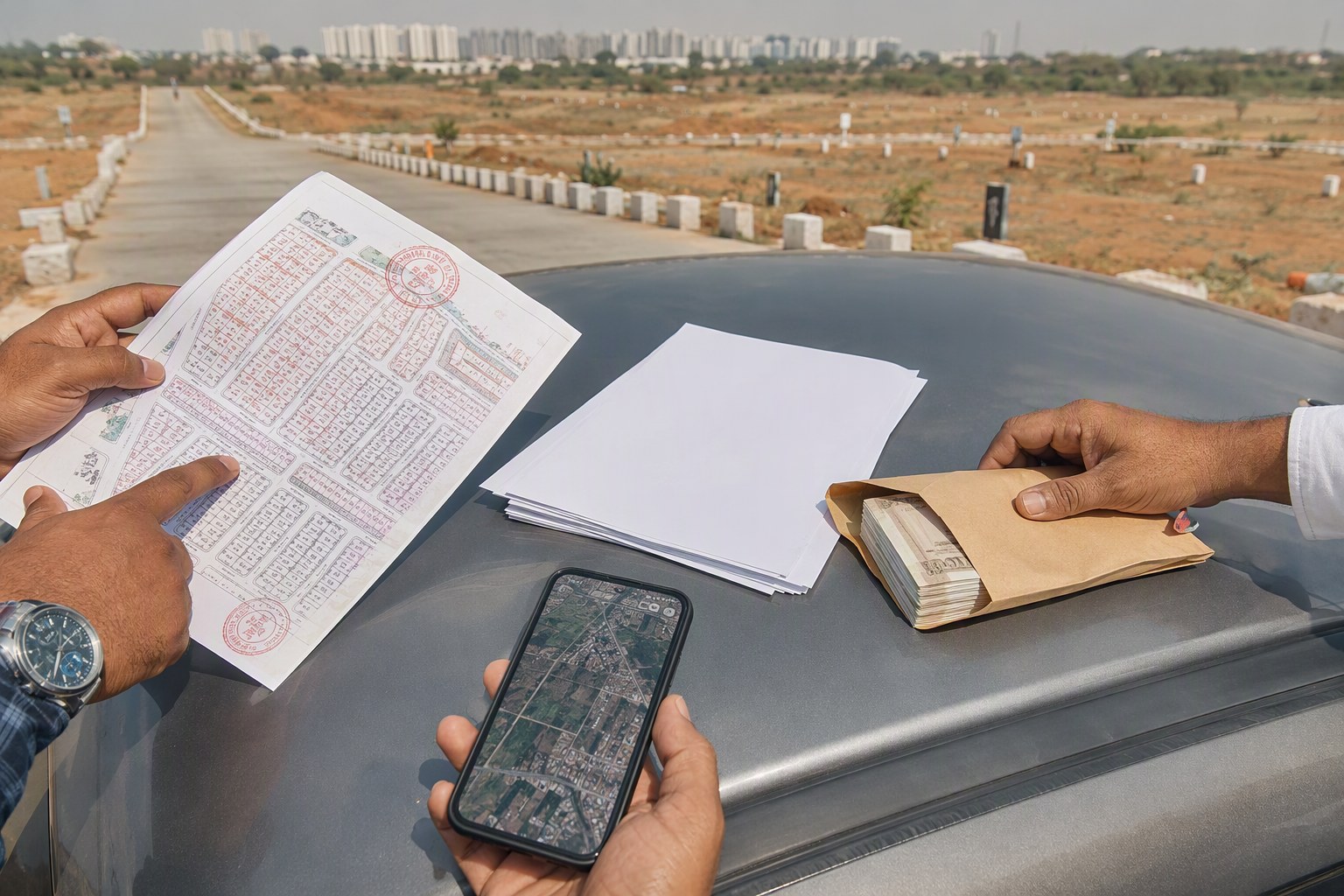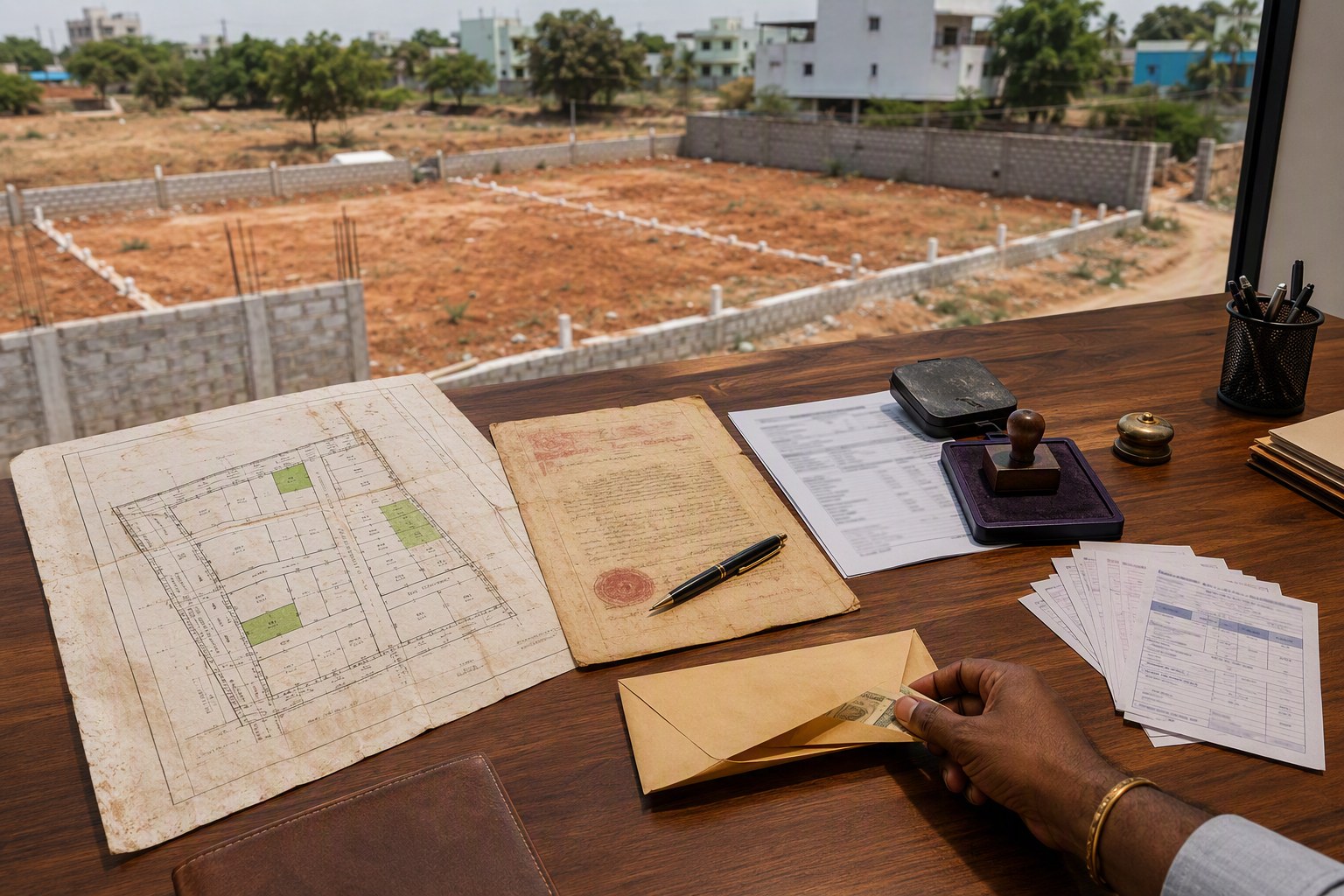



Hyderabad Property Flips look attractive when a flat in Kondapur, a plot near Shamshabad, or a villa parcel around Shankarpally moves up within a few months. But the hard number that should worry every short-term investor is this: Telangana has 1,47,934 prohibited-property records under Section 22-A. That is not a small clerical list. It is a liquidity warning. If your property falls into a prohibited category, or even has a doubtful survey number, your exit can get stuck at the SRO counter while your interest cost keeps running.
In our experience, many flips fail not because the buyer chose a bad location, but because the investor calculated only sale price minus purchase price. Hyderabad property flipping needs a tighter calculation: stamp duty, transfer duty, registration fee, brokerage, short-term capital gains tax, loan interest, repair cost, EC risk, 22-A risk and time-to-exit. Miss any one of these, and the deal that looked like a ₹10 lakh gain can become a ₹2 lakh headache.
Hyderabad Property Flips: the 6% transaction cost hits before profit arrives
For a normal sale deed in Telangana, the buyer typically pays around 6% of the property value as registration-related charges: 4% stamp duty, 1.5% transfer duty and 0.5% registration fee. This is usually calculated on the higher of the declared sale consideration or the government market value, commonly called guideline value or ready reckoner value.
That means a flipper cannot think only like a stock trader. In shares, your transaction cost is small. In property, the entry ticket itself is heavy. If you buy a resale flat in Gachibowli for ₹1 crore and register it properly, the registration-related outgo can be around ₹6 lakh. When you sell, the next buyer pays fresh stamp duty, and that buyer will negotiate the price keeping his own 6% cost in mind. So the market has to rise enough to absorb both your entry cost and the buyer’s future cost.
Before you even negotiate, use the Stamp Duty Calculator to see the exact Telangana duty impact. Then cross-check the SRO guideline value using the Market Value / Guideline Value Search. We’ve seen investors in Madhapur and Kokapet assume that only the agreement value matters, then get surprised because the SRO value has moved up for that village or ward.
| Item | Typical Telangana rate / impact | Why it matters for a flip |
|---|---|---|
| Stamp duty | 4% | Paid at purchase; must be recovered through price appreciation |
| Transfer duty | 1.5% | Part of registration cost; often ignored in quick calculations |
| Registration fee | 0.5% | Small percentage, but still material on ₹1 crore-plus deals |
| Total registration-related cost | About 6% | A ₹1 crore buy needs roughly ₹6 lakh upfront just for registration charges |
| Short-term capital gains | Taxed as per income slab if held under 24 months | Can reduce net gain sharply for high-income investors |
| Section 22-A risk | 1,47,934 prohibited-property records | Can block registration or scare the resale buyer |
Hyderabad Property Flips and Section 22-A: legal liquidity matters as much as price
The 1,47,934 prohibited-property records under Section 22-A should be read like a market risk indicator. These records can include government lands, assigned lands, endowment lands, wakf-related entries, court-disputed entries, and other categories where registration may be prohibited or restricted. For a long-term end-user, a doubt may still be examined slowly. For a flipper, delay itself is a loss.
Let us say you buy an open plot near Adibatla in Ibrahimpatnam mandal because the ORR-side story sounds strong. After six months, you find a buyer from Bengaluru. The buyer’s bank asks for a clean Encumbrance Certificate, link documents, pahani, Dharani status and Section 22-A check. If the survey number has a prohibited-property shadow, the bank may refuse funding. The buyer will either walk away or ask for a deep discount. Your flip is no longer a flip; it becomes a legal file.
This is why I prefer the phrase legal liquidity. A property is liquid only if it can be transferred without drama at the correct SRO. For land, check survey number, village, mandal, Dharani status, pahani entries and 22-A status. For flats, check RERA, building permissions, occupancy certificate where applicable, undivided share, link documents and EC.
Start with the Section 22-A Prohibited Property Check. Use the Encumbrance Certificate Search to study mortgage and sale history. If the survey number is unclear in old documents, the Survey Number Finder helps you avoid working with half-information.
A property that cannot be registered quickly is not a trading asset. It may be valuable on paper, but a flip needs a clean exit, not only a good entry price.
Example: a ₹1 crore Hyderabad flip can lose steam quickly
Here is a simple calculation for a resale apartment flip in a strong corridor like Kondapur, Narsingi, Nanakramguda, Tellapur or Kokapet. These localities attract investors because rental demand is visible and IT employment keeps the story alive. But even in these markets, numbers must be checked without emotion.
| Particulars | Amount |
|---|---|
| Purchase price | ₹1,00,00,000 |
| Stamp duty + transfer duty + registration fee at about 6% | ₹6,00,000 |
| Brokerage, legal checks, documentation, small repairs | ₹2,00,000 |
| Total cost before finance | ₹1,08,00,000 |
| Interest cost for 9 months, if funded partly by loan or private capital | ₹3,00,000 to ₹5,00,000 |
| Effective cost range | ₹1,11,00,000 to ₹1,13,00,000 |
If the property is sold for ₹1.15 crore, the headline looks like a ₹15 lakh gain. The real pre-tax gain may be only ₹2 lakh to ₹4 lakh after transaction and finance costs. If you are in the 30% slab and the holding period is under 24 months, short-term capital gains tax can reduce the net further. Use the Capital Gains Tax Calculator before signing the sale agreement, not after receiving the advance.
Now add one legal delay. Suppose the resale buyer’s bank takes 45 extra days due to EC mismatch or SRO clarification. You may pay another EMI, lose another buyer, or accept a reduced sale price. This is how stamp duty and legal liquidity together eat the gain.
Where Hyderabad flippers are active, and what they must check
Hyderabad’s flip activity is not evenly spread. It clusters around infrastructure stories, IT employment, villa demand and land conversion expectations. We’ve seen short-term investor interest in these pockets:
- Kokapet and Narsingi in Gandipet mandal, driven by Financial District spillover and premium apartment launches.
- Tellapur and Osman Nagar around Ramachandrapuram and nearby mandal limits, where gated communities and villa projects attract second-home buyers.
- Kondapur, Gachibowli and Madhapur in the core IT belt, where resale liquidity is better but entry prices are already high.
- Shamshabad, Mamidipally and Adibatla on the airport and aerospace side, where plot buyers must be extra careful with land title and permissions.
- Shankarpally, Mokila and Kollur where villas and plotted layouts get investor attention, but HMDA/DTCP layout status and road access need strict checking.
- Medchal, Kompally and Dundigal side where warehouse, residential and land-use expectations often mix.
Each pocket has a different risk. In Madhapur or Gachibowli, the biggest issue may be high entry price and limited upside after all costs. In Adibatla or Shamshabad, the issue may be title clarity, land-use zoning, approach road and whether the buyer’s bank is comfortable. In Mokila or Shankarpally, the question is whether villa demand will support your expected resale price within your holding period.
For plotted land, don’t stop at a glossy brochure. Check SRO, village map, Dharani, pahani, layout approval and road width. The Find Your SRO Office tool helps identify the correct registration office. For zoning, use the Land Use Zone Finder. If you are buying a project apartment or villa, verify the developer and registration details through the RERA Project Lookup.
Hyderabad Property Flips: guideline value can change your margin
Many investors speak only about market price per square foot. But the SRO guideline value is the number that decides minimum registration value. In Telangana, registration charges are generally applied on the higher of guideline value and declared consideration. If the government value rises between your entry and your buyer’s registration, the buyer’s cash outgo rises. Naturally, he will factor that into negotiation.
Take a simple case. You bought a small plot on the western side when the market was still digesting a new road proposal. Your sale price after eight months is higher, but by then the SRO value for that village has also gone up. The buyer sees not only your asking price, but stamp duty on that higher base. If the buyer is stretching his budget, he will ask you to reduce the sale price. This is why guideline value is not a back-office detail; it directly affects your exit.
For apartments, investors should also understand composite pricing. A builder may quote base price, floor rise, amenities, clubhouse, corpus fund, parking and GST separately. A resale buyer may compare only all-inclusive cost. Use the Composite Value Calculator to estimate real acquisition cost, especially in large projects in Kokapet, Puppalaguda, Tellapur and Miyapur.
The tax angle: short-term capital gains can hurt high-income flippers
If you sell immovable property within 24 months, gains are generally treated as short-term capital gains and taxed at your applicable income tax slab. For many Hyderabad investors working in IT, pharma, consulting or business, that can mean a high tax rate. This is separate from stamp duty. One is a transaction cost; the other is tax on gain.
For example, if your actual net gain before tax is ₹8 lakh and you are in a high slab, your post-tax gain may fall sharply. If you used borrowed money, your interest calculation must also be realistic. Many people mentally ignore interest because the money came from overdraft, family loan or business cash flow. Capital has a cost, even when no bank is sending EMI reminders.
Keep every cost in one sheet: registration charges, brokerage, advocate fee, EC and certified copies, bank processing fee, interiors, holding interest, society transfer charges, maintenance arrears, tax and expected discount during resale. If a flip still works after these entries, only then it is a serious deal.
Flat flips versus plot flips in Hyderabad
Flat flips and plot flips behave differently. A flat in a RERA-registered project at Financial District, Nallagandla, Miyapur or Kukatpally may have clearer buyer demand, especially if possession is near. But apartment flips face competition from the builder’s unsold inventory. If the builder is offering payment plans, free interiors or lower floor premiums, your resale unit has to compete with that.
Plots can give faster appreciation when infrastructure news is strong, especially around Shankarpally, Chevella road, Shamshabad or Patancheru side. But land has higher title risk. Survey number mistakes, assigned land suspicion, missing link documents, ORR/road acquisition impact, water body buffer, endowment claim or 22-A entry can destroy liquidity. This is exactly why the 1,47,934 prohibited-property records matter for investors.
With plots, I would rather pay a little more for a cleaner title than chase the cheapest quote in the village. A discount is not a bargain if the next buyer cannot get bank funding or registration comfort.
A practical pre-flip checklist for Hyderabad investors
- Calculate duty first: Use the Telangana stamp duty rate of about 6% for normal sale transactions and test whether your expected appreciation beats this cost.
- Check guideline value: Compare sale consideration with SRO market value using the guideline value tool.
- Run EC search: Look for mortgages, prior sales, court attachments or gaps in link history.
- Check Section 22-A: For land and older layouts, this is non-negotiable.
- Verify RERA: For apartments and villas in registered projects, match project name, promoter, approvals and timelines.
- Confirm SRO: Wrong SRO assumptions create delay during documentation.
- Study buyer finance: A property that banks dislike will have fewer buyers and weaker resale value.
- Keep exit discount: Build in at least some negotiation room. Every buyer will try to adjust for his own stamp duty burden.
- Check tax: Short-term capital gains tax can be the difference between profit and wasted effort.
- Track changes: Use a property tracker if you are holding land in a fast-changing mandal.
For investors holding multiple assets, the Property Change Tracker is useful because changes in EC, SRO value or public records can affect exit planning. For a deeper title screening, start with the Property Verification Tool.
My view: Hyderabad flips need a minimum margin of safety
My thumb rule is simple. If a Hyderabad property flip does not show a potential gross upside of at least 15% to 20% within your planned holding period, it may not be worth the risk. Why? Because around 6% goes at entry through registration-related charges, another chunk goes into brokerage, interest and repairs, and tax takes its share if you sell quickly. A smaller expected upside can vanish with one delayed buyer or one title query.
This does not mean flips are dead. Hyderabad still has micro-markets where timing works: a near-completion apartment bought below builder price, a distress resale in a high-demand gated community, a clean plot in an approved layout before road completion, or a villa unit where comparable supply is limited. But the investor must buy with documents, not just with WhatsApp location pins.
The real question is not, “Will Hyderabad property prices rise?” In many corridors, they may. The sharper question is: after stamp duty, legal checks, time delay, tax and buyer negotiation, will your gain still remain in your bank account?
If the answer is unclear, pause. Run the numbers. Check the SRO value, EC and 22-A status. Hyderabad rewards patient, well-documented property investors. It punishes careless flippers very quickly.
Frequently Asked Questions
Will stamp duty reduce profit in Hyderabad property flips?
Yes. For a normal sale deed in Telangana, registration-related charges are usually about 6% of the property value. A short-term flip must earn more than this, plus brokerage, interest, repairs and tax, before it becomes a real profit.
Why are the 1,47,934 Section 22-A records risky for flippers?
Section 22-A prohibited-property records can block or delay registration. For a flipper, delay affects liquidity, buyer confidence and finance approval. Always check 22-A status before buying land or older properties.
Is a flat safer than a plot for flipping in Hyderabad?
A flat in a clear RERA project may have better buyer liquidity, but it can compete with builder inventory. A plot may appreciate faster in growth corridors, but title, survey number, layout approval and 22-A checks are critical.
How is short-term capital gain taxed on Hyderabad property?
If you sell immovable property within 24 months, the gain is generally treated as short-term capital gain and taxed as per your income slab. Use a capital gains calculator before finalising the resale price.
Which documents should I verify before attempting a property flip?
Check sale deed, link documents, EC, SRO guideline value, pahani and Dharani status for land, survey number, Section 22-A status, layout approval, RERA details for projects, and bank loan eligibility.