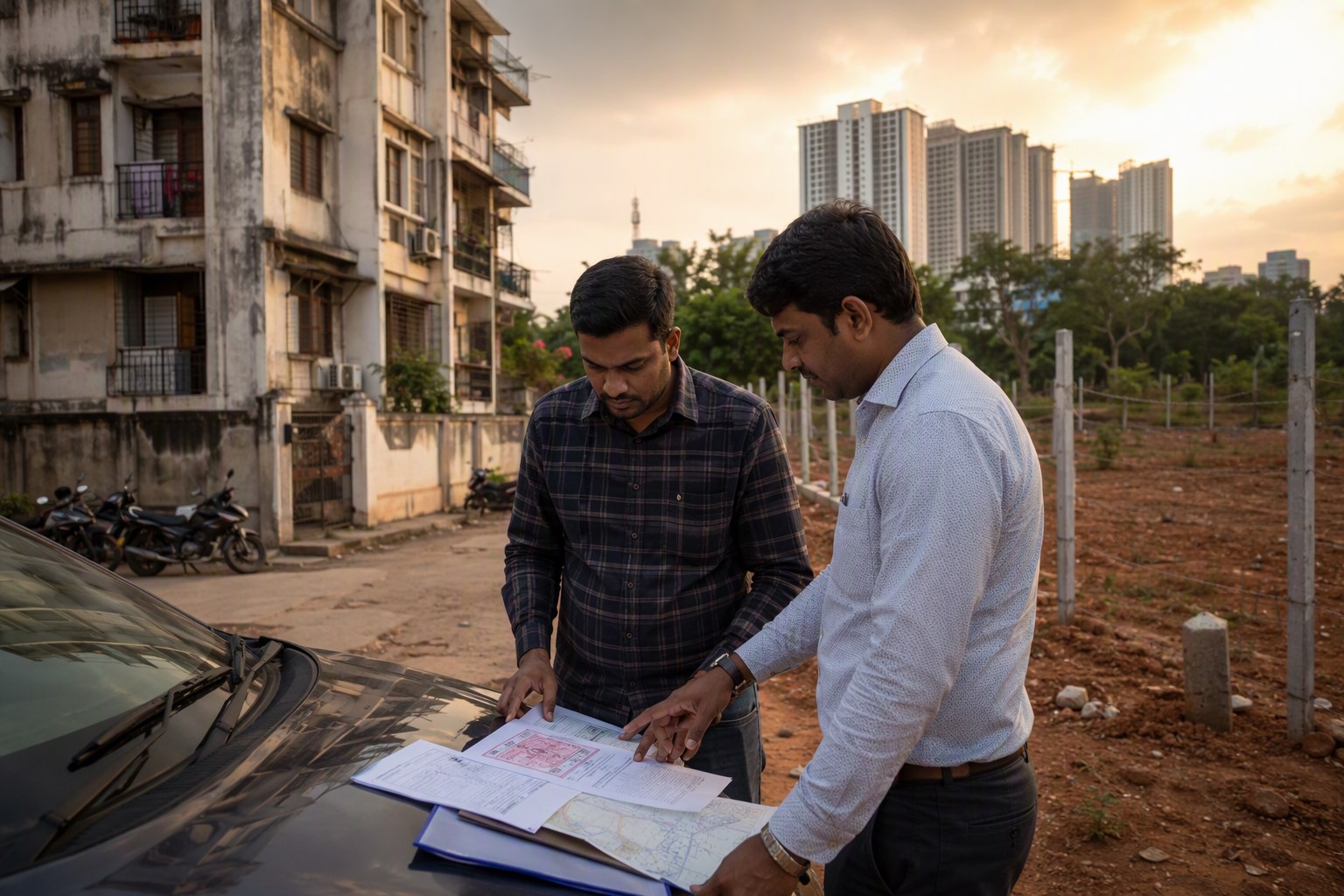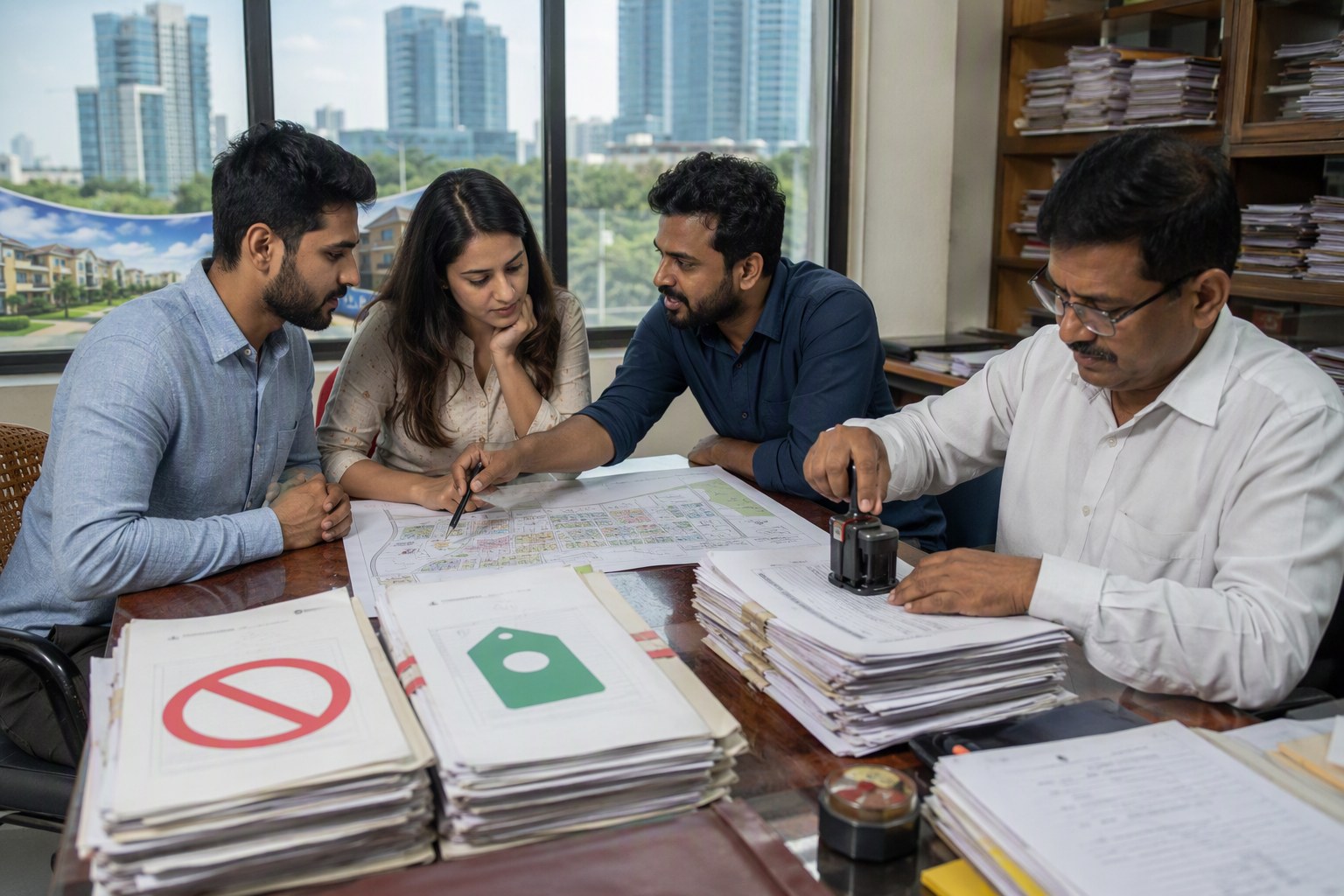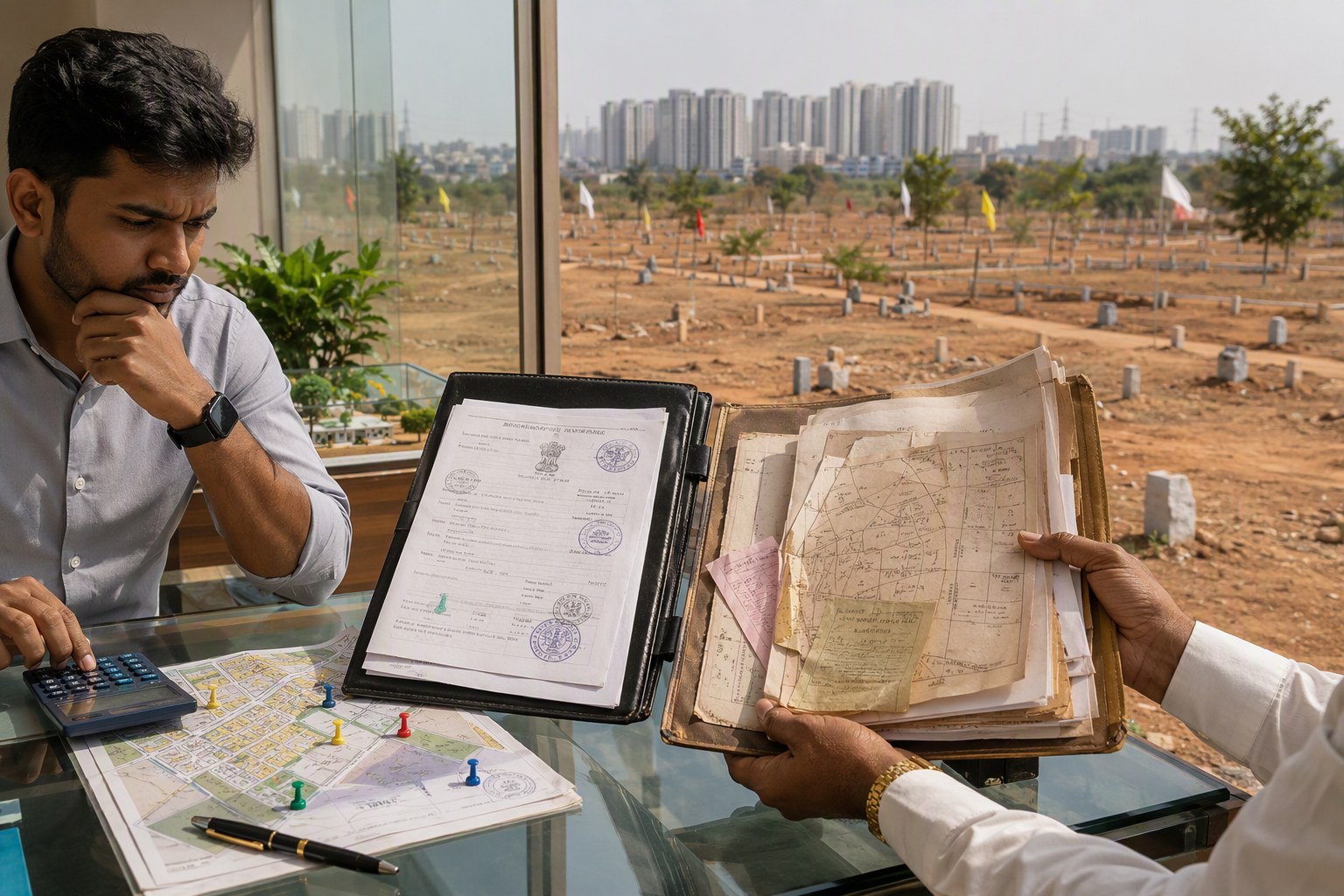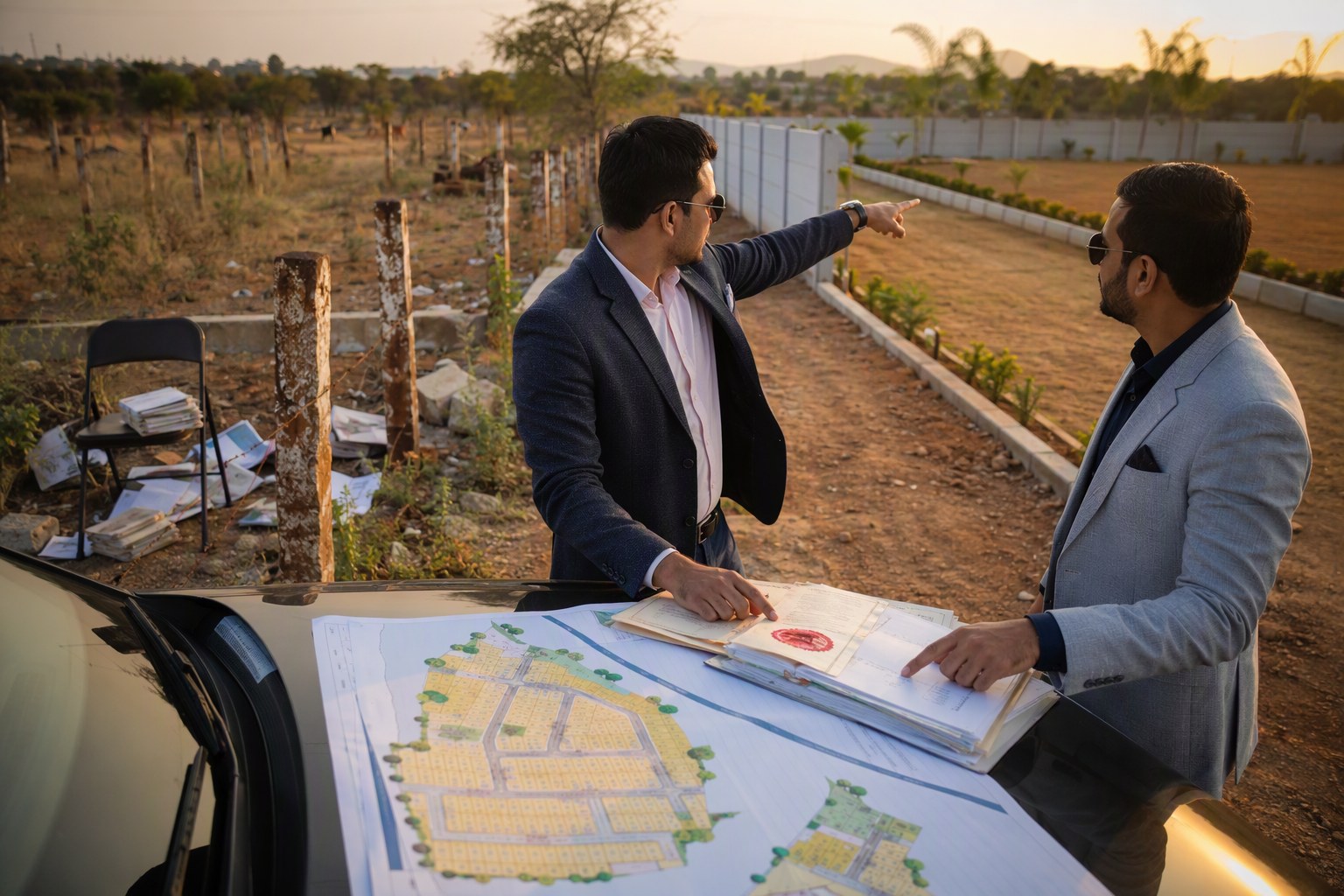
Hyderabad Deal Heatmaps are no longer just a broker’s instinct or a WhatsApp group discussion. Telangana has 1,47,934 prohibited properties under Section 22-A, and that number is a serious market signal for anyone buying land, flats, farm plots, villas or redevelopment parcels around Hyderabad. A cheap rate in a good location can still be a bad deal if the survey number is blocked, the SRO refuses registration, or the land record does not match the seller’s story.
My straight answer: buyers should stop judging a Hyderabad property only by locality name and price per square yard. The better approach is to read the deal like a heatmap — title risk, registration risk, development risk, demand risk and exit risk. Once you do that, a plot in Shankarpally mandal, a villa land share in Mokila, a resale flat in Gachibowli, and an agricultural parcel near Yacharam will not look like the same type of deal, even if the brochure tries to make them sound equally safe.
In our experience, the best deal is not the cheapest deal. It is the property where the price, records, access, zoning, registration status and resale demand all agree with each other.
Hyderabad Deal Heatmaps: Why 1,47,934 Prohibited Properties Change Buyer Behaviour
The Section 22-A prohibited property list is where many real estate stories become real. If a property is prohibited, the registration department may not allow normal sale registration. The reasons can vary — government land, assigned land, wakf/endowment issues, ceiling surplus, court-related entries, protected categories, or other departmental restrictions. For a buyer, the exact reason matters, but the first signal is simple: the property needs deeper checking before any token advance.
That figure — 1,47,934 prohibited properties — tells us Telangana’s market is not one single clean board. It is made of thousands of micro-pockets. Some are very liquid, some are stuck, and some are priced attractively only because the risk is sitting inside the survey number.
Take the western Hyderabad belt. Kokapet, Neopolis, Financial District, Narsingi, Nanakramguda and Gachibowli carry strong end-user demand. Apartment prices in prime gated communities commonly sit in the ₹9,000 to ₹15,000 per sq ft band, and premium towers can ask higher depending on brand, view, floor and handover stage. Land is a different animal. In Kokapet and Neopolis surroundings, plotted land and auction-influenced expectations have pushed market conversations into several lakhs per square yard in select pockets. But a high-price zone is not automatically a green zone. A buyer still has to check title, link documents, approvals, EC, SRO jurisdiction and land use.
Now compare that with fast-moving peripheral belts like Shankarpally, Mokila, Kollur, Tellapur, Patancheru, Adibatla, Tukkuguda and Yacharam. Rates may be lower than core west Hyderabad, but the risk pattern changes. In plotted layouts, buyers must watch survey number accuracy, HMDA/DTCP layout status, 22-A entries, road access, nala buffers, FTL, assignment history and whether the seller is selling land or only a promise.
Before paying any advance, use a Section 22-A Prohibited Property Check, run an Encumbrance Certificate Search, and verify the market value through the Market Value / Guideline Value Search. These three checks will not replace legal due diligence, but they will stop many wrong deals at the gate itself.
Hyderabad Deal Heatmaps Are Built Survey Number by Survey Number
Hyderabad buyers often say, “The location is good.” That is only the first layer. A deal heatmap is not drawn at locality level alone. It is drawn at survey number, sub-division, village and mandal level. Two plots on the same road can have different risk colours if one has clean private patta and the other has an old assigned land trail.
This is especially true in revenue-heavy areas like Gandipet mandal, Shankarpally mandal, Moinabad mandal, Maheshwaram mandal, Ibrahimpatnam mandal, Yacharam mandal, Kandukur mandal, Medchal mandal and Ghatkesar mandal. Buyers hear the big locality names — Mokila, Narsingi, Tukkuguda, Adibatla, Ghatkesar, Keesara, Shamirpet — but registration happens on the strength of records. Pahani, Dharani entry, title deed, link documents, mutation status and SRO acceptance decide whether the deal is actually movable.
For example, a one-acre parcel near Shankarpally may be quoted at a headline rate because the ORR access story is attractive. But if part of the survey number is in a prohibited list or the pahani shows a classification issue, that acre cannot be treated like a clean residential conversion candidate. Similarly, a farm plot near Yacharam or Kandukur may look affordable compared to Mokila or Kollur, but if the layout is informal and the access road is only shown on paper, resale can become painful.
A useful starting workflow is: identify the village and mandal, confirm the exact survey number using the Survey Number Finder, check SRO jurisdiction through Find Your SRO Office, then verify title risk through the Property Verification Tool. This is how serious investors read land, not by brochure map alone.
Reading a Hyderabad Deal Heatmap: Red, Amber and Green Signals
I like to classify Hyderabad property deals into three practical zones. This is not official colour coding; it is a buyer’s working method.
Red heat: walk slowly, pay nothing in hurry
Red heat does not always mean fraud. It means the property has enough risk markers that a buyer should pause. Common red signals include Section 22-A entry, mismatch between seller name and Dharani record, missing link documents, old GPA-based chain with no clarity, land claimed as patta but showing government-related classification, layout without valid approval, and a road that does not match the ground reality.
We see this often in the outer growth corridors. A broker may say, “Registration will happen, sir, no issue.” But the SRO counter has the final say. If the property falls under a prohibited category, verbal confidence is useless.
Amber heat: deal possible, but price must reflect risk
Amber deals are common in Hyderabad. Maybe the property has clear possession but old link documents need reconstruction. Maybe the layout approval exists, but some mortgage plots have to be released. Maybe the EC is clean for recent years, but older parent documents need checking. In these cases, the property is not automatically bad. But the buyer should not pay green-zone pricing.
For instance, if a plotted development near Tukkuguda quotes a rate close to a fully approved HMDA layout with good road width and clear title, but its approval trail is weaker, the buyer should demand a discount or walk away. Heatmap thinking protects the buyer from paying premium prices for half-clear assets.
Green heat: clean records, correct pricing, visible demand
Green heat is where title, registration, approvals, access and demand all line up. A RERA-registered apartment project in a strong corridor like Gachibowli, Nallagandla, Tellapur or Kondapur may fall in this zone if approvals, EC and builder record check out. A clean HMDA plot in a proper layout near Kollur or Shankarpally can also be green if the survey number, layout, road width and SRO records are in order.
For under-construction projects, use the RERA Project Lookup. For built-up value comparison, the Composite Value Calculator helps buyers understand whether the quoted price is only emotional pricing or has some market logic.
Hyderabad Deal Heatmaps Versus Price Per Square Yard
Price per square yard is useful, but it is not enough. Hyderabad has many cases where the cheap-looking deal is actually expensive after risk adjustment. Let us say one plot near Mokila is quoted at ₹65,000 per sq yd in a stronger layout, and another is quoted at ₹48,000 per sq yd in a weaker title pocket. Many buyers run towards the second one because the price gap is visible. But if the lower-priced plot has registration doubt, road uncertainty or resale hesitation, the real cost is much higher.
The same logic applies to apartments. A resale flat in Kondapur at ₹10,500 per sq ft may look costlier than a far-periphery pre-launch at ₹6,500 per sq ft. But the Kondapur flat may have immediate rental demand, known society maintenance, bank loan comfort and easy EC verification. The pre-launch may carry approval timing risk, construction delay risk and unclear exit demand. The number on the rate card is only one part of the heatmap.
| Market pocket | Typical buyer attraction | Main heatmap checks |
|---|---|---|
| Gachibowli, Kondapur, Nallagandla | IT demand, rentals, resale liquidity | RERA, EC, UDS, association dues, builder track record |
| Kokapet, Neopolis, Narsingi | Premium growth, office corridor, brand projects | Approval status, land title, project delivery, high-ticket resale depth |
| Mokila, Shankarpally, Kollur | Villa plots, gated layouts, ORR access story | Survey number, HMDA/DTCP approval, 22-A, road width, land use |
| Tukkuguda, Adibatla, Maheshwaram | Airport side growth, plotted layouts, industrial push | Layout approval, access roads, assignment history, SRO registration comfort |
| Yacharam, Kandukur, Ibrahimpatnam | Lower entry price, long-term land banking | Dharani record, pahani, prohibited list, zoning, actual possession |
How 1.48 Lakh Telangana Blocks Affect Negotiation
The presence of 1,47,934 prohibited properties across Telangana gives buyers a powerful negotiation lens. Sellers know location stories. Buyers must know record stories. When you ask for survey number, pahani, Dharani details, EC, link documents and 22-A check before discussing token amount, the conversation changes.
In many land deals, the first discount is not in rupees. It is in information. A seller who refuses to share basic records is already telling you something. A seller who gives all documents, allows SRO checking, accepts advocate review and explains the chain clearly is creating confidence. That confidence has value.
For stamp duty planning, use the Stamp Duty Calculator. Buyers should compare the registration value with the ready reckoner or market value. If the transaction value is far above the guideline value, understand why. If it is suspiciously below market, ask what risk is being hidden. Telangana’s registration system will not judge your investment wisdom; it will only process what is legally acceptable.
For plotted and development land, also check road width and land use. A 30-feet road, 40-feet road and 60-feet road do not create the same development potential. Use the Road Width Check and Land Use Zone Finder before assuming future apartment or villa development. If you are evaluating development yield, the FSI/FAR Calculator gives a practical sense of buildability.
Hyderabad Deal Heatmaps for Flats, Plots and Agricultural Land
For flats
Flat buyers usually focus on carpet area, amenities and handover date. That is natural. But the heatmap should include project registration, approved plan, undivided share of land, EC, mortgage release, occupancy certificate and association-level issues. In established zones like Madhapur, Kondapur, Manikonda, Nallagandla and Miyapur, resale demand is strong, but old apartment blocks can have deviation, parking and maintenance disputes. A good rent does not cure a bad title defect.
For plots
Plot buyers must be stricter. A plot is only as clean as its parent land and layout approval. In HMDA influence areas such as Kollur, Shankarpally, Mokila, Ghatkesar, Keesara and Tukkuguda, many layouts are sold through glossy maps. Ask for the approved layout number, mortgage release status, LP number, road handover details and exact survey numbers. Then check whether any part of the survey number appears in the prohibited category.
For agricultural land
Agricultural land is where heatmap discipline matters most. Dharani may show one picture, ground possession may show another, and old family shares may be unresolved. Pahani entries, pattadar passbook, succession, mutation and boundary confirmation matter. If you are a non-farming urban buyer looking at land banking near Yacharam, Kandukur, Chevella, Moinabad or Shamirpet, do not treat it like buying a flat. It is a revenue-record transaction first, real estate dream later.
A Practical Buyer Checklist Before Paying Token Advance
- Ask for exact details: Village, mandal, survey number, extent, plot number, SRO and seller name.
- Check Section 22-A: Use a prohibited property check before any advance.
- Read the EC: Look for mortgages, past sales, court-related transactions and unusual gaps.
- Compare market value: Use guideline value, ready reckoner and local resale evidence.
- Verify approvals: For flats, check RERA. For plots, check HMDA/DTCP approval and mortgage releases.
- Visit the site: Confirm road access, boundaries, neighbouring development and actual possession.
- Use SRO logic: If the SRO will not accept the document, your agreement paper has limited comfort.
- Take legal review: A local property advocate who understands Telangana land records is not an expense; it is insurance.
We’ve seen buyers save lakhs simply by checking one survey number before paying token advance. We’ve also seen buyers lose negotiation power because they paid first and verified later. In Hyderabad, speed is useful only after clarity.
What This Means for Hyderabad Market Trends
The 1.48 lakh prohibited-property count does not mean Telangana real estate is unsafe. That would be a lazy reading. The correct reading is sharper: the market is becoming more data-sensitive. Clean assets will command better premiums. Grey assets will need discounts. Risky assets will keep circulating among buyers who do not verify properly.
This is already visible in buyer behaviour. End-users in Gachibowli, Nallagandla and Kondapur ask more questions on RERA, OC and UDS than they did earlier. Plot buyers in Kollur, Mokila and Shankarpally are asking for survey numbers before site visits. Land bankers near Yacharam and Kandukur are checking Dharani and 22-A earlier in the conversation. That is a healthy shift.
My opinion is simple: Hyderabad’s next phase will reward verified property. Not just branded property. Not just ORR-facing property. Verified property. A good heatmap helps buyers see where the deal is genuinely hot and where it is only burning with hidden risk.
If you are evaluating a property this week, do not start with the question, “Is the rate negotiable?” Start with, “Is the record clean?” Once that answer is strong, negotiation becomes meaningful.
Frequently Asked Questions
What are Hyderabad Deal Heatmaps in real estate?
Hyderabad Deal Heatmaps are a practical way to judge property risk and value at micro-market level. Instead of looking only at locality and price, buyers check title, Section 22-A status, EC, SRO comfort, approvals, road access, land use and resale demand.
Why does the 1,47,934 prohibited property count matter?
It shows that Telangana has a large number of properties with registration restrictions under Section 22-A. For buyers, this is a warning to verify the exact survey number, village and mandal before paying token advance.
Can a prohibited property be bought safely?
Not without expert legal review. Some entries may be disputed or correctable, but a buyer should not assume registration will happen. First check the 22-A status, reason for prohibition, revenue records and SRO position.
Which checks are most important before buying a plot near Hyderabad?
For plots, check the survey number, Dharani record, pahani, Section 22-A status, EC, HMDA or DTCP approval, mortgage release, road width, land use and SRO jurisdiction. Site inspection is also essential.
Is guideline value the same as market price in Hyderabad?
No. Guideline value or ready reckoner value is used for registration and stamp duty reference. Market price depends on demand, location, approvals, title quality, road access, builder brand and resale liquidity.