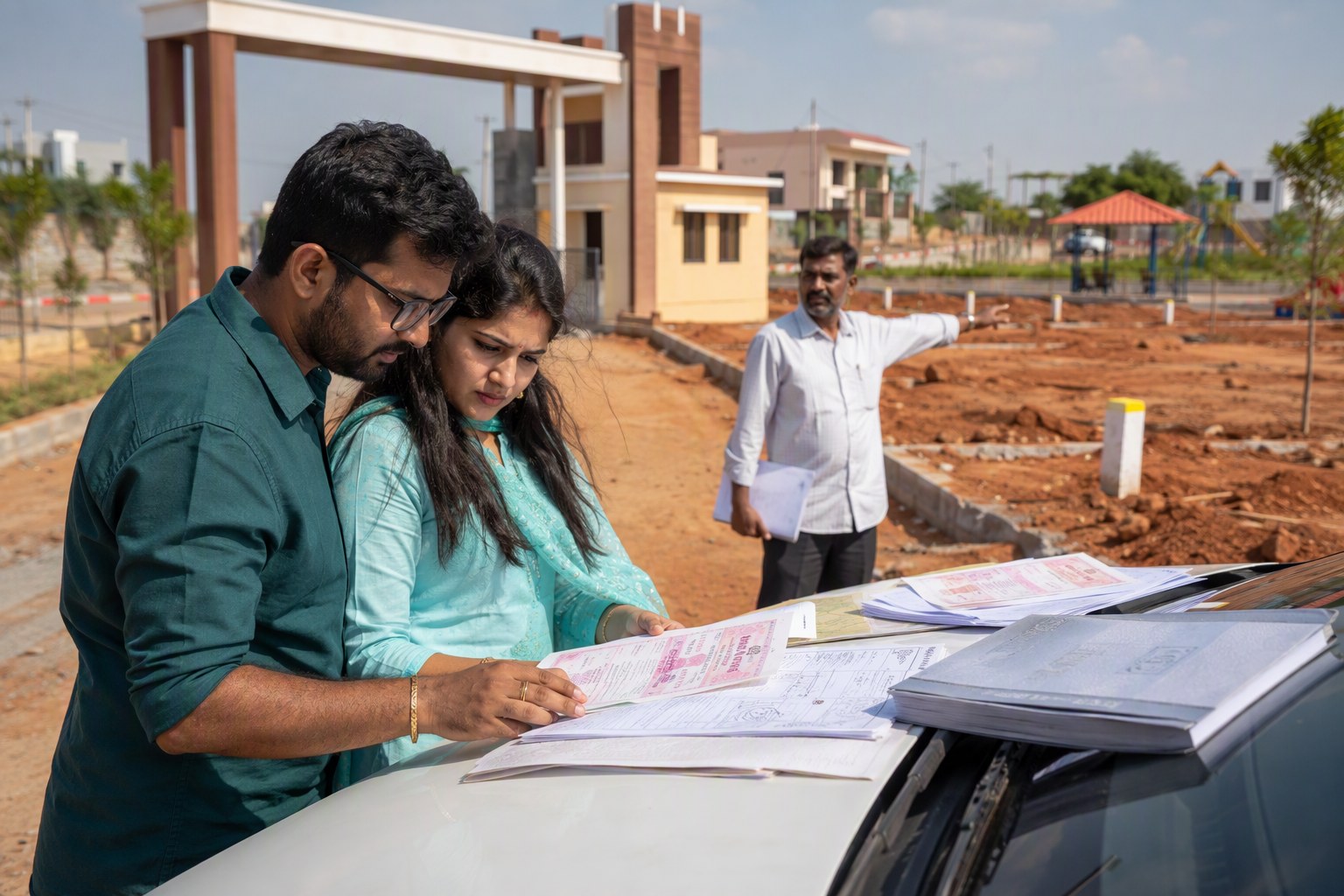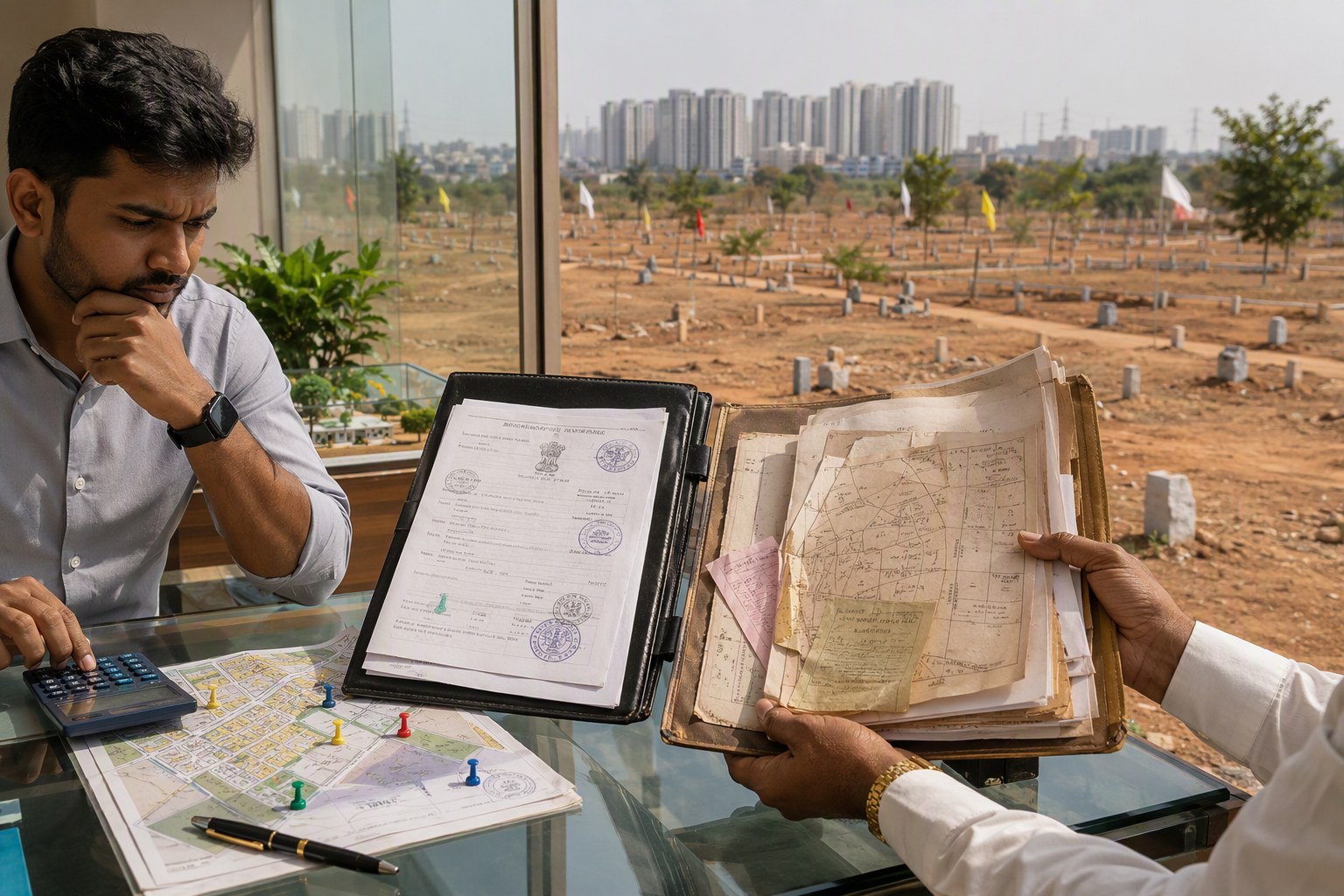
The New Liquidity Discount Shaping Telangana Plot Deals is no longer just a negotiation phrase used by sharp buyers. It is becoming a real pricing factor in Telangana’s plot market, especially after buyers started checking registration risk more seriously. As per latest IGRS data available with us, Telangana has 3,076,153 prohibited property records under Section 22-A. In normal market language, that is around 30.76 lakh records where registration may be restricted, disputed, or blocked depending on the nature of entry.
That one number is changing behaviour. Earlier, many plot buyers in Hyderabad’s outskirts would first ask about road width, HMDA approval, distance from ORR, and future development. Now, a new question is coming earlier in the conversation: Will this land register cleanly when I buy, and will it register cleanly when I sell?
In our experience, this is where the liquidity discount starts. A plot may be attractive on paper. It may be in a hot corridor like Shankarpally, Mokila, Kollur, Tukkuguda, Adibatla, Ghatkesar, Patancheru, or Maheshwaram. But if there is uncertainty around survey number, pahani history, prohibited list status, court dispute, assigned land angle, endowment claim, waqf entry, ceiling issue, or layout regularity, buyers are no longer paying the same as a clean and immediately registrable plot.
Answer first: A liquidity discount is the price reduction buyers demand when a plot may be harder to register, finance, resell, or legally verify. Telangana’s 30.76 lakh prohibited property records have made this discount more visible in plot negotiations.
Why the liquidity discount is now shaping Telangana plot deals
For many years, Telangana plot pricing was driven mainly by location and story. Near ORR? Premium. Close to an upcoming road? Premium. Near a pharma, IT, aerospace, logistics, or education corridor? Premium. HMDA layout? Better premium. Corner plot? Bigger premium.
That logic still exists. But buyers have become more careful after seeing registration blocks, Dharani mismatches, old revenue records not lining up, and SRO-level scrutiny increasing in many land parcels. The number 3,076,153 prohibited property records gives buyers a solid reason to pause before paying full price for a plot that is not clean on paper.
The point is not that every prohibited property record is a bad property. Some entries may relate to government land, assigned land, endowment land, waqf land, court matters, or administrative restrictions. Some may be old entries needing clarification. Some may not touch the plot a buyer is considering, even if the village name sounds similar. Still, the market does not wait for perfect legal interpretation. It prices fear, delay, and exit risk.
That is the liquidity discount. It is not always written in the sale agreement. It shows up in softer offers, longer due diligence periods, token advance conditions, insistence on EC and 22-A checks, and sometimes a plain refusal to buy unless the seller clears doubts first.
What exactly is a liquidity discount in plot buying?
In real estate, liquidity means how easily an asset can be converted into cash through sale. A clean apartment in a registered project in Gachibowli or Kondapur usually has better liquidity than an unclear plot in a revenue village where documents are inconsistent. A clean HMDA-approved plot in a recognised layout may sell faster than a standalone gram panchayat plot with vague access and missing link documents.
A liquidity discount is the discount a buyer demands because the asset may be difficult to sell later. In Telangana plot deals, that difficulty usually comes from one or more of these risks:
- Registration may be stopped due to a Section 22-A prohibited property entry.
- The survey number may not match cleanly across Dharani, old pahani, title deed, and layout plan.
- The plot may be part of an unapproved or doubtful layout.
- The land may have old agricultural, assigned, ceiling, endowment, waqf, or court-related issues.
- Access road may be unclear, narrow, disputed, or not reflected in layout documents.
- Previous sale deeds may have gaps or inconsistent boundaries.
- The seller may not have clear possession or mutation support.
In Hyderabad and surrounding districts, buyers are increasingly saying: If I have to take legal risk, revenue risk, and resale risk, I will not pay the same price as a clean plot. That sentence is changing negotiations.
The 30.76 lakh prohibited property records effect
The figure 3,076,153 is large enough to affect buyer psychology. It does not mean every plot buyer is directly exposed. It does mean Telangana has a large universe of properties where registration restrictions exist in government records. That alone makes buyers more cautious in mandals where land conversion, plotting, inheritance, and old revenue classifications have overlapped for years.
We see this especially in fast-moving peri-urban belts around Hyderabad. In Shankarpally mandal, buyers ask more questions about agricultural-to-non-agricultural transition, old village records, and layout approval. In Maheshwaram and Kandukur sides, they check whether the plot is in a clear layout and whether survey numbers are clean. In Ghatkesar, Medchal, Shamirpet, Patancheru, and Ameenpur belts, buyers look closely at title flow because land parcels have changed hands many times. In Shamshabad, Tukkuguda, Adibatla, and Ibrahimpatnam, the airport, ORR, and industrial corridor story brings demand, but documentation still decides the final price.
This is the new market split: two plots may be near the same road, same village, and same development story. One sells quickly because documents are clean. The other stays in discussion for weeks because the buyer’s lawyer asks for one more record, then one more clarification, then the seller gets irritated. That time lag itself becomes a discount.
Liquidity discount in Telangana plot deals: where buyers negotiate harder
Not every plot gets discounted. Clean plots with strong documentation still command confidence. But buyers are negotiating harder in a few common situations.
1. Survey number confusion
This is one of the most common deal-breakers. The seller says the plot belongs to one survey number. The old sale deed mentions another sub-division. The layout plan shows a different village boundary interpretation. Dharani may show another land classification. A serious buyer will not ignore this now.
Before paying token advance, buyers should use the Survey Number Finder and compare it with sale deed, pahani, layout plan, and village map references. If the survey number story is not clean, the plot loses liquidity.
2. Section 22-A doubt
A Section 22-A prohibited property issue can stop registration. Even a rumour of such an issue affects price because the buyer starts thinking about future resale. Many sellers say, Nothing will happen, everyone is buying here. That line is no longer enough.
A buyer should check the exact survey number through the Section 22-A Prohibited Property Check. If there is a possible restriction, the seller must explain it with documents, not just confidence.
3. Weak title chain
Plots with missing link documents, unregistered agreements, family settlement confusion, or old GPA-based sale history often face a discount. Buyers worry that even if present registration happens, future sale may become painful.
An Encumbrance Certificate Search helps, but EC alone is not full title verification. It tells registered transaction history. It may not reveal every revenue, possession, family, court, or classification issue. Still, a clean EC is a basic starting point.
4. Layout approval doubt
In HMDA and DTCP-sensitive markets, approval status matters. A plot may be physically marked on ground, but if layout approval, open space, road width, mortgage plot release, and final permission are unclear, buyers discount it. Many are now asking for approval proceedings, layout copy, release letter, and link between layout survey numbers and individual plot number.
5. Exit risk in investor-heavy areas
Some stretches around Hyderabad are investor-heavy. Plots are bought not for immediate construction, but for future resale. In such markets, liquidity is everything. If the next buyer may ask the same difficult questions, today’s buyer will reduce the offer now.
How to price the liquidity discount in Telangana plot deals without guessing
There is no fixed formula for a liquidity discount. Anyone claiming a standard deduction for every doubtful plot is oversimplifying the market. The discount depends on the nature of the risk, how easily it can be cured, seller cooperation, buyer urgency, and local demand.
But the thinking process is clear. Buyers should separate three things:
- Market value: What similar clean plots in the same locality are asking or closing at.
- Guideline value: The government value used for registration calculation.
- Risk-adjusted value: What the buyer should pay after considering registration and resale uncertainty.
For the second part, start with the Market Value / Guideline Value Search. This will not tell you the private market rate, but it gives the official value reference. For registration cost planning, use the Stamp Duty Calculator. If the plot has building potential questions, the FSI/FAR Calculator and Road Width Check are useful before assuming future construction value.
In our experience, buyers should not bargain blindly by saying, There is risk, reduce price. A better approach is to put conditions:
- Token advance only after basic EC, 22-A, and survey checks.
- Agreement clause requiring seller to clear registration objections.
- Payment linked to successful SRO registration.
- Seller to provide original link documents for legal review.
- Buyer to verify land use and road access before final payment.
This way, the discount is not emotional. It is connected to actual risk.
The seller’s side: clean documents now create premium
Sellers should not see this as buyers becoming difficult for no reason. The market has changed. Clean documentation is now a selling feature, like road access or location. A seller with clear title, clean EC, no 22-A issue, proper layout approval, and matching survey records can defend the asking price better.
If you are selling a plot in Mokila, Tellapur, Narsingi side, Shankarpally mandal, Maheshwaram, Tukkuguda, Adibatla, Ghatkesar, or Patancheru, keep your file ready before marketing the plot. Do not wait for the buyer’s lawyer to expose gaps.
A practical seller file should include:
- Parent documents and link documents.
- Latest EC.
- Layout approval copy and release details, where applicable.
- Survey number proof and village details.
- Latest revenue references, pahani or Dharani-related records where relevant.
- Tax receipts or possession support, where applicable.
- Clear boundary and access road details.
- SRO jurisdiction confirmation using Find Your SRO Office.
When sellers prepare these in advance, serious buyers move faster. When sellers say, We will show documents after advance, good buyers step back or reduce the offer.
Why Hyderabad outskirts feel this discount more than core city apartments
Core city apartments in places like Banjara Hills, Jubilee Hills, Himayatnagar, Begumpet, Madhapur, Gachibowli, Kondapur, and Kukatpally have their own issues, but plot-level revenue risk is usually less central to the negotiation. The asset is already built, registered in apartment format, and often part of a known project or society.
Plots are different. Especially in expanding mandals, land history matters deeply. A plot may have passed through agricultural land conversion, layout development, road carving, sub-division, inheritance transfers, GPAs, and resale transactions. Each layer creates scope for mismatch.
That is why the liquidity discount is more visible in plot-heavy belts:
- Shankarpally, Mokila, Kondakal, and nearby western growth villages.
- Kollur, Tellapur, Osman Nagar, and surrounding areas where apartment and villa demand has spilled into plot demand.
- Maheshwaram, Kandukur, Tukkuguda, and Adibatla along the southern and south-eastern growth corridors.
- Ghatkesar, Bibinagar side, and Yadadri-facing stretches where long-hold investors are active.
- Patancheru, Ameenpur, Isnapur, and Sangareddy-facing markets where industrial and residential demand overlap.
Buyers in these areas are not only buying land. They are buying confidence that future registration, construction, mortgage, and resale will not get stuck.
Document checks that directly affect liquidity discount
Here is a practical way to think about documentation. This is not legal advice, but it reflects how experienced buyers and lawyers evaluate plot liquidity in Telangana.
| Check | Why it matters | Impact on liquidity |
|---|---|---|
| Section 22-A status | Registration may be restricted if the property falls under prohibited category | High impact |
| EC history | Shows registered transactions and possible encumbrances | High impact |
| Survey number match | Connects deed, layout, revenue record, and physical land | High impact |
| Layout approval | Confirms planning permission and plot legitimacy in approved layouts | High impact |
| Road access | Affects construction, valuation, and resale demand | Medium to high impact |
| Land use zone | Indicates whether intended use is compatible with planning norms | Medium impact |
| SRO jurisdiction | Helps confirm where registration will happen and which records apply | Medium impact |
For land use, check the Land Use Zone Finder. For a broader document review starting point, use the Property Verification Tool. If you are tracking a plot over time because the seller is promising to clear an issue, the Property Change Tracker can help you stay alert to changes.
Buyer strategy: how to negotiate without killing a good deal
There is a thin line between smart negotiation and over-suspicion. Good plots do exist. Good sellers also exist. If you treat every document delay as fraud, you may lose genuine opportunities. But if you ignore red flags because the location sounds exciting, you may buy a problem.
My preferred negotiation method is simple:
- Start with facts: Ask for survey number, village, mandal, plot number, layout copy, and parent document list.
- Run basic checks before site excitement takes over: EC, 22-A, guideline value, SRO, and layout status.
- Visit the site after document basics: Check road, boundaries, neighbouring plots, physical access, and local usage.
- Use a conditional offer: Offer price subject to clean legal opinion and successful registration.
- Do not pay a large non-refundable advance: Especially when registration status is not verified.
- Keep emotion out: A plot near a famous road is not automatically clean.
We have seen buyers save themselves from bad deals simply by asking for survey number first. We have also seen sellers lose genuine buyers because they were casual with paperwork. In the present market, paperwork is not a back-office item. It is part of pricing.
Seller strategy: reduce the liquidity discount before listing
If you are a seller, the best way to avoid a discount is not aggressive marketing. It is document readiness. Buyers will pay better when they feel they can exit easily later.
Before quoting your price, do these checks:
- Confirm the exact survey number and plot boundaries.
- Check if the property or parent survey number has any Section 22-A issue.
- Take latest EC and review it for gaps.
- Keep layout approval and release documents ready.
- Clarify whether the land is part of HMDA, DTCP, gram panchayat, or other planning jurisdiction.
- Know your SRO and registration process.
- Prepare answers for old GPA, inheritance, partition, or family settlement history.
If there is a genuine issue, disclose it early and price accordingly. Hidden issues come out during due diligence anyway. When they come out late, the buyer either walks away or demands a sharper discount.
The New Liquidity Discount Shaping Telangana Plot Deals is not a crash call
I would not call this a market crash signal. Demand for land around Hyderabad remains structurally strong in many corridors because people still believe in plotted land as a long-term asset. Families want land. Investors want land. NRIs want land. Developers want land. That part has not changed.
What has changed is selectivity. Buyers are separating clean plots from doubtful plots more aggressively. Earlier, location could cover many weaknesses. Now, location alone is not enough. A plot near a growth corridor but with registration uncertainty will not be priced like a clean plot nearby.
This is healthier for the market. It rewards sellers who maintain clear records. It protects buyers who do proper checks. It also pushes brokers to stop selling only on future story and start explaining present documentation.
Final view: liquidity is now part of Telangana land valuation
Telangana’s 30.76 lakh prohibited property records have brought a hard truth into plot buying: legal liquidity matters as much as location liquidity. A plot is not valuable only because it is near ORR, near a proposed road, or inside a popular mandal. It is valuable when it can be verified, registered, held peacefully, financed where possible, and resold without drama.
For buyers, the message is clear. Do not negotiate only on square yards, facing, and road width. Negotiate on registration certainty. For sellers, the message is equally clear. Clean documents are not optional if you want full market value.
The new liquidity discount is not written in government ready reckoner tables. It is written in buyer behaviour, lawyer comments, SRO caution, and the time a plot takes to convert into money. In Telangana plot deals, that is now a serious pricing factor.
Frequently Asked Questions
What is the liquidity discount in Telangana plot deals?
It is the price reduction buyers demand when a plot may be difficult to register, verify, finance, or resell. In Telangana, Section 22-A doubts, survey number mismatch, weak title chain, and layout approval issues commonly create this discount.
Does a Section 22-A entry mean I should never buy the plot?
Not automatically. A Section 22-A entry means registration restriction or government-record concern must be checked carefully. The buyer should verify the exact survey number, understand the reason for the entry, take legal advice, and avoid paying major advance until clarity is available.
Which checks should I do before buying a plot near Hyderabad?
Start with survey number verification, Section 22-A check, EC search, guideline value, SRO jurisdiction, layout approval, road access, and land use zone. These checks help you understand both legal risk and resale liquidity.
Why are buyers negotiating harder in places like Shankarpally, Maheshwaram, and Ghatkesar?
These growth belts have strong plot demand, but they also include many land histories, conversions, layouts, and resale transactions. Buyers now want cleaner documentation before paying full market price.
Can clean documents help a seller get a better price?
Yes. A seller with clear title, clean EC, no prohibited property issue, proper layout approval, and matching survey records can defend the asking price better because the buyer sees lower resale and registration risk.