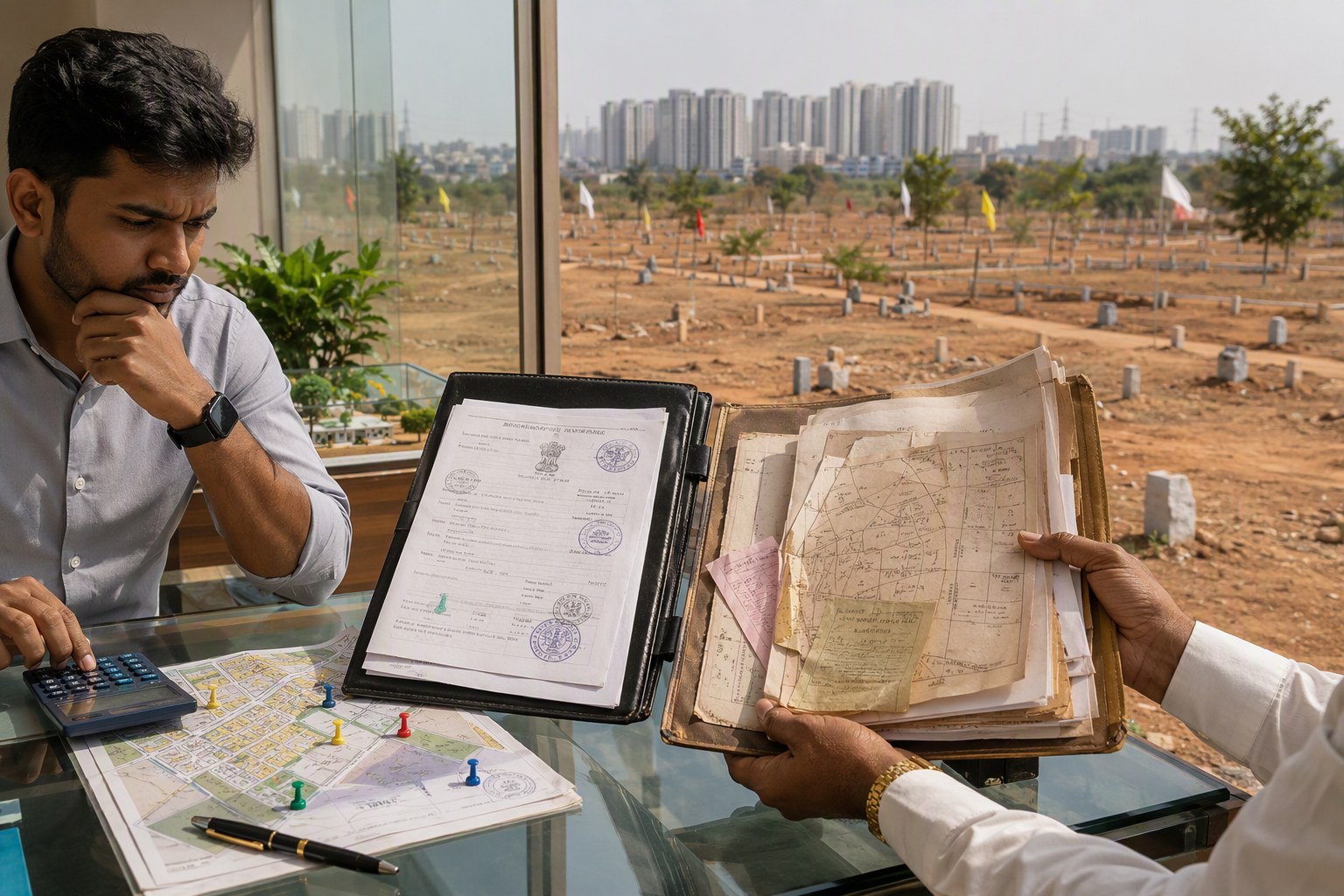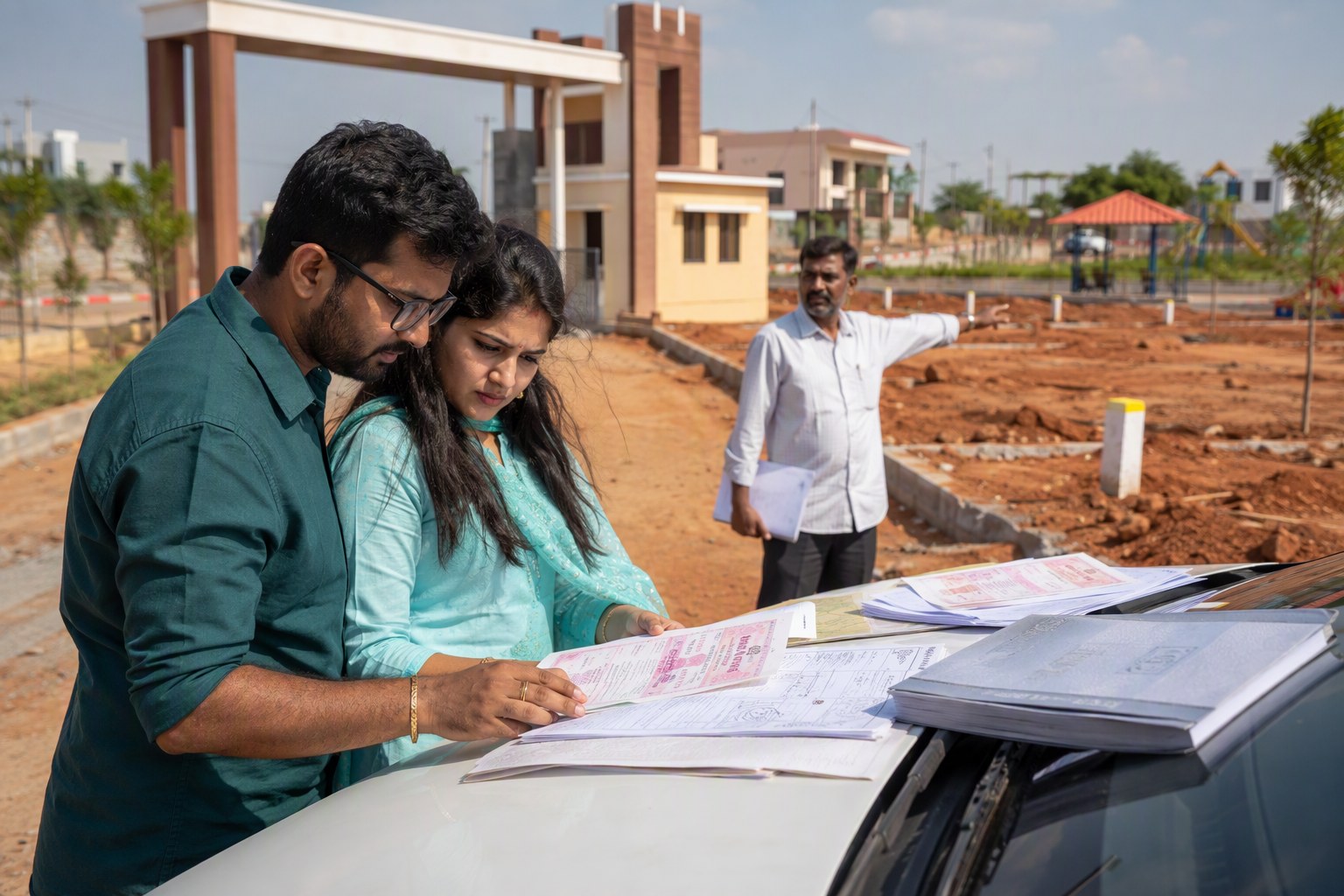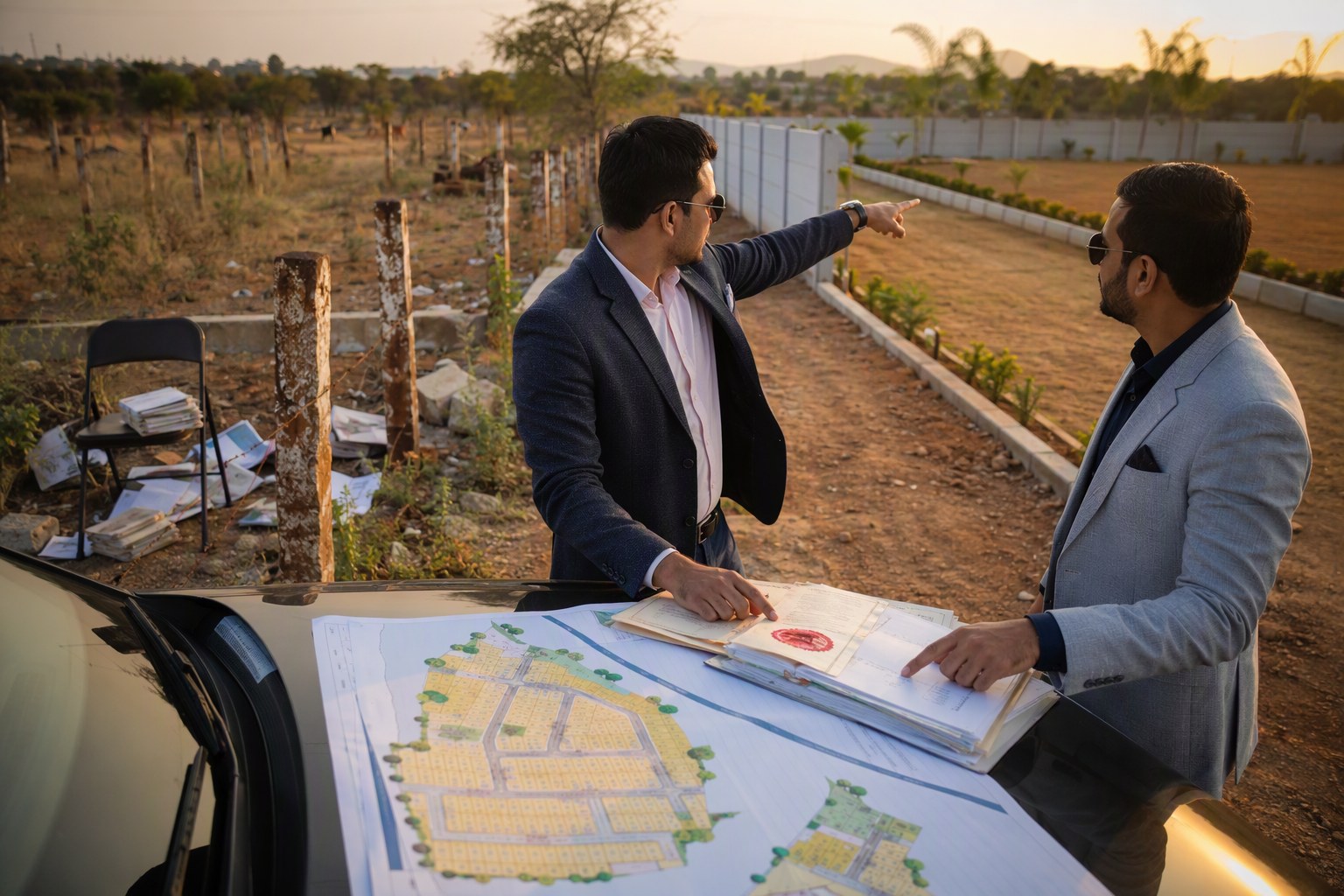
As per latest IGRS data available in our database, Telangana has 30,76,153 prohibited property records, also written as 3,076,153. That single number is enough to explain why the Clear-Title Premium is changing Telangana land prices. Buyers are no longer valuing land only by location, road width and development buzz. They are asking a sharper question: can this land be registered, financed, resold and developed without a title shock?
In our experience, this is where the market is quietly splitting. A plot with clean documentation, a traceable survey number, a proper chain of title, no adverse EC entry and no Section 22-A registration block is getting better buyer confidence. A similar plot with unclear pahani history, Dharani mismatch, assignment suspicion, court entry or SRO-level objection is being negotiated harder. The premium is not always visible in an advertisement. It shows up during token advance, bank legal, registration slot, and final price discussion.
My reading: Telangana land is not becoming cheaper or costlier only because of location. Clean, financeable, registerable title is becoming a price category of its own.
Clear-Title Premium in Telangana: what 30,76,153 prohibited property records tell us
Section 22-A prohibited property entries are not a small side issue in Telangana real estate. With 3,076,153 records in the prohibited properties database, every serious buyer has to treat title verification as part of price discovery, not as paperwork after the deal.
Section 22-A entries can relate to different types of properties that face registration restrictions under law or government records. For a buyer, the practical meaning is simple: if a property is hit by a prohibited property entry, the Sub-Registrar Office may not accept normal registration. Even if the seller says the issue is old or easily removable, the buyer’s risk has already changed.
This matters most in fast-moving belts around Hyderabad where land demand is strong: Kokapet, Narsingi, Tellapur, Kollur, Mokila, Shankarpally, Patancheru, Bachupally, Kompally, Ghatkesar, Pocharam, Tukkuguda, Maheshwaram and Shamshabad. These markets attract end-users, investors, small developers and plotted venture buyers. But the title quality is not uniform across villages, survey numbers and old revenue histories.
Take two plots in the same broad corridor. One plot has a clear link document chain, matching survey number, clean EC, mapped village and no 22-A concern. Another plot has an attractive asking price but the survey number is under doubt, the pahani trail is incomplete, or the land has a government/assigned land tag in revenue records. They may sit in the same mandal, but they are not the same asset.
That difference is what I call the Clear-Title Premium.
Clear-Title Premium is now visible before registration, not after
Earlier, many buyers checked documents after agreeing on price. The seller would share link documents, the buyer would take them to an advocate, and the risk discussion would start late. That approach is becoming costly. In high-demand Telangana locations, the best buyers now run title checks before fixing the final number.
The reason is simple. Land price is not only about what you pay today. It is also about how easily you can:
- register the sale deed at the correct SRO,
- get bank finance or developer funding,
- mutate the property in revenue or municipal records,
- sell it later without legal discounting,
- use it for layout, construction or joint development, subject to planning rules.
If any of these steps is doubtful, the buyer will price that risk. Sometimes the buyer walks away. Sometimes the buyer asks for a discount. Sometimes the buyer asks the seller to clear the issue before payment. We have seen all three reactions in Hyderabad’s outer growth pockets.
For a first check, buyers can start with the Section 22-A Prohibited Property Check. It should not replace legal opinion, but it helps you avoid walking blindly into a blocked registration situation. For survey-level identification, use the Survey Number Finder. Once the survey number and village are clear, the next layer is the Encumbrance Certificate Search and, where required, the EC Analyzer.
How registration risk becomes a land price discount
A risky title does not always announce itself loudly. Many times, it hides behind a nice location pitch: near ORR, close to IT corridor, upcoming road, near pharma cluster, near airport, near metro talk, near villa projects. All that may be true. But title risk can still reduce the buyer’s confidence.
Registration risk becomes a discount through four common routes.
1. SRO uncertainty
If the buyer is not sure which SRO handles the village, or whether the SRO will raise an objection, negotiation changes. A clean property allows the buyer to move from agreement to registration with confidence. A doubtful property creates delay and anxiety. Use the Find Your SRO Office before you finalise documentation.
2. Dharani and revenue record mismatch
In Telangana, land buyers regularly hear words like pahani, pattadar passbook, Dharani, khata, survey number and mutation. These are not casual terms. If the seller’s name, land extent, classification or survey reference does not match across records, the buyer has to slow down.
This is especially relevant in villages around Shankarpally mandal, Gandipet mandal, Maheshwaram mandal, Shamshabad mandal, Ghatkesar mandal and Patancheru mandal, where old agricultural land, plotted layouts and institutional/development interest often overlap. The issue is not that these areas are bad. They are active markets. That is exactly why document quality matters.
3. Loan and valuation friction
Many buyers do not pay full cash. They need bank support. Banks and housing finance companies look at title, EC, approvals, layout status, link documents and property usability. If the land cannot pass legal scrutiny, the buyer pool shrinks. When the buyer pool shrinks, the price discussion changes.
For flats and plotted projects that fall under RERA, check the project record through the RERA Project Lookup. For independent land, buyers should still run separate title checks because RERA coverage and land title comfort are not the same thing.
4. Resale fear
A smart buyer thinks like a future seller. If today’s purchase will be difficult to resell, it deserves a discount today. In our experience, this one factor is becoming stronger among NRIs, salaried buyers and investors buying in Tellapur, Kollur, Mokila, Kompally, Bachupally and Adibatla. They may like the location, but they do not want to inherit a title problem.
Where the Clear-Title Premium is most visible in Hyderabad’s land market
The premium is not equal everywhere. It becomes stronger where demand is high, land conversion is active, and buyers expect future liquidity. Around Hyderabad, I see it most clearly in these types of micro-markets.
| Market belt | Typical buyer concern | Why clean title gets preference |
|---|---|---|
| Kokapet, Narsingi, Gandipet side | High-value land, development potential, old revenue trail | Buyers want zero ambiguity before paying premium location value |
| Tellapur, Kollur, Mokila, Shankarpally | Plotted ventures, villa land, agricultural-to-residential transition | Survey number clarity and layout approval status affect resale comfort |
| Patancheru, Isnapur, Sangareddy side | Industrial-residential mix and village-level record variation | Financeable title broadens buyer demand |
| Shamshabad, Tukkuguda, Maheshwaram | Airport corridor interest, logistics and plotted layouts | Buyers check land use, road access and prohibited status carefully |
| Ghatkesar, Pocharam, Uppal outskirts | Institutional, residential and highway-linked growth | Clean EC and clear ownership chain reduce negotiation pressure |
Notice that I am not saying one locality is safe and another is unsafe. That would be lazy analysis. In Telangana land, risk often sits at survey-number level, not just locality level. A good village can have a problematic parcel. A lesser-known village can have excellent title. That is why the buyer has to verify the exact land, not just the pin location.
Guideline value is not the same as clear-title value
Government market value, often called guideline value or ready reckoner value in common discussion, is useful for stamp duty and registration calculation. But it does not automatically prove the title is clean. A property can have a guideline value and still face legal or registration concerns. A property can be in a popular location and still need deeper verification.
Before you compare asking prices, check the official value using the Market Value / Guideline Value Search. For registration cost planning, use the Stamp Duty Calculator. These tools help with cost visibility. Title visibility needs separate checks.
This distinction matters during negotiation. Sellers usually quote based on location sentiment. Buyers increasingly negotiate based on risk-adjusted value. The final price is moving towards a blend of location, access, approvals, land use, registration feasibility and title cleanliness.
What a clean, financeable title usually looks like
A clean title is not just one document. It is a story that should make sense from past ownership to present sale. If that story has gaps, the buyer must ask questions.
For Telangana land, I would usually look for:
- correct village, mandal and survey number identification,
- clear chain of link documents,
- seller’s legal capacity to sell,
- latest EC with no unexplained burden,
- no Section 22-A registration restriction,
- revenue record consistency, including pahani and Dharani references where applicable,
- layout approval or planning status, if it is a plotted development,
- land use compatibility for intended purchase,
- no undisclosed mortgage, charge or litigation concern.
For mortgage or charge concerns, the CERSAI Charge Check is useful. For land use checks, use the Land Use Zone Finder. If you are planning construction, do not ignore road width and planning rules; the Road Width Check and FSI/FAR Calculator can help you understand the development angle.
Why sellers with clean documents should market title, not just location
Many genuine sellers undersell their strongest point. They talk about distance from ORR, nearby villa projects, proposed roads and neighbourhood growth. Fine. But if their title is genuinely clean, they should show it as a value point.
A clean-title seller can organise documents before listing: link deeds, EC, tax records, layout papers, revenue extracts, approval copies and identity proof. If the property is not prohibited, if the SRO position is clear, if the land use is compatible, say it confidently and back it with documents.
This can reduce buyer hesitation. It can also shorten the negotiation cycle. In a market where 30,76,153 prohibited property records exist in the database, a seller who can prove clean status is not just selling land. He is selling certainty.
Buyer checklist before paying token advance
Token advance is where many mistakes begin. Once money is paid, emotions enter the deal. My suggestion is simple: do a quick risk screen before token, then a full legal review before agreement or registration.
- Confirm exact survey number, village and mandal.
- Check whether the property appears in prohibited property records.
- Pull EC for the relevant period and review entries carefully.
- Verify seller name against link documents and revenue records.
- Check SRO jurisdiction.
- Compare government guideline value for cost planning.
- Ask for layout approval if buying in a plotted venture.
- Check RERA only if the project type requires it.
- Take local legal opinion from a property advocate who understands Telangana land records.
If you want a structured first pass, start with the Property Verification Tool. For ongoing monitoring after shortlisting a property, the Property Change Tracker can help buyers stay alert to changes.
Clear-Title Premium will influence Telangana land prices for years
The Telangana land market has matured. Buyers are still attracted to growth corridors, but they are not as casual about paperwork as before. NRIs ask for EC and 22-A checks. Salaried buyers ask whether banks will fund. Developers ask for clean aggregation and road access. Even small investors are learning that a cheap plot with a registration block is not a bargain.
That is the real shift. Clean title is no longer a back-office legal topic. It is part of pricing, liquidity and marketability.
My view is that the Clear-Title Premium will become sharper in Hyderabad’s expansion belts. Land parcels that are easy to verify, easy to register and easy to finance will attract better demand. Plots with unresolved title issues may still find buyers, but the buyer will ask for protection, delay payment or demand a risk discount.
For Telangana buyers, the message is clear: do not compare two plots only by location. Compare them by title strength. In many deals, that is where the real price difference sits.
Frequently Asked Questions
What is Clear-Title Premium in Telangana land?
Clear-Title Premium means buyers are willing to value clean, financeable and registerable land better than similar land with title doubts, EC concerns, Dharani mismatch or Section 22-A risk.
Why are Section 22-A prohibited property records affecting prices?
As per latest IGRS data in our database, Telangana has 30,76,153 prohibited property records. When buyers see this scale of registration risk, they check title before fixing price and may discount properties with unresolved issues.
Can a property in a good Hyderabad locality still have title risk?
Yes. Title risk is often survey-number specific. A plot in Tellapur, Kokapet, Mokila, Shamshabad or Ghatkesar may still need checks for EC, ownership chain, prohibited status, land use and SRO registration feasibility.
Which checks should I do before paying token advance?
Confirm survey number, village and mandal, check Section 22-A status, review EC, verify link documents, identify the correct SRO, check guideline value and take legal opinion before making a serious payment.