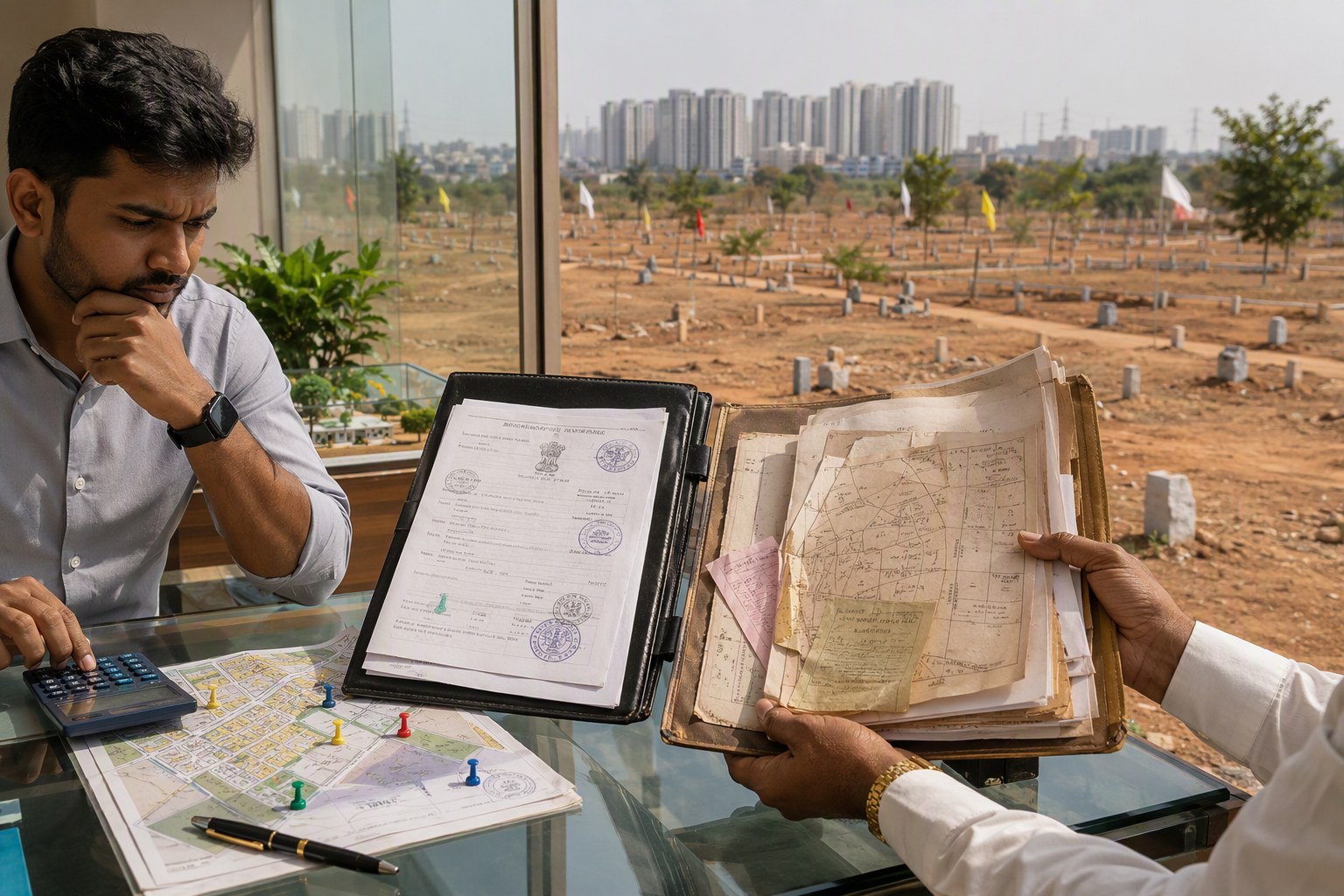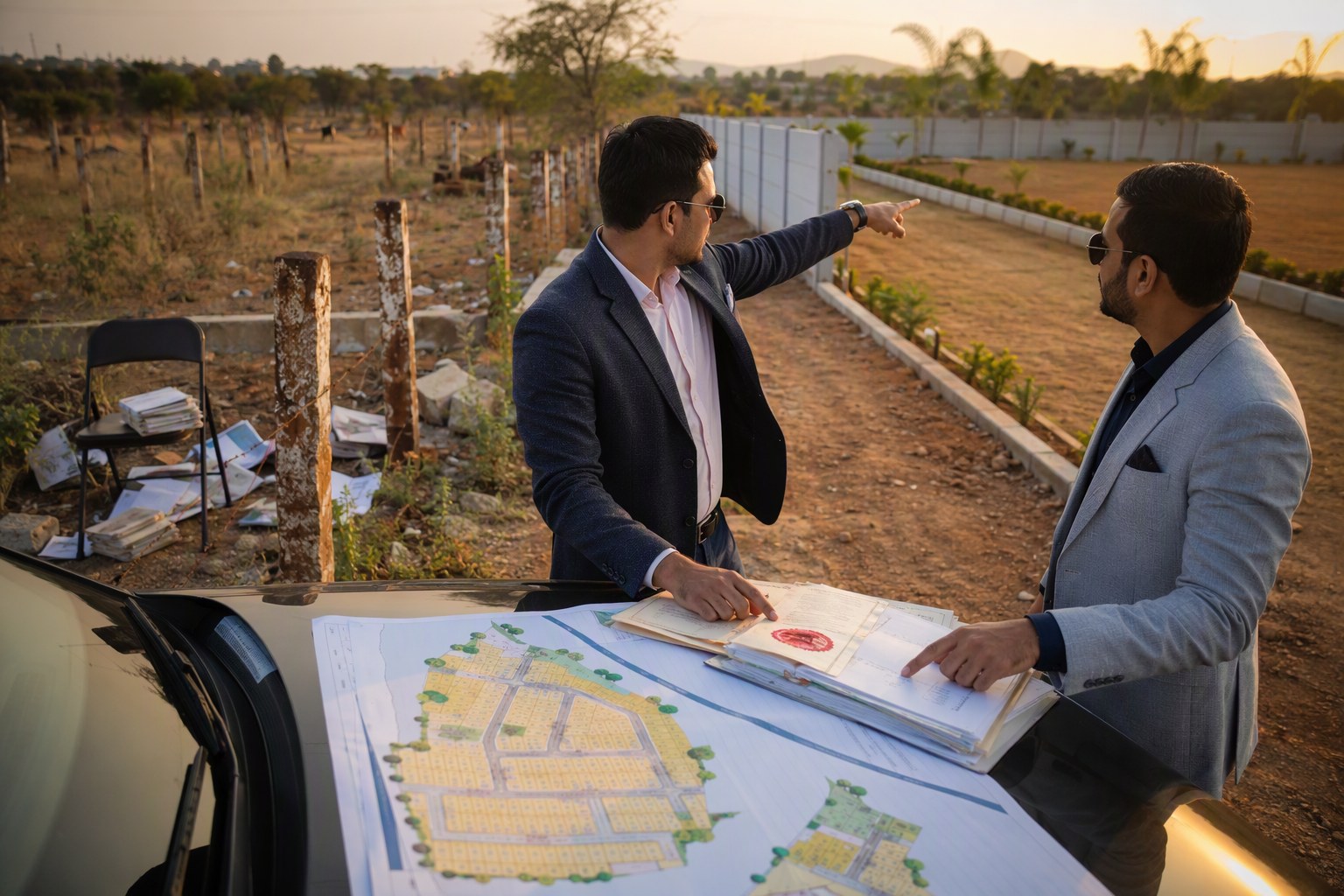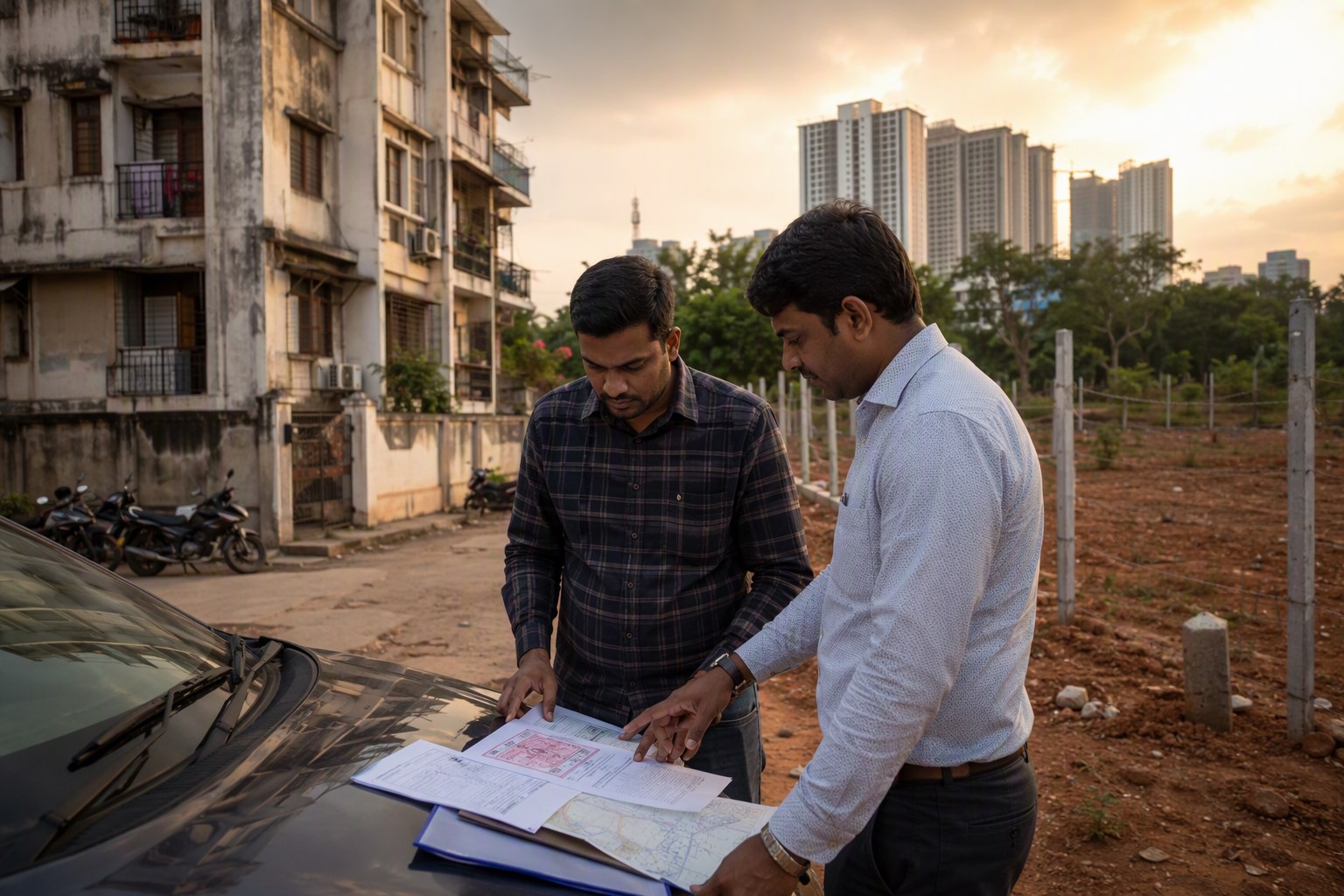
Resale Flats vs Open Plots is no longer a simple choice between rental income and land appreciation in Telangana. The bigger question now is liquidity: which asset can you sell faster, finance easier and exit with less title stress? With 3,076,153 prohibited property entries under Section 22-A recorded in the database, buyers are looking at title comfort much more seriously than before. In Hyderabad, we’ve seen this shift play out from Kukatpally and Kondapur flats to Shankarpally, Maheshwaram and Yadagirigutta plots.
A resale flat usually gives faster bank comfort when the apartment has clear permissions, registered sale deeds, an active association and no charge issues. An open plot can give excellent long-term upside, but only when the survey number, pahani, Dharani status, layout approval, land use and Section 22-A position are clean. If any one of these is doubtful, liquidity takes a hit. That is the Telangana market reality now.
My view is straightforward: flats are easier to explain to a bank and a second buyer; plots are easier to love, but harder to clear unless the paperwork is neat.
Resale Flats vs Open Plots: What liquidity really means in Telangana
Liquidity is not just about finding a buyer. In Telangana property, liquidity means four things working together: title comfort, loanability, registration readiness and exit confidence. A buyer may like your property, but if the SRO, bank lawyer or family advisor raises a title query, the deal slows down or collapses.
For resale flats in areas like Miyapur, Nallagandla, Gachibowli, Manikonda, Attapur, Uppal and LB Nagar, the buyer usually starts with the apartment name, flat number, undivided share, previous sale deed, EC and society records. There can be issues, yes, but the due diligence path is familiar. Banks have seen thousands of similar apartment files.
For open plots in Mokila, Kollur, Tukkuguda, Adibatla, Ghatkesar, Bibinagar, Shadnagar, Chevella and Ibrahimpatnam belt, the buyer must go deeper. Survey number, extent, link documents, mutation, Dharani, pahani, conversion, layout approval, road access, land use and prohibited property status all matter. One mismatch can reduce buyer confidence.
This is why a plot owner may say, “My land is in a fast-growing corridor,” while a buyer asks, “Is it registrable today?” Both are fair points. But liquidity belongs to the second question.
Resale Flats vs Open Plots: Title comfort decides the first shortlist
In our experience, most serious buyers do not reject a property because they dislike the locality. They reject it because they cannot understand the title clearly. Telangana has a unique title environment because urban apartments, gram panchayat layouts, HMDA layouts, DTCP layouts, agricultural land conversions and Dharani records all sit in the same buyer conversation.
The database count of 3,076,153 Section 22-A prohibited property entries is a major reason buyers are cautious. A prohibited property entry does not mean every plot is risky. It means buyers have learnt to check before paying token advance. That one habit has changed resale behaviour.
For a resale flat, title comfort usually comes from a chain of registered documents: landowner document, development agreement, sanctioned plan, occupancy certificate where applicable, first sale deed and latest sale deed. For newer projects, buyers also check RERA details through RERA Project Lookup. For older standalone apartments, they rely heavily on EC, municipal records and association confirmation.
For an open plot, title comfort depends on the base land. If the survey number has any government land, assigned land, endowment, waqf, ceiling, court or other restriction issue, the plot becomes difficult to sell. The safest first step is to run a Section 22-A Prohibited Property Check before negotiating. Then cross-check the survey number through Survey Number Finder and verify the broader file through Property Verification Tool.
Loanability: why resale flats often move faster
Loanability is one of the biggest reasons resale flats enjoy better short-term liquidity in Hyderabad. A bank or housing finance company is more comfortable when the asset is already built, physically identifiable and backed by previous mortgage history or past loan clearance.
In localities like Kukatpally, Ameerpet, Begumpet, Kondapur and Chandanagar, a buyer purchasing a resale flat often gets quicker credit assessment if the building has proper approvals and the previous owner’s documents are clean. The bank can inspect the flat, check EC, see old loan closure records and assess the marketability of the property.
Open plots are different. Many banks finance plots only when the layout approval, title and land use are clean as per their internal policy. If the plot is in an unapproved layout, has unclear access road, or sits in a survey number with a doubtful history, the bank may refuse or ask for extra documents. Even if the buyer has money, lack of loan support reduces the buyer pool. Smaller buyer pool means weaker liquidity.
Before any resale deal, both flat and plot buyers should pull an Encumbrance Certificate Search. If a bank charge is suspected, check with CERSAI Charge Check. For flats, this helps confirm whether a previous housing loan has been properly closed. For plots, it helps identify old mortgages that may not be obvious from verbal discussion.
Exit risk: the hidden difference between a flat and a plot
Exit risk is the part sellers often ignore when buying. Everyone asks, “Will this property appreciate?” Fewer people ask, “Can I sell it quickly when I need money?” That is where resale flats and open plots behave very differently.
A resale flat has depreciation in the building, maintenance issues and association politics. But it also has a visible end-user market. A family can walk into a ready flat in Nizampet, see the ventilation, check parking, ask about water, speak to neighbours and decide. The asset is tangible.
An open plot needs imagination. A buyer has to trust the location, title, future infrastructure and development control rules. If the plot is in an HMDA-approved layout near Tellapur or Mokila, the conversation is easier. If it is a gram panchayat layout in the outer belt with unclear conversion or road access, the buyer’s lawyer may ask difficult questions.
Exit risk also depends on who your future buyer will be. A flat may attract an end-user, investor or landlord buyer. A plot usually attracts a longer-horizon investor or self-construction buyer. When sentiment is good, plots move quickly. When paperwork anxiety rises, plots with incomplete files become slow-moving.
Comparison table: resale flats vs open plots in Telangana
| Factor | Resale flats | Open plots |
|---|---|---|
| Title checking style | Sale deed, EC, sanctioned plan, UDS, association records, loan closure | Survey number, pahani, Dharani, link documents, layout approval, land use, Section 22-A |
| Loanability | Usually easier when approvals and prior documents are clear | Depends heavily on layout approval, title chain and bank policy |
| Buyer pool | End-users, investors, rental-income buyers | Investors, self-construction buyers, long-term land buyers |
| Exit speed | Generally faster in established Hyderabad localities | Fast only when title and approvals are clean |
| Main risk | Building age, maintenance, deviation, pending loan charge | Prohibited entry, survey mismatch, access road, land use, unapproved layout |
| Best suited for | Buyers wanting usage, rental option and easier financing | Buyers comfortable with land due diligence and longer holding period |
Where Hyderabad buyers are behaving differently
In established apartment markets such as Madhapur, Kondapur, Gachibowli, Nallagandla, Miyapur, Kukatpally, Bachupally, Manikonda and Attapur, resale flats continue to attract buyers who want clarity and immediate use. Even when prices feel high, the file structure is easier to examine. The building exists. The neighbours exist. The association exists. That gives comfort.
In land markets such as Shankarpally, Mokila, Chevella, Kandukur, Maheshwaram, Tukkuguda, Adibatla, Ghatkesar, Bibinagar and Yadagirigutta, demand is more selective now. Buyers still like land. Telugu families have always respected land ownership. But they are asking sharper questions: Is this survey number clean? Is the layout approved? Is it in residential zone? Is there a road? Is it registrable at the SRO?
This is a healthy change. Earlier, many buyers trusted only brochure talk or word-of-mouth from local brokers. Now they check EC, Dharani, SRO jurisdiction and prohibited status before paying advance. That protects both buyer and seller.
Resale Flats vs Open Plots: Registration readiness at the SRO
Registration readiness is a practical liquidity test. If the seller says, “Registration can happen immediately,” the buyer will still verify it. Which SRO has jurisdiction? Is the property record traceable? Is the market value available? Is there any restriction? Are the seller details matching the documents?
For flats, the SRO file usually follows apartment documentation. The buyer calculates stamp duty and registration cost, checks guideline value and proceeds if the bank lawyer is satisfied. Use the Stamp Duty Calculator and Market Value / Guideline Value Search before finalising the transaction value. If you are unsure about jurisdiction, check Find Your SRO Office.
For plots, SRO readiness starts earlier. Confirm the village, mandal, survey number and extent. Check if the land parcel has any restriction. Verify whether the layout approval and land use support the intended purchase. A buyer planning to build must also check zoning with Land Use Zone Finder, road access through Road Width Check and planning potential through FSI/FAR Calculator.
How Section 22-A changes buyer psychology
Section 22-A is not just a legal topic. It has become a market psychology topic. When buyers hear that the database contains 3,076,153 prohibited property entries, they become less casual. They do not want to discover a problem after paying advance.
This affects open plots more sharply because the title is tied to survey numbers and land history. If the base land has an issue, every small plot carved out from it may face questions. In resale flats, the land title still matters, but the apartment may already have gone through multiple levels of scrutiny: builder finance, buyer loans, registrations, association formation and resale transactions. That does not make every flat safe. It only means the checking trail is usually easier.
A smart seller of a plot should prepare a clean title pack before marketing: link documents, latest EC, Dharani extract where applicable, pahani details, layout approval, tax receipts, location sketch and prohibited property check. This improves confidence. A smart flat seller should keep sale deed, mother deed copies, sanctioned plan, OC where available, tax receipts, society NOC, maintenance dues statement, loan closure letter and latest EC.
Price discovery without guessing
Many people ask us for “running rate” in areas like Tellapur, Kokapet, Bachupally, Mokila or Shadnagar. I avoid giving casual numbers without a file, road width, approval status and exact location. Two plots in the same village can have very different liquidity if one has clear HMDA approval and another has a title gap. Two flats in the same colony can differ based on age, floor, parking, UDS and maintenance quality.
Use government reference values as a starting point, not the final truth. Check the ready reckoner through Market Value / Guideline Value Search. For flats, estimate land plus building components using Composite Value Calculator and Building Value Calculator. For future sale planning, use Capital Gains Tax Calculator so that tax does not surprise you at exit.
Market value is not only the number agreed between buyer and seller. It is the number that survives bank valuation, SRO guideline check, family discussion and legal due diligence.
Which is better now: resale flat or open plot?
If your priority is easy financing, faster resale and immediate use, a resale flat in a well-connected Hyderabad locality is usually the more liquid asset. If your priority is long-term land ownership and you are ready to do serious title due diligence, a clean open plot can still be an excellent asset.
The wrong choice is not “flat” or “plot”. The wrong choice is buying without checking the file. A flat with deviations, unclear UDS or unresolved mortgage can be painful. A plot with prohibited status, survey mismatch or weak access can become illiquid for years.
My practical rule: buy a flat only after checking building approvals, EC, UDS and loan charge status. Buy a plot only after checking survey number, Dharani position, pahani, layout approval, land use, road access and Section 22-A status. If the seller gets irritated when you ask for documents, treat that as a warning signal.
Buyer checklist before paying token advance
- For resale flats: Check sale deed, link documents, EC, sanctioned plan, UDS, property tax, maintenance dues and society NOC.
- For open plots: Check survey number, pahani, Dharani record, layout approval, land conversion, land use zone, road width and Section 22-A status.
- For both: Confirm SRO jurisdiction, guideline value, seller identity, pending loans and litigation clues.
- Before agreement: Use a written document with clear timelines, refund terms and document obligations.
- Before registration: Recheck EC and prohibited property status close to the registration date.
We’ve seen buyers save themselves from bad deals by doing one extra search before advance. We’ve also seen good properties lose buyers because sellers did not keep documents ready. Liquidity is built before the sale, not during last-minute negotiation.
Final view on Telangana’s liquidity shift
The Telangana market is not moving away from open plots. It is moving away from blind plot buying. That is the real shift. Resale flats are gaining liquidity advantage because they are easier to finance, easier to inspect and easier to explain. Open plots still carry strong emotional and investment appeal, but only clean, registrable and well-documented plots will command buyer confidence.
For Hyderabad families choosing between a resale flat and an open plot, the decision should start with exit risk. Ask: if I need to sell this after a few years, how many buyers will be comfortable with the file? That one question will give you a more honest answer than any sales pitch.
Frequently Asked Questions
Are resale flats more liquid than open plots in Telangana?
Usually yes, especially in established Hyderabad localities, because resale flats are easier for banks and buyers to assess. But a flat with poor approvals or pending loan issues can also become difficult to sell.
Why does Section 22-A matter for open plots?
Section 22-A prohibited property entries can affect registration and buyer confidence. Since open plots are linked to survey numbers and land history, buyers should check prohibited status before paying any advance.
What should I check before buying a resale flat in Hyderabad?
Check the sale deed, link documents, EC, sanctioned plan, UDS, property tax, association dues, loan closure documents and any CERSAI charge. For newer projects, also check RERA details.
What should I check before buying an open plot?
Check survey number, pahani, Dharani record, title chain, layout approval, land use zone, road access, SRO jurisdiction and Section 22-A status. Do not rely only on layout brochures.
Which is better for long-term investment: flat or plot?
A clean plot can suit long-term land investors, while a resale flat suits buyers who want usage, rental option and easier financing. The better choice depends on title clarity, location and exit plan.