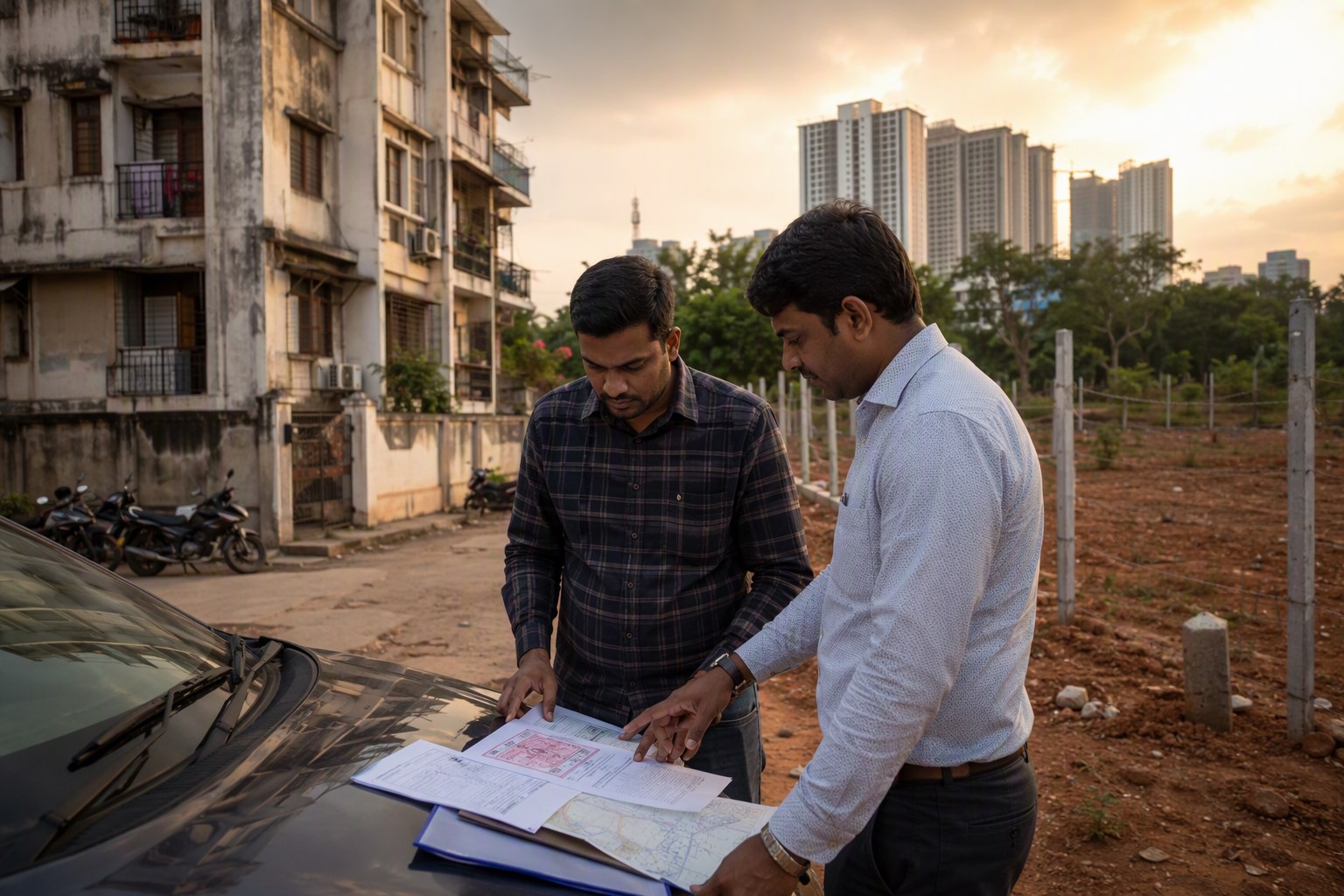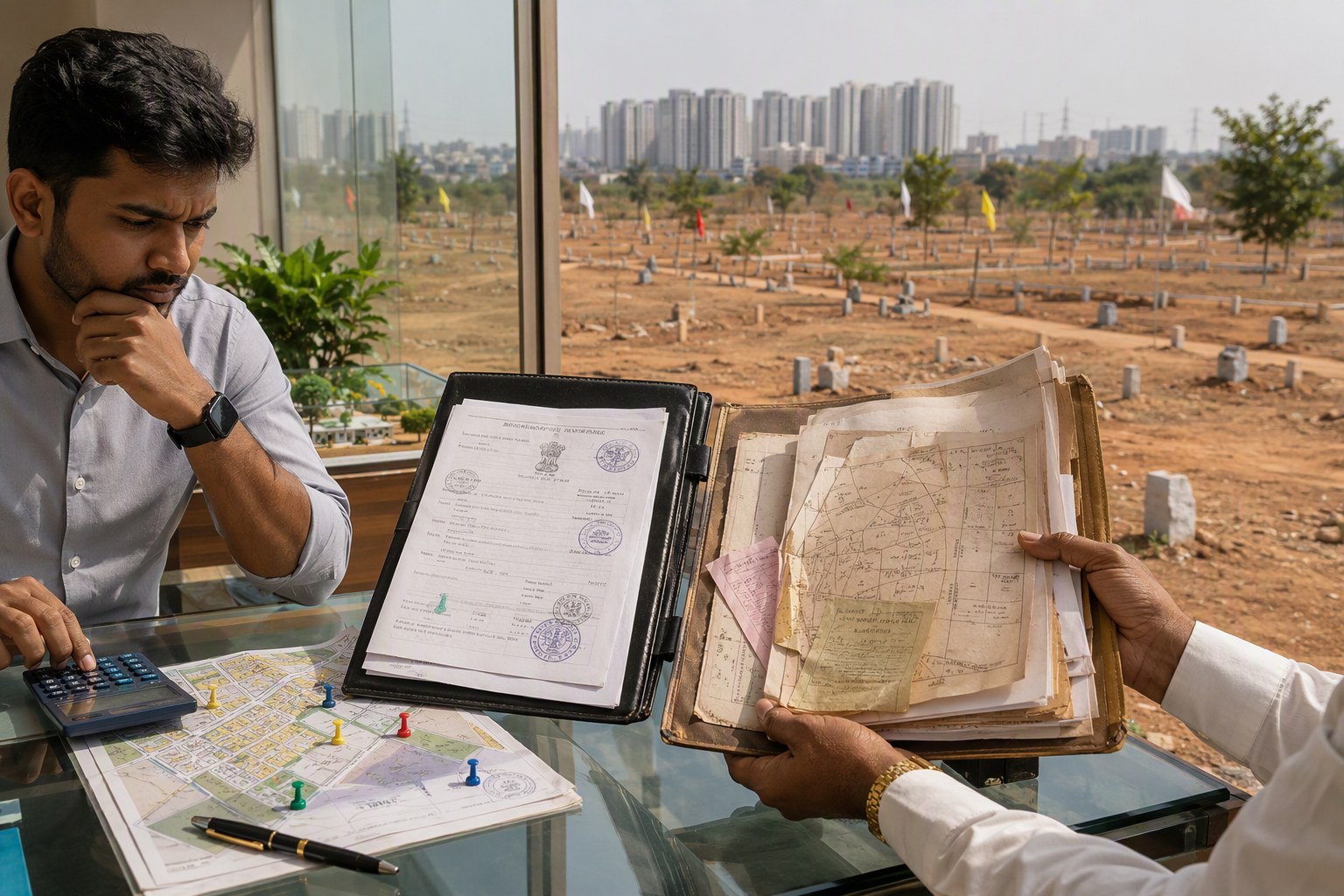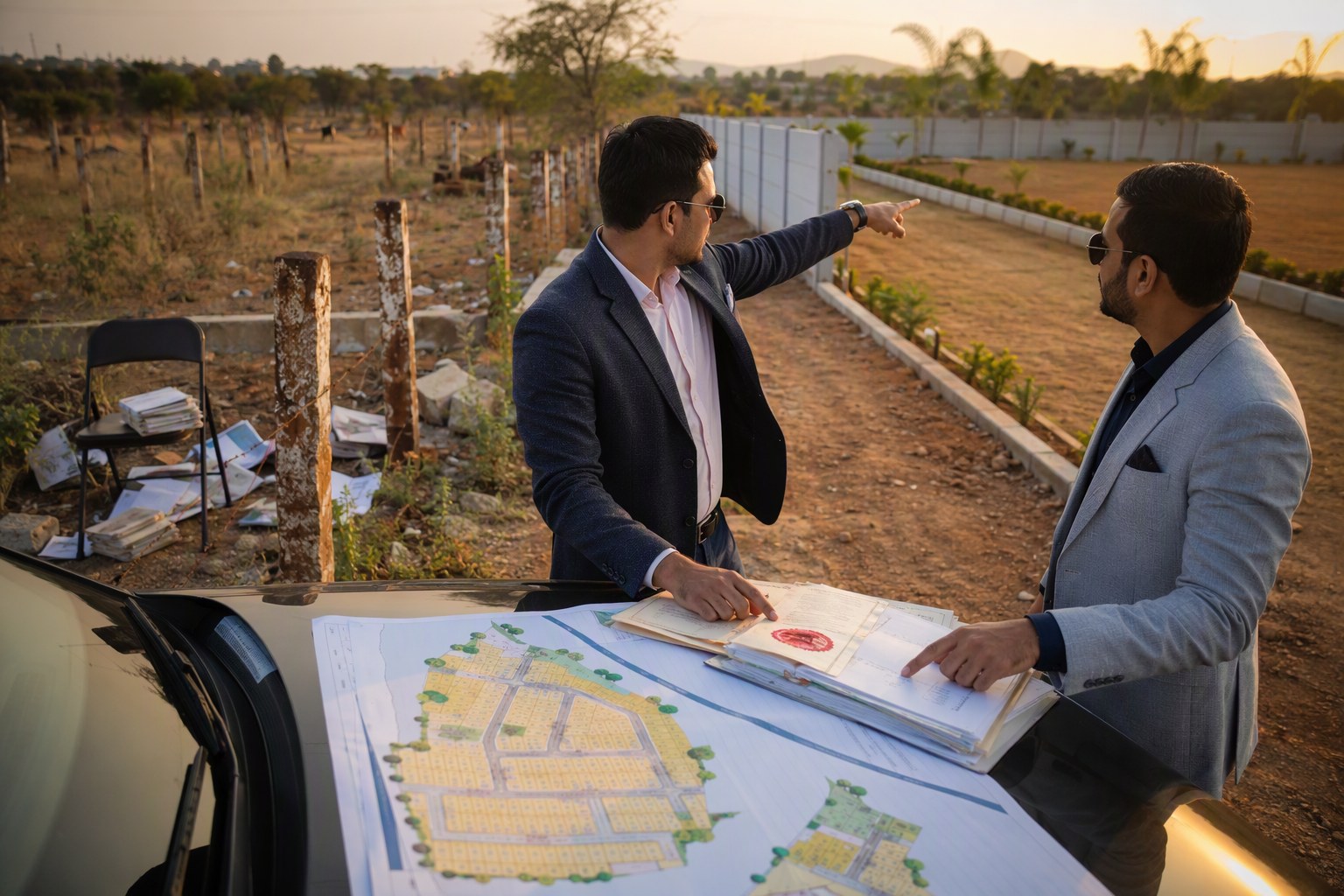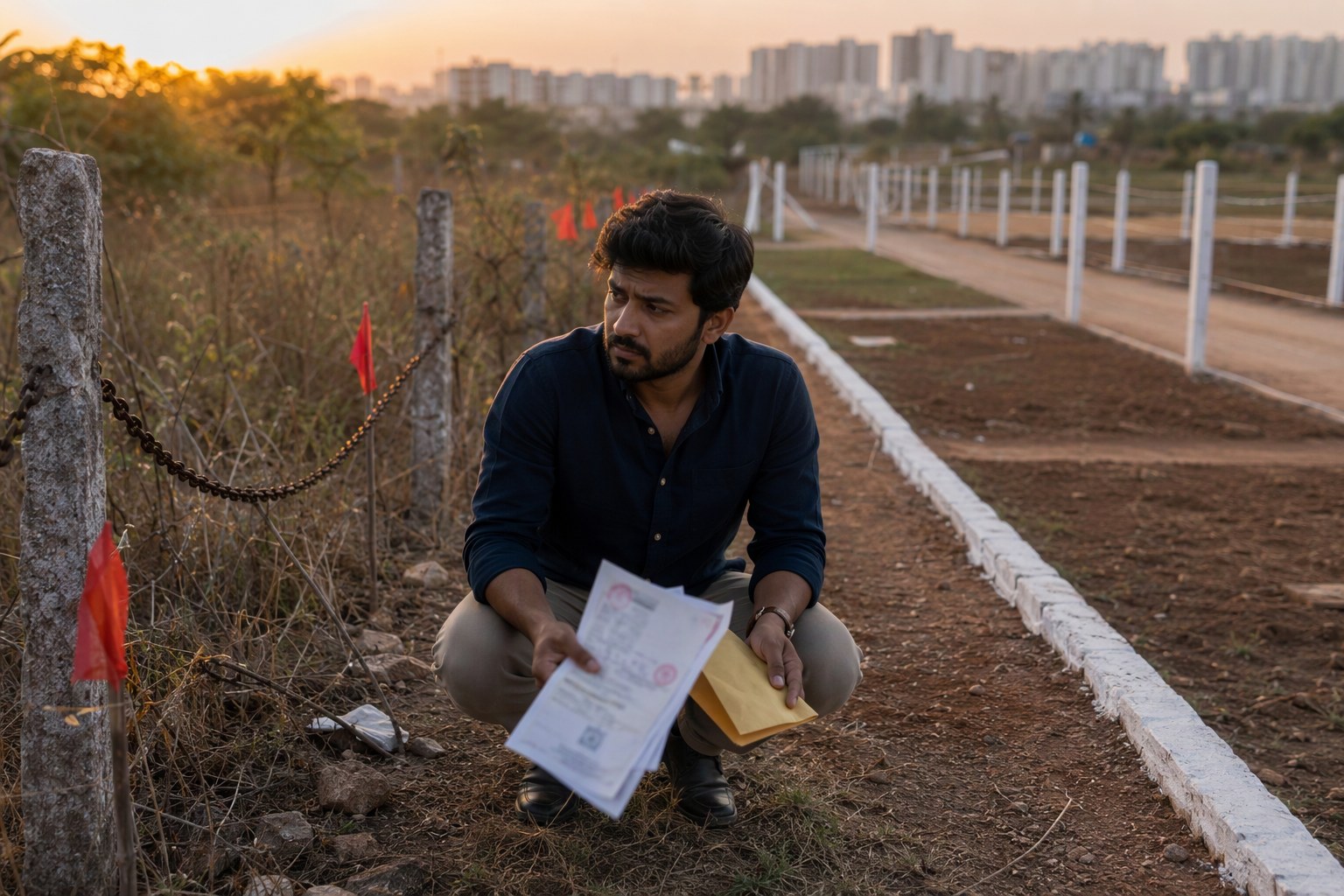
Discount Plot vs Clean Title is now a very real buyer choice in Telangana, especially around Hyderabad’s growth corridors. One plot comes cheaper because there is a Section 22-A doubt, a missing link document, a government land tag, an assigned land history, or a prohibited property entry nearby. The other plot costs more because the title is clean, registration is straightforward, and the buyer can sleep peacefully after sale deed execution. With 3,076,153 prohibited property entries sitting in the Telangana prohibited properties context, buyers are no longer treating title risk as a small legal formality. They are pricing it into the deal.
In our experience, the gap is most visible in mandals where land values moved fast: Shankarpally, Moinabad, Ghatkesar, Maheshwaram, Shamshabad, Kandukur, Abdullapurmet, Hayathnagar, Medchal, and parts around Patancheru and Ramachandrapuram. A seller may say, “Small issue only, sir, it will get cleared.” But the market hears something else: delay, uncertainty, resale problem, bank loan issue, and possible registration refusal at the SRO.
Discount Plot vs Clean Title: what the buyer is really comparing
On paper, both plots may look similar. Same road width, same village surroundings, similar HMDA or DTCP layout talk, same distance from ORR, and maybe same soil and access. But the legal profile changes everything.
A discount plot linked to Section 22-A risk usually has one or more red flags. It may appear in prohibited property records. It may be in a survey number where part of the land is marked as government, endowment, wakf, ceiling surplus, assigned, or otherwise restricted. Sometimes only a portion is affected, but buyers panic because survey-level confusion can block the transaction. In rural Telangana land records, one survey number can carry many sub-divisions, old pattadar names, and mutations across generations. That is why the pahani, dharani record, old EC, and SRO data should all speak the same language.
A clean-title plot is different. The sale chain is traceable. The survey number is not under a prohibited entry. The EC does not show suspicious transactions. The seller’s name aligns with current records. The layout approval, land use, and access road are verifiable. The SRO has no immediate objection to registration. Such plots command a premium not only because they are legally safer, but because future buyers and banks also prefer them.
| Factor | Discount plot with 22-A risk | Clean-title plot |
|---|---|---|
| Registration comfort | May face objection or refusal at SRO if prohibited status applies | Generally smoother if documents are in order |
| Bank loan | Banks may hesitate until legal risk is cleared | Easier for legal and valuation teams to process |
| Resale | Future buyer will again raise the same doubt | Wider resale audience |
| Negotiation | Buyer demands discount for uncertainty | Seller has stronger pricing power |
| Time risk | Clearance may take time, and outcome may not be guaranteed | Due diligence still needed, but less friction |
Why Telangana’s 22-A price gap exists
The reason is simple: legal uncertainty has a cost. Telangana has 3,076,153 prohibited property entries in the prohibited properties context, as per the database number available to us. That does not mean every entry is a bad private plot. It means the state’s land record ecosystem has a large prohibited-property layer that buyers must check before paying advance.
Section 22-A is not a small clerical column for serious land buyers. It can stop registration of certain categories of properties. If a property is marked as prohibited, the Sub-Registrar cannot casually ignore it because the buyer and seller are willing. The SRO office works with the notified records available to it. This is where many Hyderabad buyers get surprised. They negotiate based on location, then discover that the legal file decides the real price.
We have seen this in areas like Mokila and Shankarpally, where buyers chase villa plots; in Maheshwaram and Kandukur, where airport-side growth stories attract investors; and in Ghatkesar, Pocharam, and Bibinagar belt, where enquiries come from IT employees and NRI families. The discount is not always because the land is useless. Sometimes it is because the buyer must take responsibility for clearing doubts, waiting for clarification, or accepting resale friction.
A cheap plot is not automatically a smart buy. A clean title is not automatically overpriced. The correct question is: what risk am I being paid to carry?
Discount Plot vs Clean Title: how the same locality can show two different markets
Take a practical Hyderabad example without attaching invented rupee figures. In Shankarpally mandal, one plot in a developing layout may be offered below the surrounding asking range because the survey number has a government land doubt or a past prohibited-property note. A few streets away, another plot with clear parent documents, layout approval, EC continuity, and no 22-A issue may be quoted higher. Both sellers will claim their plot is “best location”. But the market will not value them equally.
In Moinabad mandal, buyers often like the farmhouse-style atmosphere and road connectivity towards Chevella and ORR. But this belt also needs careful checks on land use, conversion, access road, and revenue records. A lower quote can be tempting, especially when the seller says, “Registration will happen, no problem.” Still, the buyer should verify through the Section 22-A Prohibited Property Check, review the EC through Encumbrance Certificate Search, and compare the official value through Market Value / Guideline Value Search.
In Maheshwaram and Shamshabad, clean-title plots often attract end-users who want long holding comfort. People buying for children, retirement, or future house construction usually prefer clear documentation over a risky discount. Investors with legal support may look at distressed or doubtful files, but that is a different skill set. A regular salaried buyer should not behave like a land aggregator unless they understand revenue records, litigation risk, mutation history, and SRO procedure.
What Section 22-A risk does to buyer behaviour
Once a buyer hears “22-A”, three things happen. First, the buyer slows down. Second, the advance amount becomes smaller or conditional. Third, the buyer starts comparing the risky plot against clean alternatives, not just against nearby asking prices.
This is why the price gap appears. The discount is not charity from the seller. It is compensation for legal discomfort. If the issue is minor and removable, the seller should ideally clear it before sale and then ask for a better price. When the seller pushes the buyer to accept the file “as is”, the buyer has every reason to demand a lower price or walk away.
In Hyderabad’s land market, speed is often used as pressure. “Another party is ready.” “Token today, registration next week.” “Only small dharani correction pending.” These lines are common. My view is blunt: if the property cannot survive a proper title check, it is not a bargain. It is a trap with good road access.
Documents that separate a discount plot from a clean-title plot
A clean file usually has consistency. Names, survey numbers, extents, boundaries, and transaction history line up across documents. The buyer should check at least these points before deciding whether a discount is justified:
- Current ownership: Seller’s name should match revenue and registration records where applicable.
- Survey number clarity: Use the Survey Number Finder to avoid confusion between old survey numbers, sub-divisions, and village names.
- Prohibited property status: Check if the property or linked survey number appears under Section 22-A records.
- Encumbrance history: EC should show sale deeds, mortgages, releases, and other registered events clearly.
- SRO jurisdiction: Verify the correct registration office through Find Your SRO Office.
- Guideline value: Compare the official ready reckoner value with market expectations using the guideline value tool.
- Layout and land use: For plotted layouts, check approval status and zone compatibility through available planning records.
- Possession and boundaries: Physical possession must match the sale deed schedule, village map, and ground reality.
For apartments or villa projects, the buyer should also check project registration through RERA Project Lookup. For open plots, RERA may not always be the main tool, but the principle remains the same: verify before believing the brochure.
Where buyers commonly misread the 22-A price gap
Many buyers assume every legal defect has a fixed discount. That is not how Telangana land works. One 22-A-linked issue may be a data mismatch. Another may involve government land. Another may involve assigned land restrictions. Another may be stuck because the old owner’s legal heirs are fighting. The market treats each case differently.
The most dangerous misunderstanding is this: “If registration happened for neighbouring plot, mine also will happen.” Not always. Adjacent plots can fall under different survey numbers, different extents, or different legal histories. In some villages near Abdullapurmet, Hayathnagar, Ghatkesar, and Medchal, a layout-looking cluster can include clean private land, disputed bits, old road portions, and government-notified areas. Ground appearance is not title proof.
Another mistake is trusting only the latest sale deed. A sale deed shows that a transaction was registered. It does not automatically prove perfect title forever. Buyers must trace parent documents and check whether any later government restriction, court matter, mortgage, or prohibited entry affects the property.
How sellers use discounts in 22-A-linked properties
Some sellers are transparent. They disclose the issue, share documents, and price the plot accordingly. Such cases can still be studied by experienced buyers, especially if the defect is identifiable and the legal path is clear.
Some sellers are vague. They say the file is “under process” but avoid written commitments. They may insist on a non-refundable token. They may show photocopies instead of certified copies. They may discourage the buyer from visiting the SRO or taking legal opinion. That is where caution is needed.
In our experience, a genuine seller does not fear verification. If the property is clean, verification supports the seller’s price. If the property has a curable issue, verification defines the correction path. If the property has a serious title block, verification saves the buyer from a bad advance.
Clean-title plots: why buyers pay extra without regret
A clean-title plot gives the buyer optionality. You can build, resell, gift, mortgage, or hold it with less anxiety. If tomorrow your family wants to take a home loan, the bank’s legal team has a clearer path. If you want to sell after a few years, the next buyer will not use the same 22-A doubt to bargain aggressively.
This is especially true in end-user belts like Narsingi surroundings, Kokapet-side extensions, Tellapur, Kollur, Mokila, Bachupally, Kompally, Ghatkesar, and Shamshabad. When families buy land with long-term plans, they value certainty. Even investors are becoming more title-sensitive because exit is the real profit point. A cheap entry means little if resale gets stuck.
Clean title does not mean blind trust. Even premium plots require EC check, prohibited property check, SRO confirmation, layout verification, and boundary inspection. But the difference is that clean files usually withstand scrutiny. Risky files ask you to ignore scrutiny.
When a discount plot may still be considered
I will not say every discounted plot is bad. Some are priced lower because the seller needs urgent liquidity, the access road is still developing, or the locality is early-stage. Some legal doubts are record-correction issues rather than ownership defects. But the buyer must separate a negotiable issue from a non-negotiable title block.
A discount plot may be considered only when:
- The exact defect is identified in writing.
- The seller provides certified copies and full parent chain.
- The prohibited-property status is checked, not guessed.
- A local property lawyer reviews revenue and registration records.
- The sale agreement clearly protects the buyer if registration fails.
- The buyer is not using emergency funds or borrowed money for a doubtful file.
If the seller says the issue will be cleared after you pay most of the amount, be careful. The stronger structure is usually the reverse: clear the issue first, then complete payment and registration.
Practical checklist before paying advance
Before paying even a token amount for a plot in Telangana, do this basic sequence:
- Run the Section 22-A Prohibited Property Check for the relevant details.
- Pull the EC using Encumbrance Certificate Search and read it fully, not just the first page.
- Check official value through Market Value / Guideline Value Search.
- Confirm the correct SRO with Find Your SRO Office.
- Verify survey number and village mapping through Survey Number Finder.
- Use Property Verification Tool for a broader review before agreement drafting.
- Calculate transaction cost through Stamp Duty Calculator before final budgeting.
This sequence will not replace a lawyer, but it will make your first discussion sharper. You will ask better questions. You will also know when the seller is avoiding straight answers.
The real lesson from Telangana’s 22-A price gap
The plot market around Hyderabad is maturing. Earlier, many buyers focused mainly on location and future appreciation. Now title quality is becoming a visible pricing factor. With 3,076,153 prohibited property entries in the prohibited properties context, buyers cannot treat Section 22-A as a rare corner issue.
My opinion is simple: if you are an end-user or first-time land buyer, pay more for a clean-title plot rather than chasing a discount you do not understand. If you are considering a 22-A-linked discount, price the risk honestly and take professional help before paying advance. The cheapest plot in the village can become the most expensive mistake in the family.
Hyderabad land is emotional. People buy plots for children, retirement, status, and security. But emotion should come after verification, not before it. A clean sale deed, clear survey number, clean EC, and no prohibited-property issue are not boring paperwork. They are the foundation of a good real estate decision.
Frequently Asked Questions
What is Telangana’s 22-A price gap in plot buying?
It is the price difference buyers assign between a plot with Section 22-A or prohibited-property risk and a similar clean-title plot. The risky plot may look cheaper, but the discount reflects registration, loan, resale, and legal uncertainty.
Is every Section 22-A-linked plot unsafe to buy?
Not every case is the same. Some issues may be record-related, while others may involve serious restrictions such as government, assigned, endowment, or other prohibited categories. The buyer must verify the exact reason before paying advance.
Why do clean-title plots cost more in Hyderabad growth areas?
Clean-title plots cost more because registration is easier, bank legal checks are smoother, and resale confidence is higher. In mandals like Shankarpally, Moinabad, Maheshwaram, Ghatkesar, and Shamshabad, buyers are paying extra for certainty.
Which checks should I do before buying a discounted plot?
Check Section 22-A status, EC, guideline value, SRO jurisdiction, survey number, parent documents, layout approval, land use, and physical boundaries. Do not rely only on the seller’s verbal assurance.
Should I pay token advance before checking 22-A status?
Preferably no. If you must pay a token, make it conditional in writing and refundable if registration or title verification fails. A clean seller should not object to verification before major payment.