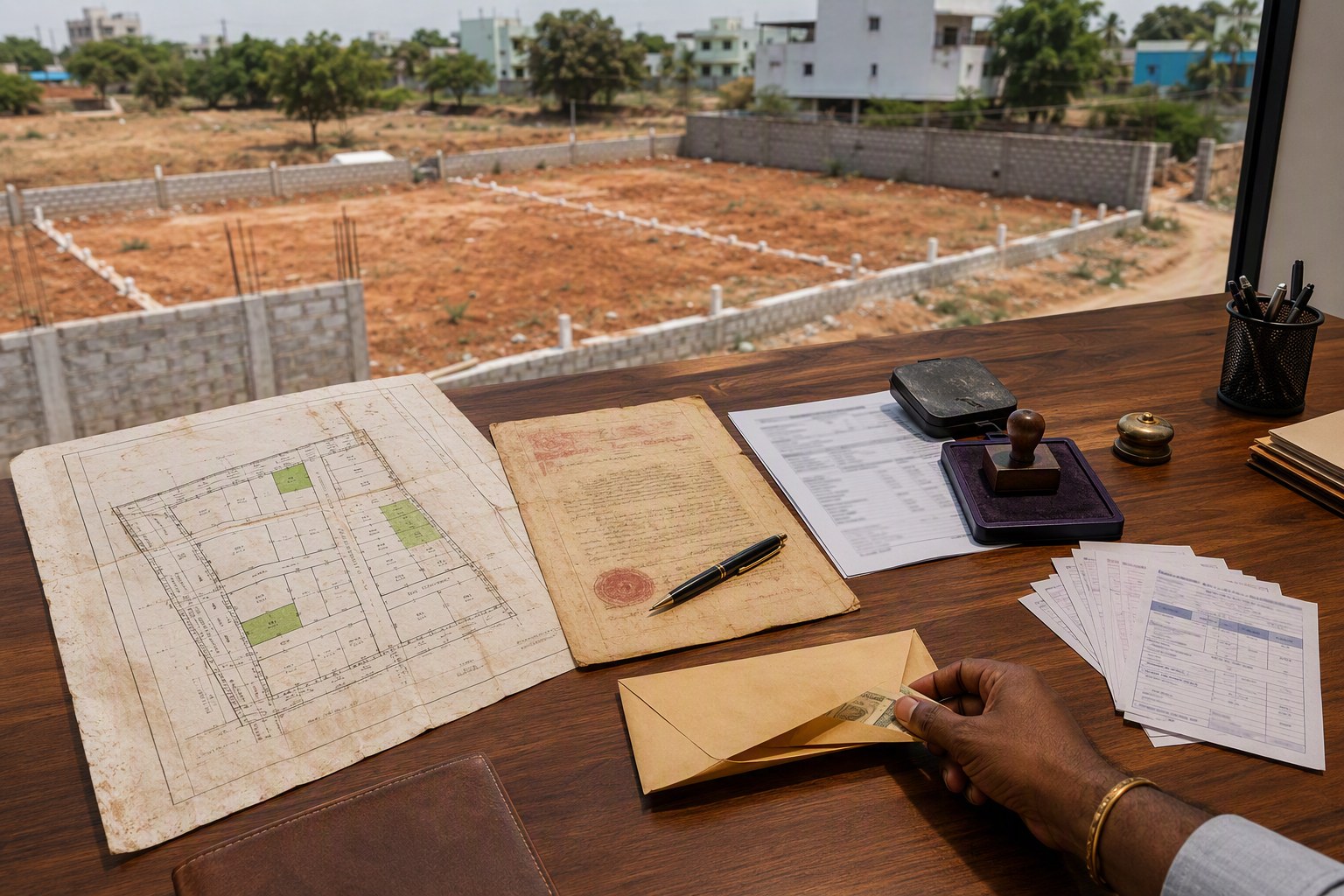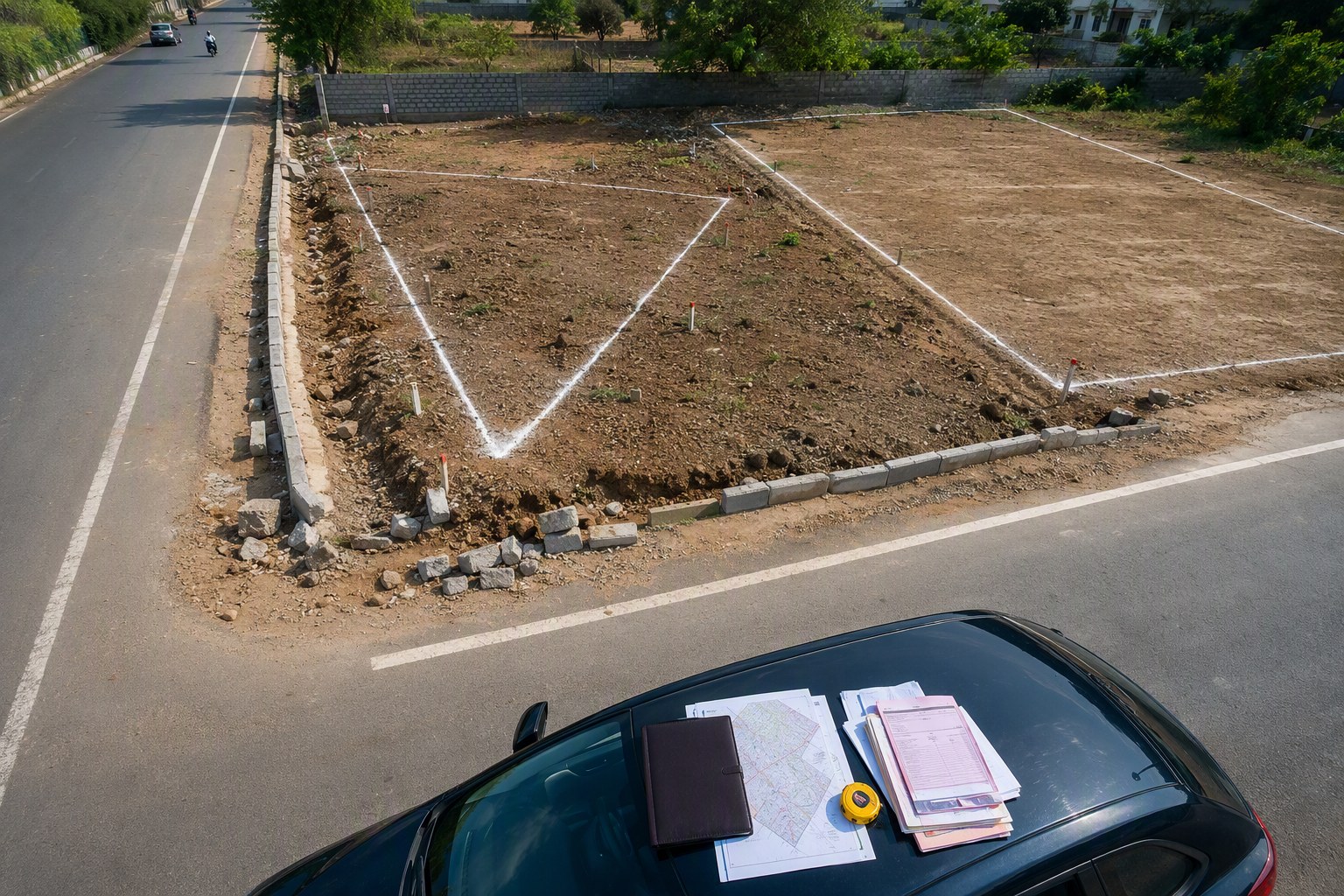


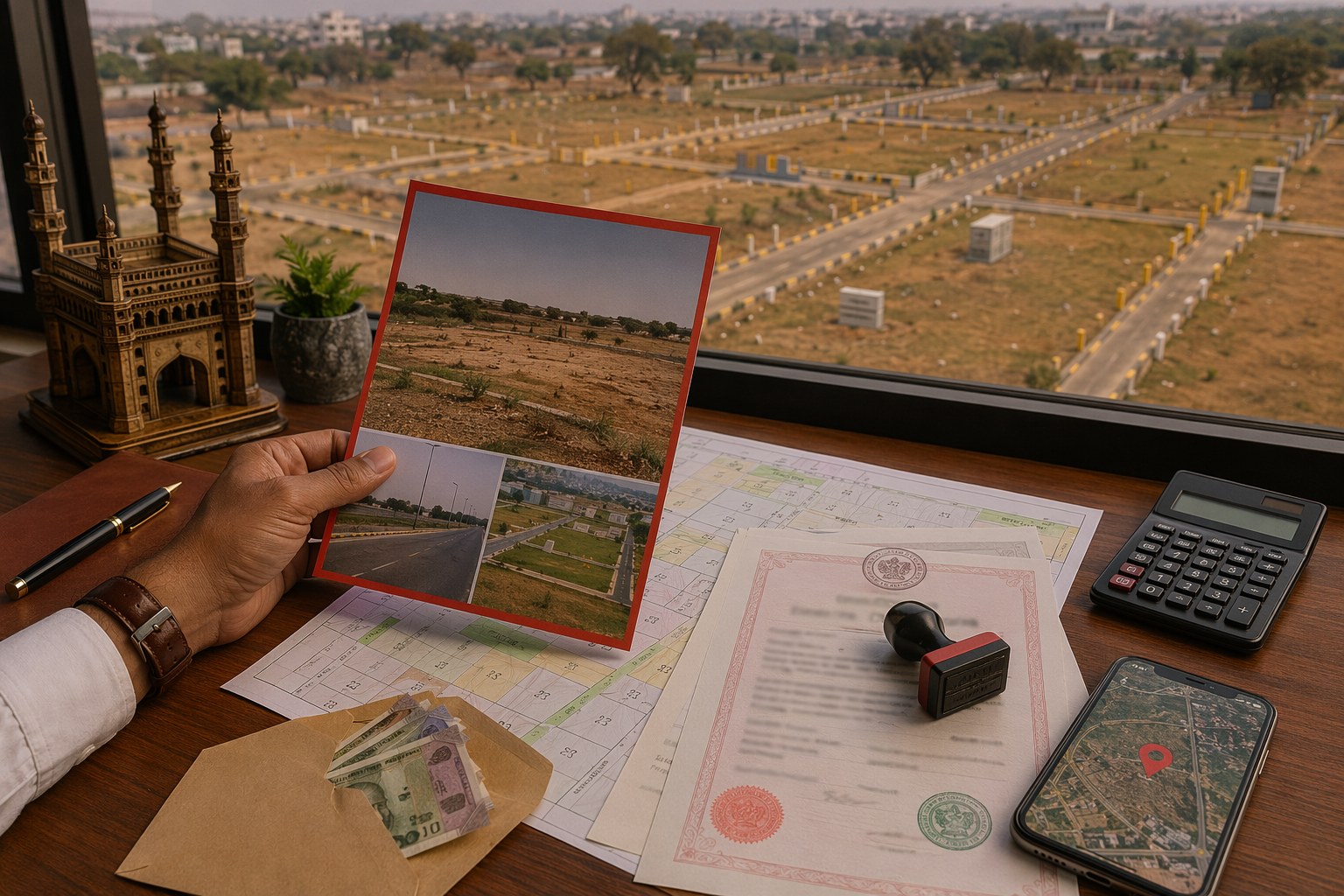
Can a Discount Plot Be a Safe Investment After 22-A Check?
Can a discount plot be a safe investment after 22-A check? Yes, it can be — but only when the discount is for a practical reason, not a legal defect. In Hyderabad’s expanding plot markets like Shankarpally, Mokila, Kollur, Maheshwaram, Tukkuguda, Adibatla, Shamirpet and Medchal, we’ve seen buyers get good deals because the seller needs urgent liquidity, the plot is slightly inside from the main road, or resale may take longer. That is different from buying land stuck in Section 22-A, unclear title, missing access, disputed survey number, or wrong land use.
My opinion is simple: a low price is not a signal to buy faster. It is a signal to verify harder. Telangana government records show 3,076,153 prohibited properties under Section 22-A as per latest IGRS data. That number alone tells us why a buyer should not treat 22-A checking as a small formality.
A discount plot is sensible only when the risk is visible, documented and priced in. If the risk is hidden, the discount is bait.
Discount Plot After 22-A Check: The Short Answer
A discount plot can be a safe investment after a 22-A check if all these points pass:
- The survey number is not listed as prohibited under Section 22-A.
- The Encumbrance Certificate does not show problematic transfers, court orders, mortgages or suspicious gaps.
- The seller’s title chain matches pahani, Dharani, mutation and registered documents.
- The plot has legal and physical access, not just a mud track through another person’s land.
- The land use permits the buyer’s intended use.
- The guideline value and local resale demand support the purchase price.
- The buyer is comfortable with liquidity risk, especially in far-growth corridors.
Start with the Section 22-A Prohibited Property Check. Then pull the Encumbrance Certificate Search, verify the survey number through the Survey Number Finder, and cross-check the SRO using Find Your SRO Office. For many buyers, these four steps immediately separate a real opportunity from a land trap.
Why Discount Plot Deals Appear Around Hyderabad
Every low-priced plot is not suspicious. In our experience, genuine discount deals happen for ordinary reasons. A family may need money for business, education or loan closure. A landlord may want to exit a layout where sales are slow. A plot may be in the second or third lane from a main road, while buyers are chasing highway-facing land. Sometimes a plot is legally fine but emotionally less attractive because it is irregular in shape, close to a nala buffer, near high-tension lines, or far from current habitation.
We see this pattern in growth edges of Hyderabad. In Shankarpally mandal, a buyer may compare Mokila and Kondakal with interior village pockets. In Patancheru side, Isnapur and Rudraram behave differently from deeper pockets away from the highway. In Maheshwaram mandal, Tukkuguda, Mansanpally and surrounding HMDA influence areas do not all move at the same pace. Around Shamirpet and Medchal, the road, access and layout approval matter as much as the village name.
The trouble starts when the seller uses a discount to push the buyer away from verification. Phrases like “registration will happen, don’t worry”, “many people bought here”, “Dharani is showing name”, or “22-A problem is only technical” should not be accepted without records. In Telangana land buying, the document is stronger than the sales pitch.
Discount Plot 22-A Check: What Section 22-A Really Means for Buyers
Section 22-A relates to properties prohibited from registration. In plain buyer language, if a property falls under 22-A, the Sub-Registrar Office may refuse registration or treat the transaction as restricted depending on the nature of the entry. These can include government lands, assigned lands, endowment lands, wakf-related entries, ceiling surplus lands, disputed categories, and other notified prohibitions.
A common mistake is checking only the plot number in a layout brochure. The safer method is to check the survey number, village, mandal and district. A plotted layout may have fancy plot numbers, but the land’s legal identity still rests on survey numbers and revenue records. This is especially relevant in fringe areas where agricultural land was converted or where layouts were carved out over time.
Use the Section 22-A Prohibited Property Check before token advance. If the seller says the entry is outdated or wrongly included, ask for official removal proceedings or clarification from the competent authority. Do not rely on oral promises. If the discount is large because “22-A will be cleared soon”, the buyer is taking a government-record risk, not a market risk.
EC, Title Chain and Pahani: Three Checks Before You Call It Safe
After 22-A, the next filter is the Encumbrance Certificate. The EC shows registered transactions such as sale deeds, gift deeds, mortgages, release deeds and other registered events for the selected period. It does not replace full legal due diligence, but it is the first document that tells us whether the transaction trail looks normal.
Use the Encumbrance Certificate Search and, where needed, the EC Analyzer. Look for these red flags:
- Seller name not matching the previous registered owner.
- Recent sale followed by immediate resale at a steep discount.
- Mortgage or charge not properly released.
- Missing link documents in the chain.
- Multiple transactions within a short period without a clear reason.
- Court-related entries or pending dispute references.
Then compare EC with pahani, Dharani records, mutation status and the actual registered sale deed. Pahani is not a sale deed, but it helps confirm possession and revenue record history. Dharani data is useful, but buyers should not stop there. A clean-looking online entry can still need title verification through link documents and SRO records.
If the plot is part of an approved project or layout, check whether the approval documents match the survey extent and plot boundaries. For plotted developments promoted as projects, the RERA Project Lookup can help when RERA registration is applicable.
Access Risk: The Most Ignored Problem in Discount Plot Buying
Many discount plots fail not because of 22-A, but because access is weak. A buyer visits on a Sunday, reaches the land through an open track, sees other plots, and assumes road access is fine. Later, during fencing or resale, a neighbour objects. That is when the “discount” becomes expensive.
Before buying, check both physical access and legal access. A road shown in a marketing sketch is not enough. See whether the road exists in the approved layout plan, village map, registered document or public records. If access passes through private land, get clarity on easement or registered right of way. In places like Chevella, Moinabad, Shamirpet, Medchal and Maheshwaram, we’ve seen internal approach roads become the main reason for buyer disputes.
Road width also affects future building permission, resale comfort and buyer confidence. Use Road Width Check to get a first-level view, then verify on ground. If the plot is landlocked or dependent on goodwill, avoid it unless a property lawyer confirms a legally enforceable access route.
Guideline Value, Ready Reckoner and the Meaning of a Real Discount
A discount should be measured against the right benchmark. In Telangana, buyers often compare against broker quotes, WhatsApp group rates or the last rumoured sale in the village. That is not enough. At minimum, compare the deal with the government market value or guideline value for that area. Use the Market Value / Guideline Value Search before discussing final price.
If the seller is quoting below guideline value, ask why. Sometimes it is innocent: urgent sale, family settlement, remote location or odd shape. Sometimes it is not: title gap, access issue, 22-A shadow, land use conflict, unapproved layout, or resale difficulty. The ready reckoner gives you a formal reference point, but marketability still depends on road, approvals, neighbourhood growth and buyer demand.
Also calculate transaction cost properly. Stamp duty, registration charges and document expenses affect the final landed cost. Many buyers bargain hard on plot price and forget the total cost until registration day. Use the Stamp Duty Calculator before paying an advance.
Land Use and Layout Approval: The Silent Resale Filter
A plot can be free from 22-A and still be a weak investment if land use does not support your plan. Buyers near ORR growth belts often assume every open parcel will become residential. That is not always how planning rules work. HMDA limits, municipal limits, gram panchayat areas, conservation zones, industrial zones and buffer restrictions can change the value story.
Use Land Use Zone Finder to understand the basic planning angle. If the plot is in or near water bodies, nalas, high-tension corridors, forest-related areas or other restricted zones, get professional advice before paying even a token amount.
For layout approval, ask for the sanctioned plan, proceedings, release letters where relevant, and proof that the specific plot is part of the approved layout. Do not accept only a colour brochure. If it is an old gram panchayat layout, check whether it is regularised, whether roads and open spaces are properly shown, and whether the plot can receive future building permission.
Locality Examples: When a Discount Plot May Still Work
| Area / corridor | What to verify first | When the discount may be acceptable |
|---|---|---|
| Mokila, Kondakal, Shankarpally mandal | Survey number, access road, layout approval, EC and land use | Seller urgency or interior location, if title and access are clean |
| Kollur, Tellapur, Osman Nagar side | HMDA planning status, road width, project documents and SRO trail | Longer resale cycle or non-prime plot position, not title confusion |
| Tukkuguda, Maheshwaram, Adibatla belt | Land use, conversion, approach road and survey boundaries | Early-stage locality risk, if records are clean and access is legal |
| Shamirpet, Medchal, Keesara belt | Village map access, layout status, EC and 22-A | Distance from main road or slower demand, not prohibited land risk |
| Chevella, Moinabad, Gandipet surroundings | GO-related restrictions where applicable, land use, water body buffers and title chain | Only when planning and revenue checks are independently cleared |
This is where many investors misread the market. A plot in a famous locality name is not automatically safe. A plot in a lesser-known village is not automatically bad. The individual survey number, road, approval and title decide the risk.
Resale Risk: The Question Buyers Ask Too Late
Before buying a discount plot, ask: “Who will buy this from me later?” If your answer is only “someone will surely buy”, slow down. Resale depends on buyer financeability, clarity of documents, road access, approved layout status and neighbourhood development. Plots with legal ambiguity attract only cash buyers and bargain hunters. Clean plots attract families, builders and long-term investors.
Discount plots often sit in the market for longer. That is fine if you have holding power. It is risky if you may need to sell quickly. A low entry price does not guarantee easy exit. In our experience, investors who buy clean but slightly less fashionable plots do better than investors who buy legally messy plots in hot corridors.
If you are buying for construction, check road width, FSI/FAR implications and building feasibility. The FSI/FAR Calculator can help you think beyond land price. If you are buying for long-term appreciation, track changes through Property Change Tracker so you do not miss later shifts in records or surroundings.
A Practical 10-Step Checklist Before Paying Advance
- Check 22-A first: Use survey number, village and mandal, not only plot number.
- Pull EC: Review the transaction chain and look for mortgages, releases and abnormal transfers.
- Match seller identity: Seller’s name should align with sale deed, EC, Dharani and supporting records.
- Read link documents: Do not buy only on current ownership proof.
- Verify pahani and mutation: Revenue records should not contradict the sale story.
- Confirm access: Check the road in documents and on ground.
- Check land use: Confirm whether residential use is possible.
- Review layout approval: Sanction plan, plot number, road width and open space should match.
- Compare guideline value: Understand whether the discount is real or only a sales trick.
- Use a conditional advance agreement: Make refund terms clear if legal verification fails.
For document drafting, buyers can use the Legal Document Generator as a starting point, but high-value or doubtful land transactions should be reviewed by a property lawyer. A good agreement should say that the advance is subject to satisfactory 22-A, EC, title, access, land use and approval checks.
When I Would Avoid a Discount Plot
I would avoid the deal if the seller refuses to share survey numbers before advance. I would also avoid it if the seller says EC is unnecessary, 22-A can be handled after registration, or access will be sorted later. These are not small gaps. They go to the heart of ownership and resale.
Another warning sign is pressure. “Pay today or the price changes” is common in land sales. A genuine seller may negotiate hard, but a genuine title can withstand verification. If the broker is more interested in your token amount than your due diligence, step back.
Also be careful with plots where the land extent in documents does not match physical layout, where boundaries are unclear, or where neighbouring owners disagree. Boundary disputes are tiring and costly, even when you are technically right.
So, Can a Discount Plot Be a Safe Investment After 22-A Check?
Yes, a discount plot can be a safe investment after 22-A check, but 22-A is only the first gate. The better answer is: buy only if the plot clears 22-A, EC, title chain, pahani, Dharani consistency, access, land use, layout approval, guideline value comparison and resale-risk review.
Hyderabad’s land market rewards patient buyers. The best opportunities are not always the loudest deals. Sometimes the sensible buy is a clean plot with a modest discount in a developing pocket. The dangerous buy is a cheap plot where every answer is verbal and every document is promised after payment.
If you are evaluating a low-priced plot in Telangana, run the checks first. Then negotiate. Not the other way around.
Frequently Asked Questions
Can I buy a discount plot if it is not listed under 22-A?
Yes, but do not stop with 22-A. Check EC, title chain, pahani, Dharani, access road, land use and layout approval. A plot can be outside 22-A and still have other risks.
Is Dharani ownership enough to buy a plot in Telangana?
No. Dharani is useful, but buyers should also verify registered sale deeds, EC, link documents, mutation records, survey number details and physical possession. For plotted layouts, approval documents matter too.
Why are some plots cheaper than nearby plots in the same locality?
Reasons can include seller urgency, interior location, odd shape, weaker road access, slower resale, unapproved layout status or legal doubts. The discount is safe only when the reason is clear and documented.
Should I pay token advance before checking 22-A and EC?
Preferably no. If you must pay, use a written agreement stating that the amount is refundable if 22-A, EC, title, access or approval checks fail.
Which tools should I use before buying a low-priced plot?
Start with the Section 22-A Prohibited Property Check, Encumbrance Certificate Search, Survey Number Finder, Market Value / Guideline Value Search, Road Width Check and Land Use Zone Finder.