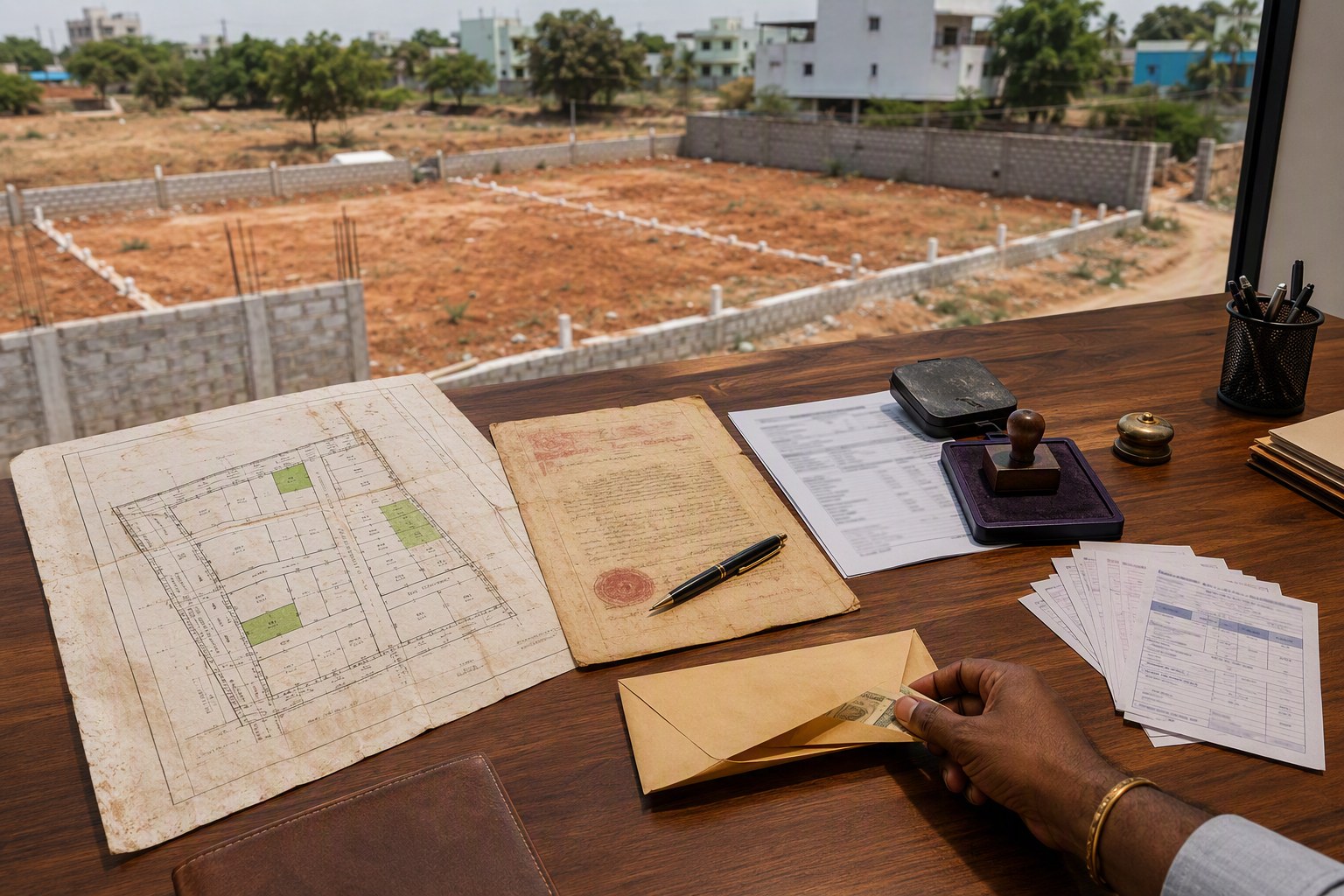



Hyderabad Co-Living Investment is attractive for one simple reason: a 3BHK near an office corridor can earn more when rented bed-wise than as a family flat. But here is my straight answer — yield is useful only when the property can be sold cleanly later. If the EC has gaps, the title chain is weak, the society does not allow co-living, or the land falls under Section 22-A, that extra rent can become a headache. Telangana has 147934 prohibited property records, so investors should not treat legal verification as a formality.
Short answer: Co-living can give better monthly cash flow in Hyderabad, especially around Madhapur, Gachibowli, Kondapur, Nanakramguda, Financial District, Narsingi and Kokapet. But the best co-living investment is not the flat with the highest rent. It is the flat with a clean EC, saleable title, registration-safe survey number, sensible society rules and an exit price that still works for a regular home buyer.
Hyderabad Co-Living Investment: the return looks attractive, but what can go wrong?
We have seen many investors calculate rent first and legal risk last. That is the wrong order in Hyderabad. A co-living operator may promise 8 percent or 9 percent gross yield. A broker may show bed-wise rent from IT employees, students and freshers. The monthly number can look better than a standard 2BHK or 3BHK rental.
But your investment result is decided on two days: the day you buy and the day you sell. In between, rent is only one part of the story.
Take a typical 3BHK in Kondapur or Gachibowli. A normal family rental may fetch around Rs 55,000 to Rs 90,000 per month depending on size, furnishing, age, parking and society quality. If converted to co-living, the same unit may be rented bed-wise at Rs 10,000 to Rs 22,000 per bed in strong micro-markets. On paper, that pushes gross rent up. In practice, you must subtract furnishing, manager commission, vacancy, repairs, repainting, deep cleaning, internet, appliance replacement, society penalties if any, and the time cost of handling churn.
In our experience, the gap between gross yield and real net yield is where many investors get surprised.
Hyderabad Co-Living Investment should start with exit, not rent
Co-living works best in areas where employment demand is deep and resale demand is also strong. That is why the western corridor remains popular. Madhapur, Gachibowli, Financial District, Nanakramguda, Kondapur, Narsingi and Kokapet have office catchments, metro or ORR access, and a large tenant base. But even in these locations, every project is not equal.
If your buyer pool later reduces because the flat has been heavily used as a paying guest setup, your exit becomes weaker. Families may hesitate if the unit has excessive wear and tear. Some societies openly discourage bachelor occupancy or high-churn rental models. Banks may ask questions if title papers are incomplete. Registration can fail if the property or underlying survey number has a prohibited property entry.
That is why I prefer this order before any co-living purchase:
- Check whether the property is registrable and not hit by Section 22-A.
- Verify the EC for mortgages, agreements, court orders, attachments and release deeds.
- Confirm the title chain from parent document to current seller.
- Read society rules on bachelor tenants, paying guests and short-stay leasing.
- Check the realistic resale market for family buyers, not just investor buyers.
- Only then calculate bed-wise rental income.
A good starting point is the Section 22-A Prohibited Property Check. With 147934 prohibited property records in Telangana, this check is not optional for serious investors. For title and transaction history, use the Encumbrance Certificate Search. For official value reference, compare the deal with the Market Value / Guideline Value Search. These three checks can save lakhs, sometimes crores.
Where co-living demand is stronger in Hyderabad
Demand is not evenly spread across Hyderabad. A co-living flat needs walkable or quick commute access to offices, colleges, hospitals or transport. It also needs a tenant profile willing to pay for convenience. A large flat in a far interior layout may look cheap, but if tenants need 40 minutes just to reach office transport, occupancy will suffer.
Here is a practical market view we commonly see in investor discussions. Rates move by project, age, furnishing and negotiation, so treat these as working bands and verify before committing.
| Locality | Common mandal reference | Typical apartment sale band | Normal 3BHK rent | Co-living fit |
|---|---|---|---|---|
| Madhapur | Serilingampally mandal | Rs 10,000 to Rs 15,000 per sq ft | Rs 70,000 to Rs 1.20 lakh | High, but entry cost is steep |
| Gachibowli | Serilingampally mandal | Rs 9,500 to Rs 14,500 per sq ft | Rs 65,000 to Rs 1.10 lakh | High, especially near offices |
| Kondapur | Serilingampally mandal | Rs 8,500 to Rs 12,000 per sq ft | Rs 55,000 to Rs 90,000 | Good if society permits |
| Narsingi | Gandipet mandal | Rs 8,000 to Rs 12,500 per sq ft | Rs 45,000 to Rs 80,000 | Good for larger units |
| Kokapet | Gandipet mandal | Rs 9,000 to Rs 15,000 per sq ft | Rs 55,000 to Rs 1 lakh | Premium, but check tenant depth project-wise |
| Bachupally | Bachupally mandal | Rs 5,500 to Rs 7,500 per sq ft | Rs 28,000 to Rs 50,000 | Moderate, works near colleges and ORR access |
| Uppal | Uppal mandal | Rs 5,500 to Rs 8,000 per sq ft | Rs 25,000 to Rs 45,000 | Selective, stronger near metro and offices |
The western corridor gives stronger rents, but it also has higher entry cost. Uppal, Bachupally and some Miyapur pockets may give lower purchase price, but co-living success there depends heavily on transport, society acceptance and tenant sourcing. Cheap purchase price alone is not a strategy.
The real yield math: gross rent is not net return
Let us take a simple example. Suppose an investor buys a 3BHK in Kondapur for Rs 1.75 crore including basic transaction costs. A family tenant may pay Rs 70,000 per month, giving Rs 8.4 lakh annual gross rent. That is around 4.8 percent gross yield before maintenance, tax, vacancy and repairs.
If the same flat is run as co-living with six beds at an average Rs 16,000 per bed, gross rent becomes Rs 96,000 per month or Rs 11.52 lakh per year. Gross yield moves to around 6.6 percent. Looks better.
Now subtract realistic costs:
- Furnishing and appliances: Rs 4 lakh to Rs 8 lakh upfront for a decent setup.
- Operator or manager fee: often 8 percent to 15 percent of rent.
- Vacancy and churn: one or two beds vacant in weak months can hurt returns.
- Repairs: beds, wardrobes, geysers, washing machine, AC servicing and repainting.
- Society maintenance: usually higher in premium gated communities.
- Compliance and documentation: police intimation, tenant KYC, rental agreements and internal society requirements.
After these costs, the net advantage may still be good, but it may not be as dramatic as the first WhatsApp calculation. If you borrow at a high interest rate, cash flow can become tight. Use the Stamp Duty Calculator before purchase to include registration cost, not just agreement value. If you plan to sell later, the Capital Gains Tax Calculator helps estimate post-tax exit returns.
Section 22-A risk: the silent deal breaker
Section 22-A prohibited property risk is one of the most ignored issues in Telangana property investment. A flat buyer often assumes that if the building is standing and people are living there, registration must be safe. That assumption is dangerous.
Prohibited property entries can relate to government land, assigned land, endowment land, wakf land, ceiling surplus, court-restricted land and other categories. Sometimes the issue sits at survey number level, not at flat level. If the underlying land has a problem, your resale registration can become difficult even if your flat looks normal.
Telangana has 147934 prohibited property records. That number should make every investor pause. Co-living investors usually focus on monthly rent, but the bigger risk is being unable to transfer the property smoothly when the market is good.
Before paying token advance, verify survey number details. If you do not know the survey number, use the Survey Number Finder. Then run a prohibited property check. If the property is in a large apartment project, ask for land documents, development agreement, GPA if applicable, building permission, occupancy certificate and latest EC. For new or under-construction projects, cross-check registration with the RERA Project Lookup.
EC, title and SRO checks for co-living flats
An Encumbrance Certificate is not just a formality to satisfy the bank. It tells you whether the property has recorded transactions, mortgages, releases, gifts, partitions, sale deeds, court attachments or other registered claims. For resale flats in Hyderabad, I like to see a long EC period, not only the last few years.
For a co-living investment, check these items carefully:
- Parent document: How did the original landowner get the land?
- Development agreement: Was the builder legally authorised to develop and sell?
- Link documents: Is the chain continuous, or are there missing deeds?
- Mortgage release: If the builder or seller borrowed against the property, is the release registered?
- Flat number and undivided share: Do they match across sale deed, EC and approved plan?
- Mutation and tax records: Are GHMC or local body records updated?
- SRO jurisdiction: Is the registration handled at the correct SRO?
If you are unsure about jurisdiction, use Find Your SRO Office. For a broader review, the Property Verification Tool helps organise checks that investors otherwise do in scattered fashion.
Do not ignore ready reckoner or guideline value. A deal far below official market value needs a reason. Sometimes it is distress sale. Sometimes it is litigation. Sometimes the seller knows something that the buyer has not checked.
Society rules can kill a co-living plan
Many investors buy first and ask the apartment association later. That is risky. In several Hyderabad gated communities, associations insist on family occupancy or strict tenant approval. Some allow bachelors but do not allow bed-wise subletting. Some ask for police verification, tenant forms, move-in charges and limits on frequent movement.
Legally, associations cannot behave arbitrarily, but practically, a running fight with your society is bad for occupancy and resale. Tenants do not want daily arguments at the gate. Operators also avoid societies where entry rules change every month.
Before buying, speak to the association manager, security office and at least two existing owners. Ask direct questions:
- Are bachelor tenants allowed?
- Is paying guest or co-living use allowed?
- Is subletting by an operator allowed?
- Are there extra charges for tenant move-in and move-out?
- How many tenants are allowed in a 3BHK?
- Have there been complaints against co-living flats earlier?
A flat with 7 percent yield but constant society friction is not better than a flat with 4.5 percent yield and clean, stable occupancy.
Building quality, FSI and layout checks matter
Co-living means heavier use. More people use bathrooms, lifts, parking, water, power backup and common areas. Poor construction ages quickly under this model. So check building quality with investor eyes, not just tenant eyes.
Look at ventilation, bathroom count, lift capacity, water supply, power backup, parking allocation and fire safety. A 3BHK with three bathrooms is usually stronger for co-living than a compact 3BHK with two bathrooms. A flat near the lift may be convenient but noisy. A high-rise with slow lifts can irritate tenants during office hours.
For land and planning comfort, tools like the FSI/FAR Calculator, Road Width Check and Land Use Zone Finder can help you understand whether the project sits in a sensible planning context. These checks are especially useful when you are considering smaller standalone buildings in places like Manikonda, Puppalaguda, Hafeezpet, Pragathi Nagar, Nizampet or Peerancheru.
When Hyderabad co-living investment makes sense
I would consider co-living investment only when these five conditions are met.
1. The property has clean legal status
No 22-A issue, no EC red flag, no unclear title chain, no disputed UDS, no missing release deed. If this is not clean, rent is irrelevant.
2. The location has daily tenant demand
The best fit is near IT parks, metro access, large office clusters, universities, hospitals and coaching hubs. Gachibowli, Kondapur and Madhapur have deeper tenant pools than a random cheap pocket with poor transport.
3. The society allows the model
Written confirmation is ideal. At minimum, there should be a consistent practice of allowing similar rentals without harassment.
4. The flat can be sold to a family buyer
This is critical. Your exit should not depend only on finding another co-living investor. A normal buyer should still like the unit layout, project, parking, view and maintenance.
5. The yield survives conservative assumptions
Assume one month vacancy, higher repair cost, furnishing depreciation and a lower resale price if the flat is poorly maintained. If the investment still works, it is worth discussing.
My view: high yield is welcome, clean exit is non-negotiable
Co-living is not bad. In fact, Hyderabad needs more professionally managed rental housing for young workers and students. The city keeps attracting talent, and not everyone wants a full flat lease with heavy deposit and furniture cost.
But as an investment, co-living is not a shortcut. It is an operating business sitting on top of real estate. You are not just buying walls and registering a sale deed. You are buying tenant churn, maintenance responsibility, association politics, compliance work and exit risk.
My thumb rule is simple: if the same flat is a decent investment even as a normal rental, co-living can be a bonus. If the flat works only because of aggressive bed-wise rent assumptions, be careful. The Hyderabad market is forgiving in good years, but legal defects are not forgiven easily at the SRO counter.
Before paying advance, run the EC, 22-A, guideline value, SRO and title checks. Then speak to the society. Then calculate rent. That order may feel slow, but it protects your capital.
Frequently Asked Questions
Is Hyderabad co-living investment better than normal flat rental?
It can give higher gross rent, especially in Madhapur, Gachibowli, Kondapur, Financial District and Narsingi. But net return depends on furnishing cost, vacancy, repairs, operator fees, society rules and resale value.
Why is Section 22-A check important before buying?
Section 22-A properties can face registration restrictions. Telangana has 147934 prohibited property records, so investors should check the survey number and property status before paying token advance.
What documents should I verify for a co-living flat?
Check the sale deed, parent documents, EC, mortgage release deed, building permission, occupancy certificate, UDS details, tax records, RERA details if applicable, and society rental rules.
Can an apartment association stop co-living tenants?
Society rules vary. Many associations allow tenants but restrict paying guest use, subletting or high-occupancy rentals. Always check the bye-laws and current practice before buying for co-living.
Which Hyderabad areas are stronger for co-living demand?
West Hyderabad locations such as Gachibowli, Madhapur, Kondapur, Nanakramguda, Financial District, Narsingi and Kokapet are stronger because of office demand. Select pockets of Bachupally, Uppal and Miyapur can work if transport and society rules are favourable.