

Case Study: An EC Gap That Exposed a Double Mortgage
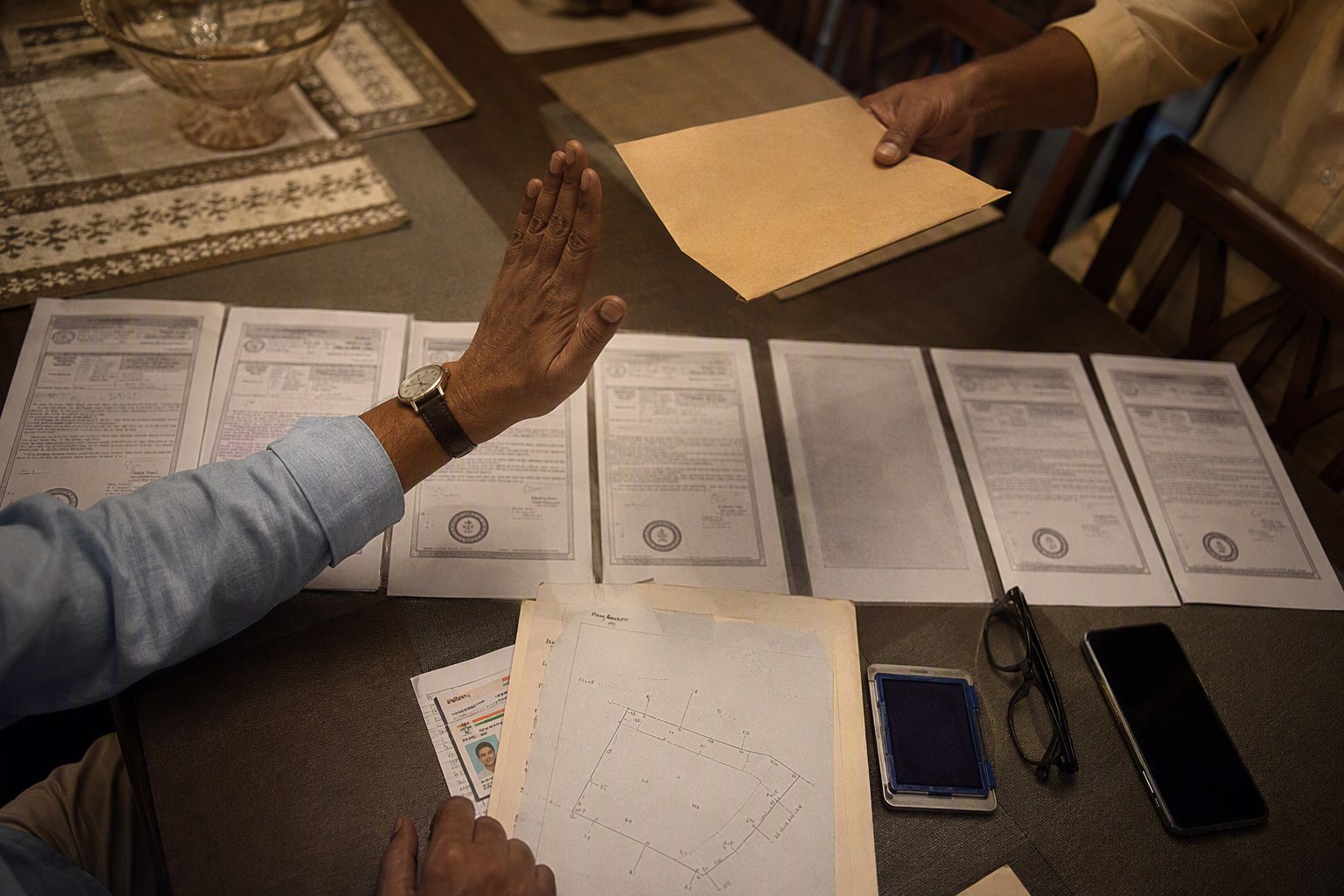
Case Study: An EC Gap That Exposed a Double Mortgage is exactly the kind of file we see in Hyderabad transactions when everyone is in a hurry to pay token money. A buyer in west Hyderabad was ready to close a resale apartment deal. The seller had shared an encumbrance certificate, bank NOC copy, link document chain and society dues letter. On paper, it looked fine. One routine EC check exposed a missing lending trail and saved the buyer from walking into a double mortgage risk.
We are masking the buyer, seller, flat number and price because this was a private verification assignment. The lesson is public: an EC is not a decorative PDF to attach in WhatsApp. It has to be read line by line, date by date, SRO by SRO.
The property was in the Narsingi-Puppalaguda belt of Gandipet mandal, an area where resale flats, gated communities and land-share arrangements often sit next to each other. We have seen similar pressure in Kokapet, Nallagandla, Kondapur, Tellapur and Miyapur also. Token first, documents later. That order is risky.
EC Gap: What the Buyer Found Before Paying Token
The buyer’s family approached us after the seller’s agent insisted that the token had to be paid immediately. The seller had given a recent-looking EC extract, a sale deed copy and a loan closure letter from one bank. The story was simple: the seller had purchased the flat earlier, taken a home loan, cleared it, and was now selling due to relocation.
At first glance, nothing screamed fraud. The names matched. The door number was broadly correct. The society letter did not show pending maintenance. The seller sounded genuine. In Hyderabad, that is exactly where buyers lower their guard.
Our first step was not legal drafting. It was document hygiene. We ran a fresh search using the Encumbrance Certificate Search and compared it with the seller-provided EC. The fresh record showed a period that was not properly covered in the seller’s version. That gap was small enough to be dismissed by a casual buyer, but large enough to hide a loan transaction.
Then we used the EC Analyzer to map the sequence: purchase, mortgage entry, release, later charge reference, and missing closure evidence. The concern was not merely that a loan existed. Many genuine sellers have loans. The concern was that the file suggested one lender had been closed while another charge had not been properly explained.
In our experience, a clean-looking EC is not enough. A latest EC, cross-checked with CERSAI and the SRO record, is what matters before token money leaves the buyer’s account.
EC Gap and Double Mortgage: How It Shows Up in Telangana Paperwork
A double mortgage risk does not always appear as a dramatic red stamp on the first page. It may show up as a mismatch. In this case, the EC gap pushed us to ask one direct question: if the earlier bank loan was closed, why was there still a charge indicator connected to another lending trail?
Here are the signs that made the file uncomfortable:
- The EC given by the seller was not aligned with the latest search. The buyer was shown a version that did not answer the most recent period properly.
- The bank NOC copy was not enough. A loan closure letter from one lender does not prove that no other lender has a claim.
- The release evidence needed SRO-level confirmation. A mortgage entry and a release entry must be read together, not separately.
- The property description had small inconsistencies. Flat number, apartment name, and schedule wording must match across sale deed, mortgage deed, EC and society records.
- The seller was pushing token before giving a full document set. In Hyderabad resale deals, that pressure itself is a warning sign.
We then asked for original loan closure papers, release deed details, latest bank statement proof for closure, and a written confirmation that no charge or security interest existed. The seller’s side hesitated. That hesitation was more useful than a long explanation.
For readers who are new to this, an encumbrance certificate is a record of registered transactions reflected through the registration system. It can show sale deeds, gift deeds, mortgage deeds, releases and other registered dealings. But it is not a complete ownership verdict by itself. Equitable mortgage, bank charge reporting, private undertakings and pending disputes may need separate checks.
Why CERSAI Mattered When the EC Gap Looked Almost Normal
The real turn in this case came when the buyer asked us whether EC alone was sufficient. We said no. For any loan-backed property, especially a resale flat, CERSAI is a key check. The CERSAI Charge Check helps a buyer look for a registered security interest connected to the property.
CERSAI is not a replacement for SRO verification. It is a parallel check. If the EC says one thing and CERSAI suggests another charge, the buyer should not proceed casually. The seller must explain it with documents, not verbal comfort.
In this file, the CERSAI angle showed why the EC gap mattered. The seller was able to explain the first home loan. The later lending trail was not explained cleanly. The buyer stopped the token payment and asked the seller to clear the record first. That was the right call.
We have seen buyers in Gachibowli, Manikonda, Bachupally and Kompally assume that bank-funded properties are safe because some bank had already checked the title earlier. That logic is weak. A bank’s earlier due diligence was for that bank’s loan, at that time, for that borrower. A buyer needs present-day title comfort.
EC Gap in Hyderabad Resale Deals: Local Patterns We See
Hyderabad resale transactions have their own rhythm. A good flat in Nallagandla or Kondapur gets multiple enquiries. A villa plot near Mokila in Shankarpally mandal attracts weekend buyers. A land parcel near Tukkuguda in Maheshwaram mandal is often sold on the strength of road talk and future growth talk. In all these cases, the paperwork should slow the buyer down.
For flats, the biggest checks are title chain, EC, loan charge, society or association dues, building permissions, occupancy certificate where applicable, and RERA status for relevant projects. Use the RERA Project Lookup where the project falls under RERA registration requirements.
For land, the checklist changes. Survey number, village, mandal, khata, pahani, Dharani status, land nature, access road and prohibited property status become critical. Telangana has a very large prohibited property database. As per latest IGRS data available to us, Section 22-A prohibited properties stand at 3,076,153. That number alone should make any buyer pause before paying money on oral assurances.
Before buying land in Adibatla, Maheshwaram, Shankarpally, Moinabad, Chevella or Medchal side, run a Section 22-A Prohibited Property Check. If the seller gives only a layout brochure and says “registration will happen, no problem”, do not accept it blindly.
How Ready Reckoner and SRO Checks Fit Into an EC Gap Review
Many buyers confuse three different things: market price, government market value, and loan value. The seller’s asking price may be one figure. The government ready reckoner or guideline value may be another. A bank’s valuation may be different again. Since this case was private, we are not publishing the agreed consideration or guideline value. But the buyer was asked to verify the government market value before drafting the sale deed.
You can check the relevant value using the Market Value / Guideline Value Search. For registration planning, the Stamp Duty Calculator is useful once the final consideration and property type are clear.
The SRO also matters. A property in Kokapet may not fall under the same registration office logic as a property in Miyapur or Bachupally. Village mapping can confuse outsiders. Before relying on an EC, confirm the SRO jurisdiction using the Find Your SRO Office. For land parcels, the Survey Number Finder can help buyers identify the correct survey reference before asking for pahani and Dharani records.
Case Study Timeline: From Clean File to Red Flag
| Stage | What Happened | Why It Mattered |
|---|---|---|
| Seller document sharing | Sale deed, EC copy, bank NOC and society letter were shared with the buyer. | The file looked normal enough for a token demand. |
| Fresh EC search | A current EC search was compared with the seller’s copy. | The missing period created the first doubt. |
| EC reading | Mortgage and release entries were matched against the bank papers. | The closure story did not fully explain the later charge trail. |
| CERSAI check | A security interest check was done. | The buyer got a stronger reason to withhold token. |
| Seller clarification | Original closure and release proof were requested. | The seller could not give a clean answer immediately. |
| Buyer decision | The token was stopped until records were cleaned. | The buyer avoided taking lending risk into the sale process. |
What Buyers Should Ask When an EC Gap Appears
If you find an EC gap, do not panic. Also, do not ignore it. Ask practical questions and insist on documentary answers.
- What exact period is missing or unclear in the EC?
- Was any home loan, loan against property or business loan taken using this property?
- Is there a registered mortgage deed?
- Is there a registered release deed?
- Does the bank NOC mention the same property schedule as the sale deed?
- Does CERSAI show any active or past security interest?
- Is the seller willing to provide original documents for inspection before token?
- Does the SRO record match the seller’s story?
- For land, does Dharani, pahani and survey number data support the title chain?
In our opinion, the safest position is simple: no token before minimum verification. If the seller is genuine, they may be impatient, but they will not refuse basic title checks. If the agent says other buyers are waiting, let them wait. A bad title will cost far more than a lost deal.
Flat Case or Land Case: The EC Gap Principle Is the Same
The facts of this case involved a resale apartment, but the principle applies across Telangana. In land transactions, gaps may be even more dangerous because identity depends on survey numbers, boundaries, village names and mandal records. A small mistake in a survey number can change the property itself.
For example, buying in Tellapur near the Ramachandrapuram side is not the same as buying inside the Serilingampally urban belt. Buying in Mokila, Shankarpally mandal, has a different document pattern from buying in Puppalaguda, Gandipet mandal. In Adibatla and Tukkuguda, buyers should be even more careful with land use, HMDA permissions, road access and prohibited status.
Use the Property Verification Tool when you want to place multiple checks in one flow. If the property is a plot or land parcel, do not stop at EC. Check survey, pahani, Dharani, SRO, market value, land use and Section 22-A status.
Our View: Token Money Should Follow Verification, Not Emotion
This case did not end with police drama or court filing. That is the good part. The buyer caught the risk early, before paying token money and before signing an agreement of sale. Many property problems become expensive only because buyers act first and verify later.
Hyderabad’s market rewards speed, but title verification rewards patience. That tension is real. Good properties in Narsingi, Kokapet, Gachibowli and Nallagandla do move quickly. Still, a seller who cannot wait for a fresh EC, CERSAI check and SRO confirmation is not giving the buyer basic comfort.
An EC gap is not always fraud. It can be a data issue, wrong search period, clerical mismatch or incomplete document set. But until it is explained, it is a red flag. In this case, that red flag exposed a possible double mortgage risk and saved the buyer from committing money too early.
Our working rule is blunt: if the property has ever touched a bank loan, read the EC with suspicion, verify CERSAI, demand release proof, and match the property schedule across every document. That small discipline can protect years of savings.
Frequently Asked Questions
What is an EC gap in a property transaction?
An EC gap is a missing or unclear period in the encumbrance certificate search. It may happen due to wrong search dates, SRO mismatch, data issue or missing document trail. Buyers should get it clarified before paying token money.
Can a property be mortgaged twice even if the seller shows a bank NOC?
Yes, a bank NOC from one lender only addresses that lender’s loan. Buyers should check the latest EC, registered release deed, original papers and CERSAI charge status to see whether any other security interest exists.
Is an encumbrance certificate enough for buying a flat in Hyderabad?
No. EC is a key document, but it should be read with the sale deed chain, mortgage and release records, CERSAI check, society dues, building permissions and SRO verification.
What should I check for land in Telangana apart from EC?
For land, check survey number, village, mandal, pahani, Dharani status, land nature, access road, market value, SRO jurisdiction and Section 22-A prohibited property status.
Should I pay token money before property verification?
In our experience, no. At least complete a fresh EC search, CERSAI check where loans are involved, SRO confirmation and basic title review before paying token money.