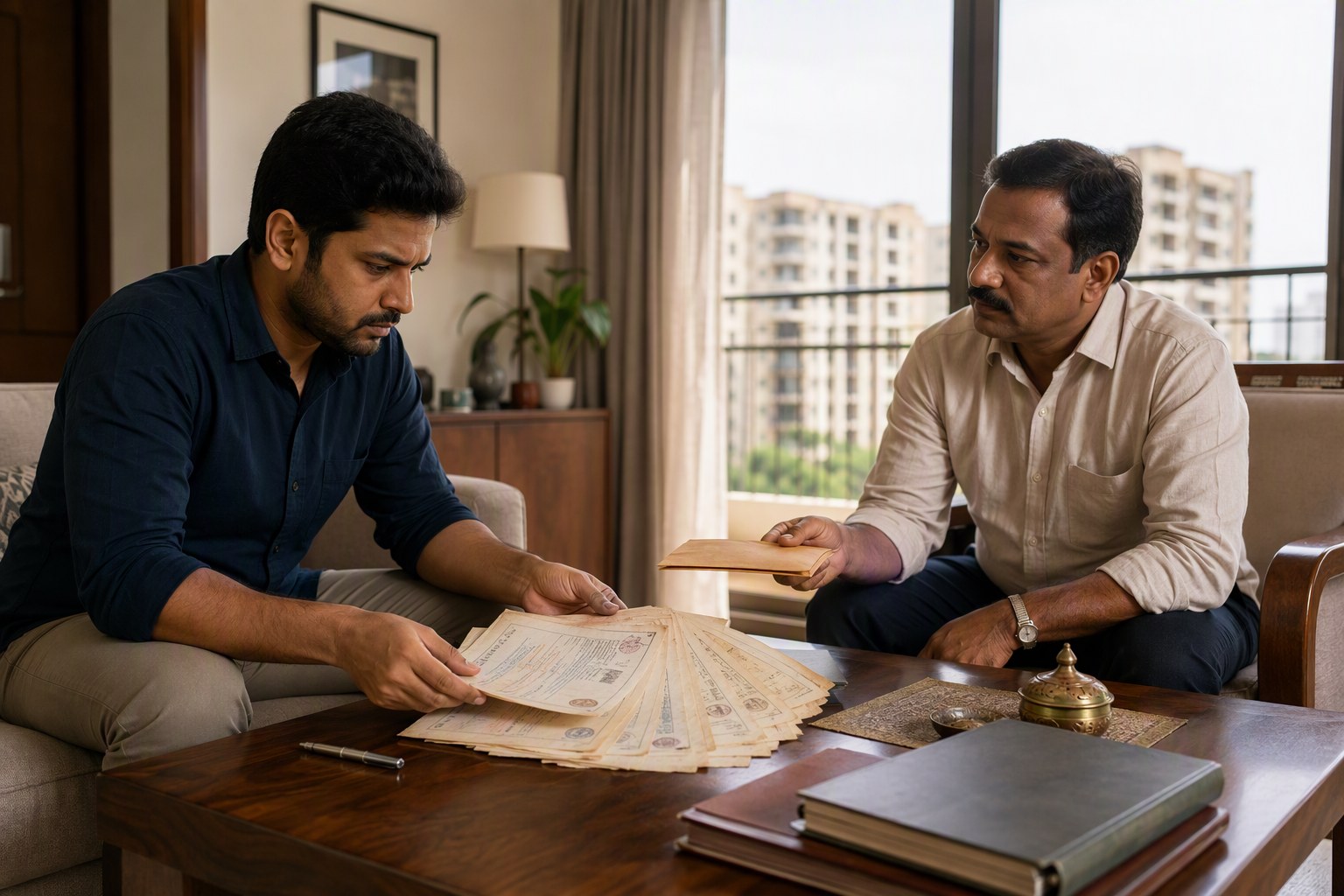
Can society dues delay your apartment sale closing? Yes, very much. In Hyderabad apartment resales, unpaid maintenance, corpus fund disputes, transfer charges, parking dues, clubhouse fees, and pending society NOC can slow down the final registration and handover. The SRO may not ask for your maintenance ledger, but the buyer, bank, apartment association, and advocate usually will. If the society does not issue a no-dues letter or NOC, your closing can get stuck at the exact moment when you thought the deal was finished.
We have seen this happen in Gachibowli, Kondapur, Narsingi, Manikonda, Miyapur, Kukatpally, Uppal, Kompally, and even older apartment blocks in Himayatnagar and Begumpet. The seller has found a buyer, token is paid, draft sale deed is ready, stamp duty is calculated, but one email from the apartment association says: maintenance pending. Suddenly everyone pauses.
My view is simple: before you list your flat, treat society dues like a title document. If they are unclear, the buyer will treat the flat as unclear.
Can Society Dues Delay Your Apartment Sale Closing in Hyderabad?
In practical terms, yes. Society dues can delay your apartment sale closing even when your title is clean and your sale deed is valid. The reason is not only legal. It is operational. The buyer wants possession without old liabilities. The bank wants a clean resale file. The apartment association wants dues cleared before changing the owner name in its records. The advocate wants no last-minute risk. These four people can slow down the closing even if the sub-registrar office is ready.
In Telangana, apartment resale closing usually involves two tracks. One is the registration track: title documents, EC, market value, stamp duty, SRO jurisdiction, PAN, Aadhaar, and sale deed. The other is the society track: no-dues certificate, NOC if applicable, transfer process, move-out rules, parking confirmation, and handover of access cards or amenities. Sellers often focus only on the first track. That is where the trouble starts.
Before you fix the registration date, check the property background through Encumbrance Certificate Search, confirm the applicable market value through Market Value / Guideline Value Search, and verify the SRO through Find Your SRO Office. These tools help on the registration side. For the society side, your best tool is a written ledger from the association.
Why Society Dues Delay Apartment Sale Closing
Society dues delay apartment sale closing because they create uncertainty over who will pay what. In a clean resale, the seller clears all dues up to the agreed handover date, and the buyer starts paying from possession or registration date, depending on the agreement. When this is not written clearly, the buyer fears hidden arrears.
Common problem areas include monthly maintenance, sinking fund, corpus fund, repair fund, water tanker charges, diesel generator charges, clubhouse fees, move-out charges, transfer charges, painting fund, penalty for late payment, and separate bills for extra car parking. In many gated communities around Financial District, Kokapet, Nanakramguda, Tellapur, and Nallagandla, there can also be app-based billing histories. If the seller has not downloaded the latest statement, nobody knows the exact pending amount.
In smaller associations in areas like Chandanagar, Ameenpur, Hafeezpet, Attapur, Bandlaguda Jagir, and Nagole, the issue may be less digital but more personal. The association treasurer may maintain records in Excel or a physical register. If there is a committee change, old dues can suddenly appear. Buyers do not like surprises after paying the booking advance.
1. Unpaid maintenance is the most common blocker
Monthly maintenance arrears are the easiest for a buyer to understand and the hardest for a seller to argue against. If you have not paid maintenance for a few months, clear it before the sale agreement. Do not wait till the registration week.
Some sellers say, “I am not living there, why should I pay full maintenance?” That argument may work inside a committee meeting, but during resale it weakens your negotiating position. The buyer will ask for a no-dues certificate. The association may refuse until the ledger is cleared.
2. Corpus fund disputes can become emotional
Corpus fund is a frequent pain point in Hyderabad apartment resales. The seller may have paid a corpus to the builder or association at the time of purchase. Later, the association may collect extra corpus for major repairs, façade work, lift replacement, STP upgrades, or security system improvements. When a resale is happening, the seller and buyer may both say the other person should bear it.
My suggestion: mention corpus treatment in the agreement of sale. If any refundable corpus exists, say who will receive it. If any non-refundable corpus or transfer contribution is payable, say who will pay it. A one-line clause can save two weeks of calls.
3. Transfer charges are often misunderstood
Many apartment associations collect transfer charges when the flat ownership changes. Some call it transfer fee, some call it admission fee, some call it documentation fee. Buyers sometimes object, saying the seller should pay. Sellers sometimes say the buyer is joining the association, so buyer should pay.
There is no universal practice across Hyderabad. A high-rise society in Serilingampally mandal may follow a different rule from an older apartment in Khairatabad mandal. The safest route is to get the society’s written transfer policy before signing the sale agreement. Do not rely on watchman-level information or WhatsApp forwards.
4. Pending approvals can stop handover even after registration
In some societies, registration can happen without society NOC. But handover becomes difficult later. The buyer may not get name transfer in the association portal, parking sticker, biometric access, intercom activation, clubhouse usage, or move-in permission until the society paperwork is complete.
This is why buyers now ask for society documents before paying the major advance. In our experience, serious buyers in IT corridor locations such as Gachibowli, Nanakramguda, Puppalaguda, Kokapet, Kondapur, and Tellapur are very particular about this. Many are taking home loans, and their banks also ask for a clean resale file.
Documents to Collect Before You Sell an Apartment
A Hyderabad apartment seller should collect society papers before the buyer’s advocate asks for them. It gives confidence and reduces bargaining drama. Keep scanned copies ready.
- Latest maintenance ledger from the association
- No-dues certificate, if the association issues one
- Society NOC, if required under the apartment rules
- Corpus fund payment proof
- Transfer charge policy or written confirmation
- Parking allotment letter or parking confirmation
- Clubhouse, access card, and amenities handover list
- Minutes or circulars about major repair collections, if any
- Move-out rules and refundable deposits, if applicable
On the government-document side, keep your sale deed, link documents, latest EC, property tax receipt, sanctioned plan or occupancy-related papers available. Use EC Analyzer to read the EC more clearly, and CERSAI Charge Check if the buyer or bank wants to see whether any secured loan charge is appearing separately.
For apartments where land title is being reviewed more deeply, especially in layouts that moved from gram panchayat to municipality or corporation limits, you can also run a broader check through Property Verification Tool. Telangana has 3,076,153 prohibited properties under Section 22-A as per latest IGRS data, so a buyer’s advocate may also ask whether the underlying land or survey number has any restriction. For that, use Section 22-A Prohibited Property Check.
Can Society Dues Delay Your Apartment Sale Closing at the SRO?
Strictly speaking, society dues are not the same as stamp duty or registration fee. The SRO focuses on the sale deed, parties, property description, market value, payment details, identity, and other registration requirements. But the SRO appointment is only one part of closing. If the buyer refuses to come for registration because the no-dues certificate is pending, your SRO slot becomes useless.
Stamp duty and market value preparation should continue in parallel. Do not wait for society disputes to finish before checking numbers. Use Stamp Duty Calculator and Composite Value Calculator to plan the transaction value, especially where undivided share of land and super built-up area have to be understood properly.
In a resale, the buyer’s bank may ask for the final sale deed draft, EC, prior title documents, NOC from the existing lender if the property has a loan, and sometimes society NOC or no-dues proof. If one item is missing, loan disbursement can be held back. That is where society dues indirectly delay registration.
How to Handle Maintenance, Corpus, and Transfer Charges in the Sale Agreement
A good agreement of sale should not only mention price and registration date. It should clearly handle apartment association dues. Too many sellers use a standard draft and then argue later. That is poor preparation.
Include clauses on these points:
- Seller will clear maintenance and society dues up to a specific date.
- Buyer will pay maintenance from possession date or registration date, as agreed.
- Any past arrears, penalties, or old repair fund demands will be seller’s responsibility.
- Any future demand raised after possession for future period will be buyer’s responsibility.
- Transfer charges will be paid by seller, buyer, or shared, as mutually agreed.
- Corpus refund, if any, will belong to the party named in the agreement.
- Seller will provide no-dues certificate or written ledger before registration.
- Possession, keys, parking access, and amenities cards will be handed over only after final payment.
If you need a starting draft, use Legal Document Generator, but get the final document checked by a property lawyer. A small drafting mistake can become a large argument during closing.
Local Hyderabad Examples Sellers Should Understand
Let us take a common case in Kondapur, Serilingampally mandal. The seller has moved to Bengaluru and rented out the flat. Maintenance is paid by the tenant for a few months, then missed for some time. The buyer agrees to buy the flat and applies for a bank loan. During verification, the society ledger shows unpaid maintenance and late fees. The buyer asks the seller to clear it. The seller says the tenant should pay. The tenant says the owner deducted enough from the deposit. Registration is pushed.
Another case: a flat in Manikonda or Puppalaguda has one covered car parking in the sale deed wording, but the society records show parking was internally reassigned years ago. Buyer wants written confirmation before closing. The association refuses because transfer charges and repair fund are unpaid. Again, sale closing slows down.
In older apartments in Ameerpet, Somajiguda, Narayanguda, and Secunderabad, the society may not have a formal NOC format. Still, a buyer may ask for a letter on association letterhead stating that there are no dues against the flat. If the committee is inactive, getting signatures itself can take time.
In fast-growing areas like Bachupally, Nizampet, Ameenpur, Kollur, Tellapur, and Osman Nagar, some projects are still moving from builder maintenance to association maintenance. If the handover from builder to association is incomplete, dues may be split between builder account and association account. Sellers must clarify both.
Seller Checklist: Clear Society Dues Before Closing
| Item | Why it matters | Best time to handle |
|---|---|---|
| Maintenance ledger | Shows monthly dues, penalties, and payment history | Before listing the flat |
| No-dues certificate | Gives buyer confidence before registration | Before sale agreement or at least before bank disbursement |
| Corpus fund status | Avoids dispute over past and future collections | During price negotiation |
| Transfer charge policy | Clarifies who pays the association transfer fee | Before signing sale agreement |
| Parking confirmation | Prevents handover dispute after registration | Before buyer’s legal verification |
| Move-out and move-in rules | Helps buyer plan shifting without society objection | Before final payment |
Red Flags Buyers Notice Immediately
Buyers have become sharper. Many of them read ECs, check RERA details for newer projects through RERA Project Lookup, compare guideline values, and ask pointed questions. If your answers are vague, they become cautious.
These red flags can hurt your sale:
- You say “all dues are clear” but cannot show a ledger.
- The society office says the flat has pending charges.
- The parking number in society records differs from what you are selling.
- You refuse to clarify transfer charges in writing.
- You say corpus is refundable but have no receipt or policy.
- The association has a dispute with the builder over common areas.
- The buyer cannot get confirmation on amenities access after purchase.
When buyers see these gaps, they either reduce the offer, delay payment, or walk away. Sellers often blame the buyer for being too cautious. I disagree. A buyer paying serious money for a Hyderabad apartment has every right to ask for clean handover.
Who Should Pay Society Dues During an Apartment Sale?
There is a fair market practice. The seller should pay all dues up to the agreed cut-off date. The buyer should pay dues after possession or registration, depending on what both parties write. Transfer charges can be negotiated. Corpus treatment should be written.
Do not leave this to oral understanding. Hyderabad real estate deals move fast until money is stuck. Once there is a disagreement, every party starts reading WhatsApp messages like legal notices. Put the dues clause in the agreement and attach the latest society ledger as an annexure if possible.
If there is a home loan on the property, coordinate three parties early: existing bank, buyer’s bank, and society. The seller has to get loan closure figures, the buyer has to get sanction and disbursement, and the society has to confirm no dues. If these are handled one after another, closing can stretch. Handle them together.
Practical Closing Plan for Sellers
Here is the plan I recommend to apartment sellers in Hyderabad and nearby municipalities:
- Before listing: collect maintenance ledger, property tax receipt, EC, sale deed, parking proof, and loan statement if any.
- Before accepting token: disclose any pending society dues or repair fund demand honestly.
- Before sale agreement: decide who pays maintenance, corpus, and transfer charges.
- Before buyer bank login: give all society papers and title papers in one folder.
- Before registration: obtain no-dues certificate or written confirmation from association.
- On handover day: document keys, access cards, parking remotes, gas connection status, electricity meter reading, and amenities cards.
A seller who prepares like this usually closes faster and negotiates better. Clean paperwork is not only for lawyers. It protects your sale price.
Final View: Can Society Dues Delay Your Apartment Sale Closing?
Can society dues delay your apartment sale closing? Yes. They may not always block registration directly, but they can delay buyer approval, bank disbursement, possession, name transfer, and final payment. In Hyderabad apartment resales, society clearance is now part of market hygiene.
My advice is blunt: do not treat maintenance dues as a small back-office matter. Clear them, document them, and mention them in the sale agreement. If there is a dispute, resolve it before you start pushing the buyer for registration dates. A flat with clean title and clean society records sells with less stress.
Frequently Asked Questions
Can unpaid society dues stop apartment registration in Telangana?
Society dues may not directly stop SRO registration in every case, but they can stop the buyer from proceeding, delay bank disbursement, and block possession or association name transfer. So, practically, they can delay the closing.
Who pays maintenance dues during an apartment resale?
Usually, the seller pays maintenance and arrears up to the agreed cut-off date, and the buyer pays after possession or registration. The exact date should be written in the agreement of sale.
Is society NOC compulsory for selling a flat in Hyderabad?
It depends on the society rules, bank requirements, and buyer’s legal checklist. Even where it is not strictly compulsory for registration, buyers commonly ask for a no-dues letter or NOC before closing.
Can an apartment association charge transfer fees on resale?
Many associations collect some form of transfer charge or documentation fee. The seller should get the written policy and agree with the buyer on who will pay it before signing the sale agreement.
What should I check before selling my Hyderabad apartment?
Check your EC, market value, SRO jurisdiction, loan closure status, maintenance ledger, corpus fund status, transfer charges, parking record, and society no-dues certificate before fixing the registration date.