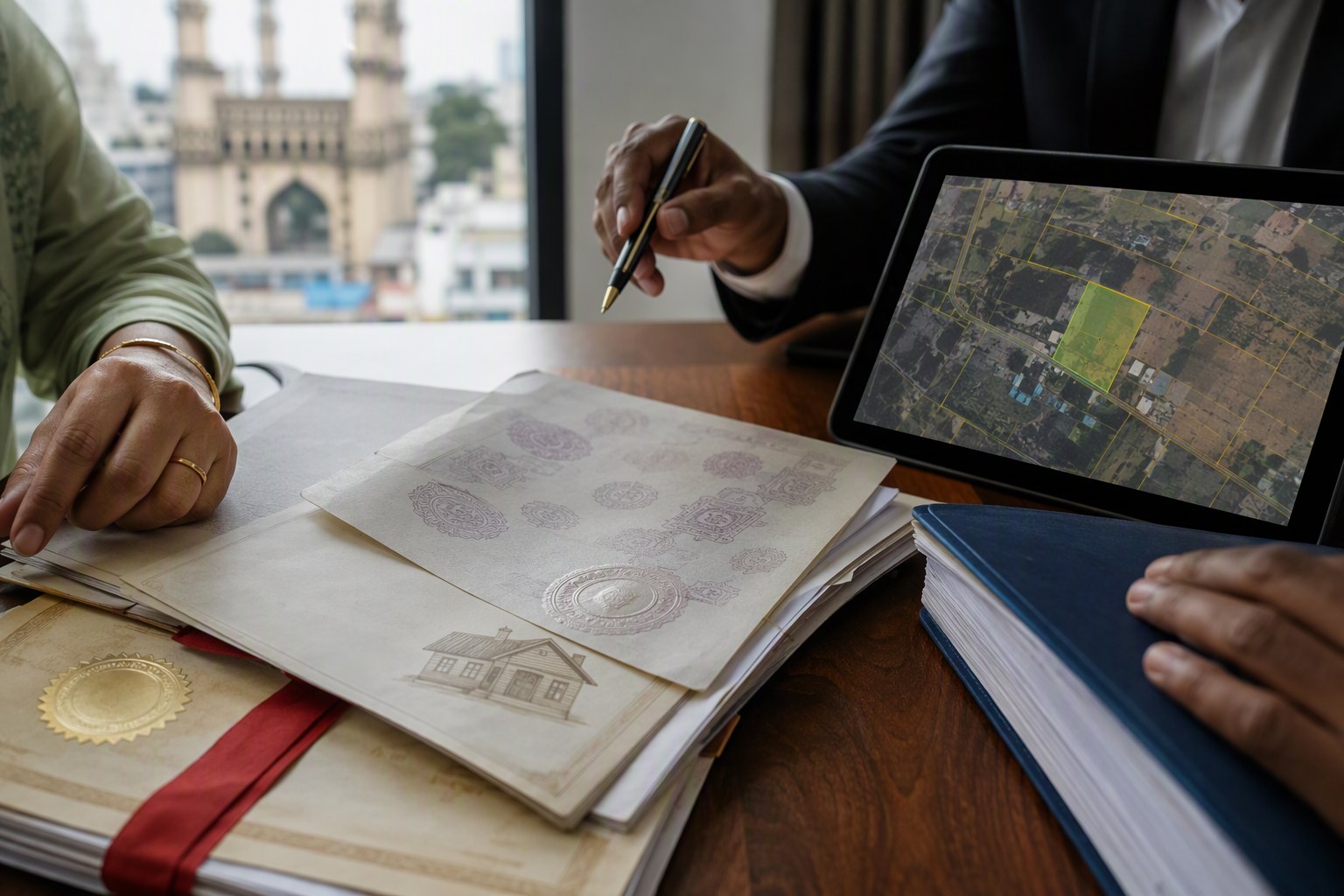
Telangana 22-A proof may soon become one of the first documents buyers, banks and future title insurers ask for before touching a land deal in Hyderabad’s expanding real estate belt. The reason is simple: as per latest IGRS-linked records available in our database, Telangana has 3,076,153 prohibited property entries under Section 22-A. That is not a small side issue. It directly affects saleability, registration confidence, bank comfort and the way buyers verify title before paying token advance.
Title insurance is still not a normal retail product for every plot buyer in Telangana. But the discussion around title risk is becoming sharper, especially in layouts and plotted developments around Shankarpally, Mokila, Maheshwaram, Adibatla, Medchal, Dundigal, Patancheru, Ghatkesar and Yadagirigutta side. In our experience, buyers are no longer asking only, “Is the price good?” They are asking, “Will this land register cleanly, and will anyone question the title later?”
Why Telangana 22-A proof may matter in title insurance talks
Section 22-A is the list of properties prohibited from registration. In plain Indian English, if a property falls under this category, the Sub-Registrar Office may not allow normal registration. These entries can relate to government land, assigned land, endowment land, wakf-linked land, court or departmental restrictions, and other notified categories depending on the record.
For a title insurer or even a conservative bank legal team, this is not a minor checklist item. It is the first filter. If a survey number appears in the prohibited properties database, the risk is not theoretical. It can stop the sale deed itself or create a future dispute even after the buyer has spent money on agreement, legal opinion, layout checks and loan processing.
My view is straightforward: any future title insurance underwriting in Telangana will have to treat 22-A status as a gatekeeping test, not as a last-minute formality.
This does not mean every 22-A entry is automatically a fraud story. Some records may need clarification, correction, de-notification, mutation follow-up or department-level explanation. But from a buyer’s side, the burden is real. You cannot treat it casually just because the seller says “registration ayipothadi sir”.
Telangana 22-A proof and the size of the verification problem
The number that stands out is 3,076,153. That is the count of prohibited property records in the available database context. For Hyderabad-facing markets, this matters because land transactions are moving far beyond core municipal areas into revenue villages and gram panchayat zones where survey-number history is often more complicated.
Take common buyer hotspots: Kokapet and Narsingi in Gandipet mandal, Tellapur and Osman Nagar in Ramachandrapuram side, Mokila and Shankarpally, Tukkuguda and Maheshwaram, Adibatla in Ibrahimpatnam belt, Kompally and Medchal, Bachupally and Dundigal. The product may look modern — gated plots, villa communities, HMDA layouts, RERA-registered projects — but the base land still has a revenue story. That story sits in survey numbers, pahani extracts, mutation records, old sale deeds, ECs and government restriction lists.
For buyers, the practical starting point is to run a Section 22-A Prohibited Property Check before paying advance. If you do not know the survey number, use the Survey Number Finder. If you want a broader first-level screen, our Property Verification Tool helps organise the checks in one place.
How underwriters may read Telangana 22-A proof
Title insurance underwriting is about risk pricing and exclusions. A clean sale deed alone may not satisfy an underwriter if the land has unresolved 22-A flags, patchy EC history, unclear link documents or mismatch between revenue and registration records.
In a Telangana context, future underwriting expectations may look like this:
- 22-A status: Is the survey number or property ID in the prohibited properties list?
- EC history: Does the Encumbrance Certificate show clean and continuous transactions?
- Revenue trail: Do pahani, Dharani entries and mutation records support the seller’s claim?
- SRO mapping: Is the correct Sub-Registrar Office identified for the village and property?
- Layout approvals: Is the project approved by the correct authority such as HMDA, DTCP or local body?
- Project registration: For applicable developments, is the project visible in RERA records?
Buyers can start with an Encumbrance Certificate Search and then use the EC Analyzer to read the document more carefully. For apartment or villa projects, the RERA Project Lookup should also be part of the due diligence file.
Buyer-side due diligence must move before agreement stage
Many buyers still do verification after paying token advance. That is risky, especially in land parcels and plotted ventures. Once money is paid, emotion enters the deal. Sellers start saying “one more buyer is ready”, brokers push for agreement, and families feel pressure to close. This is exactly when mistakes happen.
For Telangana land, I prefer this order:
| Stage | What buyer should check | Why it matters |
|---|---|---|
| Before token | 22-A status, survey number, basic ownership claim | Stops you from entering a blocked or doubtful property |
| Before agreement | EC, link documents, pahani, Dharani, layout approval | Confirms title chain and land use comfort |
| Before registration | SRO, stamp duty, market value, document draft | Avoids last-minute registration surprises |
| After registration | Mutation and record update tracking | Ensures buyer name reflects in relevant records |
For registration planning, buyers should check the correct office through Find Your SRO Office. For government market value reference, use Market Value / Guideline Value Search. For duty planning, use the Stamp Duty Calculator. These tools do not replace a lawyer, but they make the buyer ask sharper questions.
Why Hyderabad’s growth corridors need stricter 22-A screening
Hyderabad’s outer growth is land-led. Flats in Gachibowli, Kondapur or Miyapur are one kind of product. Open plots near Shadnagar, Kadthal, Moinabad, Kandukur, Bibinagar or Toopran are a different product altogether. With land, the survey number is everything.
We’ve seen buyers get attracted by road proximity, ORR access, Pharma City talk, proposed industrial growth or airport-side narratives. Those factors may support long-term demand, but they cannot cure a title defect. A wide road, compound wall, entrance arch and marketing brochure cannot override a prohibited property entry.
This is where title insurance conversations can push the market in a healthier direction. If insurers, banks and institutional buyers insist on 22-A proof, developers and land aggregators will be forced to clean up documentation before selling. That is good for genuine builders also, because clean documentation becomes a selling point.
Telangana 22-A proof is not the only check, but it is the first red flag check
A property can be outside 22-A and still have problems. There may be family disputes, unregistered agreements, missing link deeds, mortgage charges, boundary mismatches, ULC issues, layout deviations or road access questions. So buyers should not treat a clean 22-A result as full title clearance.
But if the property is present in the prohibited list, you must slow down immediately. Ask for written clarification. Ask which category applies. Ask whether any de-notification or correction order exists. Ask whether the seller has a legal opinion from an advocate who regularly handles Telangana land matters, not just a generic property consultant.
Also check CERSAI where loans or charges may exist by using CERSAI Charge Check. If buying for construction, do not ignore road and zoning checks; the Road Width Check and Land Use Zone Finder can help you frame the right questions.
What this means for buyers, builders and banks
For buyers, the message is clear: do not buy land in Telangana without 22-A verification. For builders, clean land records will increasingly decide funding comfort and buyer trust. For banks and possible title insurers, Telangana’s large prohibited-property database gives a ready risk filter, but it also demands careful interpretation.
My opinion is that the market will slowly move from “broker assurance” to “document proof”. This shift is already visible among NRIs, salaried buyers and families purchasing second homes around Hyderabad. They want screenshots, EC copies, SRO clarity, RERA details, pahani copies and legal notes before they transfer money. That is a good habit.
Title insurance may or may not become common immediately for every retail buyer. But the discipline it brings — documented risk checks, exclusions, underwriting questions and title history review — is exactly what Telangana land buyers need today. And in that checklist, Telangana 22-A proof will sit right at the top.
Frequently Asked Questions
What is Telangana 22-A proof?
Telangana 22-A proof is a verification that checks whether a property or survey number appears in the prohibited properties list under Section 22-A. If it appears, normal registration may be restricted.
Why does 22-A status matter for title insurance?
Title insurance depends on title risk. A property listed as prohibited can create registration and ownership risk, so any future insurer or bank legal team is likely to treat it as a major underwriting issue.
Can I buy a property if it is shown under 22-A?
Do not proceed casually. Ask for the exact reason, government clarification, correction or de-notification records, and take a proper legal opinion before paying advance or signing an agreement.
Is a clean 22-A check enough for buying land in Hyderabad outskirts?
No. It is only the first major red flag check. You should also verify EC, link documents, pahani, Dharani records, layout approval, RERA status where applicable, SRO jurisdiction and loan charges.
When should buyers do the 22-A check?
Before paying token advance. Once advance is paid, buyers come under pressure to close quickly. Early 22-A verification gives you better negotiation power and protects you from avoidable risk.