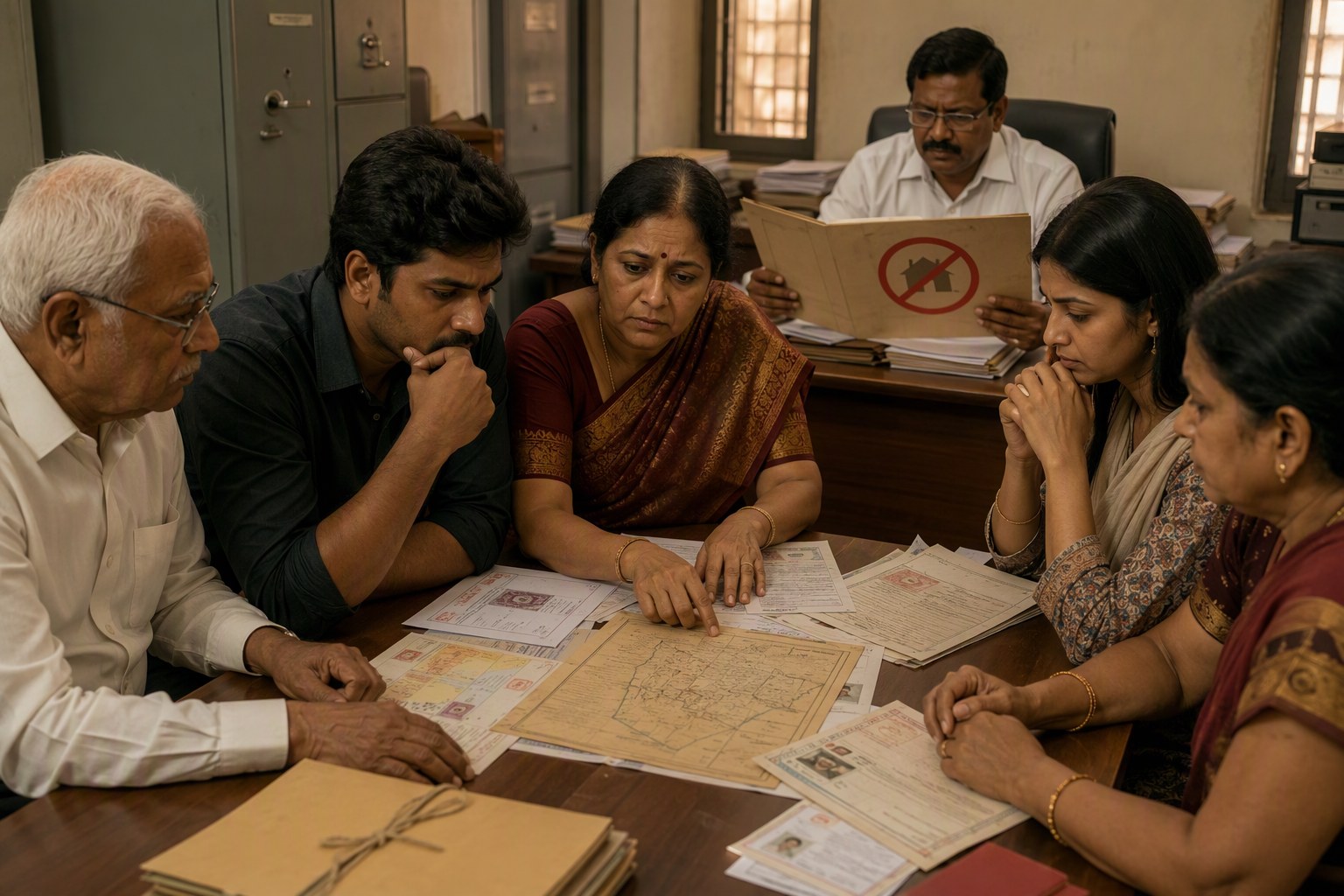
Telangana 22-A land notes may soon become a regular boardroom requirement for land-heavy companies, developers and family offices. The reason is simple: as per latest IGRS data available in our database, Telangana has 3,076,153 prohibited-property entries under Section 22-A. That scale is too large for audit committees to treat land title risk as a routine legal footnote.
In our experience, the pressure will first show up in three places: land advances, joint development agreements, and year-end disclosures. If a company is paying an advance for land in Kokapet, Mokila, Tellapur, Kollur, Ghatkesar, Maheshwaram or Shadnagar side, the audit committee may not be satisfied with only a sale deed copy and EC. They may ask: has the survey number been checked against 22-A? Which mandal record was reviewed? Is there any pahani or Dharani mismatch? Which SRO has jurisdiction?
Telangana 22-A land notes may become a pre-approval checklist item
Section 22-A is not a minor clerical flag. It is the list of properties where registration can be prohibited or restricted due to government interest, assigned land status, endowment or waqf claims, court orders, ceiling issues, or other notified reasons. For land buyers, a 22-A entry can stop a transaction at the SRO stage. For companies, it can also raise accounting, disclosure and governance questions.
Audit committees generally look at risk before money leaves the company. In Hyderabad’s land market, money often leaves early through token advances, refundable deposits, MoUs, development security deposits and JV consideration. That is exactly where Telangana 22-A land notes can become useful. A short note, backed by checks, gives directors a way to ask sharper questions before approving the next step.
My view is straightforward: for any sizeable land advance in Telangana, a board paper without a 22-A check is now incomplete. Not illegal by itself, but incomplete from a governance angle.
The practical concern is not only whether a sale deed can be registered today. It is whether the asset being shown to auditors, lenders, investors or JV partners has a clean enough title trail to justify the accounting treatment. If the land later turns out to be prohibited, the committee may have to explain why the risk was not flagged earlier.
Why Telangana 22-A land notes matter for advances, JVs and disclosures
Land transactions in and around Hyderabad are rarely single-document decisions. A parcel in Gandipet mandal, for example, may have a survey number history, subdivision history, old pahanis, Dharani mutation entries, EC entries at the SRO, and sometimes a zoning or layout angle. The same is true in Shankarpally, Moinabad, Abdullapurmet, Ghatkesar, Hayathnagar, Maheshwaram, Kandukur and Farooqnagar mandals.
When audit committees ask for a 22-A note, they are not trying to slow down the business. They are trying to reduce blind spots. A clean-looking document file can still have a registration prohibition attached to the survey number. On the other side, a 22-A mention may require explanation, rectification, de-notification, or a different deal structure.
For companies with active land banks, we have seen these questions becoming more common:
- Is the survey number appearing in the prohibited property list?
- Has the village, mandal and SRO mapping been independently checked?
- Does the EC match the claimed ownership chain?
- Is the land agricultural, converted, plotted, or part of a development approval file?
- Are there government, assigned, endowment, waqf or court-related remarks?
- If an advance is already paid, is recoverability assessed?
These are not academic points. If a company has paid money for land and cannot complete registration, auditors may ask whether the advance is recoverable. If a JV is signed on land with title restrictions, revenue recognition and project disclosures may be questioned. If land is carried as inventory or capital work-in-progress, the title file becomes part of the audit trail.
What a proper Telangana 22-A land note should contain
A useful note should be short, factual and attached to source documents. It should not read like a generic legal opinion. Audit committees need a clear risk view, not ten pages of vague comfort language.
| Item | What the note should say | Why audit committees may ask |
|---|---|---|
| Property identity | Village, mandal, district, survey number, extent and SRO | To avoid checking the wrong parcel |
| 22-A status | Whether the property appears in prohibited-property records as per latest IGRS data | Registration risk directly affects deal approval |
| Ownership trail | Link documents, EC summary and mutation position | To support title and recoverability of advances |
| Revenue record check | Pahani, Dharani entry and any visible classification issue | To catch assigned or government land concerns early |
| Action view | Proceed, proceed with conditions, hold, or reject | Boards need a decision-ready recommendation |
Teams can start with a basic screening using Section 22-A Prohibited Property Check, then verify the survey details through Survey Number Finder. The SRO mapping should also be checked through Find Your SRO Office, because wrong jurisdiction creates unnecessary confusion during registration planning.
For deal files, I would also attach an EC review using Encumbrance Certificate Search or EC Analyzer. If the transaction value is being discussed at committee level, the finance team can refer to Market Value / Guideline Value Search and Stamp Duty Calculator for government value and duty planning. These tools do not replace a lawyer’s title opinion, but they make the first review far more disciplined.
Hyderabad land corridors where committees may become stricter
The stricter approach may be felt most in fast-moving corridors where land advances are common. Think of Kokapet and Neopolis side in Gandipet mandal, Mokila and Kondakal side in Shankarpally mandal, Kollur and Tellapur around the western growth belt, Adibatla in Ibrahimpatnam side, Tukkuguda and Maheshwaram on the southern side, and Ghatkesar, Pocharam and Bibinagar towards the eastern belt.
These locations attract developers, listed companies, warehousing operators, schools, hospitals, plotted layout players and high-net-worth investors. The deal sizes can be large, but the first approval note sometimes still depends on broker inputs, a photocopy of the sale deed and a verbal assurance that “registration will happen”. That style is slowly becoming risky.
Audit committees will likely ask for a written note even when management is confident. They may also ask the CFO or company secretary to record whether the transaction has been screened for 22-A restrictions, pending charges, litigation references and SRO-level registration feasibility.
Telangana 22-A land notes and accounting disclosures
The accounting impact depends on the stage of the transaction. If a company has only evaluated land, the matter may remain a due diligence point. If an advance is paid, recoverability becomes relevant. If a JV is signed, the committee may ask whether the landowner has the right to contribute the land. If the company has recognised the land as inventory or an asset, the title file must support that position.
Auditors may not automatically qualify accounts merely because a property needs more checking. But if a 22-A issue is known and not disclosed to the audit committee, the governance risk becomes serious. In a listed or investor-backed company, even a delayed registration can trigger questions from lenders and shareholders.
My practical suggestion is to classify land proposals into three buckets:
- Green: No 22-A hit, EC and revenue records broadly match, SRO position is clear.
- Amber: No final rejection, but revenue record, survey identity, mutation or old document trail needs clarification.
- Red: 22-A entry, government or assigned land concern, court restriction, or mismatch that can block registration.
This colour coding helps directors read the risk quickly. It also prevents the usual last-minute panic at the sub-registrar office.
What developers and CFOs should do now
Companies buying or pooling land in Telangana should create a standard 22-A note format. Keep it practical. One page for summary, annexures for documents. The note should be updated before advance payment, before signing the definitive agreement, and again before registration or financial statement closure.
For developers, this is especially relevant in land aggregation. One clean parcel does not clean the entire layout. Every survey number needs checking. For plotted projects, the risk is even more sensitive because buyers, bankers and RERA reviewers may ask questions at different stages. Where a project registration angle exists, teams should also verify project details through RERA Project Lookup.
For landowners, the message is equally clear. If your land has a mistaken 22-A entry, do not wait until a buyer is ready with payment. Start correction or clarification early through the proper government route. A clean file commands more confidence than a last-minute explanation.
Telangana’s 3,076,153 prohibited-property entries are a signal. Land governance is moving from informal comfort to documented verification. Audit committees may not ask for fancy reports. They will ask for evidence. In Hyderabad real estate, that is a healthy shift.
Frequently Asked Questions
What are Telangana 22-A land notes?
They are short due diligence notes recording whether a land parcel appears in Telangana’s Section 22-A prohibited-property records, along with survey number, mandal, SRO, EC and revenue record checks.
Why would an audit committee ask for a 22-A note?
Because land advances, JVs and asset disclosures can be affected if registration is blocked or title risk is discovered later. A 22-A note gives directors a documented basis for approval.
Is an Encumbrance Certificate enough to clear land title?
No. An EC shows registered transactions and charges, but it may not fully answer 22-A prohibition, revenue classification, Dharani, pahani or government land issues. It should be used along with other checks.
Which details are needed to check 22-A status?
You need the village, mandal, district, survey number, extent and SRO details. Wrong village or mandal mapping can lead to a wrong risk view.
Can a 22-A entry be corrected if it is wrong?
In some cases, yes, but it must be handled through the proper government process with supporting documents. Buyers and companies should not rely only on oral assurances.