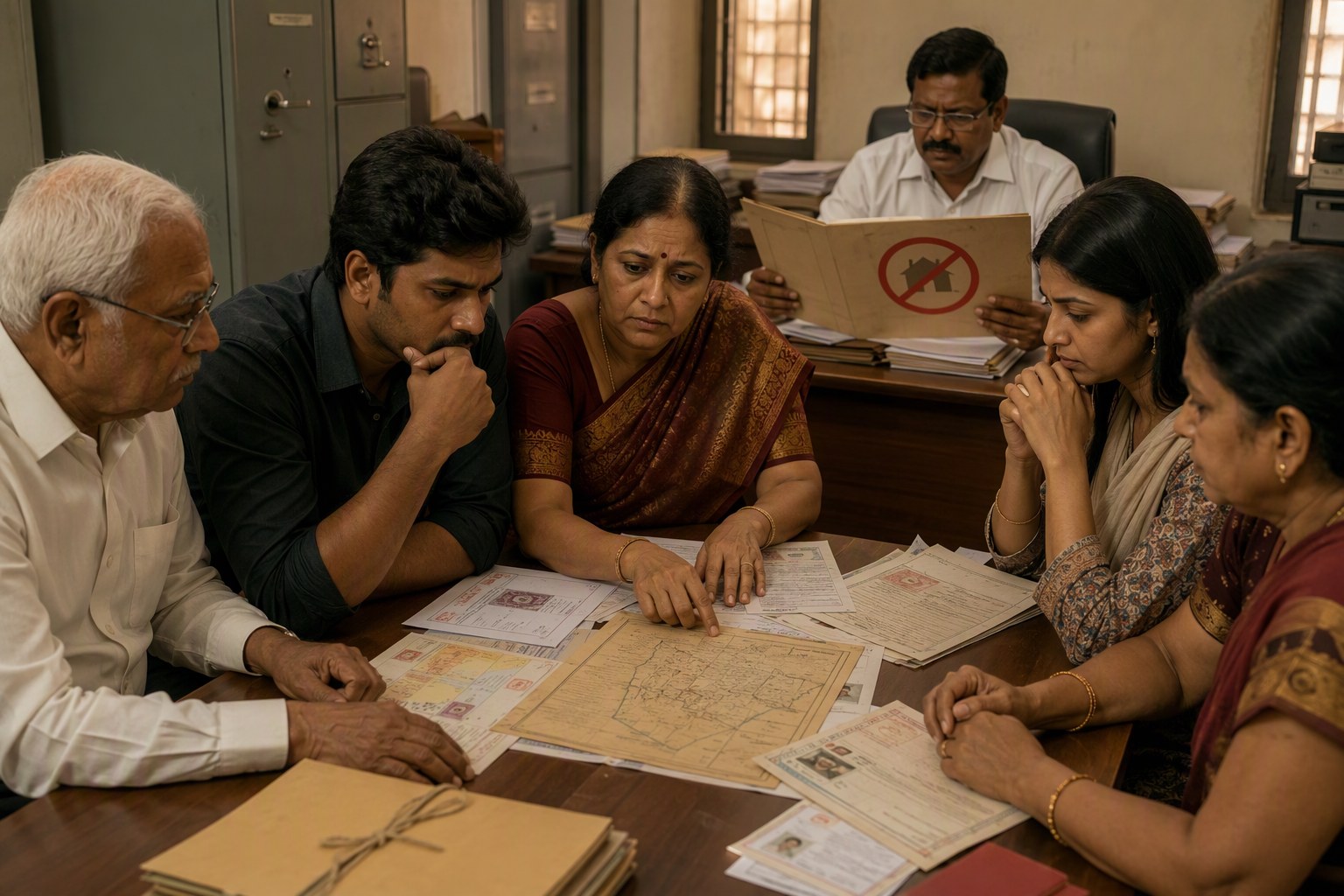
Section 22-A land risk is moving from the lawyer’s table to the boardroom in Telangana real estate deals. The reason is simple: as per the Verified.RealEstate database, Telangana has 3,076,153 prohibited property entries under Section 22-A. For developers, PE-backed platforms, plotted layout companies and even family offices buying land around Hyderabad, this is no longer a last-minute SRO surprise. It is a governance risk.
In our experience, audit committees have traditionally reviewed land acquisition as a cost, funding and approval issue. Title search was treated as a legal annexure. That approach is becoming risky, especially in growth corridors such as Kokapet in Gandipet mandal, Tellapur in Ramachandrapuram mandal, Mokila in Shankarpally mandal, Tukkuguda in Maheshwaram mandal, Shamshabad mandal, Hayathnagar, Medchal and Shamirpet. These are the very locations where a single survey number problem can freeze a land aggregation plan.
Our view: any board approving land purchase in Telangana without a Section 22-A screening note is approving a blind risk, not just a real estate transaction.
Section 22-A Land Risk Is Now a Board-Level Issue
Section 22-A entries are not small clerical obstacles. They can include lands where registration is restricted because of government interest, assigned land concerns, endowment issues, ceiling matters, court-linked restrictions or other prohibited categories reflected in government records. The exact reason has to be checked against the relevant village, survey number, pahani, Dharani record and SRO trail.
For a developer board, the problem is not only whether one sale deed can be registered. The bigger questions are:
- Can the company disclose clean land inventory to lenders and investors?
- Can the project be launched on schedule?
- Will RERA registration face title-related questions?
- Can customer advances be safely accepted?
- Will auditors have to flag contingent liability or impairment risk?
That is why we are seeing a change in the way serious buyers approach land. Earlier, many promoters would first agree on price, pay token advance and then ask the advocate to “check papers”. Now, better-governed companies are asking for survey-number screening before commercial terms are frozen. Tools like the Section 22-A Prohibited Property Check, Encumbrance Certificate Search and Survey Number Finder are becoming early-stage deal filters, not post-negotiation formalities.
Why Section 22-A Land Risk Hurts Hyderabad Land Deals
Hyderabad’s development model depends heavily on land aggregation. A residential tower site in Kokapet or Narsingi may involve fewer parcels, but a villa project in Mokila, a plotted layout near Shankarpally, or a warehouse land bank near Shamshabad can involve multiple survey numbers. If one key parcel is restricted, the site geometry, road access, mortgageability and approval strategy can change.
Boards must understand this practical point: land risk is not always visible from the road. A site may have compound walls, approach road, borewell, old sale deeds and even possession. Still, if the survey number is hit by a prohibited property entry, the transaction can get stuck at registration or later during financing. The SRO will not solve the buyer’s commercial problem. The SRO only acts on the record available to it.
In Telangana, the land record stack is layered. A buyer has to look at Dharani, pahani, ROR entries, old link documents, EC, mutation history, village map, SRO jurisdiction and the local classification of the land. For board reporting, this cannot be reduced to one line saying “title verified”. A better note should clearly say what was checked, what was not available, what exception was found, and what mitigation is proposed.
What Audit Committees Should Ask Before Approving Land Purchase
Audit committees are not expected to become revenue officers. But they should ask sharper questions. If a company is committing serious capital, taking debt or announcing a project pipeline, the board must know whether the land is registrable, mortgageable and approvable.
At minimum, I would expect an audit committee pack to include the following:
| Board question | Why it matters | Practical check |
|---|---|---|
| Is any survey number listed under Section 22-A? | Registration may be blocked or delayed. | Run a prohibited property check village-wise and survey-wise. |
| Does the EC match the seller’s ownership story? | Old mortgages, sales or court-linked entries can alter risk. | Use EC records and get the chain examined by counsel. |
| Which SRO has jurisdiction? | Wrong SRO assumptions create execution delays. | Confirm through local SRO mapping before signing. |
| Does the guideline value support the deal structure? | Stamp duty, accounting and funding planning depend on it. | Check ready reckoner or market value records. |
| Is the proposed use aligned with land use and access? | Title is only one part; approvals need planning compatibility. | Check land use, road width and layout constraints. |
For this first screen, boards can ask management to attach outputs from the Find Your SRO Office, Market Value / Guideline Value Search and RERA Project Lookup pages wherever relevant. These do not replace legal opinion, but they make the discussion more evidence-based.
Section 22-A Land Risk And Investor Due Diligence
Private equity funds, NBFCs and joint development partners are already sensitive to title risk. What is changing now is the level at which the issue gets escalated. If a prohibited property flag appears after term sheet stage, the deal may not merely get delayed; it can affect valuation, security creation, drawdown conditions and reputation.
For listed or professionally run developers, the risk also touches internal controls. A weak land diligence process can lead to poor capital allocation. If a company pays advances against land that later cannot be registered, the matter may come up in audit review. If the company has publicly spoken about a project launch, investor confidence can take a hit.
This is where audit committees should insist on a land acquisition SOP. The SOP should not be a decorative document. It should define who checks Dharani records, who verifies pahani, who reviews EC, who speaks to the SRO, who signs off on exceptions, and when the matter goes to the board. For large acquisitions, the board should also ask whether the legal team has physically reconciled the survey boundaries with the documents. Paper title and ground possession must talk to each other.
How Developers Can Build A Cleaner Land Screening Process
We’ve seen that the strongest land buyers follow a simple order: identify survey numbers first, negotiate price later. This is especially useful in peripheral Hyderabad where land parcels are often marketed through brokers using local names, old village names or informal boundary descriptions.
A practical screening workflow can look like this:
- Step 1: Identify the exact village, mandal and survey numbers. Do not rely only on location pins or broker maps.
- Step 2: Check Section 22-A status before paying a major advance.
- Step 3: Pull EC records and compare them with link documents.
- Step 4: Verify SRO jurisdiction and ready reckoner value for duty planning.
- Step 5: Check land use, road access and approval feasibility before assuming project potential.
- Step 6: Put exceptions before the investment committee or board, not after the sale agreement is signed.
For feasibility checks beyond title, teams can also use the Land Use Zone Finder, Road Width Check, FSI/FAR Calculator and Stamp Duty Calculator. The idea is not to make the board review every operational detail. The idea is to stop avoidable surprises.
What This Means For Sellers And Landowners
Landowners also need to read the signal correctly. If your land is clean, organise the papers before approaching developers. Keep pahani copies, link documents, mutation records, EC and family consent papers ready. If there is a 22-A issue, disclose it upfront and understand the reason. Trying to hide it rarely works because serious buyers will check the survey number.
In areas like Maheshwaram, Shankarpally, Medchal, Moinabad and Shamshabad, landowners often say, “Registration happened for the neighbouring land, so mine also will pass.” That is not a safe assumption. Section 22-A risk is survey-number specific. Even within the same village, one parcel can be clean and another can be restricted.
The Bottom Line For Telangana Boards
The presence of 3,076,153 prohibited property entries in Telangana changes the governance conversation. A board cannot treat title screening as a rubber-stamp legal formality. It is part of risk management, internal control, capital protection and project credibility.
My practical advice to developers is blunt: before approving any land deal in Hyderabad’s expansion corridors, ask for a one-page 22-A risk note. It should name the village, mandal, survey numbers, SRO, EC status, ready reckoner check and unresolved title exceptions. If management cannot produce that, the deal is not ready for board approval.
Clean land is not just land with possession. Clean land is land that can be registered, financed, approved, developed and sold without hidden record-level shocks. In Telangana’s current land market, that distinction matters.
Frequently Asked Questions
What is Section 22-A land risk in Telangana?
Section 22-A land risk refers to the risk that a property is listed as prohibited or restricted for registration under government records. If a survey number is affected, a buyer may face registration, financing or approval problems.
Why should audit committees review 22-A status before land purchase?
Because land title issues can affect capital deployment, project launch timelines, lender security, RERA filings and financial reporting. It is a governance matter, not only a legal checklist item.
Is an Encumbrance Certificate enough to prove clean title?
No. An EC is useful, but it does not by itself clear Section 22-A risk, land classification issues, family disputes, assigned land concerns or approval constraints. It should be read with Dharani, pahani, link documents and SRO records.
Which Hyderabad locations need extra caution for land deals?
Fast-growing land markets such as Kokapet, Narsingi, Tellapur, Mokila, Shankarpally, Tukkuguda, Shamshabad, Medchal and Shamirpet need careful survey-number checks because land aggregation and conversion risks can be high.
When should a developer run a prohibited property check?
Before paying a major advance or signing a binding sale agreement. The best practice is to check village, mandal and survey number details at the first serious negotiation stage.