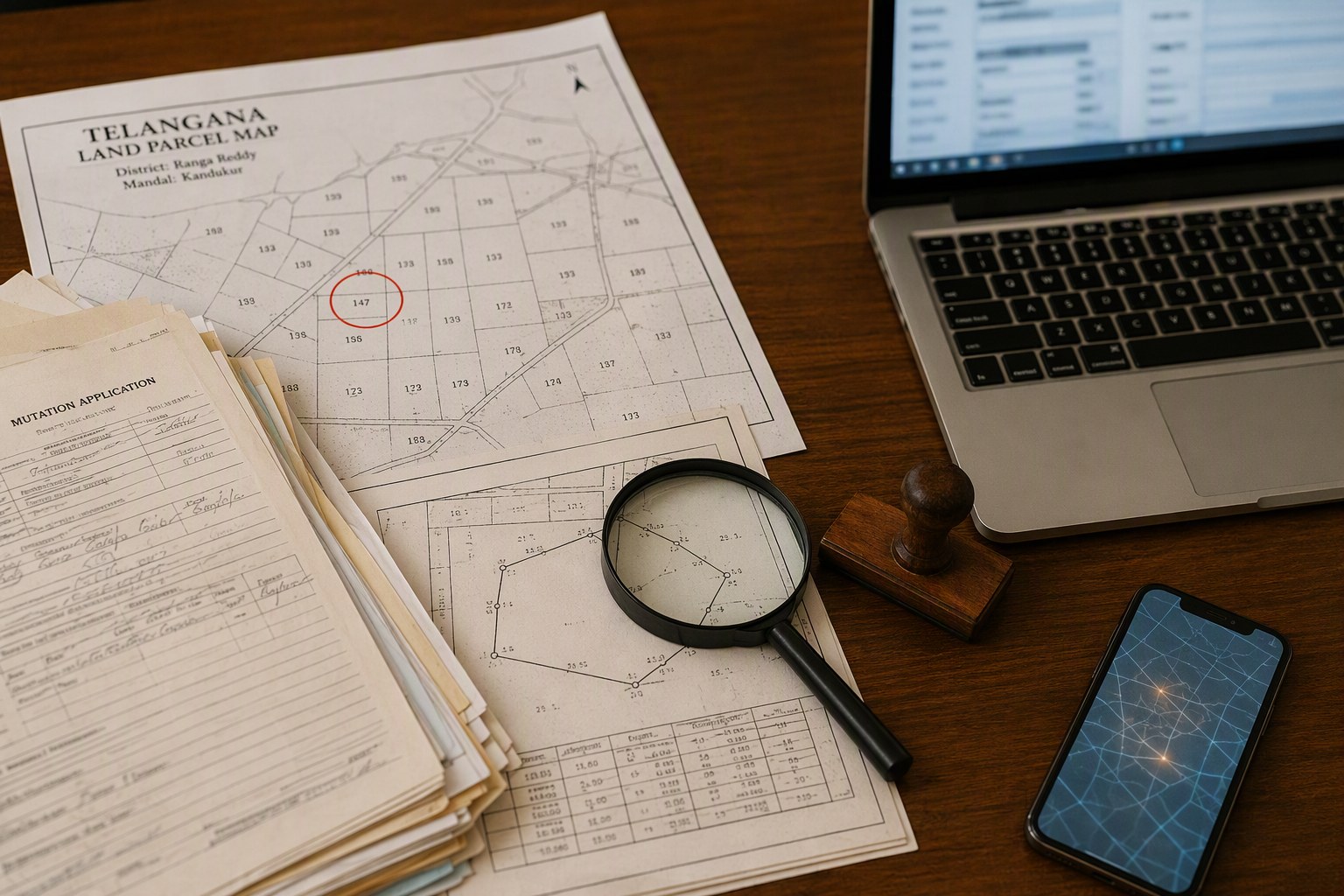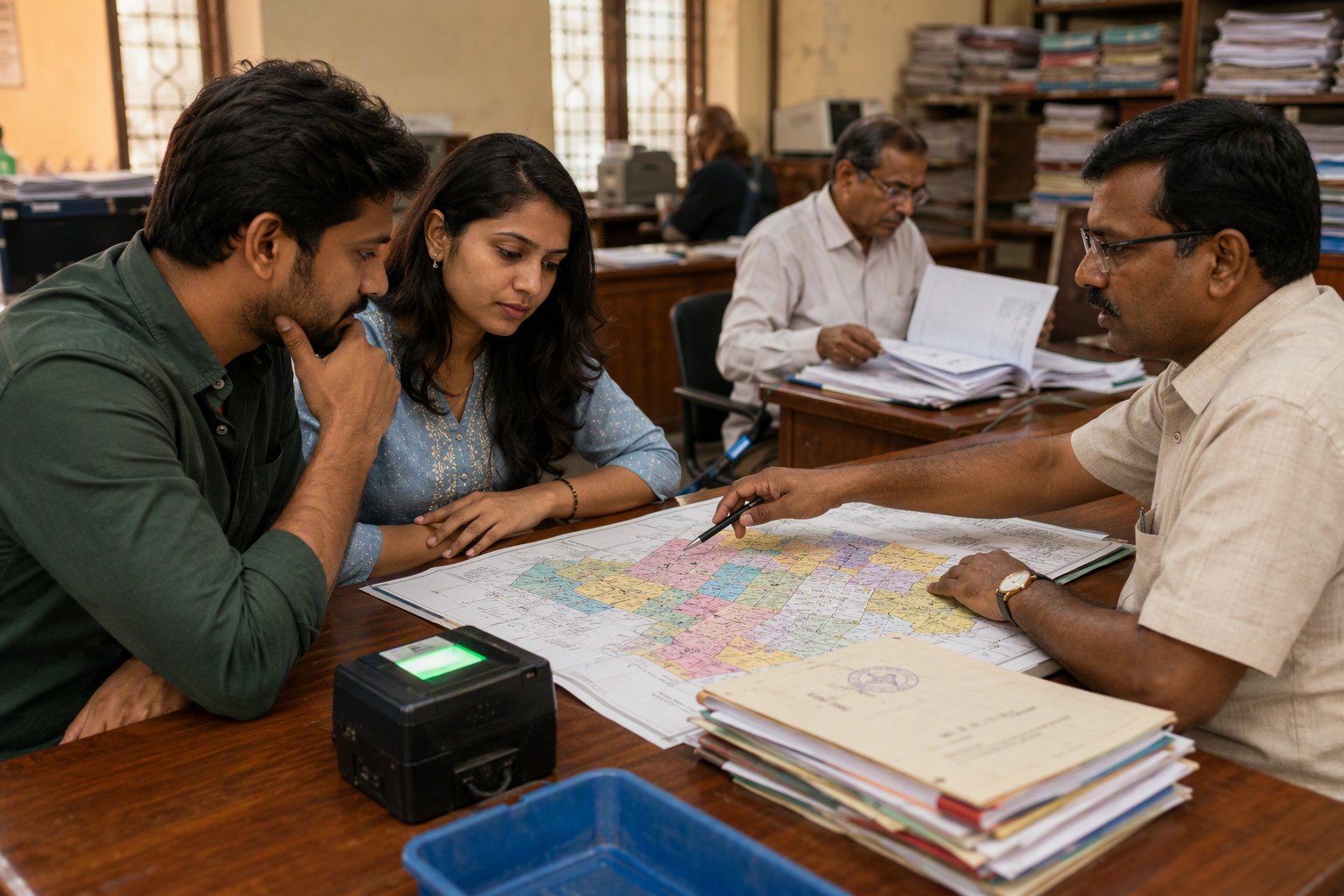
Telangana Unified Property ID is the next big government-policy story that Hyderabad property buyers should track closely. If implemented well, it can bring ownership records, property tax details, layout permissions, Dharani land data, SRO registration history and Section 22-A checks into one verification layer. For buyers in Gachibowli, Kokapet, Tellapur, Narsingi, Uppal or Maheshwaram, this could reduce the number of blind spots before signing an agreement of sale.
The idea is simple: one property, one identity number, and one connected trail. Today, a flat in Kondapur may have GHMC tax data, RERA project details, building permission records, EC data at the SRO, and UDS details in the sale deed. A plot in Shankarpally or Adibatla may have survey number, pahani, Dharani passbook, layout approval and market value records sitting in different systems. Buyers are forced to stitch the story themselves.
Telangana Unified Property ID could change property due diligence
The proposed unified property ID system matters because Telangana’s real estate market has moved faster than its public-record verification process. Hyderabad’s western corridor alone has seen serious buyer interest in Serilingampally mandal, Gandipet mandal, Patancheru belt and Mokila-Shankarpally side. On the other side, Maheshwaram, Tukkuguda, Adibatla, Hayathnagar and Ghatkesar continue to attract plot buyers and mid-segment apartment buyers.
In our experience, buyers do not usually get cheated because they skipped one big step. They get trapped because four small records do not match: the survey number in the sale deed, the pahani entry, the layout approval, and the SRO registration trail. A unified property ID can act as a common reference number across these records.
At present, a careful buyer has to check multiple places: Dharani for agricultural land and certain ownership trails, the registration department for encumbrance, municipal records for tax and building permissions, HMDA or DTCP layout approval, RERA for ongoing projects, and Section 22-A records for prohibited lands. Telangana already has 147,934 prohibited properties under Section 22-A. That one figure should make every buyer pause before paying token advance.
For Hyderabad buyers, the value of a unified property ID is not only convenience. It is risk reduction. A single mismatch should be visible before money changes hands.
What Telangana Unified Property ID may connect
A good unified ID should not become just another number printed on a tax receipt. It should connect the practical records that buyers, banks, lawyers and developers already use during verification.
| Record layer | What buyers check today | Why unified ID helps |
|---|---|---|
| Ownership and land record | Dharani, pahani, passbook, survey number | Shows whether the seller’s claim matches government land records |
| Registration history | Sale deeds, gift deeds, mortgage deeds, EC at SRO | Links registered transactions to the same property identity |
| Tax and municipal record | GHMC or municipality property tax assessment | Confirms door number, built-up area and tax payment trail |
| Planning approval | HMDA, DTCP, GHMC building permission or layout approval | Checks if the layout or building has legal permission |
| Regulatory checks | RERA, Section 22-A, court or government restriction | Flags projects or lands that need extra caution |
For a flat buyer in Nanakramguda or Financial District, the ID can connect the apartment, undivided share of land, sanctioned plan, RERA registration and property tax assessment. For a plot buyer in Shadnagar, Kandukur or Yacharam, it can connect the survey number, layout approval, land use zone and registration status.
Why Hyderabad buyers should not wait for the Telangana Unified Property ID
Even if the system comes in phases, buyers should not pause their present due diligence. Hyderabad has too many micro-markets with different risk profiles. A 2BHK resale flat in Miyapur has a different verification path from a villa plot in Kollur. An HMDA-approved plot near Moinabad is different from gram panchayat-era layouts in older village limits. A commercial property in Ameerpet or Kukatpally needs a different reading of tax, road width and usage.
Before any advance payment, start with the basics. Check market value using the Market Value / Guideline Value Search. This helps you compare the ready reckoner value with the quoted transaction value. Registration cost also matters; use the Stamp Duty Calculator before you negotiate final pricing. In Telangana, buyers usually budget for stamp duty, transfer duty and registration charges, so the landed cost is higher than the base sale price.
Then pull the registration trail through an Encumbrance Certificate Search. A clean EC does not mean the property is fully safe, but a bad EC can quickly show mortgages, earlier sales or missing links. For land, use the Survey Number Finder and cross-check whether the survey number in the agreement is the same as the one in land records.
For ongoing apartments, never skip the RERA Project Lookup. RERA details can show project registration, promoter information, approved plans and timelines. For plots and agricultural-to-non-agricultural conversions, run a Section 22-A Prohibited Property Check. With 147,934 prohibited properties on record, this is not a formality.
Telangana Unified Property ID and the Section 22-A problem
Section 22-A is where many casual buyers wake up late. If land is listed as prohibited, registration may be blocked or disputed. This can include government land, assigned land, endowment land, wakf-related entries, ceiling surplus land or other restricted categories. The issue is especially sensitive in expanding belts where old village records meet new real estate demand.
We have seen buyers in the outskirts focus only on price per square yard and road approach. That is dangerous. A plot near ORR access, a proposed pharma cluster, an IT corridor extension or a new radial road may look attractive, but the first question should be: is the title registrable and clean?
A unified property ID can help if it flags Section 22-A status directly against the property. It should also show if only part of a survey number is affected. This matters because one survey number may have multiple sub-divisions, old pattas, family partitions and layout conversions.
What should a buyer check under the new ID system?
Once Telangana Unified Property ID becomes operational, buyers should treat it as a starting point, not the only check. Government databases can have spelling errors, old entries, wrong extents and delayed updates. A practical buyer should match the ID with the following:
- Seller name in sale deed, Aadhaar-linked documents and previous link documents
- Survey number, sub-division number, door number or flat number
- Extent of land, UDS, built-up area and super built-up area
- SRO jurisdiction using Find Your SRO Office
- Land use through the Land Use Zone Finder
- Road width and planning feasibility through the Road Width Check
- FSI or FAR feasibility using the FSI/FAR Calculator
- Overall risk using the Property Verification Tool
For investors buying in fast-moving areas like Kokapet, Neopolis surroundings, Tellapur, Kollur, Bachupally, Bowrampet, Kompally and Pocharam, price growth should not replace title discipline. We’ve seen buyers accept photocopies, WhatsApp documents and broker assurances. That is not due diligence.
How it may affect builders, banks and resale sellers
Developers may have to keep their approvals cleaner and easier to trace. Banks may use the unified ID to speed up legal and technical checks before sanctioning home loans. Resale sellers may benefit if their property record is clean because buyers can verify faster and negotiate with more confidence.
For apartment associations, the ID can reduce confusion between municipal door numbers, builder flat numbers and registration descriptions. In older Hyderabad localities like Himayatnagar, Mehdipatnam, Secunderabad, Dilsukhnagar and Malakpet, mismatched door numbers and tax records are common. A unified layer can make these legacy properties easier to map over time.
There will be teething issues. Legacy data migration is never easy. Telangana has urban properties, agricultural lands, assigned lands, old layouts, merged municipalities, gram panchayat records and court-disputed properties. If the unified ID system simply joins databases without cleaning them, buyers may still need legal interpretation. But even a partial single-window verification layer is better than today’s scattered process.
Our view on Telangana Unified Property ID
My view is clear: Telangana Unified Property ID is needed, but it must be buyer-facing, searchable and transaction-linked. It should not be useful only to departments. If a buyer can enter one ID and see tax status, registration history, approval status, land use, prohibited-property flag and SRO details, the market becomes safer.
The biggest gain will be in the first 10 days of a transaction. That is when buyers usually pay booking amount, token advance or agreement advance. If red flags appear early, families can save lakhs of rupees and years of litigation.
Until the government rolls out the system fully, use available public records and verification tools. Hyderabad real estate rewards speed, but Telangana property buying rewards patience. A clean title is still the best discount you will ever get.
Frequently Asked Questions
What is Telangana Unified Property ID?
Telangana Unified Property ID is expected to be a single identity number for a property, linking ownership, tax, registration, approval and land records into one verification layer.
Will Telangana Unified Property ID replace legal verification?
No. It can make verification faster, but buyers should still check sale deeds, EC, pahani, Dharani records, approvals, RERA status and Section 22-A status with professional help.
Why is Section 22-A checking necessary in Telangana?
Telangana has 147,934 prohibited properties under Section 22-A. If a property falls in this list, registration can be blocked or legally disputed.
Which Hyderabad areas need extra property verification?
Fast-growth belts such as Kokapet, Tellapur, Kollur, Shankarpally, Maheshwaram, Tukkuguda, Adibatla, Ghatkesar and Shadnagar need careful checks because land conversion, layout approval and title history can vary from parcel to parcel.
What should I check before paying advance for a Telangana property?
Check guideline value, EC, SRO jurisdiction, survey number, RERA status for projects, land use, layout approval and Section 22-A status before paying token or agreement advance.