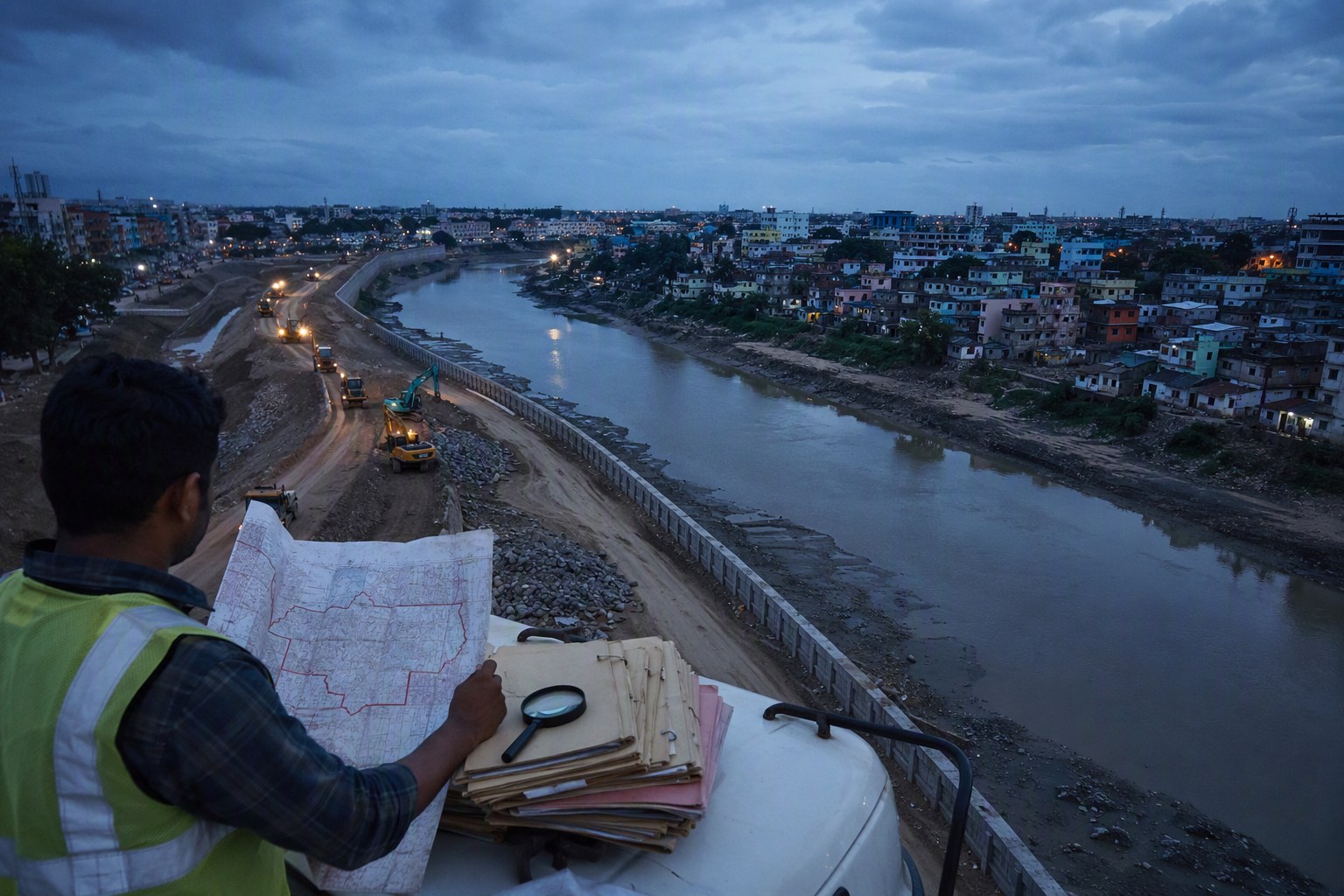



Telangana Road Widening Plans May Spur Fresh Title Audits for buyers considering open plots, old houses and small commercial parcels near busy corridors in Hyderabad, Rangareddy, Medchal-Malkajgiri and Sangareddy. The immediate buyer concern is simple: if a road is likely to be widened or a junction is likely to be reworked, the property boundary, usable land extent and title comfort need a fresh look before token advance.
In our experience, road-widening news changes buyer behaviour faster than many project launches. A plot that looked clean on a layout sketch may suddenly need a deeper check: Is the approach road recorded? Is any strip already earmarked for road purpose? Does the registered extent match the physical compound wall? Is the survey number clean under Section 22-A? These are not academic questions. They directly affect loan eligibility, resale comfort and the final price a buyer should be willing to pay.
For buyers, the safest approach is not to reject every property near a proposed wider road. The better approach is to audit the title, road width, EC and prohibited property status before negotiating the final amount.
Why Telangana Road Widening Plans May Spur Fresh Title Audits
Road widening and junction upgrades usually bring better access over time. That is the positive side. But the transaction risk sits in the details: land acquisition markings, road setbacks, old municipal notices, layout conditions, panchayat road entries, missing link documents and mismatched boundaries.
We have seen this in pockets such as Narsingi and Kokapet in Gandipet mandal, Kondapur and Gachibowli in Serilingampally mandal, Kompally side in Medchal-Malkajgiri, Uppal and Boduppal belt, Shamshabad mandal, Adibatla side near Ibrahimpatnam mandal, and the Kollur-Tellapur-Patancheru stretch. Buyer interest increases when connectivity improves. At the same time, one unclear road line on the ground can disturb the whole deal.
The first file to pull is the Encumbrance Certificate. A clean-looking sale deed is not enough. Use Encumbrance Certificate Search and then read the EC for continuity of ownership, mortgage releases, court attachments, gift deeds, partition deeds and sale transactions. If the land has moved through many hands, check whether every transfer has a proper link document.
The next check is Section 22-A. As per latest IGRS data available with Verified.RealEstate, Telangana has 3,076,153 prohibited property records under Section 22-A. This does not mean every road-side property is risky. It means buyers cannot afford to skip the prohibited property check, especially when plots are near government lands, assigned lands, ceiling lands, waqf lands, endowment lands, lake buffer zones or old acquisition corridors. Use Section 22-A Prohibited Property Check before you pay the advance.
Telangana Road Widening Plans May Spur Fresh Title Audits Near Key Corridors
When a locality starts discussing wider roads, flyover arms, junction improvements or link-road connectivity, sellers often highlight future upside. Fair enough. Better access can improve marketability. But buyers should separate location upside from document quality. A bad title does not become good only because the road is becoming wider.
Take a typical plot near a busy village road in a fast-growing mandal. The seller may show a pahani, old link deed, latest tax receipt and a layout plan. That is only the starting bundle. The buyer should compare the survey number in the deed with Dharani records, the village map, the physical possession, nearby road edge and any local-body road widening line. If the document says one extent and the ground measurement gives a smaller usable parcel after road impact, the price must reflect that.
This is where a road-width check becomes practical. Before accepting the seller’s statement, use Road Width Check. If the road is narrow today but marked for future widening in planning documents or local body records, ask your lawyer and surveyor to identify which side may be affected. Do not rely only on broker markings with white powder or temporary stones.
For buyers looking at semi-urban plots, the SRO also matters. Registration jurisdiction can differ from the marketing name of the locality. A plot sold as “near Financial District” may fall in a different village record than what the buyer assumes. Use Find Your SRO Office and SRO Village Directory to confirm where the property is registered and which village records must be checked.
What Buyers Should Check Before Paying Advance
My practical advice is to treat road-side properties as higher-documentation deals. Not necessarily bad deals. Just deals where the paperwork must be stronger. The buyer should insist on title flow, EC, Dharani status, survey sketch, layout permission, land-use confirmation and road-width clarity.
| Risk area | What to verify | Useful action |
|---|---|---|
| Title continuity | Sale deeds, link documents, partition or gift history | Match names across deed, EC and revenue records |
| Encumbrance | Mortgage, attachment, pending release deed or unusual transaction | Pull and read the EC, not just the latest deed |
| Section 22-A | Prohibited property flag or government-interest entry | Run a 22-A check before token payment |
| Road impact | Existing and proposed road width, compound wall line, setbacks | Cross-check with local body and surveyor |
| Survey accuracy | Survey number, sub-division, village and mandal | Use survey tools and compare with Dharani |
| Value expectation | Ready reckoner or market value used for registration | Check guideline value before negotiation |
The survey number is the backbone of the deal. Marketing brochures and Google pins are useful for location, but legal verification runs on village, mandal and survey details. If you do not know the correct survey number, start with Survey Number Finder. Once you have it, run the property through Property Verification Tool for a broader check.
Guideline value is another under-discussed point. When a road improves, owners may ask for a higher rate. Buyers should not argue blindly. Check the government market value or ready reckoner through Market Value / Guideline Value Search. It will not decide the final market price, but it gives a grounded reference for stamp duty, registration value and negotiation.
If the property is part of a plotted development or apartment project near a widening corridor, also verify project registration through RERA Project Lookup. For buildings, check whether future road widening affects setbacks, parking access or front open space. For open plots, confirm whether the saleable extent is measured before or after leaving the road-affected portion.
Title Audit Red Flags Around Road Widening
Some red flags deserve immediate attention. If the seller refuses to share link documents, pause. If the EC shows a bank loan but no release deed, pause. If the property falls in a village with known government land or assigned land disputes, run the Section 22-A check again with exact survey details. If the physical road is eating into the plot but the sale deed still shows the old extent, ask for a fresh survey and legal opinion.
Another common issue is the “corner plot premium”. Near junction upgrades, corner parcels are attractive for shops, clinics and rental buildings. But corner plots also face the highest chance of road splay, turning radius or setback impact. The frontage may look valuable, yet the buildable area may shrink. Before paying a premium, check road width, land-use zoning through Land Use Zone Finder, and building potential through FSI/FAR Calculator.
For investors, the cleanest deal is not always the cheapest one. It is the one where title, extent and access are all readable. In Hyderabad’s growth corridors, I would rather pay a fair rate for a fully traceable property than chase a discount on a plot with unclear road impact. That opinion comes from seeing too many buyers discover issues only at loan processing or resale stage.
If you are already in negotiation, keep one simple rule: no full advance without document verification. A small refundable token with written conditions is safer than emotional commitment based on future road promise. Ask for copies of the sale deed, EC, pahani or revenue extract where applicable, layout approval, tax receipts, mutation details, Dharani printout and any local-body notices. Then verify, measure and only then negotiate.
Frequently Asked Questions
Frequently Asked Questions
Should I avoid buying a plot near a proposed road widening area?
No. Better road access can be positive. But you should check title, EC, Section 22-A status, survey number and road width before paying advance.
Why is Section 22-A verification needed for road-side plots?
Section 22-A records can include prohibited properties such as certain government-interest lands, assigned lands or other restricted categories. Telangana has 3,076,153 such records as per latest IGRS data, so buyers should verify exact survey details.
Is an Encumbrance Certificate enough for title audit?
No. EC is essential, but it must be read with link deeds, Dharani or revenue records, layout permissions, physical survey and local-body road information.
Which tools can help before buying near a widening corridor?
Start with EC search, Section 22-A check, road width check, survey number verification, SRO lookup and guideline value search. These checks reduce avoidable risk before negotiation.