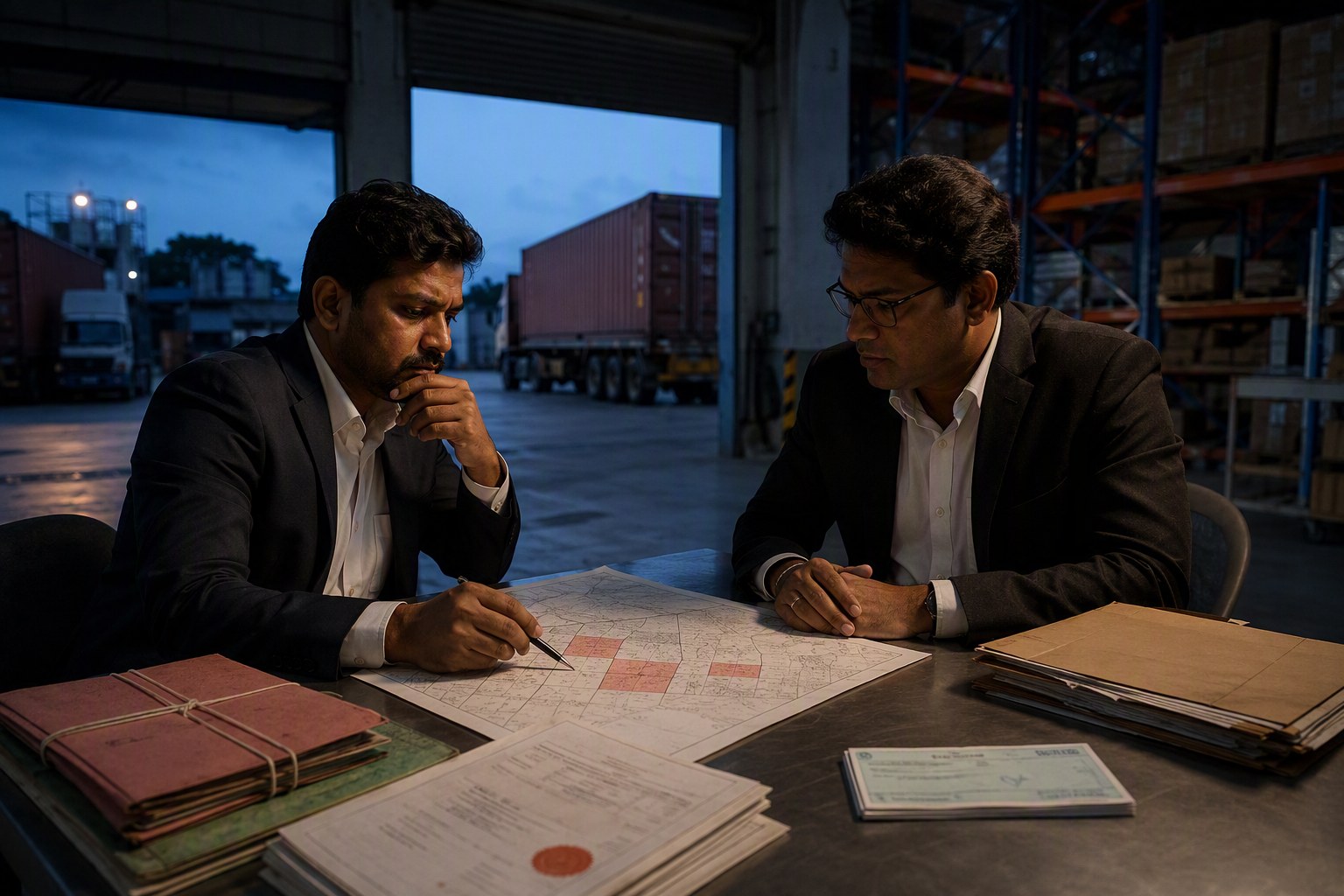
Telangana JDAs are likely to get tougher on payment milestones, with developers and land aggregators expected to link landowner payouts to Section 22-A clearance before releasing major consideration. The trigger is not academic. As per latest IGRS-linked data available in the Verified.RealEstate database, Telangana has 30,76,153 prohibited property entries under Section 22-A.
For large land deals in Hyderabad’s growth corridors, this changes the tone of negotiations. Earlier, many joint development agreements moved ahead with a broad title check, EC, pahani review and a few indemnity clauses. Now, in our experience, serious developers are asking a more direct question: “If this survey number appears in 22-A, who carries the delay risk?”
That question matters in places like Kokapet in Gandipet mandal, Mokila and Kondakal around Shankarpally mandal, Tellapur in Ramachandrapuram mandal, Kollur in Ramachandrapuram and Patancheru belt, Bachupally near Dundigal-Gandimaisamma, and Maheshwaram mandal near the southern airport side. These are not casual one-plot transactions. Many are land pooling, plotted layout, villa, apartment or mixed-use development structures where one title defect can hold up registration, project finance and RERA timelines.
Telangana JDAs and the 22-A clearance condition
Section 22-A entries are a practical registration roadblock. If a property is treated as prohibited, the SRO may refuse registration unless the issue is cleared through the proper government process. The entry may relate to government land, assigned land, endowment land, wakf-related claims, ceiling issues, court directions, or other notified restrictions. Every case is not the same, but the effect at the registration counter can be severe.
For a JDA, the landowner usually expects an upfront amount, refundable or non-refundable deposit, share of constructed area, revenue share, or a mix of these. Developers want development rights, GPA powers, permission to mortgage receivables, and freedom to obtain approvals. When 22-A risk exists, the old style of “pay first and sort papers later” becomes dangerous.
We’ve seen term sheets now moving towards a staged approach:
- token amount after basic document collection and survey number confirmation;
- larger advance only after EC, pahani, dharani, mutation and SRO checks are reviewed;
- major landowner payout after Section 22-A status is clean or formally clarified;
- construction-linked or approval-linked payments only after permissions are not blocked by title issues;
- escrow-style retention where the landowner’s share is protected but not released until agreed conditions are met.
Before signing, parties should run a Section 22-A Prohibited Property Check, verify survey details through the Survey Number Finder, and pull an Encumbrance Certificate Search. These are not substitutes for a lawyer’s title report, but they help identify trouble early.
Why Telangana JDAs are becoming more conditional
The number 30,76,153 prohibited property entries is big enough to affect behaviour. It does not mean every entry is part of an active development parcel. It also does not mean every JDA land parcel in Telangana has a problem. But it tells us one thing clearly: prohibited property checks cannot be treated as a last-minute registration formality.
In Hyderabad and surrounding districts, land is often assembled from multiple pattadars, family branches, old sale deeds, succession documents and revenue records. One JDA may involve several survey numbers. Even if nine survey numbers are clear, one disputed survey number can delay layout permissions, building approvals, mortgage creation, customer agreements and registration of undivided share.
That is why developers are pushing for clause-level protection. A landowner may say the land is patta land and has been in family possession for decades. The developer’s lawyer may still insist on checking dharani status, pahani entries, old link documents, EC, court cases, physical possession, approach road, zoning, and 22-A status. In high-value corridors, this is no longer excessive caution; it is basic risk control.
Our view is simple: in a large JDA, 22-A clearance should be treated like an approval milestone, not as a small documentation item. If registration is blocked, the commercial structure itself is affected.
How payment milestones may change in new JDA drafts
The immediate impact will be seen in drafting. Landowners may still receive a signing amount, especially where documents look clean. But large payouts are likely to be linked to evidence that the property is not prohibited, or that any wrong entry has been removed or clarified by the competent authority.
| JDA stage | Older market practice | Likely new approach |
|---|---|---|
| Term sheet signing | Commercial terms agreed quickly after basic title discussion | Survey number, village, mandal and SRO mapping checked first |
| Initial advance | Paid based on ownership documents and landowner assurance | Paid after preliminary EC, pahani, dharani and 22-A screening |
| Major landowner payout | Released on JDA/GPA execution or possession handover | Linked to clean 22-A status or written clearance process |
| Approvals stage | Developer carries most delay risk | Risk allocation split based on title defect, revenue record issue or approval delay |
| Exit or termination | General refund and indemnity language | Specific refund, interest, document cost and approval cost clauses |
This may create friction. Landowners in prime pockets may not like conditional payments, especially when multiple developers are competing. But developers who are raising institutional money, planning RERA registration, or selling to end-buyers cannot ignore a possible SRO block.
For valuation discussions, parties should check the official ready reckoner position using the Market Value / Guideline Value Search. Registration cost can be estimated through the Stamp Duty Calculator. If the deal involves apartments, villas or commercial built-up sharing, the FSI/FAR Calculator and RERA Project Lookup also become relevant.
Telangana JDAs: what landowners should expect during diligence
Landowners should be ready for deeper questioning. Developers may ask for the latest pahani, passbook details, dharani extracts, old link deeds, family settlement papers, release deeds, death certificates, legal heir documents, mutation orders, layout approvals if any, and litigation disclosures. In some cases, they may ask for village-level confirmation from revenue offices or legal opinions from two advocates.
This is not always a sign of distrust. Hyderabad’s land market has become too large and too sensitive for casual paperwork. A JDA is not a normal sale deed. The developer spends on design, approvals, consultants, liaison, soil testing, marketing, finance and site mobilisation before seeing revenue. If 22-A clearance is uncertain, the developer will either reduce the upfront payout, hold money in escrow, or walk away.
Landowners can protect themselves too. They should not hand over possession or sign wide GPA powers without clear payment timelines. If a 22-A issue is wrongly reflected, the JDA should say who will pursue correction, who will bear expenses, what happens if clearance is delayed, and when either side can exit. A vague indemnity clause is not enough.
Impact on Hyderabad land corridors
The sharper drafting will be most visible in peri-urban and fast-changing belts. Around Shankarpally, Chevella, Moinabad, Maheshwaram, Kandukur, Ibrahimpatnam, Medchal, Shamirpet, Ghatkesar and Patancheru-side villages, land histories can be layered. Agricultural records, old assignments, conversion status, nala issues, inheritance gaps and road access disputes often sit in the background.
In developed pockets like Kondapur, Narsingi, Kokapet, Puppalaguda, Tellapur and Nanakramguda, the issue is different. The land may have changed hands multiple times, and the project economics are tighter. A registration block can disturb lender comfort, customer confidence and launch timing. That is why many developers now want the 22-A check completed before they commit to a large non-refundable advance.
Buyers should also pay attention. If you are buying in a project born out of a JDA, ask whether the land title has been verified, whether the developer has proper development rights, and whether the project is registered where required. Tools like the Property Verification Tool, EC Analyzer, and Find Your SRO Office can help you ask better questions before paying a booking amount.
What a safer 22-A-linked JDA clause should cover
A practical JDA clause should not merely say “landowner confirms land is not prohibited.” It should define documents, timelines and consequences. The clause should identify the survey numbers, village, mandal and SRO. It should mention what evidence will be accepted for 22-A clearance. It should state whether the payout is released on SRO confirmation, government order, deletion from the prohibited list, legal opinion, or a combination of records.
Good drafting should also separate landowner-caused defects from government processing delays. If the landowner suppressed an old assignment, pending case or family dispute, the developer deserves stronger remedies. If the entry appears to be an administrative mismatch, both sides may agree to cooperate and extend timelines.
My advice to both sides: do not leave this to the registration week. By then, architects, consultants, brokers and investors may already be involved. The cleaner method is to place 22-A verification at the start of the JDA calendar.
The bottom line for Telangana JDAs
Telangana JDAs are moving from relationship-based negotiation to document-led negotiation. The database count of 30,76,153 prohibited property entries gives developers a strong reason to insist on 22-A-linked payment milestones. Landowners with clean records should not see this as a threat; they can use clean documentation to demand better commercial terms. Landowners with pending record issues should resolve them before inviting serious developers.
For Hyderabad’s real estate market, this is a healthy shift. It may slow down a few headline deals, but it can reduce broken agreements, delayed approvals and buyer disputes later.
Frequently Asked Questions
Can a Telangana JDA be signed if the land is in the 22-A list?
Parties may sign private agreements, but registration and development rights can face serious hurdles if the property is treated as prohibited. Legal advice and official clearance are needed before releasing major payments.
Why are developers linking landowner payouts to 22-A clearance?
Because a 22-A issue can block registration, approvals, finance and later buyer transactions. Developers want payment milestones to match title certainty.
What documents should landowners keep ready for a JDA?
Keep link deeds, latest pahani, dharani records, passbook details, mutation papers, EC, family settlement or legal heir documents, and any clearance papers related to the survey number.
Is a clean EC enough for a Telangana JDA?
No. EC is only one part of diligence. Developers should also check revenue records, dharani status, 22-A entries, litigation, zoning, access road and SRO jurisdiction.
Which tool can help check prohibited property status?
You can start with the Section 22-A Prohibited Property Check on Verified.RealEstate, then verify EC, survey number and SRO details before moving to lawyer review.