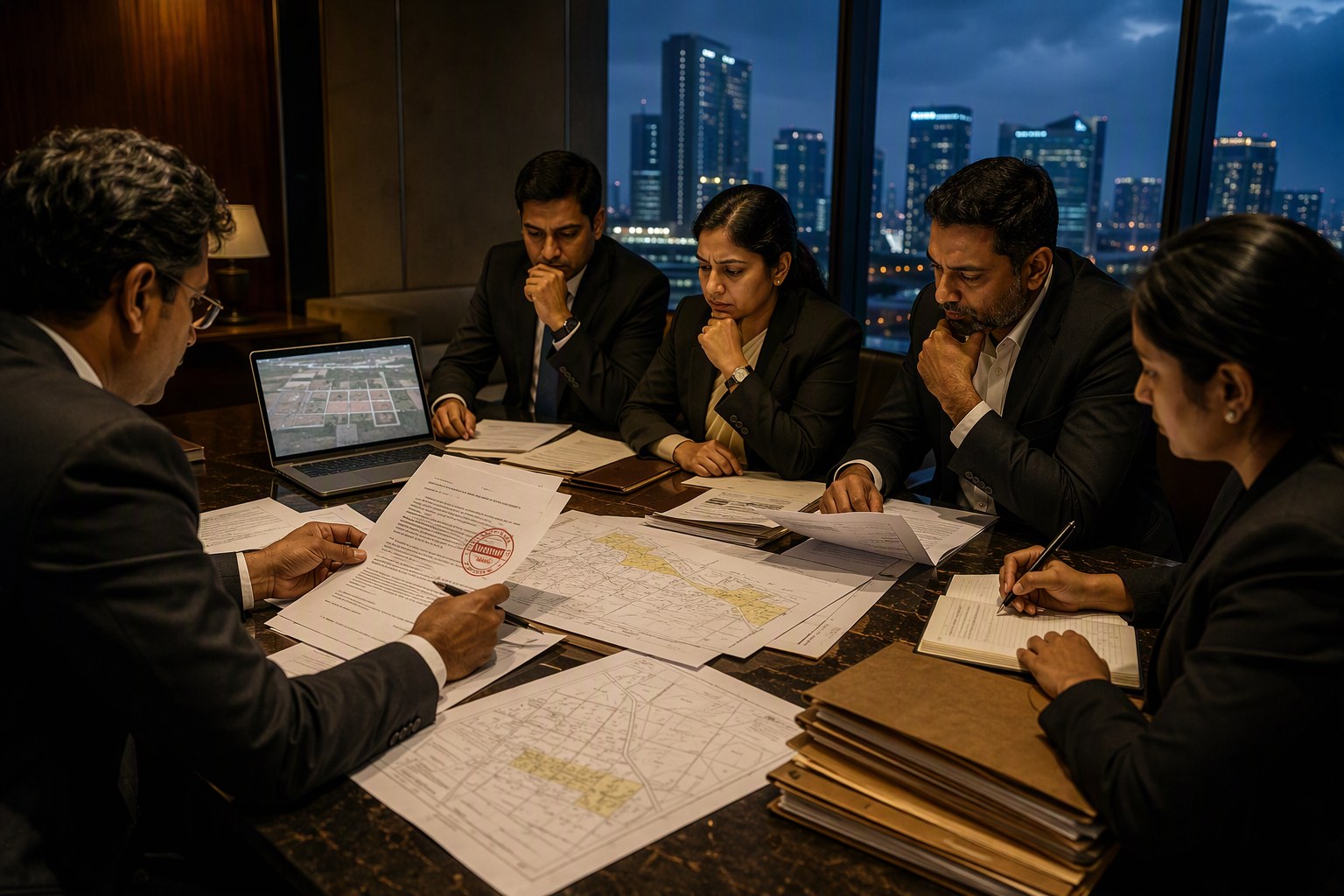
Hyderabad REIT discussions have pushed rent-generating office towers in HITEC City, Gachibowli, Financial District and Kokapet back into the deal spotlight. The reason is simple: large investors want predictable rental income, clean title and fewer land surprises. Telangana’s prohibited-property list under Section 22-A has 147,934 entries, and that backdrop is making institutional buyers look harder at completed, leased commercial assets where ownership, approvals, tenants and cash flows can be verified before signing.
For Hyderabad’s office market, this is a meaningful shift. Earlier, many big-ticket investors were willing to take land aggregation risk in growth corridors such as Kokapet, Neopolis, Tellapur and Kollur. Now, after multiple title checks, dharani mismatches, pahani issues and SRO-level red flags, the premium is moving towards ready or near-ready Grade-A office towers with long leases from IT, GCC, BFSI and pharma services occupiers.
Our reading is clear: in a market where 147,934 properties are sitting in the prohibited category, clean-title leased towers are no longer boring income assets. They are becoming the safer deal currency.
Hyderabad REIT Talks: Why Leased Office Towers Are Getting Attention
The current Hyderabad REIT chatter is not only about yield. It is also about risk filtration. A REIT-ready asset usually needs clean land title, sanctioned building permissions, occupancy certificate, registered leases, proper property tax records, fire NOC, environmental compliance where applicable and a predictable rent roll. That list automatically screens out many doubtful assets.
In Hyderabad, the stronger institutional interest is visible around Madhapur, Raidurg, Nanakramguda, Gachibowli, Kondapur, Financial District, Kokapet and parts of Puppalaguda. These micro-markets sit across Serilingampally mandal and Gandipet/Rajendranagar-side growth belts, depending on the exact survey number and village limits. That mandal-level clarity matters because one road crossing can change the SRO, guideline value and title trail.
Current market conversations peg quality office rentals in established IT corridors broadly in these bands: Madhapur and HITEC City at about ₹75 to ₹115 per sq ft per month for stronger buildings, Gachibowli and Financial District at about ₹70 to ₹110, and Kokapet/Nanakramguda emerging stock at roughly ₹60 to ₹95 depending on frontage, floor plate, parking and tenant profile. These are market rent indications, not government ready reckoner values.
Before any institutional deal, buyers usually cross-check the ready reckoner or market value using a Market Value / Guideline Value Search, pull title movement through an Encumbrance Certificate Search, and run a Section 22-A Prohibited Property Check. In our experience, serious investors do not treat these as paperwork. They treat them as deal gates.
Hyderabad REIT Demand Is Linked To Telangana’s 147,934 Prohibited Properties
The 147,934 Section 22-A prohibited-property entries in Telangana are not just a statistic sitting in a government database. They shape investor behaviour. Section 22-A restrictions can cover government lands, assigned lands, endowment lands, wakf-related properties, court-disputed parcels and other categories where registration may be blocked or questioned.
For a retail buyer, a prohibited-property surprise can delay registration. For an institution buying a ₹500 crore to ₹2,000 crore office asset, it can derail the entire transaction. REIT investors are even more sensitive because listed vehicles need regular disclosures, stable distributions and defensible valuations. Nobody wants a future query on whether the underlying land was clean at the time of acquisition.
This is why leased office towers with completed title diligence are becoming attractive. The building may already have bank funding history, tenant due diligence, prior legal opinions, municipal approvals and years of tax payments. That does not remove all risk, but it gives the buyer a stronger paper trail compared to raw land parcels where survey boundaries, old pahanis and dharani entries may still need reconciliation.
| Hyderabad micro-market | Typical office rent band | Investor comfort factor |
|---|---|---|
| HITEC City / Madhapur | ₹75-₹115 per sq ft per month | Deep tenant base, mature leasing history |
| Gachibowli / Financial District | ₹70-₹110 per sq ft per month | Large campuses, GCC demand, better institutional depth |
| Nanakramguda / Kokapet | ₹60-₹95 per sq ft per month | Newer stock, scale potential, title scrutiny needed |
| Kondapur / Raidurg belt | ₹65-₹105 per sq ft per month | Connectivity advantage, mixed asset quality |
What Makes An Office Tower REIT-Ready In Hyderabad?
A leased tower is not automatically REIT-ready. Investors look at the asset as a bundle of legal, income and operating risks. The best assets usually have a single ownership structure or clearly documented strata ownership, registered lease deeds, low vacancy, tenant lock-ins and escalation clauses of 12% to 15% every three years. They also have parking clarity, fire safety records, occupancy certificates and no ambiguity on access roads.
For Hyderabad, road width and land use are especially sensitive. A tower in the wrong land-use zone, or one dependent on a disputed access road, can face valuation cuts. Before deal closure, technical teams often verify FSI consumption through an FSI/FAR Calculator, check road status using a Road Width Check, and confirm zoning through a Land Use Zone Finder.
The SRO also matters. A Financial District asset may not follow the same registration trail as a Madhapur asset. Stamp duty, registration charges and market value references have to be checked at the right jurisdiction. Buyers can use Find Your SRO Office and estimate transaction costs through the Stamp Duty Calculator.
Why Investors May Prefer Income Over Land Banking Now
Hyderabad land banking is still attractive. We have seen strong appetite in Mokila, Shankarpally, Kollur, Tellapur, Tukkuguda, Maheshwaram and Medchal-side industrial belts. But land comes with patience and pain. Survey number mapping, old pahani entries, family partition claims, nala buffers, HMDA permissions and dharani corrections can stretch timelines.
A leased office tower gives something different: monthly rent. If a tower has 1 million sq ft leased at an average ₹85 per sq ft per month, the gross monthly rental stream is about ₹8.5 crore before maintenance recoveries, vacancy assumptions and operating deductions. At 90% economic occupancy, that still gives institutional investors a clear income base for valuation.
That visibility is the REIT attraction. Investors can model net operating income, cap rate, lease expiry, tenant concentration and future escalation. In land deals, the upside may be higher, but the cash flow is usually zero until development or sale. With interest costs still meaningful, income-producing assets are getting a second look.
Deal Impact For Hyderabad Office Owners
Owners of leased Grade-A towers in Serilingampally mandal and the Financial District belt may find themselves in a stronger negotiating position if REIT-linked buying interest grows. Buildings with multinational tenants, clean occupancy certificates and strong rent collection records can command sharper valuations. Assets with title gaps may still get interest, but with price haircuts, escrow conditions or indemnity demands.
For smaller investors holding commercial units, this trend is also useful. If institutional money prices good office rent more aggressively, strata office units in proven buildings may see better liquidity. But buyers must still check building-level approvals, association dues, undivided share details and lease registration. A good tenant cannot cure a bad title.
For developers, the message is blunt: clean documentation is now a commercial advantage. We have seen deals where rent was strong but the buyer paused because the land chain had old missing links. In Hyderabad, title quality is becoming almost as valuable as frontage and tenant profile.
What Buyers Should Check Before Betting On Hyderabad REIT-Style Assets
Retail buyers cannot buy a whole office tower, but they can learn from institutional diligence. Start with the survey number and village name. Match the sale deed, pahani, dharani entry, EC and municipal approval. Check whether the property appears in the prohibited list. If the asset is part of a RERA-registered commercial project, verify it through the RERA Project Lookup.
For capital gains planning after sale of a commercial asset, use a Capital Gains Tax Calculator. For buyers comparing land plus construction value, the Composite Value Calculator can help build a more realistic cost view.
My view: Hyderabad’s next large office deals will not be won only by the highest rent. They will be won by assets where title, tenants and approvals are all clean enough for public-market scrutiny. The 147,934 prohibited-property backdrop has made that lesson sharper.
Frequently Asked Questions
What are Hyderabad REIT talks indicating for office real estate?
They indicate stronger investor interest in completed, leased office towers in areas like HITEC City, Gachibowli, Financial District and Kokapet, mainly because these assets offer rent income and clearer diligence trails.
Why does Telangana’s Section 22-A list matter for office deals?
Telangana has 147,934 prohibited-property entries. Large investors prefer assets that can pass Section 22-A, EC, pahani, dharani and SRO checks before committing big capital.
Which Hyderabad office locations are most watched by investors?
Madhapur, Raidurg, Kondapur, Gachibowli, Nanakramguda, Financial District and Kokapet are the main watched locations because of tenant demand and Grade-A office supply.
What should a buyer verify before investing in a leased office asset?
Check title chain, EC, Section 22-A status, SRO jurisdiction, occupancy certificate, RERA details if applicable, lease registration, property tax and building approvals.