

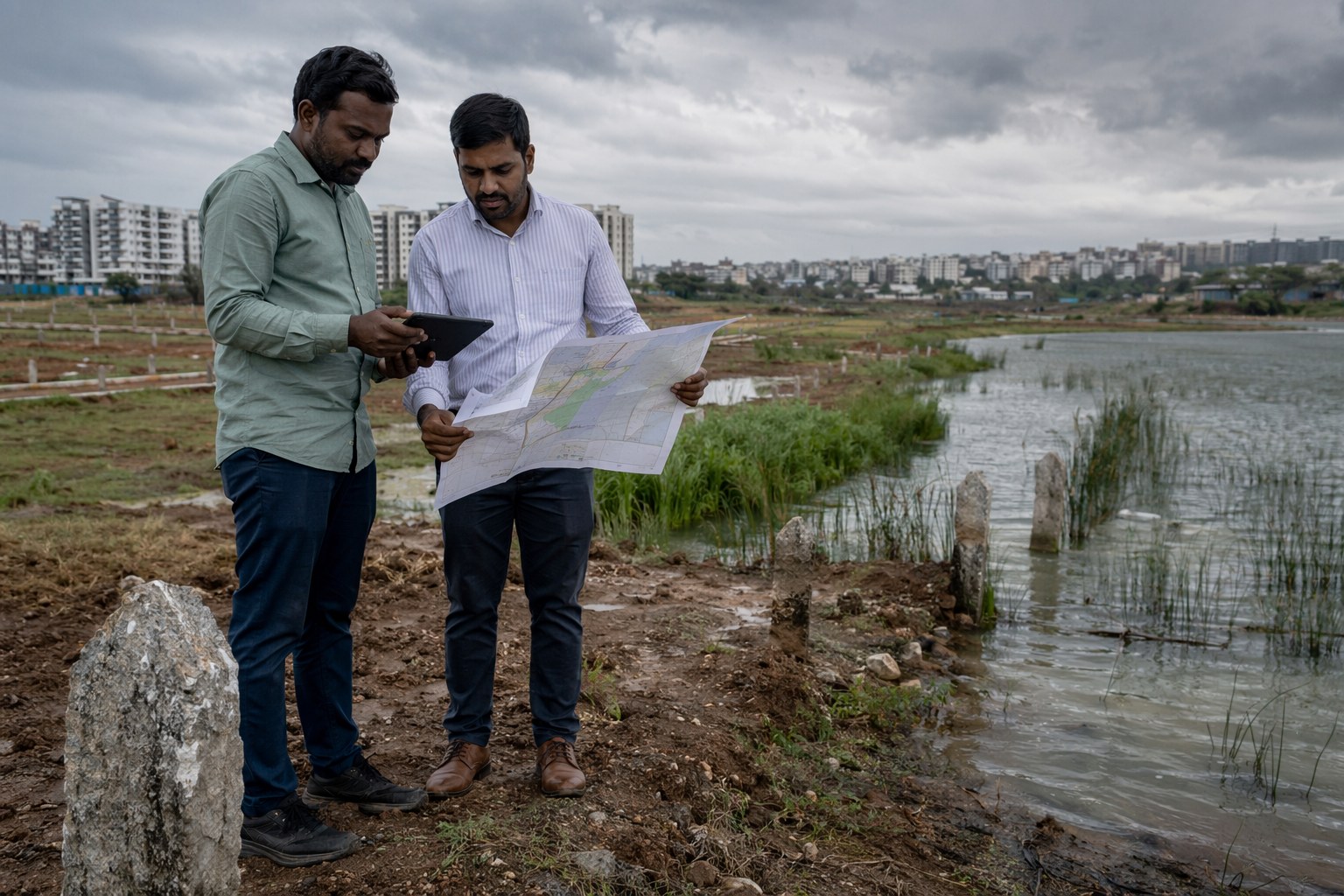
Lake Buffer Checks May Tighten Plot Due Diligence in Telangana
Lake Buffer Checks are likely to become a sharper part of Telangana plot verification, especially in Hyderabad’s fast-growing western and northern corridors where buyers already check Dharani records, EC, SRO details and Section 22-A prohibited-property status before registration. The shift is practical, not cosmetic. A plot can have a clean sale deed trail and still carry risk if it sits near a lake boundary, nalas, low-lying drainage path or flood-prone pocket.
For buyers in Gandipet mandal, Serilingampally mandal, Ameenpur mandal, Shankarpally mandal, Shamshabad mandal and parts of Medchal-Malkajgiri, this is becoming a serious due-diligence point. We’ve seen the same pattern in enquiries from Kokapet, Narsingi, Puppalaguda, Tellapur, Osman Nagar, Ameenpur, Bachupally, Miyapur, Mokila and Kompally: people first ask, “Is the land in Dharani?” Then the second question is now becoming, “Is it close to a lake or flood channel?”
Lake Buffer Checks in Telangana Plot Verification: What Is Changing?
The immediate reason is simple. Buyers are no longer satisfied with only ownership confirmation. They want to know whether the plot can be registered, built upon, financed and resold without environmental or planning objections. In Telangana, land verification has traditionally focused on pahani, pattadar passbook, survey number, village map, EC and SRO registration records. Now, lake buffer and flood-risk review is joining that list.
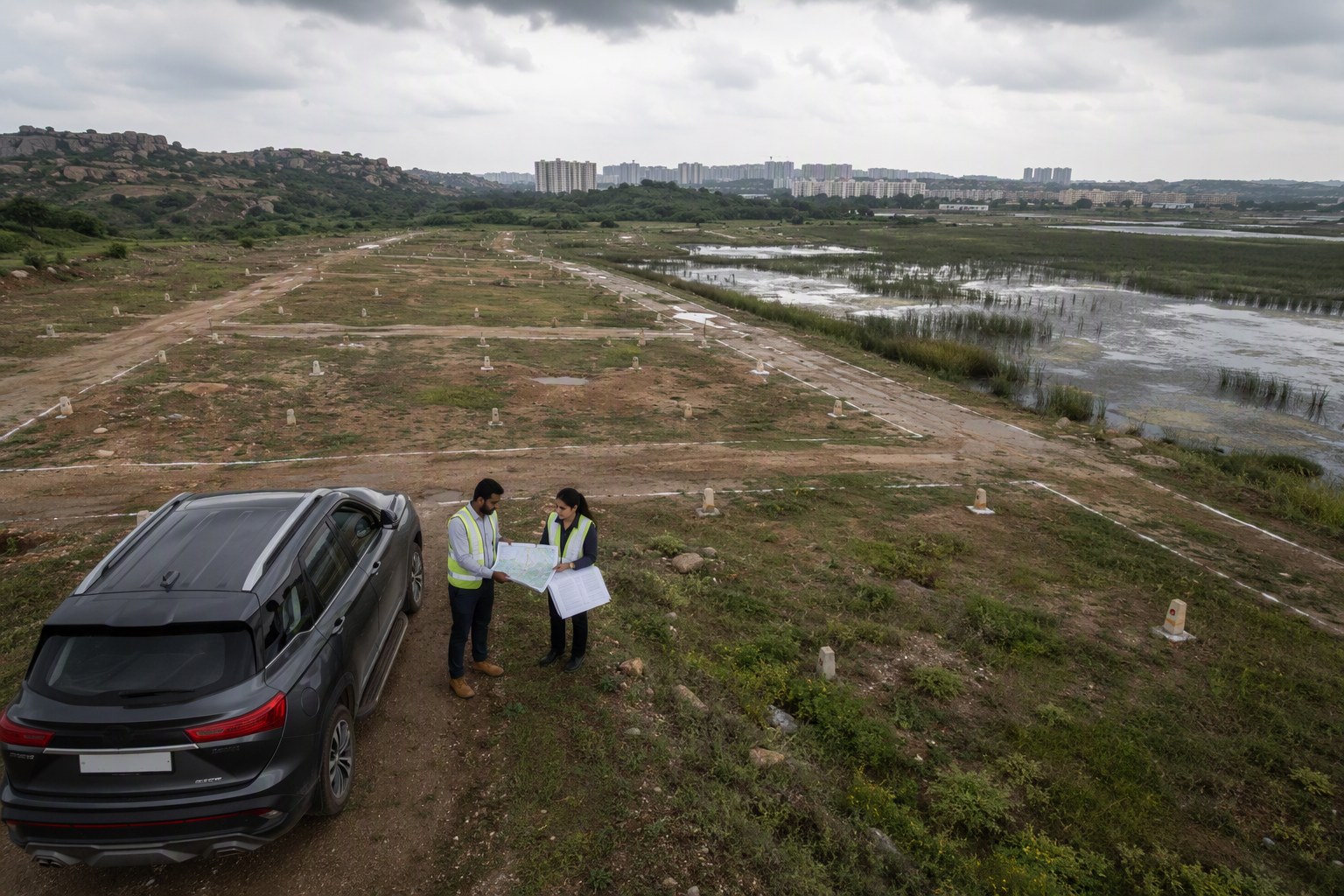
This does not mean every plot near water is unsafe or illegal. Hyderabad and its surrounding mandals have many old village tanks, cheruvus, kunta lands, stormwater channels and seasonal nalas. Some layouts are legally approved near such areas after leaving required open spaces and buffers. The problem comes when buyers rely only on a brochure, a WhatsApp location pin or a “HMDA future growth” pitch and skip the ground-level map check.
Our view is clear: if a plot is near a lake, nala or low-lying catchment, the buyer should treat environmental verification with the same seriousness as title verification. A clean EC alone is not enough.
Before paying token advance, buyers should map the survey number, check the land-use zone, see whether the plot is in an approved layout and review any visible drainage risk. Tools like Survey Number Finder, Land Use Zone Finder and Geo Insights are useful starting points for this type of screening.
Lake Buffer Checks and Section 22-A: Two Different Risks
One common mistake in Telangana plot buying is assuming that if a property is not blocked under Section 22-A, then all other risks are over. That is not correct. Section 22-A prohibited-property status deals with registration restrictions for categories such as government lands, assigned lands, endowment properties and other notified restrictions. Environmental risk is a separate layer.
As per latest IGRS data available in the Verified.RealEstate database, Telangana has 3,076,153 prohibited-property entries under Section 22-A. That number itself tells us why buyers have become careful before walking into the SRO. But even after a plot clears a Section 22-A Prohibited Property Check, the buyer should still ask: Is this plot inside or near a lake buffer? Is there a nala cutting across the layout? Is the approach road usable during heavy rains? Is there any mismatch between the sale layout and the ground situation?
In our experience, this layered approach is better than checking documents one by one in isolation. A buyer in Ameenpur may have a proper sale deed, EC and market value entry, but if the plot is near a water body edge, extra caution is needed. Similarly, a plot in Mokila or Shankarpally may look attractive because of road connectivity, but drainage slope and village tank proximity still need field verification.
Why Hyderabad Buyers Are Asking Tougher Questions
Hyderabad’s plot market has moved far beyond the old city limits. Buyers are looking at western corridors around Kokapet, Gandipet, Narsingi and Tellapur; northern pockets like Bachupally, Dundigal, Kompally and Medchal; and southern belts such as Shamshabad, Adibatla and Maheshwaram. Many of these areas have old irrigation tanks, village lakes and natural drainage paths.
The buyer profile has also changed. IT employees, NRIs, doctors, small business families and first-time land investors are now asking for survey-level clarity. They want to know the SRO, market value, EC history, layout approval, road width and land-use zone before they even negotiate. That is healthy for the market.
For cost-side checks, buyers can use the Market Value / Guideline Value Search and Stamp Duty Calculator. For title-side checks, an Encumbrance Certificate Search or EC Analyzer helps identify past transactions and possible mortgage trails. For the registration office, Find Your SRO Office is handy, especially when village names sound similar across mandals.
What Lake Buffer Checks Should Include Before Registration
A sensible buyer should not wait until the sale deed drafting stage. Lake and flood-risk review should happen before paying a major advance. The check need not be dramatic. It should be methodical.
| Due-diligence item | What the buyer should verify |
|---|---|
| Survey number | Confirm the exact survey number, sub-division and village. Do not rely only on a pin location. |
| Dharani and pahani | Check pattadar name, land nature, extent and whether entries match the seller’s claim. |
| Section 22-A status | Check whether the property is restricted from registration according to government records. |
| EC and SRO records | Review past sale deeds, mortgages, releases and transaction continuity. |
| Lake or nala proximity | Study maps and physically inspect whether the plot is near a tank boundary, feeder channel or low-lying area. |
| Layout approval | Verify whether the plotted layout is approved and whether open space or buffer conditions are shown. |
| Road and access | Check approach road width, public access and whether the road becomes waterlogged during rains. |
For plotted layouts, buyers should also review open space requirement and planning norms. The OSR Calculator, Road Width Check and FSI/FAR Calculator can help buyers understand whether the project’s planning story makes sense.
Lake Buffer Checks Matter Even in Approved Layouts
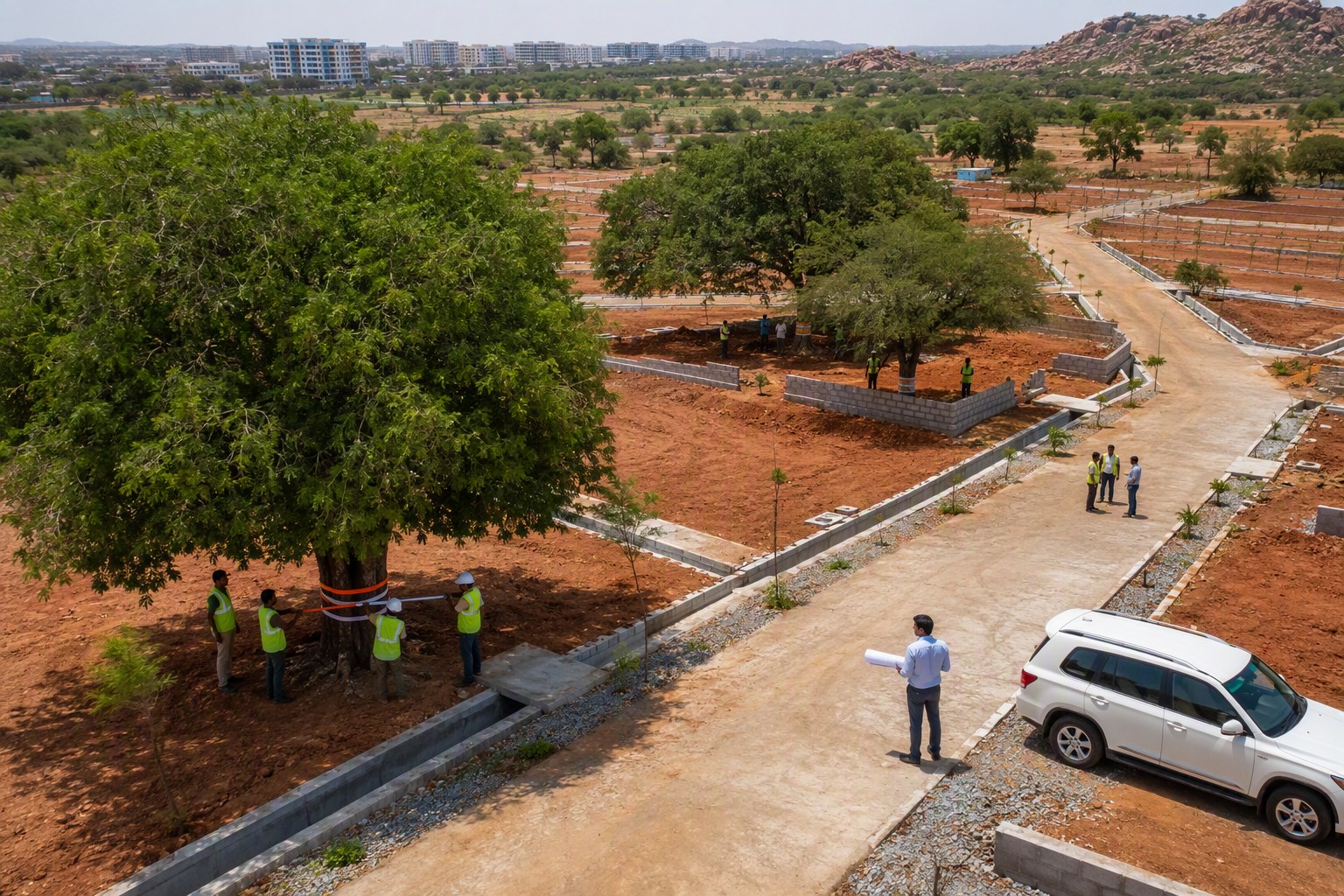
Some buyers feel that an HMDA-approved or DTCP-approved layout automatically removes all environmental concern. Approval is a strong positive point, no doubt. But the buyer should still read the layout plan carefully. Where is the open space? Is there a water body marked nearby? Are there conditions in the approval copy? Is the plot at the edge of the layout near a drain?
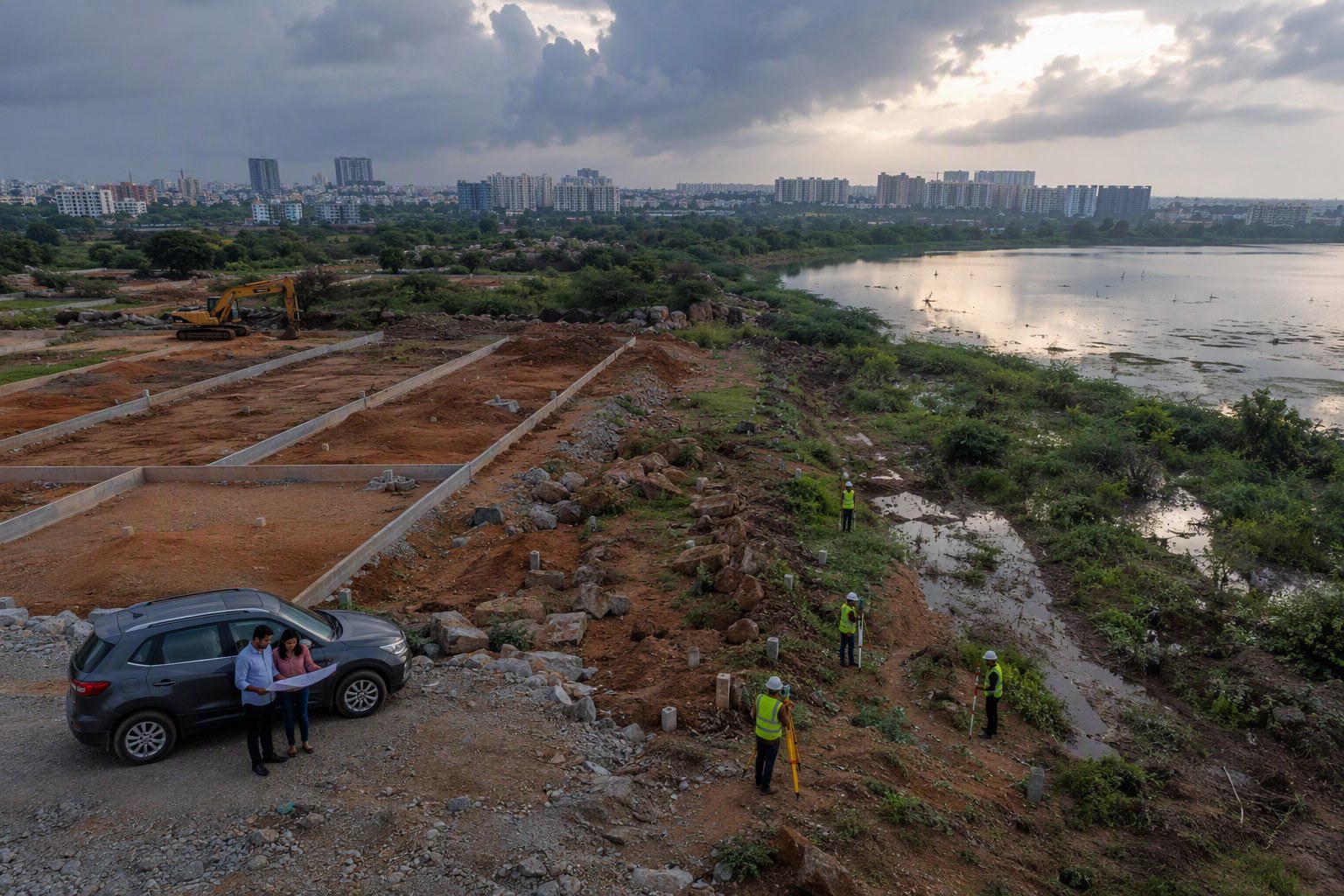
This is especially relevant in places where development has moved quickly around older village tanks. In Neknampur, Puppalaguda, Narsingi and Gandipet side, the lake conversation is not theoretical. In Ameenpur and Bachupally, buyers routinely ask about water bodies and drainage. In Osman Nagar and Tellapur belt, low-lying pockets and access roads need closer field visits during and after rains.
A plot may still be a good buy after these checks. The point is not to create fear. The point is to price risk correctly, avoid disputed pockets and prevent future resale trouble. Banks, builders and future buyers are becoming sharper. If you ignore lake buffer questions today, the next buyer may not ignore them when you try to sell.
How Buyers Should Build a Safer Verification File
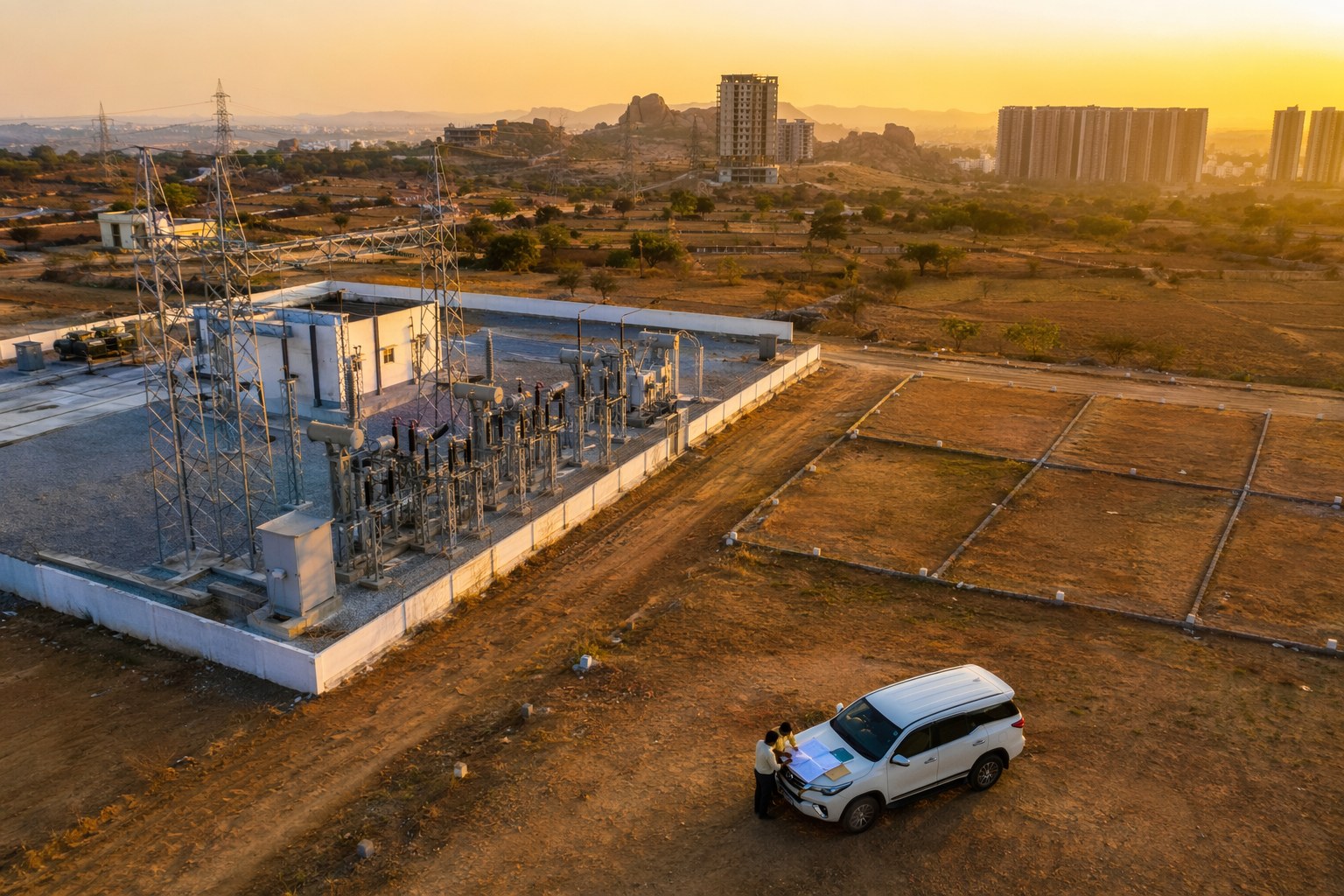
A good Telangana plot file should contain more than photocopies of sale deeds. Keep a neat set of documents and screenshots: Dharani extract, pahani, title deed chain, EC, Section 22-A result, market value reference, SRO details, layout approval, survey sketch if available, land-use check and location photos. If the land is near a lake, add map screenshots and field photos showing the approach road, boundaries and surrounding drainage.
For apartments and villa projects, the same thinking applies in a slightly different form. Check RERA status through RERA Project Lookup, then compare the project location with land-use, flood-risk clues and access roads. For standalone plots, the Property Verification Tool and Property Change Tracker can help buyers keep track of changes before registration.
My practical advice: do not treat lake buffer checks as a last-minute legal opinion item. Make it part of the first visit itself. Ask the seller for the survey number before visiting. Stand on the plot, look around, speak to nearby residents, check whether water stagnates, and then compare what you saw with the records. Hyderabad land decisions should be made with both documents and shoes on the ground.
What This Means for Telangana’s Plot Market
The market impact will be uneven. Clean plots with clear title, proper approval, good access and no environmental red flags may gain buyer confidence. Plots with vague boundaries, missing survey clarity, doubtful access or proximity to sensitive water bodies may face tougher negotiation and slower resale.
That is actually good for serious buyers. Better scrutiny pushes the market towards cleaner transactions. Sellers with proper files will be able to answer questions faster. Brokers will have to stop saying “everything clear” without showing records. Buyers will become less dependent on verbal assurances.
Telangana’s land market has matured. People already understand EC, Dharani, SRO, ready reckoner values and Section 22-A better than they did a few years ago. The next step is environmental and location intelligence. Lake Buffer Checks are not replacing title due diligence. They are becoming part of it.
Frequently Asked Questions
Do Lake Buffer Checks replace EC and Dharani verification?
No. Lake Buffer Checks are an extra layer. Buyers should still verify Dharani records, pahani, EC, SRO details, sale deed chain and Section 22-A status before registration.
If a plot is not in Section 22-A, is it fully safe to buy?
Not automatically. Section 22-A checks registration restrictions. A plot can clear that check and still need review for lake buffer, nala proximity, layout approval, road access and flood-risk clues.
Which Hyderabad areas need extra lake and flood-risk scrutiny?
Buyers should be careful in any locality near tanks, nalas or low-lying areas. Common enquiry zones include Gandipet, Kokapet, Narsingi, Puppalaguda, Tellapur, Osman Nagar, Ameenpur, Bachupally, Miyapur, Mokila and Kompally.
When should I do Lake Buffer Checks in a plot purchase?
Do it before paying a major advance. Ask for the survey number, check maps and records, visit the site, inspect surrounding drainage and then proceed with legal and registration verification.
Can an approved layout still have lake-related conditions?
Yes. An approved layout may show open spaces, buffers or conditions near water bodies. Buyers should read the approval plan and not rely only on the marketing brochure.