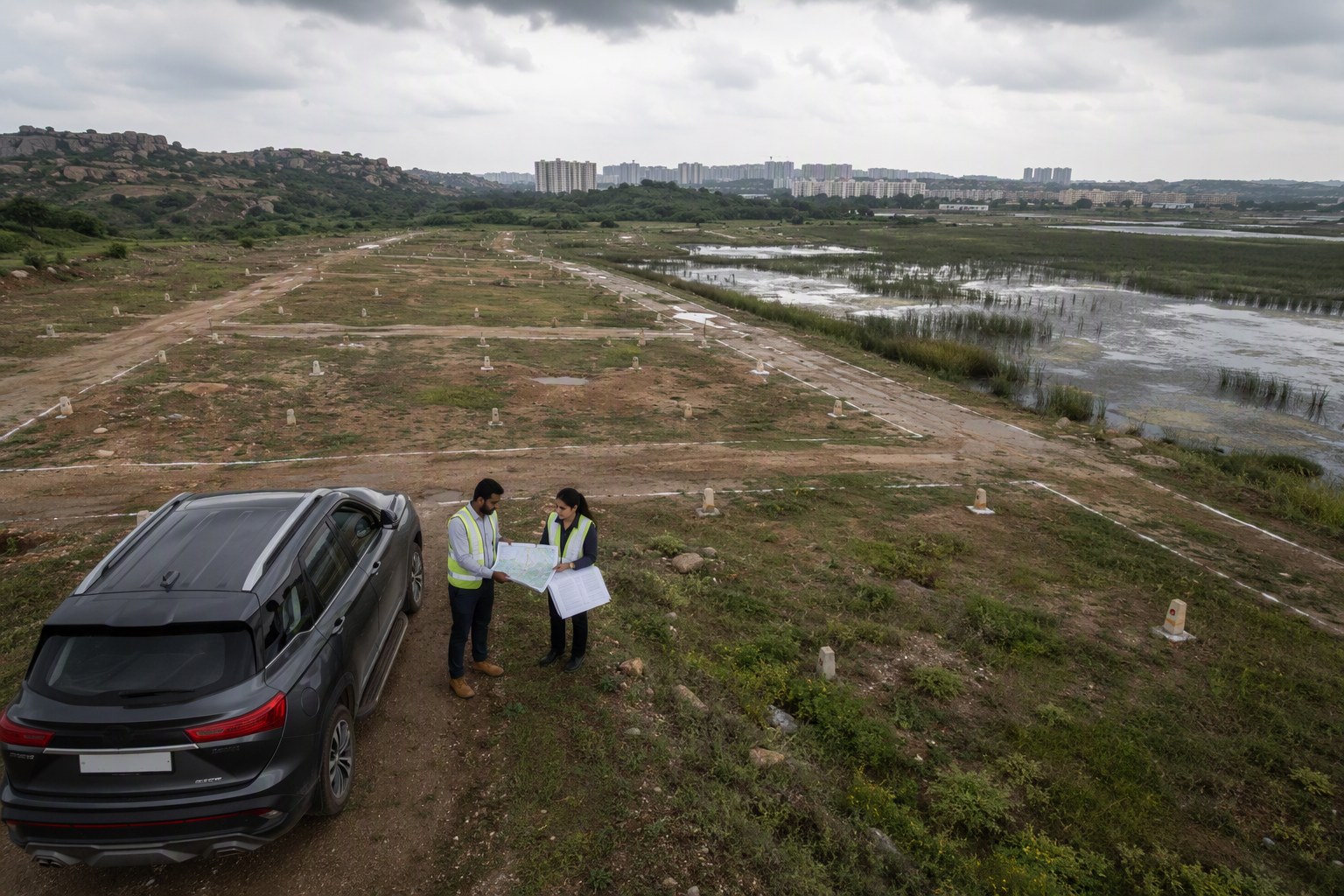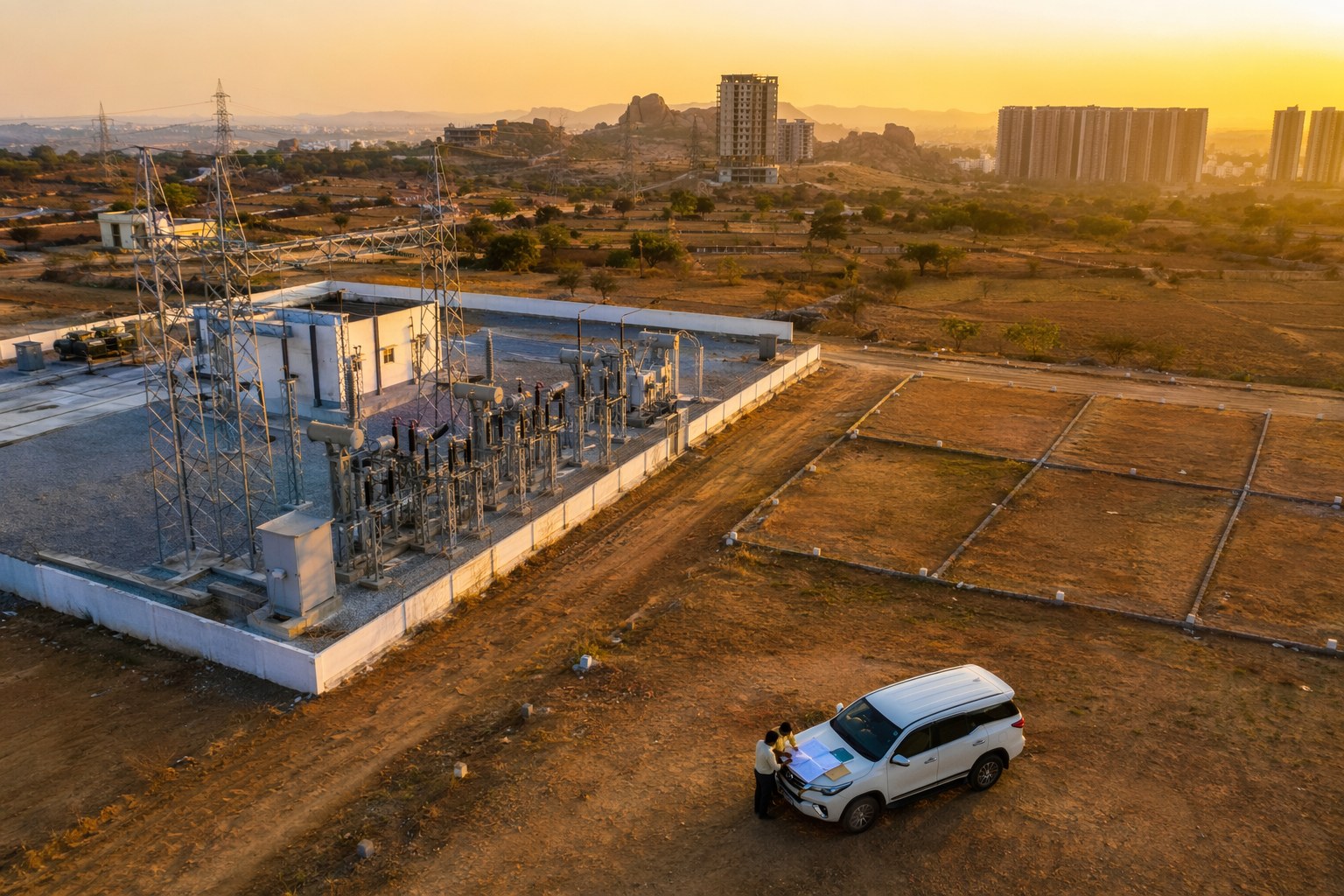


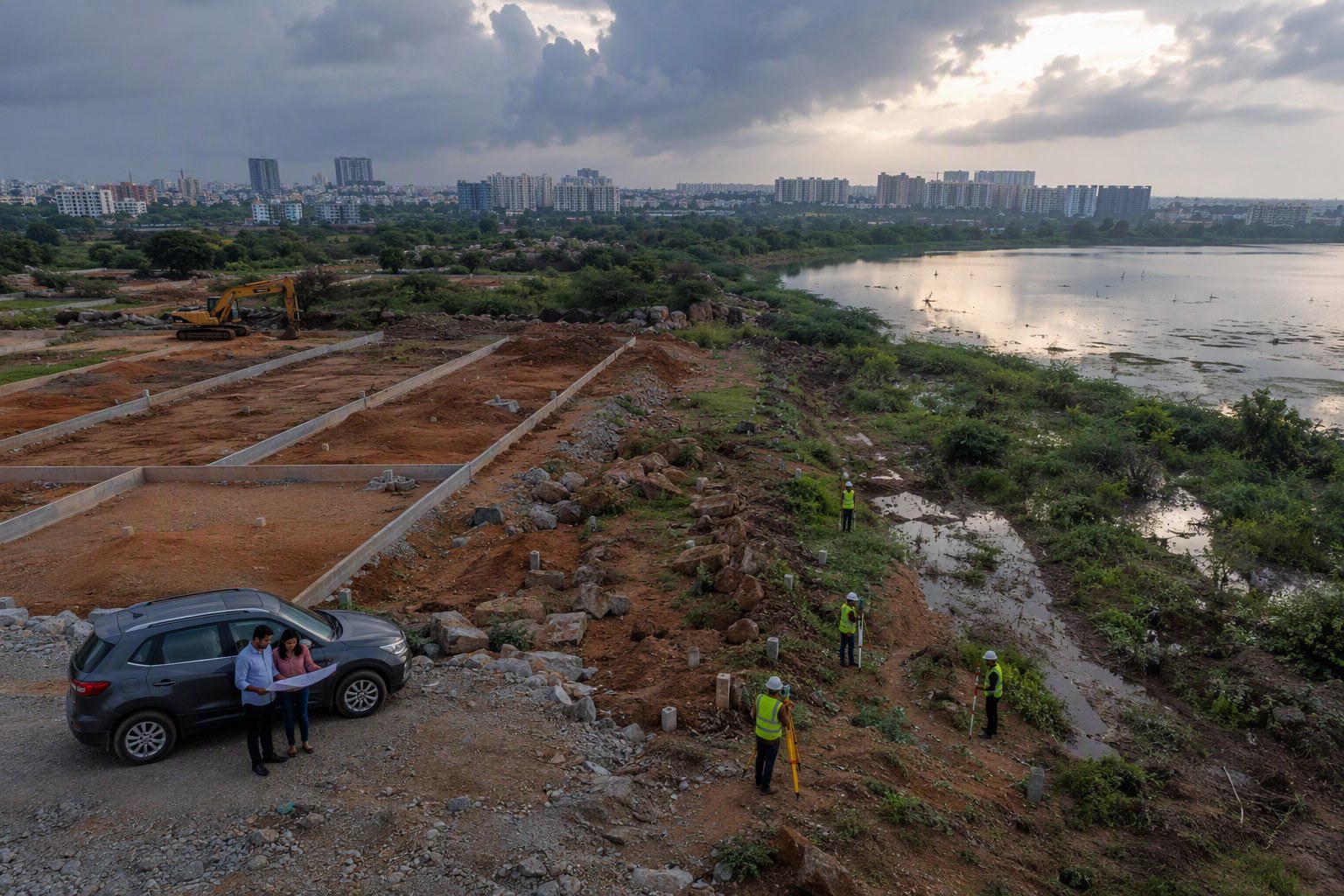
Telangana lake buffer checks are likely to become a sharper filter in urban layout approvals, especially for plot projects around Hyderabad’s fast-expanding corridors. For buyers, this means one more non-negotiable due diligence point: does the venture sit near a lake, kuntas, cheruvu, storm-water nala or drainage channel, and has that been verified on the ground before layout sanction?
The issue is no longer only about greenery or flood safety. It is now becoming a title-risk, approval-risk and resale-risk question. We’ve seen buyers in areas like Kokapet, Narsingi, Tellapur, Mokila, Bachupally, Kompally, Adibatla and Maheshwaram ask mainly about HMDA/DTCP approval, road width and price. Going forward, the smarter question will be: “Where is the nearest water body or nala, and is my plot outside the restricted buffer?”
Our view is simple: a layout that cannot clearly explain its lake, nala and drainage status is not a clean sustainability story. It is a buyer-risk story.
Telangana lake buffer checks move from paperwork to buyer due diligence
In Telangana’s urban land market, the approval file often contains many layers: title link documents, pahani entries, Dharani records, master plan land use, road access, mortgage release, layout proceedings and SRO registration history. Lake and nala verification may now sit alongside these checks as a practical sustainability screen.
This matters most in peri-urban mandals where agricultural land has rapidly converted into plotted layouts. Around Hyderabad, buyers are active in Gandipet mandal, Shankarpally mandal, Ramachandrapuram side, Medchal-Malkajgiri pockets, Ibrahimpatnam mandal and Maheshwaram mandal. These locations have genuine growth drivers, but they also have tanks, feeder channels and seasonal drainage lines that may not be obvious during a summer site visit.
A dry nala in March can behave very differently during heavy rain. A lake boundary shown casually on a brochure may not match revenue, irrigation or local body records. That is why layout-level verification is becoming more than a government formality.
Why Telangana lake buffer checks can affect layout approvals
For a plot project, a lake or nala issue can affect multiple points in the approval chain. The planning authority may ask for field verification, revised drawings, buffer marking, open space adjustment or exclusion of certain land pockets. In some cases, even after buyers pay advances, the promoter may struggle to get final layout approval if the site overlaps with a restricted zone or drainage path.
From the buyer side, the concern is not only demolition fear. The bigger day-to-day risks are blocked bank loans, delayed registrations, resale objections, civic service issues and future disputes with neighbouring owners. If a layout road is laid across a natural drain, the problem may not show up immediately. It may surface after occupation, compound wall construction or monsoon flooding.
That is why buyers should stop treating “HMDA approved” or “DTCP approved” as a single magic phrase. Approval has to be read with the layout plan, survey numbers, land use and ground reality. A project can look neat on paper and still require careful checking near water bodies.
What buyers should verify before booking a plot
Before paying a token amount in any Telangana plot project, especially near Hyderabad growth corridors, buyers should insist on a basic water-body and drainage checklist. In our experience, genuine developers will not object to these questions. The evasive ones usually say, “Sir, all clear, don’t worry,” without showing records.
| Check | Why it matters | Useful Verified.RealEstate tool |
|---|---|---|
| Survey number confirmation | Lake and nala questions are checked survey-wise, not only by venture name. | Survey Number Finder |
| Master plan land use | Residential plotting should align with permitted land use and zoning. | Land Use Zone Finder |
| Road and layout access | Drainage issues often appear along internal roads and approach roads. | Road Width Check |
| Title and prohibited status | Environmental risk must be checked along with title restrictions. | Section 22-A Prohibited Property Check |
| Registration and EC trail | Past transactions may reveal mortgages, disputes or abnormal transfers. | Encumbrance Certificate Search |
Telangana’s Section 22-A prohibited property records are a separate but serious filter. As per the available database context, prohibited properties stand at 3,076,153. That number should remind buyers that government restrictions are not rare edge cases. A lake buffer issue and a prohibited-property issue are different, but both can make a plot difficult to register, finance or sell later.
Telangana lake buffer checks and the Hyderabad plot market
Hyderabad’s plot market has always moved ahead of infrastructure. First come the land aggregators, then venture boards, then approach roads, then utilities. This pattern is visible from Mokila and Shankarpally to Kadthal, Yacharam, Adibatla, Tukkuguda, Kandukur and parts of Medchal. Some projects are properly planned. Some only look planned because of a compound wall and a sales office.
Lake buffer verification can separate serious developers from quick-sale operators. A developer who has done the homework will usually have survey sketches, approved layout copies, land conversion documents, local body correspondence and a clear answer on nearby water bodies. A weak project will push urgency: “Only a few plots left, price changing tonight.” That is not due diligence; that is pressure selling.
For buyers comparing rates, the ready reckoner or market value is only one side. Use the Market Value / Guideline Value Search to understand government value, but do not stop there. A plot with a tempting price near a nala may become costlier than a cleaner plot at a higher quoted rate. Stamp duty is also better calculated only after confirming the survey number, SRO and document structure through tools like the Stamp Duty Calculator and Find Your SRO Office.
How promoters may need to change their approval files
If lake buffer and nala verification becomes a stronger approval filter, promoters will need cleaner documentation before marketing. The old habit of launching sales first and sorting approvals later may become riskier. Buyers are already more alert after seeing disputes around government land, assigned land, FTL claims, missing approach roads and unapproved extensions.
Good promoters should start giving a simple disclosure note: nearby water bodies, drainage channels, buffer marking, layout boundaries, open space reservation and any authority conditions. This will also help brokers. Many brokers are caught between developer claims and buyer questions. A documented answer protects everyone.
For larger layouts, open space calculation will also matter. Buyers can cross-check planning claims using the OSR Calculator. Where construction potential is relevant, especially for villa plots and low-rise communities, the FSI/FAR Calculator can help understand whether the promised built-up plan is realistic.
Telangana lake buffer checks should be treated as a resale filter
Many plot buyers think only about purchase approval. I would look at resale also. After a few years, when you sell, the next buyer may ask tougher questions than you asked. Banks may be stricter. Local bodies may insist on clearer maps. Digital land records may improve. A water-body conflict that is ignored today can reduce liquidity tomorrow.
This is why a clean plot file should include three layers: revenue title, planning approval and environmental location check. Revenue title covers link documents, pahani, Dharani entries and mutation flow. Planning approval covers layout sanction, roads, open spaces and land use. Environmental location check covers lakes, nalas, drainage paths and low-lying risk.
For a quick first-pass review, buyers can use the Property Verification Tool. It cannot replace a site inspection or legal opinion, but it helps organise the questions before you meet the seller, broker or advocate.
What buyers should ask at the site office
- Which village and mandal does this survey number fall under?
- Is there any cheruvu, kunta, vagu or storm-water nala near the layout boundary?
- Has the buffer been marked in the approved layout drawing?
- Are any plots excluded, mortgaged or reserved in the sanction plan?
- Which SRO will register the sale deed?
- Can the promoter share the EC, link documents and approval proceedings before token payment?
If the salesperson cannot answer, ask for the planning consultant or landowner representative. In Telangana land transactions, the person with the brochure is not always the person with the file.
The best projects will not fear verification. In fact, lake buffer clarity can become a selling point. Buyers increasingly want safer layouts, better drainage, usable open spaces and less legal headache. Sustainability is not only about planting avenue trees. It begins with respecting the natural water system already present on the land.
Frequently Asked Questions
What are Telangana lake buffer checks in plot approvals?
They refer to verification of whether a proposed layout is near a lake, tank, kunta, nala or drainage channel, and whether the plan respects the required restricted area and authority conditions.
Can a plot be risky even if the layout has approval?
Yes. Buyers should read the actual approved layout, survey numbers, land use and site conditions. A general approval claim is not enough if the plot is close to a water body or drainage line.
Which tools can help before buying a Telangana plot?
Start with survey number, land use, EC, SRO and prohibited property checks. These help you ask better questions before paying an advance or signing an agreement.
Do lake buffer issues affect resale value?
They can. Future buyers, banks or authorities may raise objections if the plot is near a restricted water-body zone or drainage path. Clear documentation improves resale confidence.