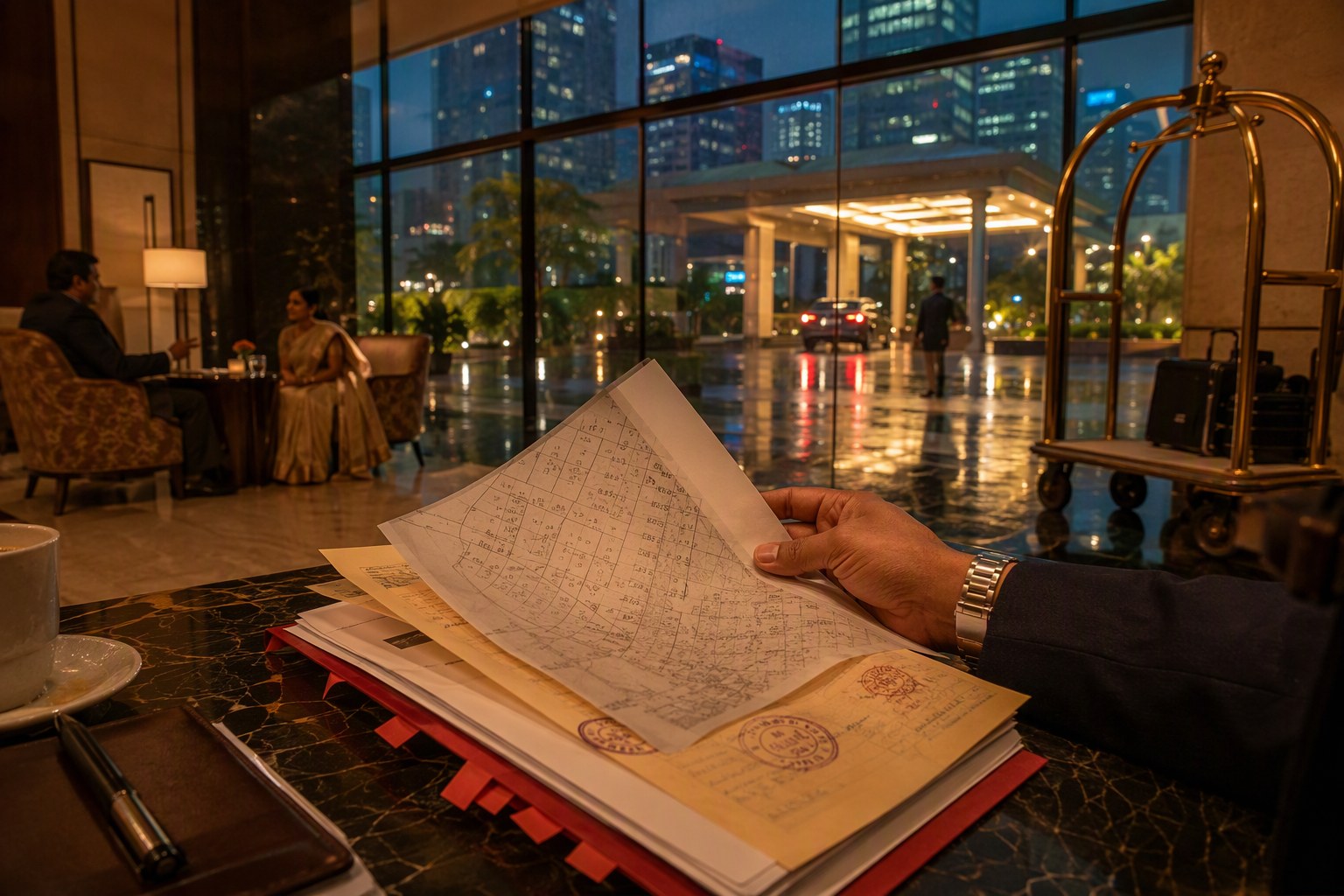
Hyderabad Retail Asset Deals Put Clean Titles at Premium as large-format shops, malls, high-street showrooms and mixed-use retail blocks attract sharper investor scrutiny across the city. The immediate trigger is not only rent yield or frontage. Buyers are now pricing title risk more openly, especially after factoring Telangana’s 147,934 prohibited properties listed under Section 22-A into their due diligence checklists.
In simple terms, a retail asset with a clean chain of ownership, clear survey boundaries, correct land use, and no registration block can command better pricing than a similar income-generating property with unresolved pahani, dharani or SRO-level issues. We have seen this play out strongly in Hyderabad’s transaction discussions, particularly in Banjara Hills, Jubilee Hills, Madhapur, Gachibowli, Kokapet, Kukatpally, Uppal and LB Nagar.
Hyderabad Retail Asset Deals Put Clean Titles at Premium as Investors Reprice Risk
Retail property buyers in Hyderabad are no longer looking only at rental income. They are asking sharper questions: Is the land in a prohibited list? Does the survey number match the sale deed and municipal record? Is the building approved for commercial use? Is there any mortgage, court attachment or family dispute sitting in the Encumbrance Certificate?
That change matters because retail assets are usually expensive, operationally visible and tenant-heavy. A single registration issue can hold up a sale, refinancing, lease restructuring or redevelopment. For a ₹50 crore showroom block on Road No. 36, Jubilee Hills or a leased retail floor in Hitec City, even a small title doubt can become a serious price negotiation point.
In our experience, serious investors are not rejecting Hyderabad retail assets because of one missing paper. They are discounting the price when the seller cannot explain the title trail clearly.
The 147,934 prohibited properties figure in Telangana has made buyers more cautious. Section 22-A properties may include government land, assigned land, endowment land, wakf-related entries, court-disputed parcels and other categories where registration can be blocked. For retail transactions, this is not a theoretical risk. Hyderabad has many older commercial pockets where land records, municipal approvals and actual occupation have travelled in different directions over decades.
Hyderabad Retail Asset Deals Put Clean Titles at Premium in Prime Localities
The clean-title premium is most visible in high-value commercial stretches. In Jubilee Hills and Banjara Hills, high-street retail properties with clear road access, strong frontage and proper commercial permissions can quote at a noticeable premium because replacement supply is limited. In Madhapur and Gachibowli, investors focus on lease quality, parking, fire NOC, sanctioned plans and whether the asset sits in Serilingampally mandal records without land classification surprises.
Across Hyderabad, market discussions for prime retail rentals often fall into broad locality bands. Banjara Hills and Jubilee Hills high-street spaces can see asking rentals of roughly ₹180 to ₹350 per sq ft per month depending on frontage, floor level and brand visibility. Madhapur, Hitec City and Gachibowli retail in strong micro-markets often trades around ₹150 to ₹300 per sq ft per month. Kukatpally, Miyapur, Uppal and LB Nagar generally see a wider band, often ₹80 to ₹180 per sq ft per month for good road-facing stock. These are not government rates; they are market conversation ranges and vary sharply by building quality.
When such rental streams are capitalised into a sale value, title clarity becomes money. A buyer may accept a lower yield for a clean, bankable asset. For a property with unclear survey mapping, missing link documents or land-use mismatch, the same buyer may ask for a discount, an escrow, seller indemnity or a longer closing period.
What Due Diligence Now Looks Like for Hyderabad Retail Deals
Earlier, many mid-sized commercial property sales were driven by rent roll, tenant profile and location. Now, the title file is getting equal weight. A proper check normally starts with the sale deed chain and moves into pahani, dharani records, town planning permissions, building approvals, tax receipts and EC history.
For buyers, the basic digital checks should start before paying token advance. Use the Section 22-A Prohibited Property Check to see if the property or survey number has any registration restriction. Then run an Encumbrance Certificate Search to identify mortgages, past sales, releases and possible claims. If the site is land-heavy, the Survey Number Finder helps connect the physical property to revenue records.
For valuation, investors should compare the SRO market value with actual market pricing. The Market Value / Guideline Value Search gives the official benchmark, while the Stamp Duty Calculator helps estimate transaction cost. For large retail plots or mixed-use assets, the Land Use Zone Finder and FSI/FAR Calculator are useful because redevelopment potential can change the bid price.
Why Section 22-A Risk Is Becoming a Pricing Factor
Section 22-A risk affects liquidity. A buyer may love the tenant and location, but if the SRO refuses registration, the deal gets stuck. This is why Telangana’s 147,934 prohibited properties are now part of boardroom-level discussion for serious investors, family offices and developers buying retail blocks.
In Hyderabad, the risk is not uniform. Newer plotted commercial assets in planned layouts may have cleaner documentation, though approvals still need checking. Older retail stretches in Himayatnagar, Abids, Koti, Secunderabad, Ameerpet and parts of Kukatpally may have excellent footfall but need deeper title review because ownership has often changed hands many times.
| Retail location type | Common investor focus | Title-related risk to check |
|---|---|---|
| High-street showroom in Jubilee Hills or Banjara Hills | Frontage, parking, brand tenant, rental yield | Link documents, commercial use, setbacks, mortgage history |
| IT corridor retail in Madhapur, Gachibowli, Kondapur | Lease lock-in, footfall, building approvals | Survey number match, fire NOC, occupancy certificate |
| Growth corridor retail in Kokapet, Narsingi, Financial District | Future catchment, road width, redevelopment value | Land classification, HMDA permissions, access road title |
| Mass-market retail in Kukatpally, Uppal, LB Nagar | Daily consumption demand, tenant stability | Old EC entries, municipal deviations, family partition claims |
Clean Title Is Now Part of the Cap Rate Conversation
Retail assets are usually valued by capitalising rent. If a property earns ₹25 lakh monthly rent, investors may discuss price based on expected yield, tenant risk and future rental growth. But now, clean title is entering that calculation directly. A clean asset may trade at a sharper cap rate because the buyer sees lower exit risk. A doubtful asset may need a higher yield to compensate for legal and registration uncertainty.
For example, two similar retail buildings in Gachibowli may have the same rent roll. If one has a clear chain from original owner to present seller, updated mutation, no EC burden and proper commercial sanction, it will attract more lenders and more buyers. The other may still sell, but the buyer may insist on a price cut or holdback until the title is cured.
We have also noticed that institutional-style buyers ask for more than the EC. They want old link documents, land conversion orders if applicable, municipal sanction plans, occupancy certificate, property tax receipts, lease deeds, GST rental records, litigation search and SRO confirmation. This is good practice. Hyderabad’s retail market has matured enough to reward sellers who keep their files ready.
What Sellers Should Do Before Marketing a Retail Asset
Owners planning to sell a retail property in Hyderabad should not wait for the buyer’s lawyer to find gaps. A pre-sale verification can protect pricing. Start with a title file index: parent documents, sale deeds, gift deeds, partition deeds, release deeds, mutation records, pahanis, dharani extracts, sanctioned plans, property tax receipts and tenant lease papers.
Then check the correct SRO. Many delays happen because parties assume the wrong jurisdiction. The Find Your SRO Office tool can help identify where registration checks should be made. For a broader risk scan, use the Property Verification Tool and track future changes through the Property Change Tracker.
If the asset has redevelopment scope, confirm road width, zoning and built-up potential before quoting a premium. The Road Width Check and Composite Value Calculator can support a more realistic price discussion. Sellers who can show clean title plus redevelopment upside will usually have stronger negotiating power.
The Bottom Line for Hyderabad Retail Investors
Hyderabad’s retail asset market remains attractive because incomes, consumption and office catchments are still expanding. But the quality of title is now sitting next to location and rental yield. With 147,934 prohibited properties in Telangana, no serious investor should treat title verification as a last-minute formality.
Clean titles are not just legal comfort. They improve funding options, shorten deal timelines, reduce SRO surprises and support a better exit. In a market where prime retail stock is limited, that clarity can easily become the difference between an average bid and a premium bid.
Frequently Asked Questions
Why are Hyderabad retail asset deals putting clean titles at premium?
Because investors are pricing registration risk, lending comfort and exit certainty. A retail property with clear ownership records, clean EC, proper land use and no Section 22-A issue can attract better bids than a similar asset with doubtful records.
What is Section 22-A in Telangana property transactions?
Section 22-A refers to categories of properties where registration may be prohibited or restricted. Telangana has 147,934 prohibited properties, so buyers should check whether the survey number or property appears in this list before committing money.
Which Hyderabad retail locations need extra title checking?
Older and high-value commercial areas such as Jubilee Hills, Banjara Hills, Himayatnagar, Abids, Secunderabad, Ameerpet and Kukatpally need careful checks. Newer areas like Kokapet, Gachibowli and Madhapur also require survey, zoning and approval verification.
Which documents should a buyer verify before purchasing a retail property?
Check link documents, sale deeds, EC, pahani, dharani records, mutation, sanctioned building plan, occupancy certificate, property tax receipts, lease deeds, land-use permission and SRO status. For retail assets, fire and parking approvals also matter.
Can a property with title gaps still be sold?
Yes, but it may face a price discount, delayed closing, escrow condition or stronger indemnity demand. Many buyers will proceed only after the seller cures the defect or gives clear documentary comfort.