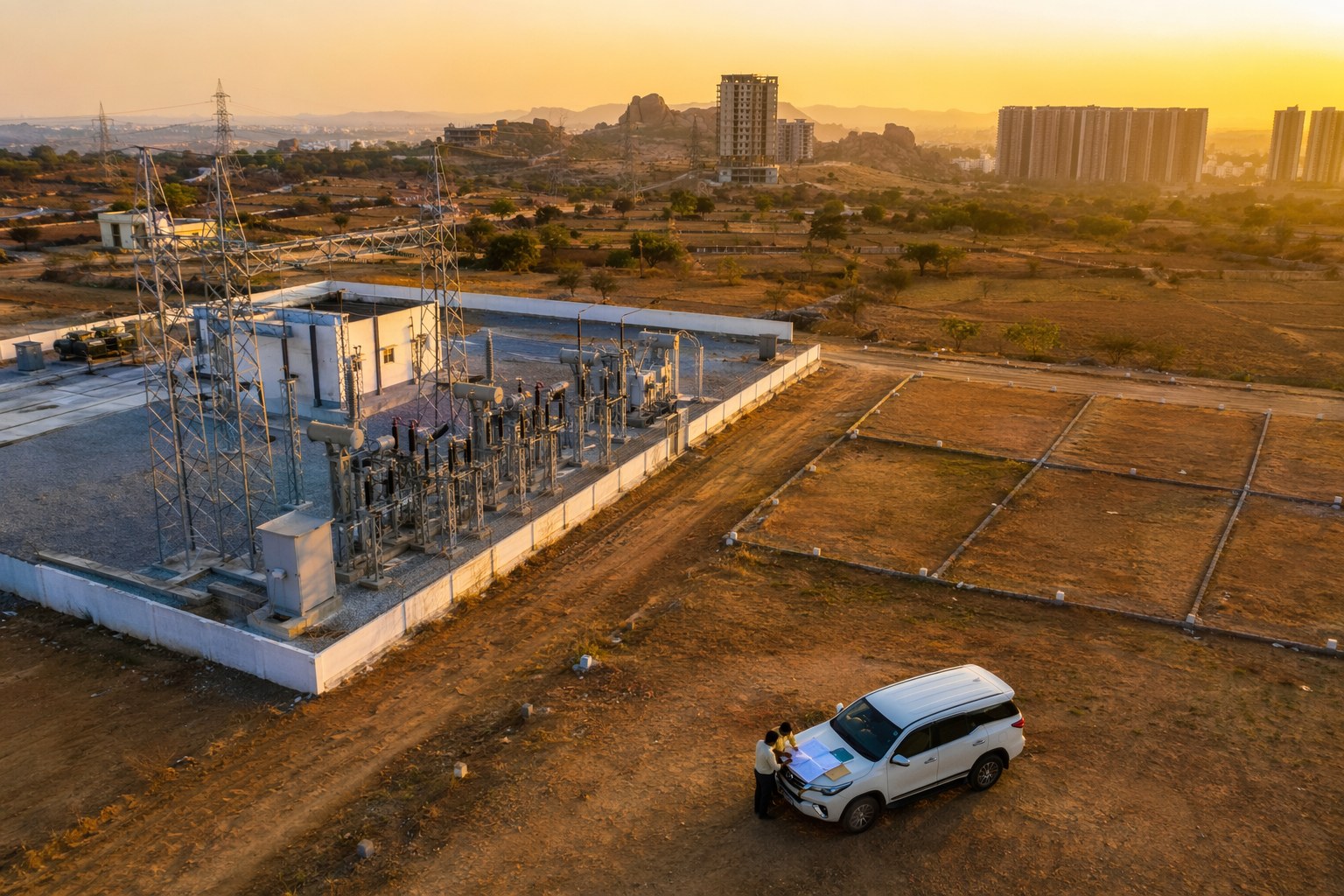



Hyderabad MMTS Extension talk is already changing how some buyers look at homes in the city’s rail-linked pockets. The immediate market signal is simple: if a new MMTS stop gives dependable access to an office belt, college cluster, hospital zone or airport road, nearby apartments and plots start getting more attention. But the safer buyer will not book only on a proposed station map. Access road, title, pahani history, Dharani status, SRO readiness and Section 22-A risk need checking before paying a token.
In our experience, transport-led demand in Hyderabad does not move evenly. It moves lane by lane. A flat near Lingampally station behaves differently from a flat deep inside a colony with no proper approach road. The same logic will apply to any MMTS expansion around Medchal, Ghatkesar, Umdanagar, Shamshabad, Bolarum, Malkajgiri, Kompally, Charlapalli or Tellapur side.
Our view: proposed MMTS stops can create buyer curiosity, but registration safety is still the first filter. A station nearby is useful only when the property title, access and approvals are clean.
Hyderabad MMTS Extension: why buyers are watching new stop locations
The city’s residential market has always rewarded daily-use connectivity. Metro stations did this in parts of Miyapur, Uppal, LB Nagar, Hitec City and Raidurg. MMTS has a different character. It serves regular commuters who want affordable rail access between older residential pockets, IT corridors, cantonment-side localities and suburban growth areas.
That is why proposed or discussed MMTS expansion corridors matter for housing demand. If a station improves access from Medchal mandal towards Secunderabad, or from Ghatkesar mandal towards the city, the buyer pool can widen. A family that earlier rejected a location due to travel time may reconsider it if train access becomes practical. Tenants also react fast to commute savings, especially near stations where last-mile autos, buses and shared transport are available.
Still, a buyer should not assume that every property near a proposed halt will appreciate. Some parcels may have narrow roads, pending layout issues, lake buffer concerns, land-use mismatch or old revenue entries. Some may fall under prohibited categories. According to latest IGRS data available to us, Telangana’s Section 22-A prohibited properties database contains 3,076,153 records. That single number should make any buyer slow down and verify before signing.
Hyderabad MMTS Extension and the title-risk angle near rail-linked pockets
Transport news often brings quick marketing. We have seen brochures use phrases like ‘near proposed station’ even when the actual station access, road width and alignment are not clear. A buyer in Ghatkesar, Pocharam, Annojiguda, Medchal, Gundlapochampally, Kandlakoya, Kompally, Bolarum, Umdanagar, Satamrai, Shamshabad or Tellapur should ask one direct question: can I register this property cleanly at the correct SRO today?
Start with the survey number and village. For open plots and land parcels, match the survey number with Dharani entries, pahani details, mutation trail and any conversion or layout approval. For apartments, check the project approval, RERA registration where applicable, UDS share, link documents, EC and current mortgage status. Do not rely only on a builder’s office file.
Verified.RealEstate tools can reduce the first layer of risk checking. Use the Survey Number Finder to identify the land reference, then run the Section 22-A Prohibited Property Check. For ownership and transaction history, use the Encumbrance Certificate Search and the EC Analyzer. If it is a registered project, cross-check through the RERA Project Lookup.
Localities where rail access can matter more
Some Hyderabad localities are more sensitive to MMTS connectivity because road travel can be tiring during peak hours. Malkajgiri, Safilguda, Moula Ali, Bolarum and Alwal have long depended on rail and bus combinations. On the western side, Lingampally, Chandanagar, Hafeezpet and Tellapur already show how station proximity can support rental demand. Towards the north, Medchal, Gundlapochampally, Kandlakoya and Kompally are watched by buyers who work in Secunderabad, Begumpet, Hitec City or Genome Valley side and want better commute options.
On the eastern stretch, Ghatkesar mandal, Pocharam, NFC Nagar and Annojiguda have residential demand linked to institutions, IT parks and the Warangal highway belt. If MMTS access improves here, end-users may compare these pockets more seriously against Uppal, Nagole and Boduppal. Towards the south, Umdanagar and Shamshabad mandal have the airport pull, logistics jobs, ORR access and plotted development activity. But southern-side land buying needs careful checks because agricultural-to-non-agricultural conversion, master plan land use and layout status can change the risk profile.
What buyers should verify before paying token near a proposed MMTS stop
A proposed stop is not the same as a functioning station with entry, exit, parking, feeder transport and safe pedestrian access. Before paying advance, visit the site during working-day peak hours. Check whether the approach road is legally available or only used informally. In many mandals, a small access gap can become a large resale problem later.
- Confirm the SRO: Use Find Your SRO Office and make sure the property falls under the correct registration office.
- Check government market value: Before negotiating, verify the ready reckoner style value through Market Value / Guideline Value Search.
- Estimate registration cost: Use the Stamp Duty Calculator so you are not surprised at the registration stage.
- Test land-use fit: For plots and land, use Land Use Zone Finder and check whether the intended use is allowed.
- Check road width: Station demand is useful only when access is practical. Use Road Width Check for a first-level view.
How demand may shift around upcoming stops
The first shift usually comes from tenants. They are quicker than owners because they can move with less cost. If a proposed MMTS stop becomes operational and connects well to Secunderabad, Begumpet, Hitec City, Lingampally or other employment nodes, rental enquiries can rise in nearby colonies. Investors then enter, looking for compact flats, independent floors or small plotted units depending on the locality.
The second shift comes from end-users. Families compare school access, medical facilities, road condition, water supply and station reach. In places like Malkajgiri and Safilguda, rail access is already part of daily life. In growth pockets like Medchal, Ghatkesar and Shamshabad, the station effect will depend on last-mile convenience and whether surrounding layouts are legally clean.
The third shift is speculative, and this is where buyers must be careful. A seller may raise the asking price simply because a proposed station is being discussed. That does not mean the market value, guideline value or bank valuation has moved. Always separate asking price from registration value and bank-approved value.
| Buyer trigger | Where it may matter | Verification to do |
|---|---|---|
| Daily commute by rail | Malkajgiri, Safilguda, Bolarum, Lingampally | Station access, EC, SRO mapping |
| Suburban growth bet | Medchal, Kandlakoya, Gundlapochampally, Ghatkesar | Survey number, Dharani, pahani, Section 22-A |
| Airport-side interest | Umdanagar, Satamrai, Shamshabad | Land use, conversion, layout approval |
| Rental demand | Pocharam, Annojiguda, Tellapur, Chandanagar | RERA, EC, mortgage or CERSAI check |
Our reading of the MMTS-linked housing story
Hyderabad buyers are practical. They will pay for commute comfort, but they also remember past land disputes, layout regularisation worries and registration surprises. The smartest move is to treat the Hyderabad MMTS Extension as a positive access factor, not as a substitute for legal due diligence.
If you are buying an apartment, ask for the parent document, link documents, sanctioned plan, occupancy position, RERA details where applicable and latest EC. If you are buying a plot, spend more time on survey number identity, village map, pahani, Dharani passbook trail, conversion proceedings, layout approval and prohibited property status. For under-construction projects, use the Property Change Tracker to monitor changes and the CERSAI Charge Check to see if any registered charge needs attention.
My opinion is clear: MMTS expansion can make some Hyderabad pockets more liveable and liquid. But a buyer should not pay a premium only for a promise. Pay for a property that can be verified, registered and resold without drama.
Frequently Asked Questions
Will Hyderabad MMTS Extension increase property demand near new stops?
It can increase interest, mainly from tenants and daily commuters. The actual impact depends on final station location, road access, feeder transport, approvals and title clarity.
Should I buy a plot only because it is near a proposed MMTS station?
No. First verify survey number, pahani, Dharani status, land use, layout approval, EC and Section 22-A status. A proposed station cannot fix a weak title.
Which Hyderabad areas may benefit from better MMTS access?
Rail-linked pockets such as Malkajgiri, Safilguda, Bolarum, Lingampally, Medchal, Ghatkesar, Pocharam, Umdanagar and Shamshabad may get more buyer attention if access improves.
What documents should I check before registration?
Check link documents, EC, SRO jurisdiction, market value, tax receipts, RERA details for projects, and prohibited property status. For land, also check survey number, Dharani and pahani records.