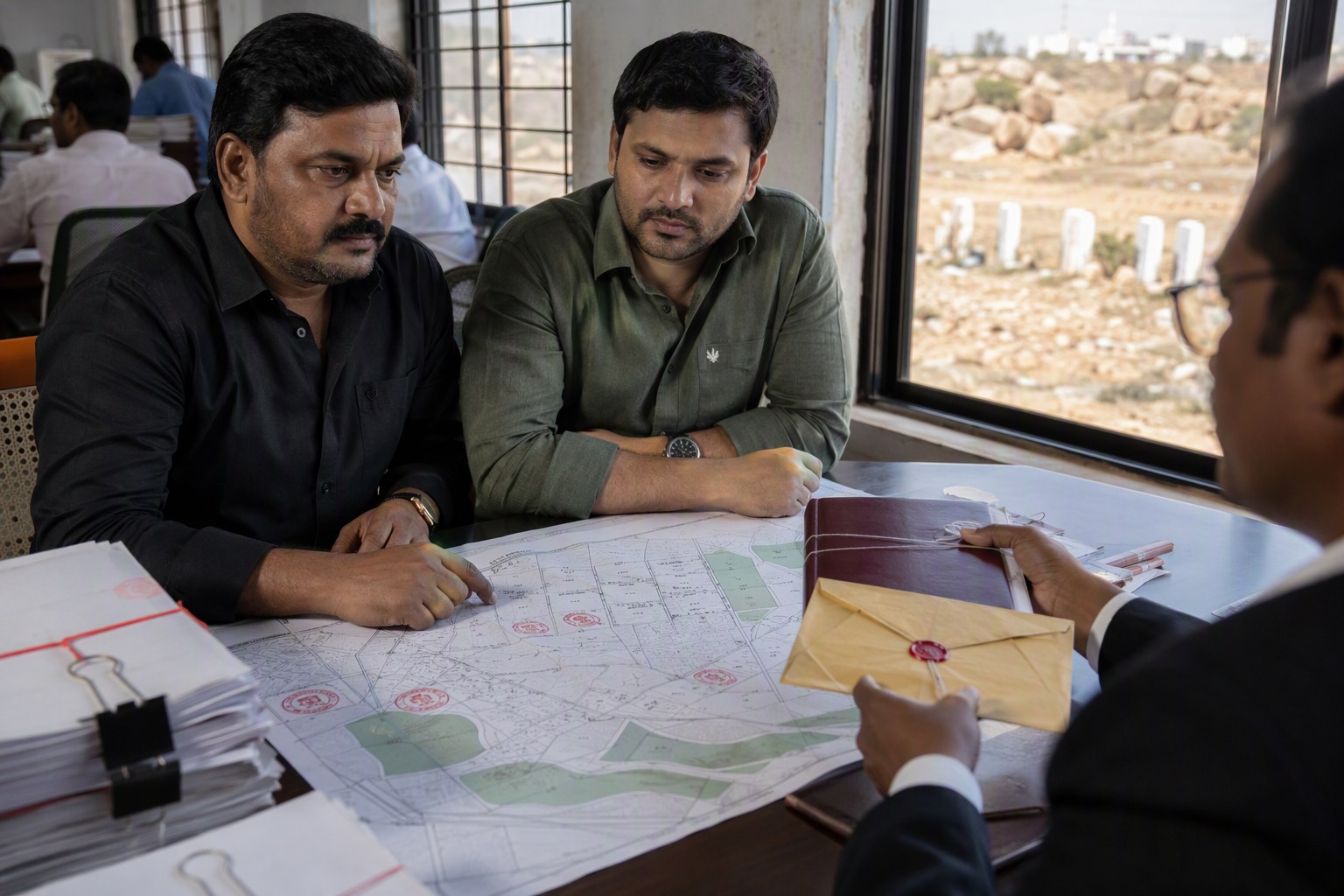
Hyderabad Industrial JV Deal Tests 22-A Carve-Out Clauses because any large land partnership in Telangana now has to treat prohibited property risk as a deal breaker, not a post-signing formality. With 147,934 properties listed under Section 22-A prohibited properties across the state, serious industrial land transactions around Hyderabad are moving towards tighter carve-out schedules, escrow holdbacks, survey-wise indemnities and mandatory Dharani/SRO verification before money changes hands.
The deal being discussed in the market is not just about land price, FSI potential or warehouse demand. The real test is this: can the joint venture isolate clean survey numbers from disputed or restricted parcels without freezing the entire transaction? In our experience, that one question decides whether a land JV in corridors like Medchal, Patancheru, Shamshabad, Maheshwaram or Kandukur moves to signing or quietly disappears.
For industrial land in Hyderabad’s growth belt, Section 22-A is no longer a footnote. It is now part of the commercial structure of the deal.
Hyderabad Industrial JV Deal Tests 22-A Carve-Out Clauses in a 147,934-property backdrop
Section 22-A of the Registration Act allows the government to prohibit registration of certain properties. These may include government lands, assigned lands, endowment lands, wakf lands, ceiling surplus lands and properties under litigation or administrative restriction. Telangana’s current prohibited-property universe stands at 147,934 properties, and that figure is large enough to make every institutional land buyer nervous.
In a plain sale deed, the buyer either accepts the title or walks away. In a joint venture, it is more complicated. The landowner contributes land. The developer or industrial platform brings capital, approvals, tenants, construction capability and exit strategy. If even a portion of the land falls under 22-A, the whole business model can get stuck unless the transaction documents are written with surgical clarity.
That is why Hyderabad’s larger industrial JVs are increasingly using 22-A carve-out clauses. These clauses identify survey numbers or sub-divisions that will not be considered part of the clean land pool until they are cleared from the prohibited list or supported by acceptable government orders, court orders or revenue records.
How Hyderabad Industrial JV Deal Tests 22-A Carve-Out Clauses before signing
The first practical step is survey-wise mapping. Nobody should rely only on the landowner’s oral explanation or an old pahani copy. The parties need survey number, extent, village, mandal, district, SRO jurisdiction and Dharani status lined up in one title matrix.
For example, industrial buyers looking at land around Shamshabad mandal, Maheshwaram mandal, Kandukur mandal, Medchal mandal, Patancheru side or Shankarpally belt usually check three things together: revenue record, registration history and planning permission pathway. A parcel may look fine in one file and still raise a red flag elsewhere.
At a minimum, the due diligence stack should include:
- Current Dharani record and mutation trail
- Pahani or adangal entries for relevant years
- Encumbrance Certificate from the concerned SRO
- Section 22-A prohibited property check
- Village map and survey sketch
- Land use classification and industrial zoning suitability
- Litigation search and family title chain review
- Access road verification, especially for warehousing and truck movement
Buyers can do an initial screen using Verified.RealEstate tools such as the Section 22-A Prohibited Property Check, Encumbrance Certificate Search and Survey Number Finder. These are not a substitute for legal opinion, but they help separate obvious risk from manageable paperwork issues.
The escrow holdback is where the real negotiation happens
In most large industrial JVs, the legal language is only half the story. The money structure is the other half. If a landowner says a 22-A entry is a clerical mistake and will be cleared soon, the developer will usually ask: fine, then let the consideration linked to that portion sit in escrow.
A clean structure may look like this:
| Deal issue | Typical JV response | Why it matters |
|---|---|---|
| Survey number appears in 22-A list | Carve out from initial land contribution | Prevents the entire JV from being infected by one restricted parcel |
| Landowner promises clearance | Escrow holdback until written clearance | Stops premature payout before title risk is cured |
| Partial clean land available | Phase-wise development rights | Allows work to begin only on verified land |
| SRO refuses registration | Condition precedent failure | Gives buyer exit or renegotiation rights |
| Extent mismatch in records | Joint survey and updated schedule | Avoids future boundary disputes |
We’ve seen promoters underestimate this point. They think a prohibited entry can be handled by giving an undertaking. Institutional capital does not work like that. Funds and large developers want a measurable mechanism: what is held back, for how long, who controls the escrow, what document triggers release, and what happens if clearance does not come.
Why industrial land around Hyderabad is extra sensitive
Industrial and logistics land is not like a small residential plot in an approved layout. The land extents are bigger, title histories are older and survey boundaries are often messy. Many parcels near ORR-connected industrial corridors have passed through agriculture, conversion, inheritance, agreements of sale, GPA-era transactions and partial acquisitions.
In locations such as Patancheru, Bollaram, Medchal, Kompally, Shamshabad, Maheshwaram, Kandukur, Adibatla and Ibrahimpatnam, the demand story is strong. Warehousing, data support uses, light manufacturing, EV supply chain units and cold storage operators all want road access and clear title. But one bad survey number can disturb bank funding, tenant onboarding and eventual REIT-style exits.
That is why ready reckoner or market value is only one input. Parties should still verify applicable value using the Market Value / Guideline Value Search and calculate transaction outgo through the Stamp Duty Calculator. But price discovery without title clarity is risky. A low quote can look attractive until the SRO desk says registration is blocked.
What a strong 22-A carve-out clause should say
A good carve-out clause should not be vague. It should list the exact survey numbers, extents and village names. It should state whether the excluded land is outside the JV permanently or only until clearance. It should also say whether development rights, revenue share, built-up area allocation or exit proceeds will be recalculated if the land never becomes usable.
In my view, the clause should cover five practical points:
- Identification: Exact survey number, sub-division, extent, village, mandal and SRO.
- Status: Whether the land is in 22-A, pending mutation, under litigation, assigned, endowment-linked or facing any other restriction.
- Commercial treatment: Whether the land value is excluded, discounted or placed under escrow.
- Clearance trigger: What document proves cure — SRO acceptance, Dharani update, government memo, court order or revenue proceedings.
- Failure result: Exit right, price adjustment, indemnity claim or replacement land obligation.
The parties should also verify SRO jurisdiction using Find Your SRO Office. This sounds basic, but in peri-urban Hyderabad, wrong assumptions about registration jurisdiction can waste weeks. For land use and project feasibility, the Land Use Zone Finder, Road Width Check and FSI/FAR Calculator can help the commercial team avoid surprises before board approval.
Hyderabad Industrial JV Deal Tests 22-A Carve-Out Clauses and lender comfort
Lenders and private credit teams will not be satisfied with broad warranties. They want clean security. If the JV company is borrowing against the project land, any 22-A shadow can reduce collateral value or delay mortgage registration. That can affect drawdowns, construction timelines and tenant possession commitments.
This is where escrow holdbacks become more than a buyer-protection device. They also improve lender comfort. If the disputed portion is clearly excluded and the clean portion is independently developable, the financing conversation becomes easier. If everything is bundled together, the bank’s legal team may treat the entire land bank as high-risk.
Developers should also keep a live watch after signing. A property that is clean today can face later changes due to litigation, mutation disputes or government updates. For continuing monitoring, tools like the Property Change Tracker and Property Verification Tool are useful at the pre-closing and post-closing stages.
What this means for Hyderabad’s industrial land market
The big message is simple: landowners with clean, well-documented title will command better terms. Landowners with 22-A issues may still transact, but they should expect escrow, staggered payouts and sharper indemnities. The old style of saying “registration will happen, sir” is not enough for large capital anymore.
For buyers, the lesson is also clear. Do not reject every flagged parcel blindly. Some entries may be clerical or capable of correction. But do not pay as if the land is clean until the record says so. In Telangana’s current 147,934-property prohibited backdrop, that discipline is not being overcautious. It is commercial common sense.
Hyderabad’s industrial story remains strong, especially along ORR-linked and highway-connected corridors. But the next phase of serious land deals will be won by teams that understand revenue records, registration practice and deal structuring together. The best JV is not the one with the thickest presentation. It is the one where every survey number can survive a hard SRO and lender review.
Frequently Asked Questions
What is a 22-A carve-out clause in a Hyderabad industrial JV?
It is a clause that excludes or separately treats survey numbers affected by Section 22-A prohibited property restrictions, so the clean land portion can proceed without taking on the same title risk.
Why are escrow holdbacks used in Telangana land JVs?
Escrow holdbacks protect the buyer or developer by keeping part of the consideration unpaid until the landowner clears title issues, including 22-A entries, SRO objections or revenue record mismatches.
How many prohibited properties are listed under Section 22-A in Telangana?
Telangana has 147,934 prohibited properties listed under Section 22-A, making prohibited-property verification a key step in large land transactions.
Which checks should be done before signing an industrial land JV near Hyderabad?
Parties should check Dharani records, pahani entries, EC, SRO jurisdiction, 22-A status, survey boundaries, land use zoning, road access and litigation history before signing.
Can a 22-A flagged land parcel still be part of a JV?
Yes, but it should usually be carved out, discounted or linked to escrow release until the restriction is formally cleared through acceptable revenue, registration or court records.