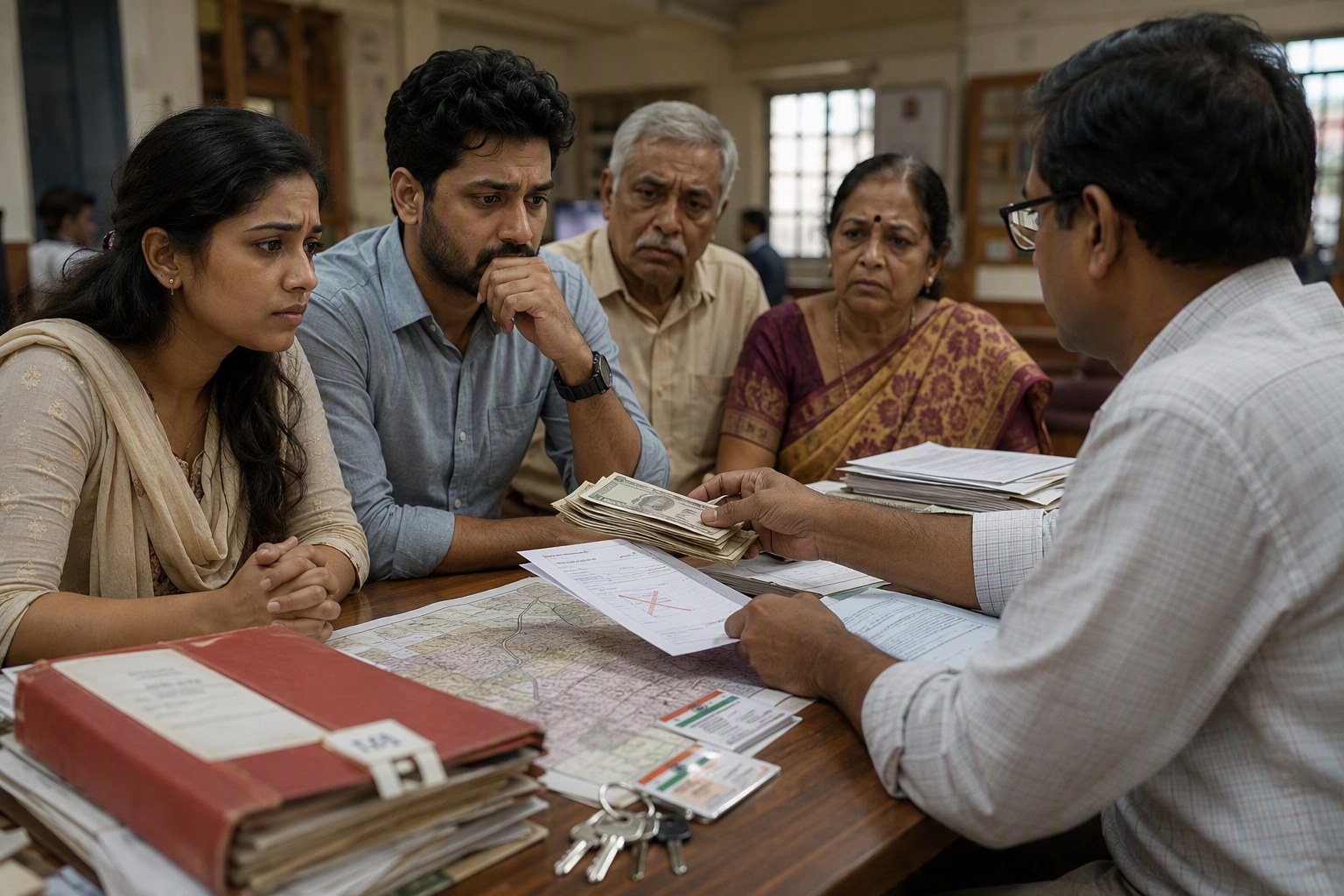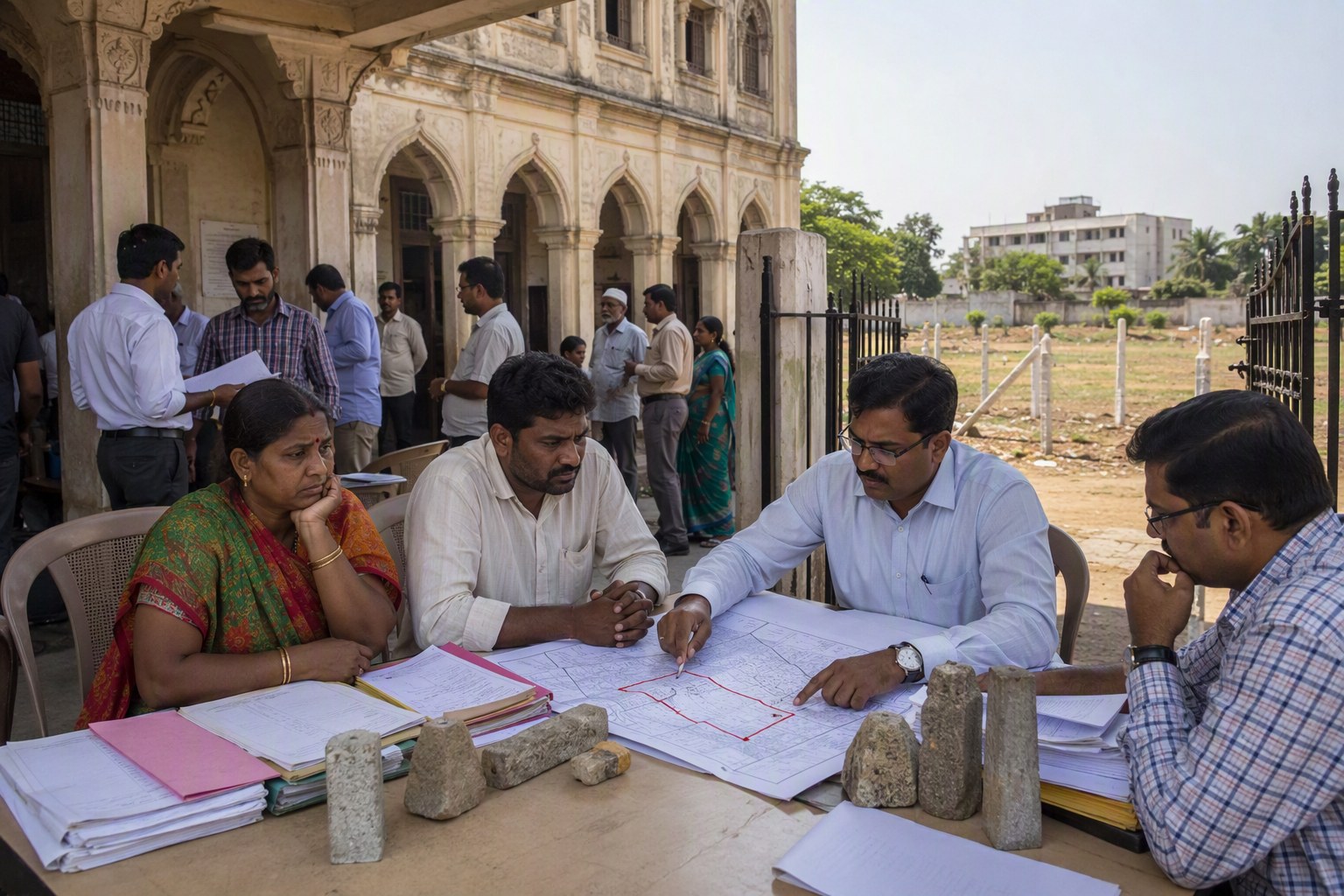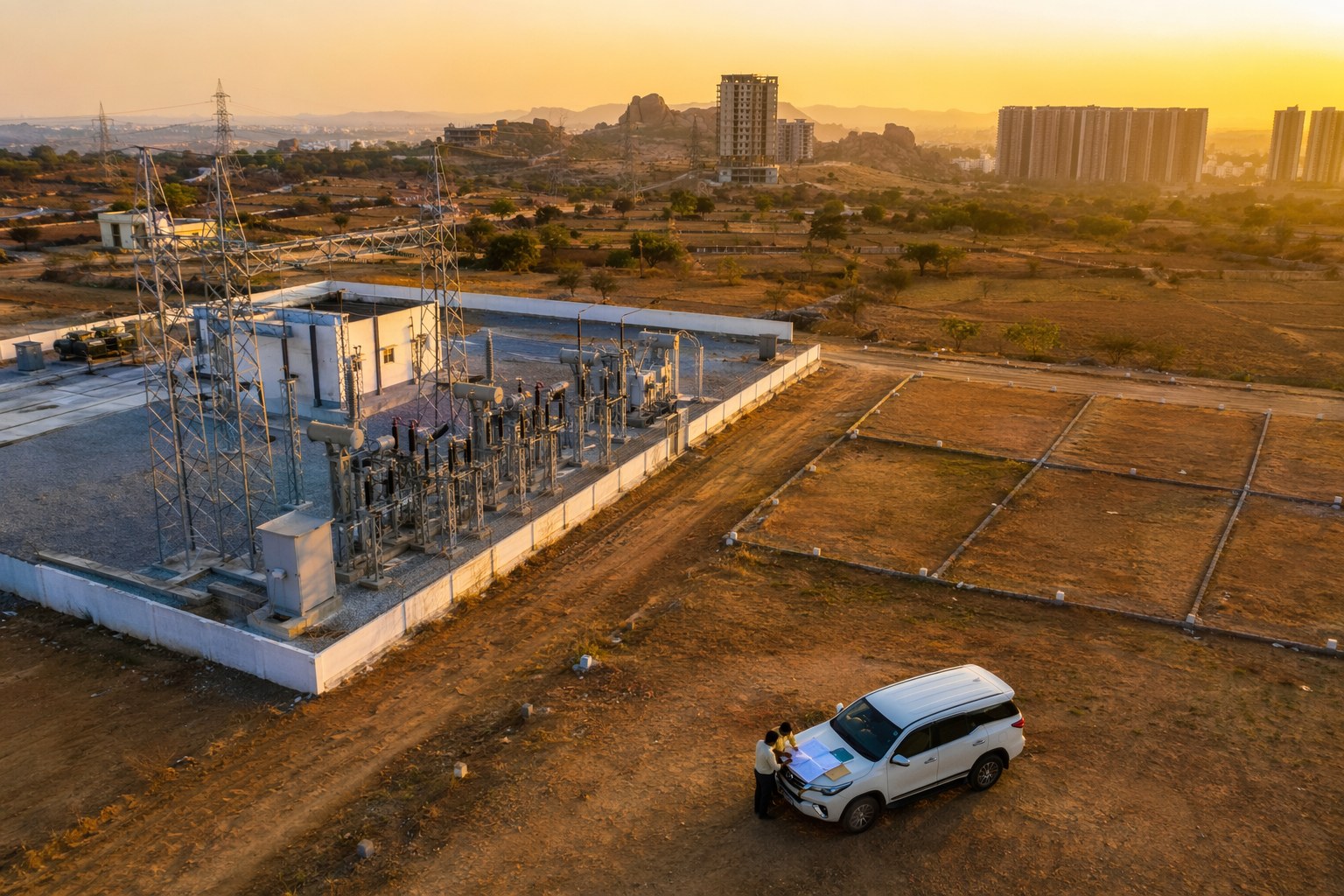


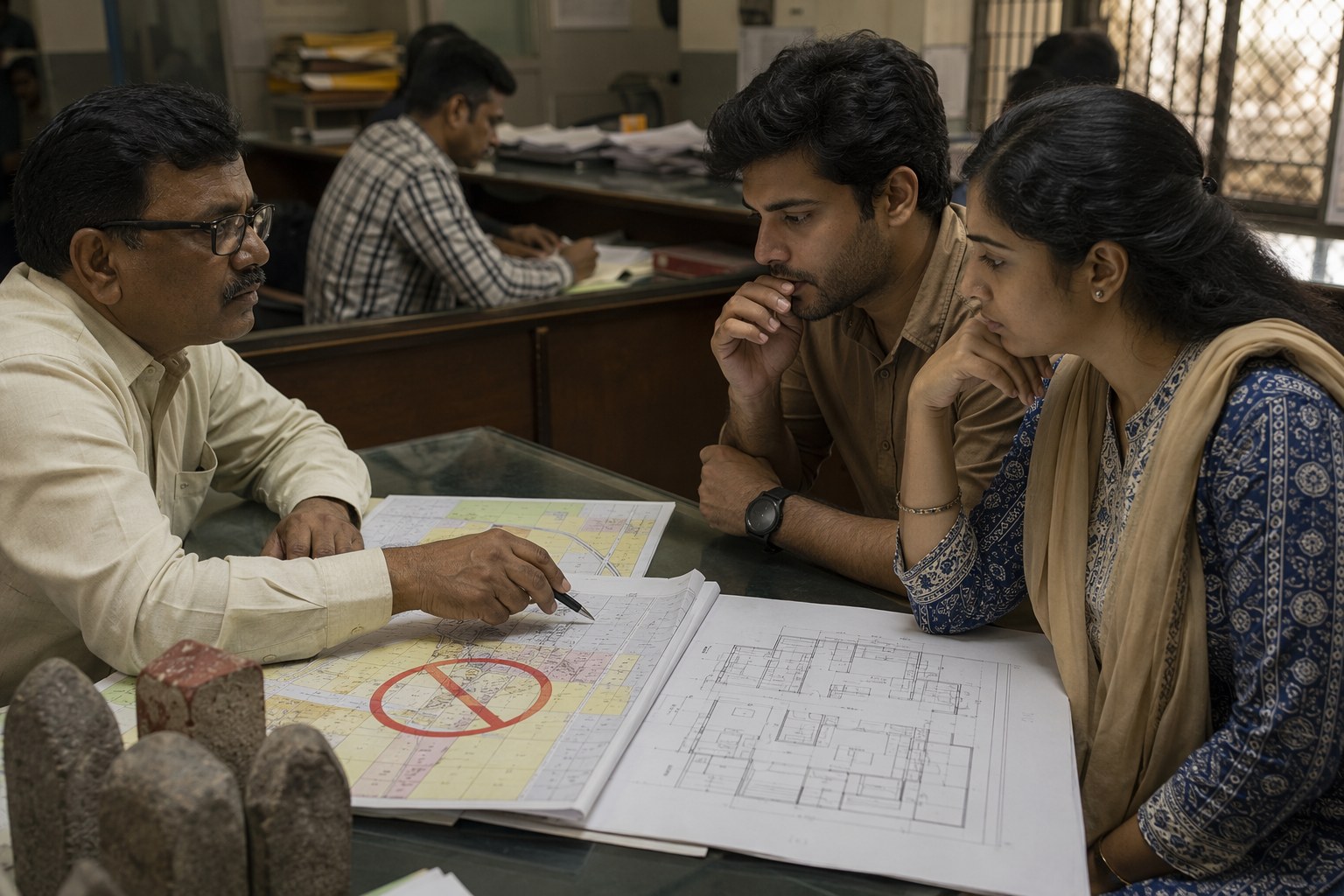
Building Permits May Face 22-A Land Filter in Telangana as municipal approval systems are expected to get tighter around prohibited properties. The idea is simple: before a building permission moves ahead, the system should be able to check whether the survey number or property parcel appears in the Section 22-A prohibited properties database. For buyers and developers, this can become an early warning signal much before money is blocked in agreements, plans, soil tests, loans and marketing.
As per the Verified.RealEstate database, Telangana has 3,076,153 records under prohibited properties linked to Section 22-A. That is not a small background check item. In Hyderabad’s fast-moving land market, especially across growth belts like Kokapet in Gandipet mandal, Tellapur in Ramachandrapuram mandal, Gachibowli in Serilingampally mandal, Shamshabad, Maheshwaram, Medchal and Shankarpally, this filter can change how developers and flat buyers look at land due diligence.
Building Permits May Face 22-A Land Filter in Telangana: what may change
At present, many buyers treat building permission as a comfort document. If a municipality or urban development authority has approved the plan, people assume the land title is also clean. That is not always a safe assumption. Building permission primarily checks planning parameters such as land use, road width, setbacks, height, built-up area, FSI/FAR, fire norms and local development rules. Title and prohibition status sit in a different bucket.
If municipal building permit checks are linked with the Section 22-A prohibited properties database, the approval workflow can flag a property early. This does not mean every flagged land parcel is automatically fraudulent. Some records may need clarification, rectification or updated entries. But for a homebuyer, even a flag is useful. It tells you to pause and verify before paying the next token amount.
In our experience, most disputes do not start at registration day. They start much earlier, when somebody relies only on a brochure, a layout sketch, a Google Maps pin or a confident sales pitch. A 22-A filter inside building permission checks can make that first layer more factual.
Why Building Permits May Face 22-A Land Filter in Telangana now matters to Hyderabad buyers
Hyderabad’s expansion has pushed buyers into revenue villages and mandals where old land records, assigned land notings, government land claims, endowment entries, wakf references, ceiling land issues and court-related restrictions can overlap with private transactions. A buyer may see a gated community board on site, but the underlying survey number may carry a history that is not visible from the road.
Localities like Kollur, Mokila, Narsingi, Bachupally, Kompally, Tukkuguda, Adibatla and Dundigal have attracted both genuine development and speculative land pooling. When land moves from agricultural to plotted layout to apartment project, several records must speak to each other: pahani, Dharani entries, SRO registration history, municipal permissions, RERA registration where applicable, mortgage charges and actual possession.
A 22-A check at the building permit stage can sit between revenue records and planning approvals. It can ask one basic question: is this land showing up in the prohibited property list? If yes, why should a permit be processed without a clear explanation?
What is Section 22-A and why does it affect sale deeds?
Section 22-A refers to categories of properties that may be prohibited from registration. In Telangana property conversations, people commonly call them “22-A lands” or “prohibited properties”. These can include government lands, assigned lands, certain endowment or wakf properties, lands under specific restrictions, and other categories notified by authorities.
The practical impact is serious. If a property is marked under 22-A, registration at the SRO may be refused or questioned. Even if a buyer is only purchasing a flat later, the land beneath the project matters. Apartment ownership is not floating in air; it is linked to undivided share in land, sanctioned plan, occupancy compliance and clean title chain.
Before paying for any land or flat, buyers should run a quick check through the Section 22-A Prohibited Property Check, verify survey details using the Survey Number Finder, and review past transactions through the Encumbrance Certificate Search.
How the proposed filter can help developers
Some developers may initially see this as one more approval hurdle. I see it differently. A clean developer benefits when risky land parcels are filtered out early. It reduces later embarrassment, litigation risk and buyer distrust.
For a developer buying land in places like Shankarpally mandal, Maheshwaram mandal or Gandipet mandal, a 22-A flag before plan sanction is better than a shock after project marketing. If the land is clean, the developer can document the clearance. If there is a mismatch, it can be resolved before large design, approval and construction costs begin.
This is especially relevant for apartment projects where buyers rely heavily on permissions. Many first-time buyers ask only for HMDA or municipal approval, RERA number and bank loan availability. Those are useful, but they are not substitutes for land verification. Developers who voluntarily show land checks, EC history, SRO mapping and RERA details will stand out.
For project-side checks, buyers can use the RERA Project Lookup, planning teams can estimate buildability with the FSI/FAR Calculator, and land teams can check jurisdiction using Find Your SRO Office.
Where the system must be careful
A database filter is only as good as the underlying data matching. Telangana land records can have spelling variations, old village names, survey subdivision differences and legacy entries. In some cases, the same land may appear differently across pahani, Dharani, SRO records and municipal files.
So the 22-A filter should not become a blind rejection machine. It should act as a warning layer. If a survey number is flagged, the applicant should be asked to produce supporting documents, clarification from the competent authority, updated revenue records or court orders where applicable. The municipal officer should not be forced to decide complex title issues alone.
There is also a buyer education angle. Many people search only by flat number or project name. But 22-A status is usually tied to land particulars such as survey number, village and mandal. If the sale team cannot clearly share the survey number and land extent, that itself is a red flag.
Buyer checklist before booking in a project
| Check | Why it matters | Tool to use |
|---|---|---|
| 22-A prohibited status | Shows whether the land is in a restricted category as per records | Section 22-A Prohibited Property Check |
| Survey number and village | Confirms the exact land parcel behind the project | Survey Number Finder |
| Encumbrance history | Helps identify prior sales, mortgages and registered claims | Encumbrance Certificate Search |
| RERA registration | Checks project registration and promoter disclosures where applicable | RERA Project Lookup |
| Ready reckoner value | Helps compare declared value with government market value | Market Value / Guideline Value Search |
What this means for registrations at the SRO
The SRO is usually where buyers discover problems very late. By then, agreement money may already be paid. A municipal-level 22-A filter can shift the warning to an earlier stage. That is good for the market.
Still, buyers should not depend only on one department. Use a layered approach: check 22-A status, compare Dharani or revenue details, pull EC, confirm SRO jurisdiction, check RERA if it is a project, and get legal scrutiny of title documents. For plotted land, ask for layout approval and land conversion documents. For apartments, ask for sanctioned plan, link documents, development agreement, GPA where relevant, and UDS details.
Our view is clear: a building permission with a 22-A clean signal will carry more confidence than a permission that says nothing about prohibited land status. It will not replace legal due diligence, but it can reduce avoidable surprises.
Impact on Hyderabad’s active growth corridors
The biggest impact may be felt in the outer growth corridors where land conversion and aggregation are common. In Kokapet and Narsingi, land values and project sizes attract institutional scrutiny. In Tellapur, Kollur and Mokila, buyers often compare villas, plots and high-rise apartments across different revenue villages. In Tukkuguda, Adibatla and Maheshwaram, industrial and residential demand overlap. In Medchal, Kompally and Dundigal, buyers often evaluate plotted layouts and mid-market apartments.
In each of these belts, the same rule applies: do not fall in love with the elevation before checking the land. A 22-A-linked permit system can support serious buyers, honest developers and lenders. It can also discourage casual land packaging where title issues are pushed down the line.
The bottom line for buyers and builders
Building Permits May Face 22-A Land Filter in Telangana, and that is a practical move if implemented with proper data correction and appeal mechanisms. Telangana already has 3,076,153 prohibited property records in the database we track. Connecting that information to building permission checks can give the market an early caution signal.
For buyers, the advice is simple: ask for survey number, village and mandal before booking. For developers, clean up land records before applying for approvals. For agents, stop saying “permission is there, no issue” unless the land record also supports that statement.
Use the Property Verification Tool for a broader check, track changes through the Property Change Tracker, and confirm government values using the Market Value / Guideline Value Search. In Telangana real estate, early verification is cheaper than late litigation.
Frequently Asked Questions
What does a 22-A land filter in building permits mean?
It means the building permission system may check whether the land or survey number appears in the Section 22-A prohibited properties database before approval moves ahead.
Does building permission prove that the land title is clear?
No. Building permission mainly deals with planning rules. Buyers should still check 22-A status, EC, revenue records, SRO jurisdiction and legal title documents.
How many prohibited property records are tracked in Telangana?
As per the Verified.RealEstate database, Telangana has 3,076,153 records linked to Section 22-A prohibited properties.
Which Hyderabad areas should buyers be extra careful in?
Buyers should be careful in all areas, especially active growth belts like Kokapet, Tellapur, Kollur, Mokila, Tukkuguda, Maheshwaram, Shankarpally, Medchal and Dundigal where land aggregation is common.
What should I ask the builder before booking a flat?
Ask for the survey number, village, mandal, sanctioned plan, RERA details where applicable, EC, link documents, development agreement and confirmation that the land is not under Section 22-A restriction.