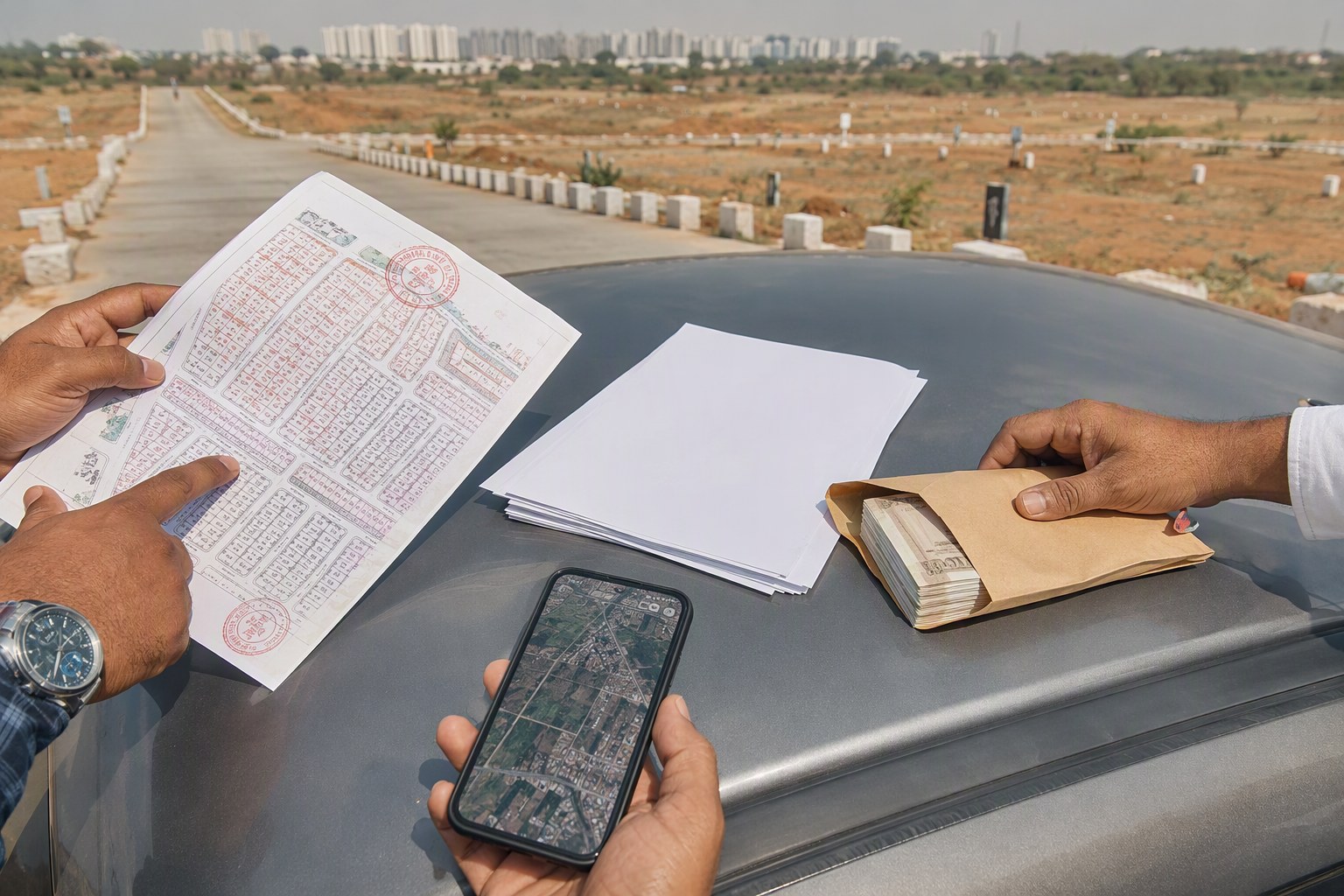



Telangana Property Investors Check Exit Risk Before Buying is now the sharper investment rule across Hyderabad, not just a cautious slogan. The shift is clear: serious buyers are no longer stopping at purchase price, rental yield and appreciation story. They are asking one blunt question first — can I sell this property cleanly after five or seven years, close my loan, and receive full payment without a legal block?
The reason is not small. Telangana has 147934 prohibited property records under Section 22-A. A single match in this list can disturb resale, bank loan processing, buyer confidence and final registration. For an investor, that means the exit door may be narrower than the entry door.
In our experience, the investor who checks exit risk before paying token advance is usually the one who sleeps better after registration.
Why Telangana Property Investors Check Exit Risk Before Buying
Until recently, many investors in Hyderabad had a simple checklist. Buy near IT corridor, ORR, metro route or proposed growth pocket. Compare price per square foot. Check rental yield. Negotiate car parking, corpus, club house and maintenance. For open plots, check road width and HMDA or DTCP approval. Then close the deal.
That style is changing. Investors are now looking at whether the next buyer can get a bank loan, whether the title will pass an Encumbrance Certificate check, whether the land is clean in Dharani, whether survey numbers match pahani records, and whether the property has any Section 22-A mark. This is especially visible in Kokapet, Narsingi, Tellapur, Miyapur, Kompally, Uppal, Shamshabad, Adibatla and the Shankarpally belt.
The old calculation was: buy at ₹7,500 per sq ft, rent at ₹35,000 per month, sell at ₹10,000 per sq ft later. The new calculation is tougher: even if the value rises, will the buyer’s bank approve it? Will the SRO accept registration without objection? Is the land use correct? Is the project RERA-registered? Is there any government, assigned, endowment, wakf or ceiling land issue in the chain?
That is why investors are using tools such as the Section 22-A Prohibited Property Check, Encumbrance Certificate Search, Market Value / Guideline Value Search and Find Your SRO Office before even discussing the final price.
Telangana Property Investors Check Exit Risk Before Buying Because 147934 Records Can Hit Resale
Section 22-A is not some small clerical line in a file. It can block or delay registration where the property is classified under prohibited categories. Telangana’s 147934 prohibited property records make this a live issue for anyone buying land, flats built on earlier land parcels, farm land, villas and plotted layouts.
The risk is not limited to rural land. Hyderabad’s expansion has pulled many old village lands into premium urban pricing. Areas that once had agricultural survey numbers are now selling as gated villas, high-rise apartment sites, commercial plots and weekend farm layouts. If an old land record is not clean, the future buyer may not care about your interior work, rental history or appreciation. He will ask for a clean title and loanable property.
We have seen this pattern in Hyderabad investor conversations. A buyer may accept a slightly lower rental yield in a clean RERA apartment in Nanakramguda, Financial District or Kondapur. But the same buyer may refuse a high-appreciation plot near a disputed survey number in a fast-growing mandal. The reason is simple: exit liquidity matters.
What Exit Risk Means in Telangana Real Estate
Exit risk is the chance that you will struggle to sell, transfer, mortgage or close the property investment at the time you want. In Telangana, it is not only about market demand. It is about paperwork, approvals, land classification, title chain and lender comfort.
- Registration risk: SRO may not allow registration if the property appears in prohibited records.
- Loan risk: Banks and NBFCs may reject or delay funding due to title defects, missing link documents or land classification issues.
- Buyer confidence risk: A resale buyer may reduce offer price after legal due diligence.
- Mutation risk: Dharani mutation or municipal records may not reflect ownership cleanly.
- Approval risk: Layout, building permission, RERA registration or land use may not match the investor’s assumption.
- Tax exit risk: Capital gains planning may be poor if purchase value, improvement cost and sale timing are not documented properly.
For this reason, the smart investor now checks the exit path before the entry price. Use the Property Verification Tool and Survey Number Finder before relying only on a broker’s WhatsApp brochure.
Hyderabad Markets Where Exit Risk Is Being Priced In
Hyderabad still has strong demand. There is no doubt about that. But investors are becoming selective. The difference between a clean asset and a doubtful asset is now visible in negotiation.
| Locality / Belt | Mandal / Area context | Indicative investor price band | Exit-risk question buyers ask |
|---|---|---|---|
| Kokapet | Gandipet mandal | Apartments around ₹9500-₹14000 per sq ft; premium plots often above ₹1.5 lakh per sq yd | Is the project RERA-listed and is the land chain clear from original survey numbers? |
| Narsingi | Gandipet mandal | Apartments around ₹8500-₹12500 per sq ft; plots around ₹1.2-₹1.9 lakh per sq yd in better pockets | Will a resale buyer’s bank accept the title without extra legal queries? |
| Tellapur | Ramachandrapuram side / Sangareddy growth belt | Apartments around ₹6500-₹9500 per sq ft; plots around ₹75000-₹1.4 lakh per sq yd | Is it approved layout land or only marketed as future development land? |
| Miyapur | Serilingampally mandal | Apartments around ₹6500-₹9000 per sq ft; independent plot values can cross ₹1 lakh per sq yd | Are old title documents, EC and municipal records consistent? |
| Kompally | Quthbullapur / Medchal side | Apartments around ₹5500-₹7500 per sq ft; plots around ₹55000-₹90000 per sq yd | Is the layout approval clear and is there any road widening or land use issue? |
| Uppal - Nagole | Uppal mandal and nearby metro belt | Apartments around ₹5500-₹8000 per sq ft; plots around ₹60000-₹1.1 lakh per sq yd | Does the property have clear approach road, zoning and EC history? |
| Shamshabad | Shamshabad mandal | Open plots often around ₹30000-₹80000 per sq yd depending on approval and location | Is it near airport-related restrictions, assigned land or unclear village records? |
| Adibatla | Ibrahimpatnam belt | Plots around ₹20000-₹55000 per sq yd; apartments lower than west Hyderabad | Is the growth story supported by clean title and proper layout approval? |
These price bands are not government market values. They reflect investor-level asking and resale discussions we see in the market. For registration value and ready reckoner reference, check the Market Value / Guideline Value Search. For stamp duty and registration cost, use the Stamp Duty Calculator.
Purchase Price Alone Is No Longer the Main Filter
A low price can be a trap if the exit is weak. For example, suppose an investor gets a plot in a village near Shankarpally at 15% below nearby market rate. On paper, it looks like a bargain. But if the survey number has a past assignment issue, if the approach road is not recorded, or if land use does not support the planned development, the discount may not compensate for the risk.
The same logic applies to apartments. A flat in a non-RERA building may give higher rent today. But during resale, a cautious buyer may ask for building permission, occupancy certificate, UDS clarity, link documents, mutation, property tax record and EC. If two documents do not match, the price discussion changes immediately.
This is why institutional-style thinking has entered even family investments. NRIs from Gachibowli, Hitec City-linked professionals, small business owners from Secunderabad and retired government employees buying in Bachupally or Kollur are asking better questions now. We welcome this change. Telangana real estate has matured enough for proper due diligence.
How Telangana Property Investors Check Exit Risk Before Buying
A practical exit-risk check starts with the asset type. A flat, open plot, agricultural land, villa and commercial unit each need a different check. Still, the following sequence works well for most Telangana purchases.
1. Check Section 22-A status first
Before paying token advance, check whether the property or its survey number appears in prohibited property records. With 147934 records in Telangana, this is not a formality. Use the Section 22-A Prohibited Property Check. If there is a match or near match, do not assume it is harmless. Take written legal advice and verify with the SRO or revenue office.
2. Pull the Encumbrance Certificate
The EC tells you registered transactions, mortgages, releases and other recorded dealings. A clean EC does not prove everything, but a problematic EC can reveal loans, old sales, court attachments or missing links. Use the Encumbrance Certificate Search and compare the EC with the sale deed chain.
3. Match survey number, pahani and Dharani details
For land, the survey number is the heart of the asset. Check pahani, Dharani record, extent, owner name, land nature and mutation history. Be extra careful where a large survey number has been split into many plots. A good layout plan is useful, but it cannot cure a bad parent title.
4. Verify SRO jurisdiction
Many buyers get confused between municipal area, village, mandal and SRO. Registration happens at the correct SRO based on jurisdiction. Use Find Your SRO Office before comparing registration details or guideline value.
5. Check RERA for apartments and gated communities
For ongoing projects, use the RERA Project Lookup. Verify project name, promoter, sanctioned floors, completion date, approvals and complaints if any. In the resale market, RERA details can still help you understand whether the original project was registered correctly.
6. Compare guideline value and deal value
If the market price is ₹9000 per sq ft in a locality but registration value is much lower, plan stamp duty and tax correctly. If the seller pushes for an unusual split between sale deed value and cash, treat it as a future exit risk. Your next buyer may not agree to the same style.
7. Plan tax exit before buying
Investors often discuss capital gains only when selling. That is late. Keep proof of purchase price, stamp duty, registration charges, brokerage, improvement cost and loan interest records. Use the Capital Gains Tax Calculator to understand post-tax return, not only gross appreciation.
Local Examples: Where a Clean Exit Beats a Cheap Entry
Take two investors. One buys a clean RERA apartment in Narsingi at ₹10500 per sq ft with slightly modest rental yield. Another buys a cheaper under-construction flat in an unregistered small project near an interior road. After four years, both try to sell. The first investor has bankable title, RERA trail, clear UDS and buyer confidence. The second investor may still get appreciation, but every buyer asks more questions. Time-to-sell becomes longer.
In open plots, the difference is even sharper. A HMDA-approved plot in Kollur or Mokila with clear title may look expensive at entry. But it usually has a wider buyer pool at exit. A low-cost plot in an unapproved layout may look attractive, but if regularisation, road width, land use and parent survey title are unclear, the exit may be painful.
We have seen investors accept 5-8% lower expected return for a clean resale path. That is not fear. That is discipline.
Bank Loan Closure Is the Hidden Test
Many investors buy with home loans and plan to close the loan after resale. Exit risk directly affects this. A buyer’s bank will inspect the title, approvals, valuation and legal chain. If the bank refuses funding, the buyer may cancel or demand a deep discount. If the seller has an existing loan, closure becomes more sensitive because the sale consideration must clear the mortgage and release the original documents.
In Hyderabad’s premium apartment market, banks are comfortable with established projects in Financial District, Kondapur, Madhapur, Gachibowli, Nallagandla, Tellapur and Narsingi when documents are in order. In plotted layouts and peripheral mandals, banks may be stricter. That is why exit-risk due diligence must happen before buying, not when selling.
Red Flags Telangana Investors Should Not Ignore
- Seller says EC is not needed because the property is ancestral.
- Survey number in sale deed does not match pahani or Dharani record.
- Property is priced far below local market without a clear reason.
- Broker says registration can be managed despite a document mismatch.
- Layout approval copy is blurred, incomplete or unrelated to the plot number.
- Seller refuses to share link documents before token payment.
- RERA number belongs to a different phase or project name.
- Guideline value, sale agreement and loan value are structured in a confusing way.
- Land is described as farmhouse, weekend plot or investment plot without clear conversion or approval details.
Use the Land Use Zone Finder, Road Width Check and Property Change Tracker where relevant. These checks will not replace a lawyer, but they help you ask better questions.
What Sellers and Developers Should Learn From This Shift
This trend is not bad news for good sellers. In fact, clean documentation can now command a premium. Developers who keep land title, approvals, RERA filings, OC status, UDS details and bank approvals transparent will sell faster. Individual sellers who prepare EC, link documents, tax receipts, loan closure letters and mutation records before listing will attract better buyers.
In Telangana, trust is becoming a pricing factor. A flat in a well-documented society in Kondapur may get faster resale than a flashier unit with missing papers. A plotted layout in a clear mandal record may beat a cheaper grey-market layout. This is healthy for the market.
The Investor Verdict
Telangana real estate is still one of India’s most active property markets. Hyderabad’s job base, infrastructure, ORR connectivity, metro expansion talk, pharma and data centre activity continue to support demand. But the investor mindset has changed. The first question is no longer only: what is the entry price? The better question is: how clean is my exit?
With 147934 Section 22-A prohibited property records, no buyer should treat title checks as optional. Check prohibited status, EC, SRO, guideline value, RERA and land records before booking. A good investment is not just the property you can buy today. It is the property you can sell tomorrow without drama.
Frequently Asked Questions
What is exit risk in Telangana property investment?
Exit risk is the chance that you may face trouble while selling, transferring, mortgaging or closing a property investment. In Telangana, it can come from Section 22-A prohibition, unclear title, EC issues, wrong land use, missing approvals or poor loan eligibility.
Why are Section 22-A records a concern for investors?
Telangana has 147934 prohibited property records under Section 22-A. If a property or survey number falls in this list, resale registration and bank loan processing can become difficult or even blocked until the issue is resolved.
Should I check EC before paying token advance?
Yes. An Encumbrance Certificate should be checked before token advance, especially for resale flats, plots, villas and land. It helps identify registered loans, sales, releases and other transactions linked to the property.
Is a low-price plot near Hyderabad always risky?
Not always. But a price far below nearby market value needs careful checking. Verify survey number, Dharani record, pahani, layout approval, land use, road access and Section 22-A status before treating it as a bargain.
Which tools can help Telangana investors reduce exit risk?
Start with Section 22-A Prohibited Property Check, EC Search, Guideline Value Search, Find Your SRO Office, RERA Project Lookup and Property Verification Tool. These checks help you identify issues before you commit money.