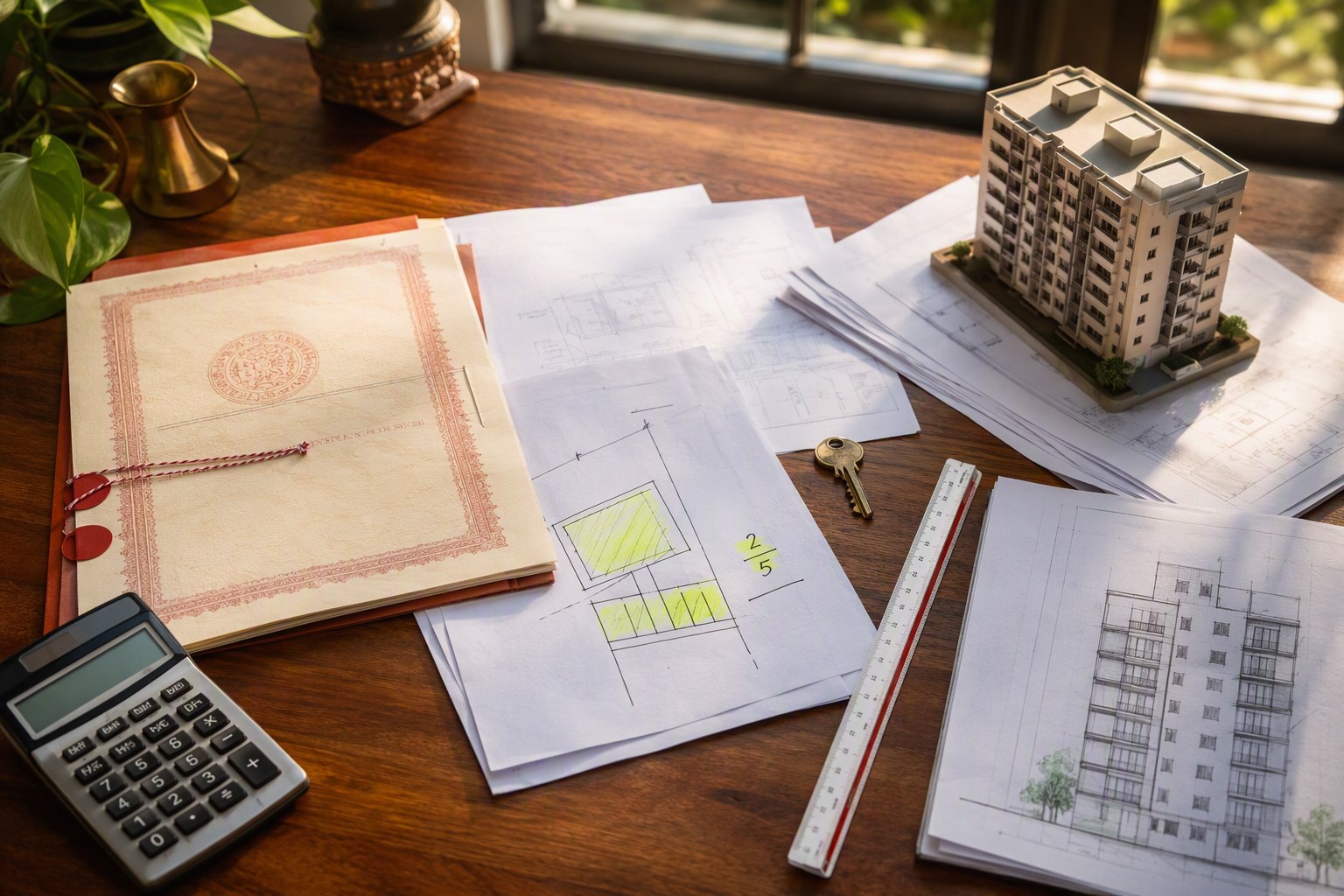



Telangana Plot Boundary Check answer first: no, fencing cannot prove ownership in Telangana. A compound wall, barbed wire fencing, gate, name board, watchman room or planted boundary stones may show physical possession, but ownership is proved only by matching the registered deed, link documents, FMB sketch, survey stones, pahani or Dharani records where applicable, layout approval, Encumbrance Certificate and Section 22-A status. Before paying even a small token advance, the buyer must verify whether the fenced land is the same land being sold.
We have seen this problem repeatedly around Mokila in Shankarpally mandal, Kokapet and Narsingi in Gandipet mandal, Bachupally, Ameenpur, Adibatla and Ghatkesar side. The seller takes the buyer to a neatly fenced plot, says ‘sir, boundary is clear’, and asks for a quick advance. But in land matters, a fence is only a starting point. It is not the final proof.
In our experience, a compound wall is often the strongest visual comfort and the weakest legal evidence. The file has to prove what the fence is claiming.
Telangana Plot Boundary Check: what fencing really proves
Fencing proves that someone has marked and occupied a piece of land. That is all. It does not prove that the person selling it owns it. It also does not prove the exact survey number, exact extent, road access, layout approval or absence of encumbrance.
In Telangana, a land parcel can look perfect on ground and still have issues in records. One side may be government land. A corner may fall in a neighbour’s survey number. The access road may be only on paper. The actual fenced extent may be 240 square yards while the deed says 267 square yards. Sometimes the seller shows Plot No. 42 on ground, while the sale deed refers to Plot No. 24 in an old Gram Panchayat layout. These are not rare mistakes.
Hyderabad’s land values make boundary errors very expensive. Kokapet Neopolis land auction in 2023 reportedly touched Rs 100.75 crore per acre, with average bids around Rs 73.23 crore per acre. In Mokila auctions, bids crossed Rs 1 lakh per square yard in select parcels. Even where private residential plots trade at much lower street rates, a 20 or 30 square yard boundary shortage can mean several lakhs of loss. That is why boundary verification is not a formality.
Telangana Plot Boundary Check before token advance
A buyer should not treat token advance as casual money. Once the seller receives Rs 1 lakh, Rs 5 lakh or Rs 10 lakh, the negotiation tone changes. If a boundary defect comes out later, getting the amount back can become a separate fight. Do the boundary check before token, not after agreement.
Start with the survey number. If the seller is offering a plot in Kondakal, Mokila or Shankarpally, confirm the village and mandal. If it is in Bachupally or Nizampet side, check the district and SRO jurisdiction because old documents may refer to different administrative names. You can use our Survey Number Finder to cross-check the basic survey reference before going deeper.
Next, ask for the latest deed copy, parent documents, layout copy, link documents for at least 30 years where possible, EC, tax receipts, mutation or Dharani extract for agricultural origin land, and FMB sketch if it is survey-number based land. For a plotted layout, ask for the approved layout plan from HMDA, DTCP, municipality or the competent authority. Do not accept only a colour brochure and fencing photos.
Why FMB sketch matters more than a fence
The FMB, or Field Measurement Book sketch, is one of the most useful boundary documents for agricultural and converted land. It shows the survey number geometry, measurements and neighbouring survey references. In many Telangana villages, the FMB sketch is the document that tells you how the land was originally measured on ground.
If the seller says the fenced plot is in Survey No. 118/A, the FMB should support the shape and boundaries. The village map, Tippan, FMB and pahanis should not tell a different story. If the land is part of a larger survey number, the layout plan should clearly show how the parent extent was divided into roads, open spaces and plots.
For example, if a builder is selling villa plots near Tellapur in Ramachandrapuram side, the buyer should not stop at the gate and compound wall. The approved layout must show the same plot number, same dimensions, same road width and same open space allocation. If the plot is near a nala, lake buffer, proposed road or high-tension corridor, the fence will not save the buyer from planning restrictions.
Deed extent versus ground extent: where buyers get trapped
The sale deed usually states the extent, boundaries and sometimes measurements. A typical plot deed may say 300 square yards bounded by road on east, Plot No. 16 on west, Plot No. 12 on north and Plot No. 14 on south. On ground, however, the fenced area may measure 286 square yards. Or the road may be on the south instead of east.
Do not ignore such mismatches. In Hyderabad outskirts, people casually say ‘minor variation sir’. A one-foot shortage across a long boundary can reduce the extent sharply. In a high-value locality like Gachibowli, Kokapet, Narsingi, Tellapur or Osman Nagar, even a small shortage can hit the resale value and building plan.
Use a licensed surveyor, not only a tape measurement by the broker. Ask the surveyor to mark the corners with reference to FMB, layout plan and existing survey stones. If the land is in a gated plotted venture, compare the plot dimensions with the approved plan. If the plot falls under HMDA limits, check whether the road width and open space match the sanctioned layout. A 30-feet road shown as 40 feet in marketing material is a common red flag.
EC and registration records: what they can and cannot prove
The Encumbrance Certificate shows registered transactions, mortgages, sale deeds, gift deeds, release deeds and other recorded dealings for the selected property description and period. It is essential, but it is not a land survey document. EC will not stand on the land and confirm that the fence is correctly placed.
Still, EC is a must before token advance. If the current seller bought 400 square yards but is selling 450 square yards, the EC and parent deed chain may reveal the problem. If there is an old mortgage, court attachment, family partition or sale agreement registered earlier, EC can catch it. Start with our Encumbrance Certificate Search and compare the result with the deed schedule line by line.
Also remember that SRO registration is not a government guarantee of physical boundaries. The Sub-Registrar records the transaction based on documents presented and applicable rules. For SRO jurisdiction, use Find Your SRO Office. For stamp duty planning, Telangana sale transactions commonly involve stamp duty, transfer duty and registration fee that together are often around 6% for many sale deeds; verify the current duty for your document type using our Stamp Duty Calculator.
Section 22-A risk: a fence on prohibited land is still a problem
Telangana has a large prohibited property dataset under Section 22-A. As per the database fact available with us, there are 147,934 prohibited properties listed under Section 22-A. This number itself should make buyers careful. A fenced parcel can still be government land, assigned land, endowment land, Wakf-related land, ceiling surplus land or land blocked from registration for another reason.
Before paying advance, run a Section 22-A Prohibited Property Check. This is especially critical in villages on Hyderabad’s growth corridors: Shankarpally, Moinabad, Chevella, Maheshwaram, Ibrahimpatnam, Kandukur, Ghatkesar, Medchal, Patancheru and Ameenpur. Many of these areas have a mix of patta lands, assigned lands, old layouts, conversion files and government claims.
If the property appears in the prohibited list, do not rely on the seller’s statement that ‘it will be cleared soon’. Ask for documentary clearance. If the seller cannot provide it, walk away or keep the money in a properly drafted escrow-like arrangement with strict refund terms.
How to match boundaries properly
A proper Telangana plot boundary check has four layers: document boundary, revenue boundary, planning boundary and physical boundary. All four should broadly point to the same land.
| Check | Document to verify | What to compare | Risk if ignored |
|---|---|---|---|
| Deed boundary | Sale deed and link deeds | Plot number, extent, four boundaries, road side | Wrong plot or reduced land extent |
| Revenue boundary | FMB sketch, pahani, Dharani extract where applicable | Survey number, sub-division, neighbouring survey numbers | Encroachment into another survey number |
| Planning boundary | HMDA, DTCP, municipal or GP layout approval | Road width, open space, plot dimensions, land use | Building permission or resale trouble |
| Registration record | EC and SRO records | Ownership chain, mortgages, prior sales | Hidden charge or title dispute |
| Physical boundary | Site survey and survey stones | Fence line, corner points, access road | Shortage, overlap or no legal access |
For a stronger pre-purchase check, use our Property Verification Tool. To understand official market value used for registration, check Market Value / Guideline Value Search. Ready reckoner or guideline value is not the same as market price, but it helps you estimate registration cost and detect undervaluation pressure from the seller.
Common boundary tricks in Hyderabad outskirts
One common trick is shifting the fence after selling neighbouring plots. In small ventures near Adibatla, Bongloor, Tukkuguda and Maheshwaram, buyers sometimes find that the internal road has slowly eaten into their plot. Another trick is showing a corner plot as larger because of road curvature, while the sanctioned layout has a smaller extent. In Patancheru and Ameenpur side, old panchayat layouts may have unclear road handover records.
We have also seen cases where the seller shows survey stones, but those stones were placed privately and not by the revenue survey team. A stone painted white and red is not automatically an official survey stone. Ask the surveyor to identify reference points and match them with FMB. If required, apply for official survey through the revenue channel before final payment.
Lake and nala issues need special care. A fenced land near water bodies in Gandipet, Manikonda, Peerancheru, Ameenpur, Pocharam or Kompally belt may fall within buffer or FTL limits. If you plan construction, also verify zoning through Land Use Zone Finder and road access through Road Width Check.
Practical buyer checklist before paying token
- Take the survey number, plot number, village, mandal, district and SRO name in writing from the seller.
- Collect sale deed, parent deeds, link documents, EC, layout approval, FMB sketch and latest revenue records.
- Match the deed extent with the actual measured extent on ground.
- Check whether all four boundaries in the deed match the site reality.
- Verify whether the road shown on ground is part of the approved layout or revenue record.
- Check Section 22-A prohibited status before advance.
- Use a licensed surveyor to confirm corner points and survey stones.
- Do not rely only on fencing, name board, electricity pole or watchman statement.
- Put refund conditions in writing if any advance is paid subject to verification.
When fencing can support your case
Fencing is not useless. It can support a possession claim when documents are already clean. If your registered deed, EC, FMB, layout approval and surveyor report all match, a compound wall helps protect the land from casual encroachment. It also gives clarity to neighbours and future buyers.
But the order matters. First prove title and boundary through documents and survey. Then treat fencing as protection. Do not reverse it by assuming that a fenced plot must have clean ownership.
Final view on Telangana Plot Boundary Check
For any Telangana Plot Boundary Check, my blunt advice is this: believe the records first, the ground second, and the broker last. A genuine seller will not object to FMB verification, EC search, Section 22-A check, survey measurement and layout comparison. If the seller pushes for immediate token and says documents can be checked later, slow down.
In Hyderabad’s expanding property market, land mistakes are costly and slow to fix. A proper boundary check may take a few days and a small professional fee, but it can save years of dispute. Fencing can protect ownership after you establish it. It cannot create ownership by itself.
Frequently Asked Questions
Can fencing prove ownership of a plot in Telangana?
No. Fencing can show physical possession, but ownership must be proved through registered title documents, link deeds, EC, FMB sketch, layout approval and revenue records.
What should I check before paying token advance for a plot?
Check the sale deed, parent documents, EC, FMB sketch, survey number, layout approval, Section 22-A status, ground measurements and SRO records before paying token.
Is an Encumbrance Certificate enough for boundary verification?
No. EC shows registered transactions and charges, but it does not confirm physical boundaries. You still need FMB, layout plan and site survey.
What if the deed extent and fenced extent are different?
Treat it as a red flag. Ask a licensed surveyor to measure the land and compare it with the deed, FMB and approved layout before proceeding.
Can I buy a plot if it is in the Section 22-A prohibited list?
Do not proceed without legal clearance. Telangana has 147,934 prohibited properties in the Section 22-A dataset, and registration may be blocked or disputed.