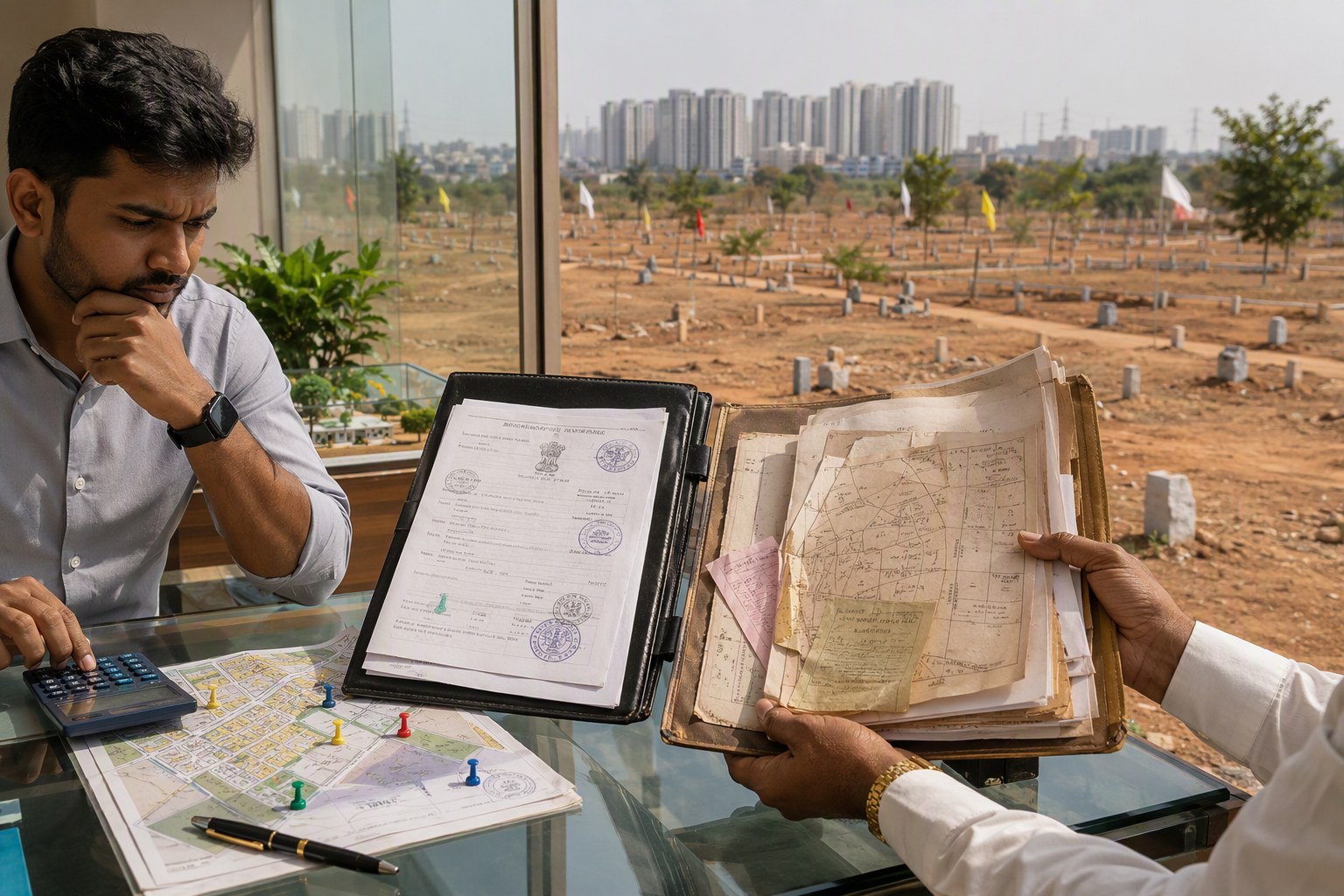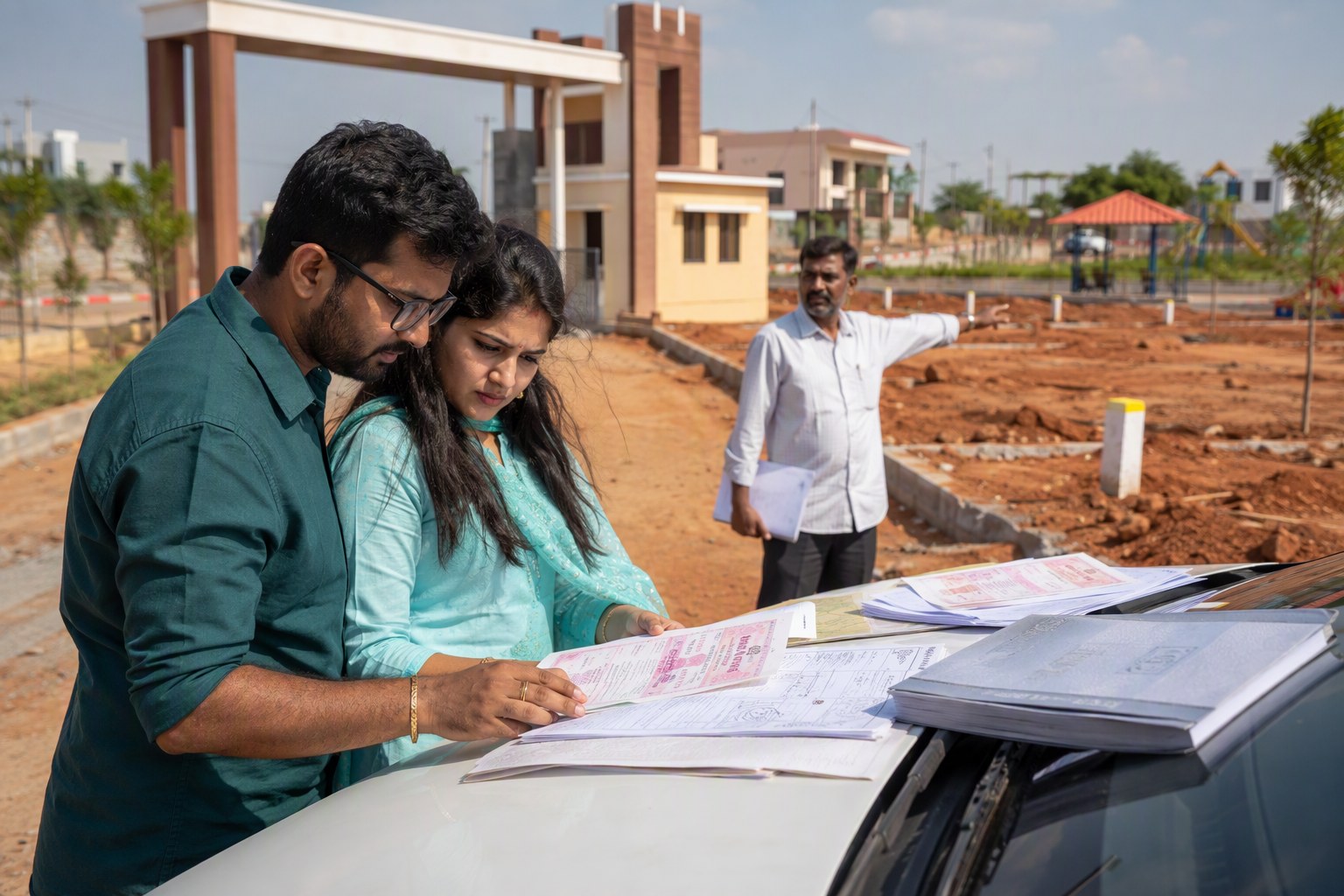
Telangana Market Trend is now moving beyond location, carpet area, road width and builder brand. The new liquidity signal is land-record clarity. With 1,47,934 properties listed under Section 22-A prohibited property records in Telangana, serious buyers are asking one direct question before they even discuss price: can this property be registered without a record shock at the SRO?
This is changing how homes, open plots and development land are getting sold across Hyderabad and the wider HMDA region. A flat in Gachibowli with clear title may attract quick site visits and bank-backed buyers. A plot in Shankarpally, Mokila, Tukkuguda or Adibatla with survey-number confusion may sit longer, even if the asking price looks attractive. We have seen this pattern become sharper in the last few quarters: buyers are not only checking location, they are checking whether the property is liquid on paper.
In Telangana real estate, clean land records have become a resale feature. If the pahani, Dharani entry, EC and SRO record do not speak the same language, buyers slow down.
Telangana Market Trend: 1.48 lakh prohibited records are changing buyer behaviour
The headline number is large enough to affect market psychology: 1,47,934 prohibited property records under Section 22-A. Section 22-A entries can restrict registration of certain properties, depending on the nature of the prohibition. For a buyer, that means uncertainty. For a seller, it means slower conversion. For a broker, it means more questions before token advance.
Earlier, many buyers would first ask about price, road access, nearby metro, school distance and loan availability. Those points still matter. But in our experience, the first serious filter now is whether the document trail is clean. A buyer looking at a villa plot in Kollur, a gated community flat in Narsingi or a resale apartment in Kondapur is likely to ask for EC, link documents, mutation status, tax receipts and approval copy much earlier than before.
This is especially visible in locations where land conversion and layout approvals have played a big role in value growth. Think of Gandipet mandal, Serilingampally mandal, Rajendranagar mandal, Shamshabad mandal, Maheshwaram mandal, Hayathnagar mandal and Shankarpally mandal. These areas have seen strong demand because of ORR access, IT corridor employment, airport connectivity and upcoming infrastructure. But fast-growing land markets also create document sensitivity. A small mismatch in survey number, extent, pattadar name or classification can reduce buyer confidence.
For urban apartments, the risk is different but still real. Buyers in Madhapur, Manikonda, Kukatpally, Nallagandla, Miyapur, Uppal and Kompally are asking whether the project is RERA registered, whether the land title has been vetted, whether the undivided share is properly mentioned and whether the previous sale deed chain is available. They may not understand every legal term, but they understand one thing clearly: unclear records can block resale or loan processing.
Why Telangana Market Trend is now linked to liquidity, not only price
Price is visible. Liquidity is felt only when you try to sell. That is the key shift. A property may have a high quoted value, but if buyers hesitate because of title doubts, its real market value becomes weaker. Liquidity means how quickly you can find a serious buyer, complete due diligence, get loan approval where needed, execute sale deed and receive payment.
In Hyderabad, two properties in the same locality can behave very differently. A flat in Financial District with RERA registration, clear EC and no deviation concerns may close faster. Another flat nearby, priced slightly lower, may take longer if ownership documents are incomplete or society handover is messy. Similarly, a plot in Tellapur with proper layout approval, road access and matching survey records may attract immediate interest. A cheaper plot in the same belt with unclear land classification can keep buyers away.
That is why land-record clarity is becoming a market signal. Buyers are reading documents like they read location maps. Banks are doing stricter checks. NRIs are asking relatives to verify Dharani and SRO records before flying down. Even small investors buying 150 to 300 square yards around Patancheru, Keesara, Bibinagar, Shamirpet or Tukkuguda are becoming more careful.
The practical reason is simple. Telangana transaction costs are not small. In a normal sale, buyers usually calculate around 6% registration-related outgo, including stamp duty, transfer duty and registration fee components, subject to the latest notified rules and property type. Before spending that kind of money, they want certainty. Our Stamp Duty Calculator helps buyers estimate this outgo before final negotiation.
Where record clarity matters most in Hyderabad and HMDA belts
Document clarity matters everywhere, but some micro-markets are more sensitive because of land history, rapid conversion or mixed development. In West Hyderabad, areas like Kokapet, Narsingi, Gandipet, Puppalaguda, Tellapur and Kollur have strong buyer depth. But buyers here expect professional documentation because ticket sizes are high. Even a minor issue can lead to renegotiation.
In North Hyderabad, places such as Kompally, Shamirpet, Medchal, Gundlapochampally and Dundigal attract plot buyers and villa buyers. Here, people often compare layout approvals, road widths, HMDA or DTCP status and ownership chain. A clear file sells better than a glossy brochure.
In South and South-East Hyderabad, Shamshabad, Tukkuguda, Maheshwaram, Adibatla, Raviryal and Kandukur have airport and industrial corridor demand. These are active land markets, so survey-number verification becomes critical. A buyer should not rely only on a Google pin or marketing layout map. The survey number, extent, village, mandal and ownership details must be checked properly.
In East Hyderabad, Uppal, Pocharam, Ghatkesar, Bibinagar and Hayathnagar have a mix of apartments, plots and independent houses. The price points are attractive for many middle-class buyers, but title verification still decides loan comfort and resale speed.
| Market belt | Typical buyer concern | Liquidity impact |
|---|---|---|
| Gachibowli, Kondapur, Nallagandla, Miyapur | Apartment title chain, RERA, UDS, EC | Clean files get faster bank-backed buyers |
| Kollur, Tellapur, Mokila, Shankarpally | Layout approval, survey number, land conversion | Unclear plots face longer negotiation cycles |
| Shamshabad, Tukkuguda, Maheshwaram, Adibatla | Dharani status, village records, access road | Buyers demand verification before token advance |
| Kompally, Shamirpet, Medchal, Dundigal | HMDA or DTCP approval, road width, ownership | Clear approvals improve resale confidence |
| Uppal, Ghatkesar, Pocharam, Bibinagar | EC, mutation, old link documents | Loan eligibility often depends on record clarity |
How Section 22-A records affect the sale conversation
Section 22-A is not just a legal list sitting somewhere in government records. It directly affects the mood of a transaction. If a property falls under a prohibited category, the SRO may refuse registration or ask for clarification. For a buyer, that is a serious risk. For a seller, it can mean months of delay.
Many people discover the issue late, after fixing the price. That is where deals break. The buyer may have already arranged funds, the seller may have committed to another purchase, and the broker may have taken both parties to document writers. Then one SRO check changes everything.
We advise buyers to check prohibited status before paying a major advance. Use a Section 22-A Prohibited Property Check first, especially for open plots, agricultural land proposed for conversion, old family properties and land parcels in fast-developing mandals. Sellers should also do this before listing. A seller who can confidently say the property is not blocked at registration level has a stronger negotiation position.
There is another angle. Even when a property is not prohibited, buyers now want proof. A simple verbal assurance does not work in serious transactions. The property file should include EC, sale deed, link documents, tax receipts, approval copy, RERA details where applicable, mutation or Dharani status and SRO jurisdiction details.
Ready reckoner value, SRO records and the new pricing discipline
In Telangana, the ready reckoner or government market value is a baseline for registration valuation. It is not always equal to market selling price, especially in premium Hyderabad localities. Still, buyers use it to understand stamp duty, registration value and whether the declared transaction value looks sensible. If the asking price is much higher than the local market but the title file is weak, buyers push back harder.
For example, a resale apartment in Hitec City or Kokapet can command strong pricing if the building has approvals, OC where applicable, proper society records and clean EC. A similar flat with missing link documents may face discount demands. In plotted layouts near Ibrahimpatnam or Maheshwaram, buyers compare the government value, local resale quotes and title strength before deciding whether to move ahead.
Anyone negotiating should first check the registration baseline using the Market Value / Guideline Value Search. Then check transaction history through an Encumbrance Certificate Search. If the EC shows mortgages, past sales, court references or unusual entries, get legal review before committing. If the EC is clean but the Dharani or pahani record shows a mismatch, do not ignore it.
For jurisdiction clarity, use Find Your SRO Office. This matters because buyers often assume the nearest registration office is the correct one. SRO jurisdiction depends on location and notified boundaries. A wrong assumption can waste time during sale deed planning.
Telangana Market Trend: clean records can increase buyer depth
Buyer depth is the number of serious people willing to proceed at a given price. Land-record clarity increases buyer depth because it reduces fear. A property that can be verified quickly attracts salaried buyers, bank-loan buyers, NRI buyers and investors. A doubtful property mostly attracts bargain hunters.
This is visible in resale flats also. A 2BHK in Kukatpally or Miyapur with a proper sale deed chain, tax payments and society NOC will normally get more confident enquiries. A similar unit with unclear succession papers or missing original documents may still sell, but it may need a discount, extra time and more legal effort.
For villas and plots, the gap is sharper. A 300 square yard plot in a clean approved layout near Kollur can move quickly if the seller has approval copy, link documents, EC, mutation and tax proof. A plot with only an agreement copy and vague promises will struggle, even in a hot market. Buyers have learnt from bad experiences in family circles. They now ask harder questions.
Our view is direct: land-record clarity is becoming a form of market currency. Sellers who organise their file before listing will save weeks. Buyers who verify early will avoid emotional decisions. Brokers who screen records before marketing will protect their reputation.
Checks buyers should complete before paying token advance
Token advance is where many buyers make mistakes. They like the property, agree on price and pay a small amount to block it. Later, when document issues appear, getting the token back becomes uncomfortable. A better method is to complete basic checks before payment or keep the token agreement conditional on document clearance.
- Check prohibited status: Use the Section 22-A Prohibited Property Check for land, plots and old properties.
- Verify survey number: For plots and land parcels, use the Survey Number Finder and match village, mandal and extent.
- Review EC: Run an Encumbrance Certificate Search for the relevant period and compare it with link documents.
- Check RERA: For new apartments, villas and plotted developments covered by RERA, use the RERA Project Lookup.
- Verify full property file: Use the Property Verification Tool when the transaction value is high or the title chain is complicated.
- Track future changes: For shortlisted assets, use the Property Change Tracker to monitor record movements.
For development land, also check land use. A parcel may look perfect on the road, but zoning can change its usable value. A buyer planning a warehouse near ORR, a school near Shamirpet or a small apartment project near Hayathnagar should check the permitted land use using the Land Use Zone Finder. Builders should also check road width using the Road Width Check and development potential using the FSI/FAR Calculator.
What sellers should do before listing a property
Sellers often feel document checks are the buyer's headache. That thinking is outdated. In the current Telangana market, a seller with a ready document file can demand better attention. The listing looks more credible. Brokers take it more seriously. Buyers do not waste time asking the same basic questions repeatedly.
A good seller file should have the latest EC, parent documents, present sale deed, property tax receipts, electricity bill, building approval or layout approval, RERA details where relevant, mutation details, Dharani status for land, pattadar passbook details where applicable, and identity documents of all owners. If the property came through inheritance, succession papers must be kept ready. If there is a loan, the outstanding loan statement and bank NOC process should be understood before negotiation.
Sellers of plots in mandals like Shankarpally, Moinabad, Chevella, Maheshwaram, Kandukur, Medchal and Keesara should be extra careful with survey numbers and extents. Do not market a plot using only layout plot number. Buyers will ask for the underlying survey number and approval details. If the layout is approved, keep the approval copy. If it is not approved, be transparent. The market punishes half-truths.
Apartment sellers should check whether the UDS mentioned in the sale deed matches the builder records. They should also keep society maintenance dues clear. A small pending dues issue can become a last-minute irritation during registration.
Why this matters for Hyderabad prices in 2026
Hyderabad has enough demand drivers: IT employment, pharma, aerospace, logistics, education, ORR access, metro expansion expectations and a large NRI buyer base. But high demand does not protect every property equally. The next phase of value growth will reward properties that are easy to verify and easy to finance.
In premium markets like Jubilee Hills, Banjara Hills, Kokapet and Financial District, buyers can afford lawyers and detailed due diligence. In mid-market areas like Miyapur, Bachupally, Uppal and LB Nagar, bank legal teams play a major role. In plotted markets around ORR exits, buyers depend on survey verification and SRO checks. Across all these segments, the message is the same: paperwork affects liquidity.
The 1.48 lakh prohibited property record count has made buyers more alert. It does not mean every property is risky. It means the market is asking for evidence. Clean records are not a luxury feature now. They are part of the property's saleability.
At Verified.RealEstate, we see this as a healthy correction in buyer behaviour. Hyderabad needs transparent transactions. Telangana's digital record systems have made information more accessible, but buyers still need to connect Dharani, pahani, EC, SRO and approval records correctly. That connection is where real confidence comes from.
If you are buying, verify before emotion takes over. If you are selling, clean up your file before advertising. If you are investing, treat land-record clarity as seriously as location. That is the Telangana market trend that will decide which properties move fast and which ones wait for the next buyer.
Frequently Asked Questions
Why are Section 22-A records affecting Telangana property liquidity?
Section 22-A records can restrict registration of certain properties. With 1,47,934 such records in Telangana, buyers are checking prohibited status early. If there is doubt, they delay, renegotiate or walk away.
What should I check before buying a plot in Hyderabad outskirts?
Check the survey number, village, mandal, Dharani status, EC, layout approval, road access, land use and Section 22-A status. This is especially needed in Shankarpally, Maheshwaram, Shamshabad, Medchal, Keesara and similar growth belts.
Does a clean EC mean the property is fully safe?
No. A clean EC is a strong signal, but it is not the full title check. You should also verify link documents, owner identity, mutation, tax records, approvals, RERA status where applicable and SRO registration eligibility.
Can land-record clarity improve resale value?
Yes. Clean records improve buyer confidence, loan comfort and registration certainty. Such properties usually attract more serious buyers and face fewer last-minute negotiation cuts.
Which tools can help with Telangana property verification?
Start with prohibited property check, EC search, guideline value search, survey number finder, RERA lookup and SRO finder. For higher-value transactions, use a full property verification process before paying a major advance.