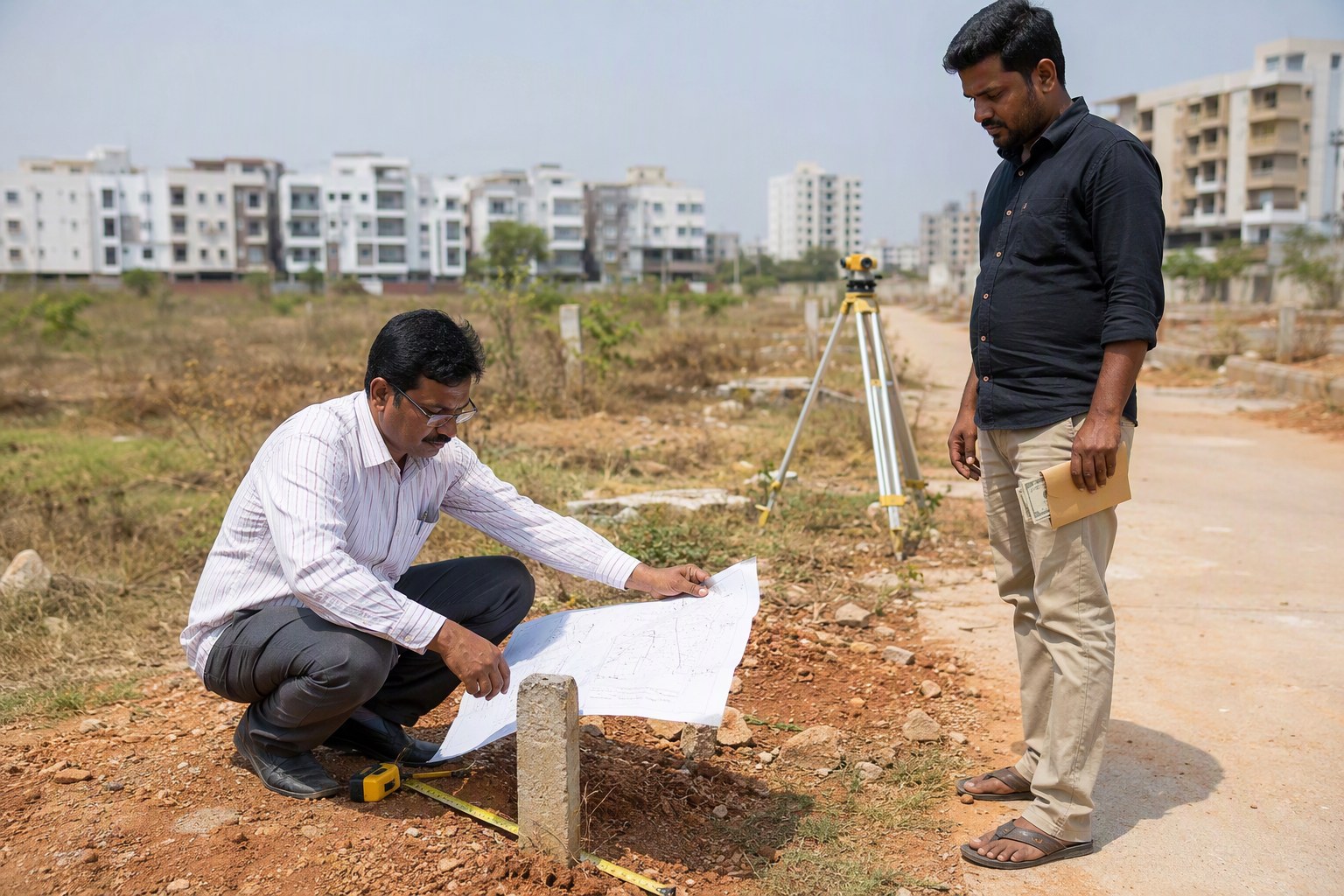



Telangana Lawyers See Risk Memos Enter Buyer Negotiations as buyers in Hyderabad, Rangareddy, Medchal-Malkajgiri and Sangareddy start asking for short written legal risk notes before token advance, loan file submission or final price bargaining. This is a clear shift from the older style of relying on a broker’s word, one EC printout and a quick WhatsApp confirmation from a lawyer.
Property lawyers we spoke to say these risk memos are usually 2 to 5 pages long. They flag title gaps, Section 22-A risk, missing link documents, Dharani mismatch, pahani issues, RERA gaps, UDS doubts in apartments, mortgage entries, layout permissions and road access concerns. Buyers are then using that memo to renegotiate price, delay token payment, ask for indemnities or walk away.
In our experience, this is not just a high-end Jubilee Hills or Financial District habit. We are seeing it in Bachupally flats, Mokila villas, Shankarpally plots, Kollur gated communities, Kompally apartments, Narsingi resale units, Tellapur under-construction projects and even gram panchayat layout plots around Kandukur and Maheshwaram.
Telangana Lawyers See Risk Memos Enter Buyer Negotiations Before Token Advance
The biggest change is timing. Earlier, many buyers paid ₹1 lakh, ₹2 lakh or even ₹5 lakh as token advance first, then went to a lawyer. Now, serious buyers are saying: show me the documents, give me 48 hours, let my lawyer issue a risk memo, then I will discuss price.
One Hyderabad property lawyer who handles resale flats in Kondapur, Gachibowli and Manikonda told us: Buyers are no longer asking only whether the title is clear. They are asking what risk can be used in negotiation. That is a big behavioural change.
Another lawyer from Kukatpally said the trend became stronger after many buyers got stuck with small but costly problems: missing mother deed, old GPA without proper stamp duty, wrong flat number in EC, unapproved extra floor, pending bank release letter, or builder share and landowner share confusion.
The risk memo is not a full title opinion. That distinction matters. A full title opinion for bank loan or registration may run deeper, especially for agricultural land, converted land or old family properties. A risk memo is shorter, faster and more practical. It answers a buyer’s immediate question: should I negotiate, pause or proceed?
What A Risk Memo Usually Covers In Telangana Property Deals
Lawyers say a proper risk memo should not be a generic template. It should respond to the exact property type, locality and stage of transaction. A resale flat in Hitech City needs a different note from an HMDA plot in Shadnagar or an agricultural parcel in Yacharam mandal.
| Property type | Common memo checks | Negotiation impact |
|---|---|---|
| Resale apartment in Kondapur, Miyapur, Nallagandla | Sale deed chain, EC, occupancy certificate, association dues, UDS, mortgage release | Buyer may ask seller to clear dues or reduce price |
| Under-construction flat in Kokapet, Tellapur, Puppalaguda | RERA registration, approved plans, phase details, carpet area, payment schedule | Buyer may delay booking advance or demand clause changes |
| Open plot in Shankarpally, Tukkuguda, Shadnagar | Layout approval, survey number, road width, land use, Section 22-A, EC | Buyer may reduce offer if approvals are weak |
| Agricultural land in Moinabad, Kandukur, Yacharam | Dharani, pahani, pattadar passbook, mutation, family claims, prohibitory list | Buyer may insist on seller-side rectification before advance |
| Villa in Mokila, Kollur, Gandipet belt | Land title, villa permission, UDS, common area rights, clubhouse ownership | Buyer may negotiate on legal risk and maintenance burden |
For quick self-checks before sending papers to an advocate, many buyers now use digital tools. A buyer can start with the Encumbrance Certificate Search, run a Section 22-A Prohibited Property Check, check the Market Value / Guideline Value Search, and then share the output with the lawyer. This does not replace legal advice, but it saves time and avoids very basic surprises.
Why Telangana Lawyers See Risk Memos Enter Buyer Negotiations More Often Now
There are four clear reasons.
1. Buyers are paying high EMIs and want bargaining material
In Hyderabad’s western corridor, even a mid-range 2BHK or 3BHK can push a salaried buyer into a long loan tenure. Once the EMI is serious, small legal doubts become price points. A missing link document may not kill the deal, but it can become a ₹2 lakh to ₹10 lakh negotiation point depending on property value.
One lawyer in Nallagandla said buyers are asking for legal red flags before speaking to the seller again. The memo becomes a negotiation script. Instead of saying the price is high, the buyer says: the EC has a mortgage entry, the OC copy is not shared, the UDS is unclear, and the seller must adjust.
2. Section 22-A awareness has increased
Telangana has a large prohibited property universe. As per the available database fact used for this report, there are 147,934 prohibited properties under Section 22-A. That number alone is enough to make cautious buyers ask for written checks before any commitment.
Section 22-A issues can appear in different ways: government land, assigned land, endowment land, wakf-related entries, court-attached properties or other restricted categories. A buyer may not understand every legal category, but he understands one thing very clearly: if the SRO refuses registration, the deal is stuck.
For lands around Adibatla, Maheshwaram, Tukkuguda, Ibrahimpatnam, Shadnagar and Chevella, lawyers say Section 22-A screening has become a standard early question. Buyers are also checking survey numbers through the Survey Number Finder before asking for the lawyer’s memo.
3. Dharani made land records visible, but not always simple
Dharani has made many land details accessible, but visibility is not the same as clean title. Lawyers told us that buyers often bring screenshots of Dharani, pahanis and passbook details, then ask whether that is enough. Usually, it is not enough for a purchase decision.
A pahani may show cultivation and possession history. Dharani may show current pattadar details. But lawyers still ask for old sale deeds, partition documents, succession documents, mutation flow, court case declarations if any, and family consent where required. In many Telangana villages, especially where ancestral land has moved through oral partitions, the risk memo becomes a useful early warning.
4. Banks are strict, but buyers do not want to wait for bank rejection
Many buyers earlier relied on the bank’s legal team. If HDFC, SBI, ICICI or another lender approved the file, they assumed the title was safe. Lawyers we spoke to called that a lazy shortcut.
Bank legal verification is for the bank’s lending comfort. A buyer’s risk is wider. The bank may care about mortgage enforceability, while the buyer must care about possession, access road, future resale, municipal compliance, undivided share, pending maintenance dues and family disputes. That is why buyers are asking for their own memo before loan processing.
How The Memo Changes Price Talks In Hyderabad Localities
In Hyderabad, price talks are emotional. Sellers quote based on neighbour transactions, broker feedback and their own urgency. Buyers compare with online listings, bank eligibility and guideline value. A risk memo brings a third voice into the room.
Take a resale apartment in Madhapur. If the seller is quoting aggressively but cannot produce a clear mortgage release letter from the previous bank, the buyer may not walk away immediately. He may say: I will proceed only if the release deed is registered or the price is adjusted till the risk is cleared.
In Manikonda or Puppalaguda, if an apartment has a mismatch between sanctioned plan and actual construction, the buyer may use the memo to ask for a lower price. In Bachupally or Mallampet, if the layout road and access are unclear, the buyer may seek a discount. In Shankarpally or Mokila, if the villa project has unclear landowner-builder sharing records, the buyer may pause token payment.
We have seen buyers use memos in three practical ways:
- Price cut: The buyer asks for a lower price because the defect reduces resale comfort.
- Condition precedent: The seller must fix an issue before sale agreement or registration.
- Indemnity: The seller gives written protection for a specific risk, though enforcement later can still be painful.
For registration cost planning, buyers also check the Stamp Duty Calculator. In Telangana, a standard sale transaction commonly involves stamp duty at 4%, transfer duty at 1.5% and registration fee at 0.5%, making the broad registration outgo 6% on the applicable value. The exact treatment depends on document type and latest government rules, so buyers should verify before execution.
What Lawyers Want In The Document Folder
Every lawyer we spoke to had one complaint: buyers send documents in random WhatsApp photos. Half the pages are cut, old deeds are unreadable, and file names say IMG_4821. This wastes time and weakens the memo.
A good buyer-side document folder should include:
- Current sale deed or title deed of seller
- Link documents for at least 30 years, where available
- Latest EC and older EC if property history is long
- Property tax receipts or municipal assessment copy
- Approved building plan, layout approval or HMDA/DTCP permission
- Occupancy certificate for apartments, where applicable
- RERA details for ongoing projects
- Mortgage release deed or bank NOC if loan existed
- Mutation, Dharani and pahani records for land
- Survey sketch, FMB or village map where land boundaries matter
- Seller identity, family tree or legal heir papers if inherited property
For ongoing projects, the RERA Project Lookup is now one of the first checks. A buyer should match the project name, promoter name, phase, tower, approved built-up details and validity. Many buyers make the mistake of checking only whether some RERA number exists. Lawyers say the memo must check whether that number belongs to the same phase and same promise being sold.
Risk Memo Is Not A Clean Chit
This is where buyers must be sensible. A short memo cannot guarantee that no dispute will ever arise. It can only record visible risks based on the documents reviewed and public records checked. If a cousin of the seller files a suit after registration, the memo may not have predicted it unless documents already showed that family risk.
One Secunderabad lawyer put it bluntly: A risk memo is a torchlight, not an insurance policy.
That is a fair way to see it. The memo helps the buyer ask better questions. It also creates a paper trail showing that the buyer raised concerns before paying money. But it does not replace a detailed title search where the property is old, inherited, litigated, converted from agricultural use, or part of a large layout.
For plots and land, buyers should also check land use and access. The Land Use Zone Finder and Road Width Check are useful starting points before the lawyer reviews the file. A plot may have clean ownership but poor development potential if road width, zoning or layout status is weak.
Seller Side Reaction: Irritation First, Acceptance Later
Many sellers dislike this new habit. They feel the buyer is creating excuses after verbally agreeing to price. Brokers also get irritated because memos slow the deal. But serious sellers are adapting.
In premium apartment resales at Banjara Hills, Jubilee Hills, Hitech City and Nanakramguda, some sellers are now keeping scanned document folders ready before listing. In plotted layouts around Kadthal, Shadnagar and Kothur, developers are sharing approval copies, LP numbers and survey details earlier than before. This is healthy for the market.
Our view is simple: a clean seller should not fear a short legal memo. If there is a defect, better to discuss it before token advance than fight after cancellation. If there is no defect, the memo helps close the deal faster because the buyer’s family and banker get comfort.
Where The Memo Can Go Wrong
There is also a bad version of this trend. Some buyers use vague lawyer comments only to bargain unfairly. A memo saying documents need further verification is not the same as a title defect. Sellers should not panic every time a lawyer writes cautious language.
Lawyers, too, must avoid lazy drafting. A useful memo should separate risk levels:
- Fatal risk: Do not proceed unless cured, such as prohibited property entry or seller not having title.
- High risk: Proceed only after rectification, such as missing release deed or unresolved legal heir issue.
- Moderate risk: Price negotiation or indemnity may be possible, such as minor document gaps.
- Low risk: Record and proceed, such as older EC not available online but supported by registered deeds.
This grading helps everyone. Buyers get clarity. Sellers know what to fix. Brokers can stop guessing. Banks receive a cleaner file.
Telangana Lawyers See Risk Memos Enter Buyer Negotiations In Land Deals Too
The strongest use case is land. Agricultural land and plotted development in Telangana carry more title layers than a typical flat. Mandal-level records, old pattadar names, assigned land history, conversion, nala, layout permission and family succession all matter.
In Moinabad, Chevella, Shankarpally and Gandipet side, land prices have moved sharply over the last few years. A buyer paying a large amount cannot depend only on the seller’s passbook. In Maheshwaram, Kandukur and Yacharam, buyers are checking whether the land is patta, assigned, government, ceiling surplus, endowment-linked or under any restriction. Around Medchal, Shamirpet and Ghatkesar, plotted layouts require careful checks on approval authority and road access.
A practical land risk memo should include survey number verification, Dharani status, pahani review, EC, village record consistency, SRO jurisdiction, Section 22-A screening and access road. Buyers can identify the relevant registration office through Find Your SRO Office and then line up document checks correctly.
What Buyers Should Ask Before Paying Token Advance
If you are buying in Telangana, ask these questions before paying even a small token:
- Is the seller the registered owner, or only a GPA holder?
- Are all link documents readable and complete?
- Does the EC match the sale deed chain?
- Is the property listed under Section 22-A prohibited category?
- For flats, is the UDS clear and is there an OC?
- For projects, does the RERA record match the tower or phase?
- For plots, is the layout approved and is the road access legal?
- For land, do Dharani, pahani and old deeds tell the same story?
- Is there any existing loan, mortgage or attachment?
- Which SRO will register the document and what value will apply?
Before final offer, a buyer can run the Property Verification Tool to organise checks. The output should then be reviewed by a lawyer, especially where the amount is large or the property has multiple owners.
Our Take: This Habit Will Stay
Risk memos are becoming part of the Telangana property negotiation process because they serve a real need. Buyers want speed, but they also want written clarity. Sellers want commitment, but they cannot expect blind token payments anymore. Lawyers are filling the gap between informal broker talk and full legal opinion.
The best deals will now move like this: seller shares documents, buyer runs basic checks, lawyer gives a short risk memo, parties negotiate based on specific issues, then agreement of sale and loan processing begin. That is cleaner than the old style of paying advance first and discovering problems later.
For Hyderabad’s market, this is a positive sign. It may slow a few transactions in the beginning, but it will reduce careless buying. In a state with 147,934 Section 22-A prohibited properties and fast-moving corridors from Kokapet to Shadnagar, that caution is not fear. It is common sense.
Frequently Asked Questions
What is a property risk memo in Telangana?
A property risk memo is a short written note from a lawyer highlighting visible legal and documentation risks before a buyer pays token advance, negotiates price or submits a loan file. It is shorter than a full title opinion.
Is a risk memo enough before buying land in Hyderabad outskirts?
For land in areas like Shankarpally, Maheshwaram, Yacharam, Chevella or Shadnagar, a memo is a good first step, but a detailed title search is safer before agreement or registration.
Can buyers use legal defects to reduce property price?
Yes, buyers often use genuine issues such as missing link documents, mortgage entries, RERA mismatch, layout approval gaps or Section 22-A risk to renegotiate price or ask the seller to rectify before payment.
Should I check Section 22-A before paying token advance?
Yes. Telangana has 147,934 prohibited properties under Section 22-A in the available database. A quick prohibited property check before token advance can prevent major registration trouble.
Does bank legal approval mean the title is fully safe?
No. Bank approval protects the lender’s loan interest. A buyer should still check possession, UDS, approvals, road access, family claims, maintenance dues and resale risk through independent legal review.