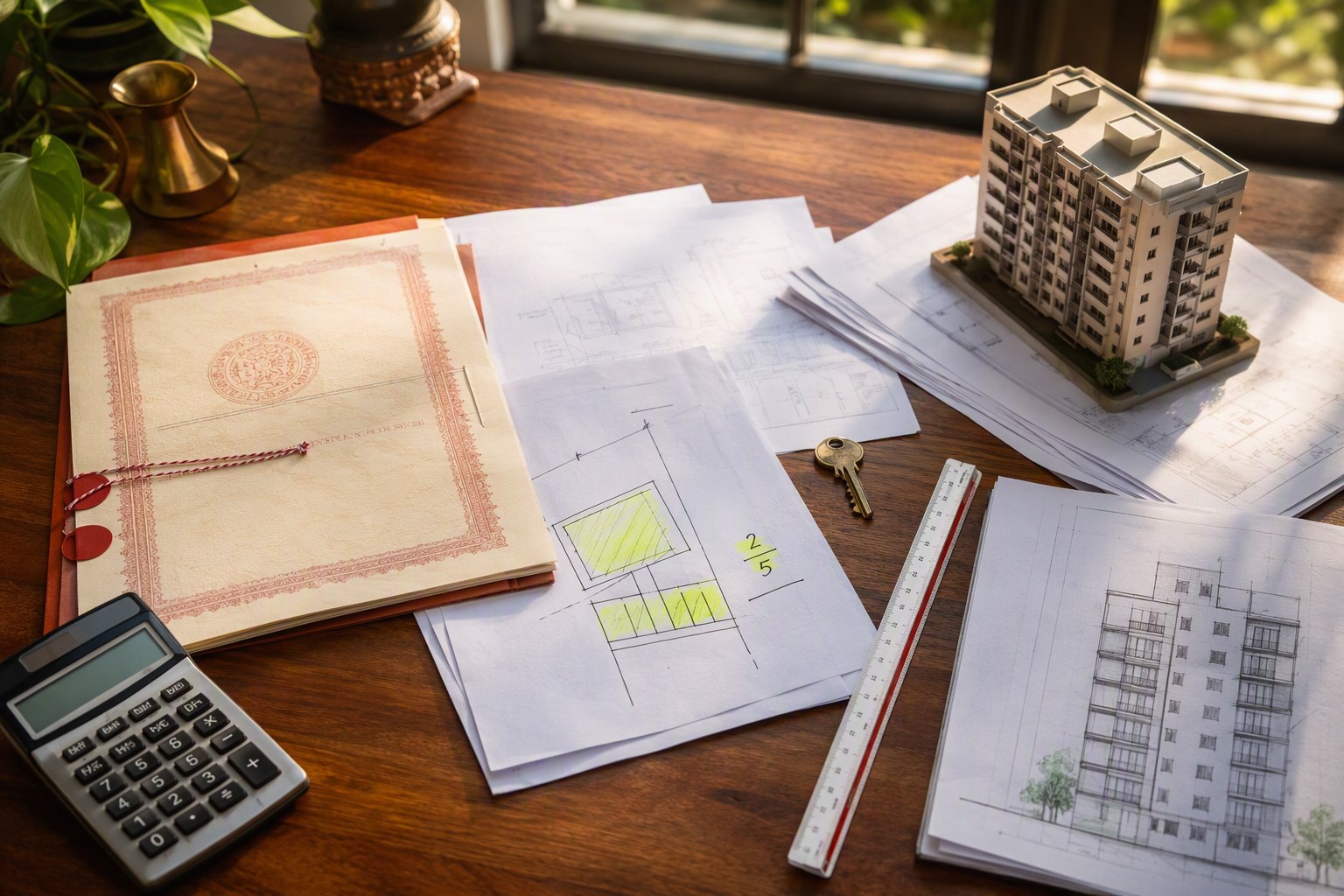



Telangana Khata vs Title is a doubt I hear almost every week from buyers in Hyderabad, especially when a seller says, “Sir, khata is in my name, no problem.” Short answer: khata, mutation, pahani, municipal assessment and Dharani entries can support possession and revenue history, but they do not prove marketable ownership by themselves. For a safe purchase, you still need title deeds, Encumbrance Certificate review, link documents, SRO checks and a Section 22-A prohibited property check. Telangana has 147934 prohibited property records under Section 22-A, so relying only on khata is risky.
My professional view is simple: khata is a supporting record. Title is proved through valid ownership documents and clean legal history. A buyer should never treat mutation as a substitute for title verification.
Telangana Khata vs Title: the clear answer for buyers
In Telangana, many people use the word “khata” loosely. In Karnataka, khata has a specific municipal meaning. In Hyderabad and other parts of Telangana, buyers usually mean one of these records:
- Municipal property tax assessment in GHMC, HMDA municipality or gram panchayat records
- Mutation entry after sale, gift, inheritance or partition
- Dharani pattadar passbook for agricultural land
- Pahani or adangal showing cultivation and possession history
- Survey number details in revenue records
- House number or assessment number in local body records
These records are useful. They show that a public office has recognised somebody for tax or revenue purposes. But recognition by a revenue or municipal office is not the same as legal ownership. Courts have repeatedly treated mutation entries as fiscal records, not title documents. In plain English, the government may collect tax from you, but that alone does not mean you have perfect title.
A proper title comes from documents such as registered sale deed, gift deed, partition deed, release deed, court decree, succession documents, development agreement, GPA where legally valid, and link documents going back far enough to establish ownership flow. For flats, you must also check the land title of the project, building permissions, occupancy certificate, RERA details where applicable and UDS share.
Why Telangana Khata vs Title confusion is common in Hyderabad
Hyderabad buyers are practical people. If a seller shows property tax receipts, electricity bill, water bill and mutation certificate, the file looks convincing. In areas like Kukatpally, Miyapur, Manikonda, Nizampet, Uppal, Nagole, Kompally and LB Nagar, older layouts often have mixed paperwork. Some plots began as gram panchayat layouts. Some were later absorbed into municipalities. Some buildings got regularised. Some never did.
We’ve seen this pattern many times: the seller has been paying property tax for 12 years, but the parent land has a gap in link documents. Or the flat owner has a municipal door number, but the project land had a pending family dispute before construction. Or the agricultural land is shown in Dharani, but part of the survey number is affected by Section 22-A or assigned land restrictions.
That is why a buyer must separate three ideas:
- Possession: Who is physically using or occupying the property?
- Revenue recognition: Whose name appears in tax, pahani, mutation or Dharani records?
- Title: Who can legally sell the property with marketable ownership?
All three should ideally match. If they do not match, do not panic, but investigate before paying token advance.
What khata or mutation can prove in Telangana
Khata-style records are not useless. They have value when read correctly. They can support the ownership story, especially when they match registered deeds and possession history.
1. They show tax and local body recognition
For a flat in Kondapur or a house in Sainikpuri, GHMC or municipality property tax mutation shows that the local body has recorded the owner for tax purposes. This helps while applying for utilities, renovation permissions, loan processing and future resale conversations.
2. They show revenue continuity
For land in Shankarpally mandal, Moinabad mandal, Maheshwaram mandal, Kandukur mandal or Ibrahimpatnam mandal, pahani entries and Dharani records can show who was recorded as pattadar or possessor over different years. This helps in tracing history, especially for agricultural land.
3. They help detect mismatch
If the sale deed says one person, Dharani says another person, and property tax is in a third person’s name, the mismatch itself is a warning signal. Many buyers ignore this because the price looks attractive. In our experience, mismatch is where disputes begin.
4. They help with post-registration formalities
After you buy, mutation is necessary. It helps update government records and protects your day-to-day dealings with the property. But it comes after title transfer; it does not create title on its own.
What khata cannot prove
This is the part every buyer should read before paying advance. Khata cannot answer some of the most serious legal questions.
- It cannot prove that the seller’s parent deed was valid.
- It cannot prove that all legal heirs have joined the sale.
- It cannot clear a mortgage, court attachment or pending charge.
- It cannot override Section 22-A prohibited status.
- It cannot convert assigned land, government land or endowment land into private freehold land.
- It cannot validate an unauthorised layout or missing building permission.
- It cannot replace an Encumbrance Certificate from the SRO.
For example, a plot near Adibatla may have a gram panchayat assessment number. But if the survey number has a government land claim or 22-A restriction, the assessment number will not save the buyer. Similarly, a flat in a busy area like Hafeezpet may have an electricity bill and property tax receipt, but if the land title is under litigation, the buyer still carries risk.
Section 22-A check: why it matters more than many buyers think
Telangana has 147934 prohibited property records under Section 22-A. This is not a small number. These records can include government lands, assigned lands, endowment lands, Wakf-related entries, ceiling surplus lands and other properties barred from registration.
When a property is listed under Section 22-A, the Sub-Registrar may refuse registration. In some cases, buyers discover the problem only after paying a large advance. I have seen families lose months chasing NOCs and clarifications because they checked tax receipts but skipped prohibited property verification.
Before dealing with any open plot, agricultural land, farmhouse land or redevelopment property, run a Section 22-A Prohibited Property Check. If the property has a survey number, cross-check it carefully. If the seller says, “Registration happened for neighbouring land,” do not accept that as proof. One survey number can have clean and restricted portions, and subdivisions can change the risk picture.
Title verification is wider than khata verification
A serious buyer should ask a different question: not “Is khata available?” but “Can the seller convey clear, marketable and mortgage-free title?”
Here is the working checklist I suggest for Hyderabad and Telangana buyers:
- Registered deed: Check the seller’s sale deed, gift deed, partition deed or other title document.
- Link documents: Trace title flow for at least 30 years where possible, especially for land.
- EC review: Use an Encumbrance Certificate Search to check registered transactions, mortgages and releases.
- SRO jurisdiction: Confirm the correct Sub-Registrar Office using Find Your SRO Office.
- 22-A status: Check prohibited property status by survey number and village.
- Revenue records: Verify Dharani, pahani and mutation entries for agricultural land.
- Survey number: Identify correct village, mandal and survey/subdivision using a Survey Number Finder.
- Layout and building approvals: Check HMDA, DTCP, GHMC or municipal permissions.
- RERA: For eligible projects, verify registration through RERA Project Lookup.
- Guideline value: Compare declared value with official market value using Market Value / Guideline Value Search.
If you want a single starting point, use the Property Verification Tool and then take the file to a property lawyer. Online checks are helpful, but legal reading of old deeds still needs human judgement.
Hyderabad examples: how the issue plays out on ground
Let us take some realistic local situations. These are the kinds of files we regularly see in the Hyderabad market.
Case 1: Flat in Gachibowli or Kokapet
Market prices in premium western Hyderabad corridors often run around ₹9,000 to ₹16,000 per sq ft depending on project, age, builder, view, club house and possession status. A buyer may focus on the flat owner’s sale deed and property tax. But for a flat, the deeper check is the project land title. Was the land owned by the developer? Was there a development agreement? Is the UDS share correctly mentioned? Is the project RERA registered? Was occupancy certificate issued?
Khata in the flat owner’s name is good. But it does not answer all project-level questions.
Case 2: Plot near Mokila, Shankarpally or Kollur
Open plot rates in these belts can vary sharply, roughly from ₹35,000 per sq yd in developing pockets to above ₹1 lakh per sq yd in stronger gated layouts and better-connected locations. Here, survey number, village, mandal, layout approval and 22-A status matter more than glossy brochures.
If the seller shows Dharani passbook and says mutation is complete, still verify whether the land is converted for non-agricultural use, whether the layout has HMDA/DTCP approval, and whether roads, open spaces and mortgage plots are properly marked.
Case 3: Independent house in Uppal, Nagole or LB Nagar
Many older houses have long possession history and regular property tax payments. But some files have missing link deeds, unregistered family arrangements or unrecorded inheritances. If the father bought the house and the son is selling, check whether all legal heirs have signed. A municipal mutation in one heir’s name may not defeat the rights of other heirs.
Case 4: Agricultural land in Maheshwaram or Kandukur mandal
These mandals attract buyers due to airport-side growth, pharma-related activity and outer-ring connectivity. But agricultural land files need extra care. Dharani entry is useful, yet you must check classification, assigned land risk, ceiling issues, pattadar history, pahanis, 22-A status, access road and land use zone. Use the Land Use Zone Finder before assuming future construction potential.
Document-by-document comparison: khata vs title
| Record | What it shows | Can it prove ownership? | Buyer action |
|---|---|---|---|
| Municipal khata / property tax mutation | Local body has recorded a person for tax assessment | No, only supporting evidence | Match with sale deed and possession |
| Dharani pattadar record | Revenue record for agricultural land | Not by itself | Check title deed, pahani, 22-A and land classification |
| Pahani / adangal | Cultivation, possession and revenue history | No | Use to support title chain, not replace it |
| Registered sale deed | Transfer of ownership from seller to buyer | Yes, if seller had valid title | Verify link documents and EC |
| Encumbrance Certificate | Registered transactions and charges in SRO records | No, but very important | Check for sale, mortgage, release, court orders if recorded |
| Section 22-A status | Whether registration is prohibited or restricted | No | Must be clean before purchase |
| RERA record | Project registration details for eligible projects | No | Check approvals, promoter details and project status |
Stamp duty, ready reckoner and why low value deals need caution
For most sale deeds in Telangana, buyers commonly budget around 6% registration cost, generally made up of stamp duty, transfer duty and registration fee. The exact amount depends on property type and transaction nature. Before finalising numbers, use the Stamp Duty Calculator.
The ready reckoner or government market value is the minimum value used for registration. Actual Hyderabad market prices are often much higher. For instance, a resale flat in Kondapur may be quoted around ₹8,000 to ₹12,000 per sq ft, while a newer Kokapet project may ask much more. In contrast, registration value may not fully reflect market reality. That gap is common, but a very low declared value can create tax and lending issues.
Also check whether the seller is pushing for a large cash component. A clean title seller usually has no problem with transparent payment through bank channels. If somebody insists on cash, refuses document copies or avoids SRO verification, treat it as a red flag.
Red flags when seller says “khata is enough”
- Seller refuses to share parent documents before advance.
- Only tax receipts are available, but no registered title deed.
- Dharani shows seller’s name, but old pahanis show different family names.
- EC shows mortgage but release deed is missing.
- Property is in a village with known government land disputes.
- Survey number is not clearly identified on ground.
- Layout approval number is missing or not traceable.
- Seller says mutation will be done only after full payment.
- Legal heirs are not joining the sale deed.
- Agreement of sale mentions one extent, but physical measurement differs.
One more practical point: in fast-moving areas like Tellapur, Narsingi, Puppalaguda, Bachupally and Tukkuguda, buyers sometimes skip verification because prices are rising. That is exactly when mistakes happen. Growth corridor does not mean clean title for every property.
How to verify a Telangana property before purchase
Here is a simple order of work. Follow it before paying a big token amount.
Step 1: Identify the property correctly
For land, get village, mandal, survey number, subdivision number, extent and boundaries. For flats, get flat number, floor, block, project name, UDS, parking details and land schedule.
Step 2: Check title documents
Ask for the seller’s title deed and link documents. Do not accept only Xerox copies forever; before final payment, originals must be inspected.
Step 3: Pull EC from the correct SRO
EC should be reviewed for a meaningful period, not only one or two years. A 30-year EC is common for land due diligence, though availability depends on records.
Step 4: Check 22-A and revenue records
For any land-linked purchase, check Section 22-A status, Dharani records, pahanis and classification. If the property is agricultural, also check conversion and permitted use.
Step 5: Check approvals
For layouts, verify HMDA or DTCP approval. For buildings, check sanctioned plan and occupancy certificate. For RERA-applicable projects, check RERA details.
Step 6: Compare value and taxes
Use guideline value, stamp duty and market price comparisons. If the deal is far below area rate, ask why. A distress sale can be genuine, but it can also hide legal trouble.
Step 7: Record the deal properly
Pay through bank, sign a clear agreement of sale, mention document delivery, pending loan closure, registration date, default clauses and possession date. After registration, complete mutation in your name.
Final view: khata supports, title proves
If you remember only one line from this article, remember this: khata supports the ownership story, but title proves the right to sell. In Telangana, especially around Hyderabad’s high-value corridors, buyers must verify both revenue records and legal title. With 147934 prohibited property records under Section 22-A, the risk is not theoretical.
A clean file should have matching names, proper link deeds, clean EC, no 22-A restriction, correct survey details, valid approvals and sensible possession history. If one item is missing, get an explanation. If three items are missing, slow down. Property buying rewards patience.
Frequently Asked Questions
Does khata prove ownership in Telangana?
No. Khata, mutation, property tax assessment, Dharani entry or pahani can support possession and revenue history, but they do not prove ownership by themselves. Title must be verified through registered deeds, link documents, EC and legal checks.
Is Dharani passbook enough to buy agricultural land?
No. Dharani passbook is useful, but buyers should also check title deeds, old pahanis, survey number, land classification, Section 22-A status, access road, legal heirs and whether conversion is needed for intended use.
What is the difference between mutation and title?
Mutation updates government or local body records after a transfer or inheritance. Title is the legal ownership right flowing from valid documents. Mutation follows title; it does not create title independently.
Why is Section 22-A check necessary in Telangana?
Section 22-A lists properties where registration may be prohibited or restricted, such as government, assigned or endowment-related lands. Telangana has 147934 prohibited property records, so this check is essential before buying land or plots.
Should I check EC even if khata is in seller’s name?
Yes. EC can show registered sales, mortgages, releases and other recorded transactions. A seller may have khata in his name, but the property can still have an unpaid loan, prior agreement or title defect.