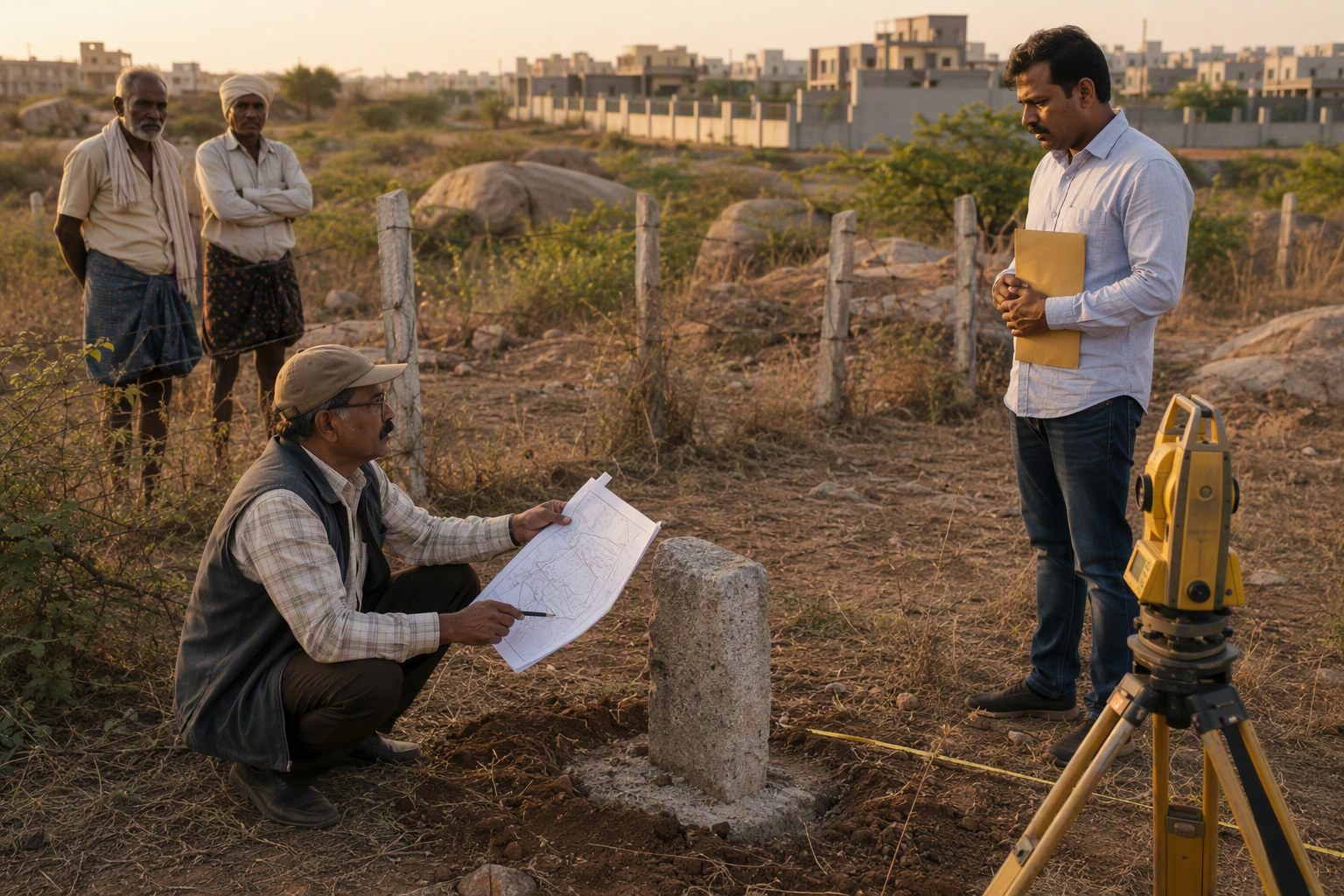



Telangana Experts Read 1.48 Lakh Blocked Property Entries as more than a government list. The exact number in the prohibited property records is 147,934 Section 22-A entries, and senior title professionals say this figure shows how buyer risk is shifting across Telangana. In Hyderabad's growth belt, the risk is not only about whether a property is blocked today. It is about why it got blocked, how the survey number travelled through revenue records, and whether the buyer is pricing that risk into the deal.
We spoke to title lawyers, document writers, valuation consultants and revenue-side professionals who handle sale deeds, pahanis, Dharani records, SRO objections and bank legal scrutiny every week. Their reading is clear: the 1.48 lakh number is a warning sign for buyers chasing discounted land in fast-moving mandals like Gandipet, Serilingampally, Shamshabad, Maheshwaram, Shankarpally, Moinabad, Ibrahimpatnam, Keesara and Medchal.
Telangana Experts Read 1.48 Lakh Blocked Property Entries as a Risk Map
The official count of 147,934 prohibited property entries is usually discussed like a static database. Our experts read it differently. They see it as a map of old revenue disputes meeting new real estate demand. In simple words, where land values rise fast, every weak link in title history becomes expensive.
A Hyderabad title lawyer who vets plotted layouts in Rangareddy and Sangareddy told us that the number should not be seen only as a failed-registration problem. He said many buyers reach the SRO counter only after paying advance, arranging home loan papers and finalising the sale agreement. By that stage, a Section 22-A hit becomes a financial and emotional shock.
When a survey number is blocked, the buyer does not lose only registration time. He may lose bargaining power, bank confidence, resale comfort and sometimes the advance paid to the seller. That is the real cost of a prohibited entry.
In our experience, the highest-risk conversations happen in land deals, not completed apartments. A flat in a large RERA-registered project in Kokapet or Narsingi still needs title review, but there is usually a paper trail through development agreement, approvals, lender due diligence and project registration. A 300 sq yd plot near Mokila, a farmhouse share near Moinabad, or a low-priced acre near Shadnagar can carry far more hidden history.
Before paying token money, buyers should run the survey number through a Section 22-A Prohibited Property Check, match the village and mandal correctly, and then use the Survey Number Finder if the seller is quoting only a plot number from a private layout brochure.
Where Telangana Experts Read 1.48 Lakh Blocked Property Entries Differently in Hyderabad
Hyderabad buyers often assume that risk reduces as prices increase. Our experts disagree. In fact, expensive micro-markets attract more aggressive title packaging. A land parcel with a complicated history may be presented with better brochures, faster site visits and polished sale agreements because the margin is higher.
Look at the current market behaviour. In Kokapet and Neopolis surroundings, premium apartments often quote around Rs 9,000 to Rs 13,000 per sq ft depending on builder, tower stage and view. In Narsingi and Puppalaguda, many good gated community quotes sit around Rs 7,500 to Rs 10,500 per sq ft. Tellapur is regularly discussed in the Rs 7,000 to Rs 10,000 per sq ft apartment band. In Miyapur and Bachupally, mid-segment projects are often seen around Rs 6,000 to Rs 8,500 per sq ft.
Plots behave differently. Mokila, Velimela and Kollur-side plotted inventory can range widely, with many market conversations between Rs 35,000 and Rs 65,000 per sq yd depending on approach road, HMDA status and layout quality. Shadnagar plotted offers may be seen from around Rs 12,000 to Rs 25,000 per sq yd, but the variation is huge. At these rates, a single title defect can wipe out years of expected appreciation.
| Market | Typical buyer attraction | Common expert concern | Practical first check |
|---|---|---|---|
| Kokapet, Narsingi, Puppalaguda | IT corridor access, premium flats, rental demand | Land aggregation history behind large projects | RERA Project Lookup and EC review |
| Tellapur, Kollur, Velimela | New gated communities and villa plots | Conversion, layout approval, old survey subdivision clarity | Encumbrance Certificate Search |
| Mokila, Shankarpally, Moinabad | Weekend homes, villa plots, land banking | Assigned land, government land claims, road access disputes | Property Verification Tool |
| Maheshwaram, Adibatla, Ibrahimpatnam | Aerospace, pharma, ORR-side growth story | Village-level survey mismatch and old pahanis | 22-A check before advance |
| Shadnagar, Kothur, Chevella | Lower ticket plotted investment | Cheap land masking revenue restrictions | Find Your SRO Office |
These rates are market observation bands, not government market values. For duty and registration planning, buyers should separately check the ready reckoner value using the Market Value / Guideline Value Search and then estimate charges through the Stamp Duty Calculator.
What 147,934 Prohibited Entries Say About Buyer Behaviour
The 147,934 figure tells us something uncomfortable: many buyers still treat title verification as a post-negotiation activity. They see the land first, like the road, bargain on price, pay advance, and only then ask for documents. That order is risky in Telangana because revenue records and registration records do not always tell the same story at first glance.
A senior document writer near a busy Rangareddy SRO put it bluntly: buyers are very sharp while negotiating Rs 200 per sq yd, but casual while checking whether the seller can legally register the land. We have seen the same pattern. People ask for discount because the road is narrow, but they do not ask why the seller is pushing for immediate cash token.
The experts identified four buyer risk patterns behind many blocked-entry surprises:
- Discount chasing: A plot quoted 15-25% below the local market rate is treated as a lucky find, not a warning signal.
- Plot-number confusion: Buyers verify a private plot number but not the underlying survey number, village and mandal.
- Old EC comfort: A clean Encumbrance Certificate is mistaken for full title safety. EC shows registered transactions, not every revenue restriction.
- Layout trust: Buyers assume that because many plots are sold in the same layout, their individual plot is safe.
This is why the expert community keeps repeating one practical point: registration possibility and ownership quality are related, but not identical. A property may have old transactions, tax receipts and possession, yet still face a bar due to category, assignment, court order, government claim or classification issue.
The 22-A List Is Not One Type of Problem
The phrase prohibited property sounds simple, but the ground reality is layered. A retired revenue professional explained that entries can arise from different administrative and legal backgrounds. Some are government lands. Some are assigned lands. Some involve endowment, wakf or institutional claims. Some are tied to court disputes or notifications. Some are the result of old classification mistakes that later need correction through proper channels.
This difference matters because every case does not carry the same level of cure. A clerical mismatch in village name is not the same as assigned land restriction. A temporary dispute entry is not the same as government land classification. A buyer should not accept a seller's casual statement that it will be removed soon unless there is written, verifiable progress from the right authority.
In mandals like Gandipet, Rajendranagar, Serilingampally and Shamshabad, land has passed through several hands due to urban expansion. In older village belts, survey numbers may have been split, converted, pooled into layouts, mortgaged, released and resold. When records are not mapped properly, one old entry can affect multiple later transactions.
That is why our title experts prefer a chain approach. Start with survey number and village. Check prohibited status. Pull EC for a long enough period. Compare pahani, Dharani data, link documents, layout permission, land use and SRO jurisdiction. For urban projects, check RERA details and approved plans. This is not paperwork for the sake of paperwork; it is how you protect capital.
How Banks Read Blocked Property Risk
Bank legal teams are often more conservative than individual buyers. If a prohibited entry appears or if the survey number has unresolved revenue remarks, loan processing may slow down or stop. Even when a seller says cash buyers are ready, a bank refusal should make you pause.
A loan-backed buyer in Tellapur or Bachupally may assume the bank will catch everything. That is partly true, but not enough. Banks review from the lender's risk angle. They may reject the file without giving the buyer a full education on the defect. By then, the buyer may already have paid booking amount, legal fee and agreement charges.
For resale flats, EC and link documents remain essential. For under-construction flats, RERA project details matter. For plots, the bank will usually look closely at layout approval, land conversion, title chain and revenue classification. The buyer should do the same before emotional commitment.
Useful first-stage checks include the Encumbrance Certificate Search, RERA Project Lookup, Land Use Zone Finder and Road Width Check. Road width and land use may not directly answer Section 22-A status, but they reveal whether the marketed use of the property matches planning reality.
Locality-Specific Signals Experts Watch
Every locality has its own risk language. In the western corridor, the worry is often not demand; demand is strong. The worry is whether land assembly behind a project is clean. In peri-urban mandals, the worry shifts to classification, assignment history and layout approval. In lower-ticket investment belts, the worry is exaggerated future promise combined with weak documents.
Kokapet, Financial District and Narsingi
Here, buyers are usually paying premium rates for flats, not raw land. Experts still check whether the project land has clean development rights, RERA registration, mortgage disclosures and approvals. A branded tower does not remove the need for title review, but it usually gives more documents to examine.
Tellapur, Kollur and Velimela
This belt has become a favourite for IT employees wanting larger homes. The expert caution is on projects sitting across old survey boundaries. Buyers should verify whether the flat or villa plot corresponds properly to approved layout plans and whether the underlying land has any prohibited classification history.
Mokila, Shankarpally and Moinabad
In our experience, this is where aspirational villa-plot buying meets revenue complexity. Green surroundings and ORR access create excitement. But a beautiful compound wall does not prove title. Buyers must check survey number, land nature, approach road, conversion and any restriction before paying advance.
Maheshwaram, Adibatla and Ibrahimpatnam
Industrial and infrastructure narratives are strong here. The problem is that some buyers rely only on future-growth talk. Experts advise matching Dharani details, pahani history, EC, SRO jurisdiction and layout permission. If the rate is far below nearby quotes, ask why.
Pricing Should Reflect Title Risk
One strong opinion from every professional we spoke to: title risk should change price. Telangana buyers negotiate based on facing, road width, amenities and distance from ORR, but rarely calculate legal risk as a cost. That is a mistake.
If a land parcel in a village near Shankarpally is quoted at Rs 45,000 per sq yd while similar clean plots are moving closer to Rs 60,000 per sq yd, the Rs 15,000 gap is not automatically profit. It may be the market charging you for uncertainty. If that uncertainty later blocks registration or resale, the discount was an illusion.
For flats, pricing risk appears differently. A non-RERA small project in a developing lane of Miyapur may quote less than a larger gated community. That discount may be acceptable if approvals, title and construction quality are clear. But if land records are weak, the lower price is not a bargain; it is a transfer of risk from seller to buyer.
Buyers comparing total cost should include stamp duty, registration charges, amenities, GST where applicable, legal review fee and potential resale friction. The Composite Value Calculator helps estimate value where land and building components both matter, especially for independent houses and villas.
What Experts Want Buyers to Do Before Paying Advance
This article is not repeating a basic checklist. The expert message is more strategic: change the order of your purchase process. Verification should come before negotiation closure, not after it.
- Ask for survey number first: If the seller hesitates, slow down. Plot number alone is not enough.
- Check the exact village and mandal: Similar village names can create confusion in Telangana records.
- Run 22-A status before token: Do not wait for the registration week.
- Compare EC with revenue records: EC alone is not full title proof.
- Use SRO knowledge: Find the correct office through Find Your SRO Office and understand local registration behaviour.
- Track changes: If you are waiting for clearance or mutation, monitor the property through the Property Change Tracker.
We have seen buyers save themselves from bad deals simply by asking for the survey number one day earlier. We have also seen buyers get stuck because they trusted a WhatsApp location pin, a colourful layout map and a seller's confidence.
The Expert Verdict on 1.48 Lakh Blocked Entries
The expert reading of Telangana's 147,934 prohibited property entries is not panic. It is discipline. Telangana remains one of India's most active real estate markets, especially around Hyderabad. Strong job creation, ORR connectivity, metro expansion expectations, warehousing, pharma, aerospace and IT demand continue to support property buying.
But high-growth markets punish lazy verification. The same land that looks affordable today can become unsellable tomorrow if title risk is ignored. The same flat that appears slightly cheaper can become difficult to finance if project land documents are not clean.
Our view is simple: do not fear every property because the 22-A number is large. Fear the deal where documents are shared late, survey numbers are unclear, rates are unusually low, and the seller pushes urgency. That combination is where buyers usually get hurt.
Telangana's property market rewards informed buyers. Use the tools, speak to the right SRO, read the pahani, check Dharani, verify EC, compare guideline value and involve a competent title professional. The cost of checking is small. The cost of a blocked registration can be life-changing.
Frequently Asked Questions
What does 1.48 lakh blocked property entries mean in Telangana?
It refers to 147,934 prohibited property entries under Section 22-A records. Experts see this as a risk signal for buyers, especially in land and plotted layout transactions where survey number history may be unclear.
Is a clean EC enough to buy land in Hyderabad outskirts?
No. An Encumbrance Certificate shows registered transactions, but it may not reveal every revenue restriction, government claim or prohibited classification. Buyers should also check survey number, pahani, Dharani status and Section 22-A records.
Which Hyderabad areas need extra title caution?
Extra caution is sensible in fast-growing and peri-urban belts such as Mokila, Shankarpally, Moinabad, Maheshwaram, Adibatla, Ibrahimpatnam, Shadnagar, Tellapur and Kollur. Premium areas like Kokapet and Narsingi also need project-level title review.
Should I pay advance before checking 22-A status?
Avoid it. First get the survey number, village and mandal, then check prohibited property status. If you must pay any token, record refund terms clearly in writing after legal review.
Do RERA projects still need title verification?
Yes. RERA registration improves transparency, but it is not a substitute for checking project land title, approvals, mortgage disclosures and EC. For high-value Hyderabad purchases, independent legal review is still advisable.