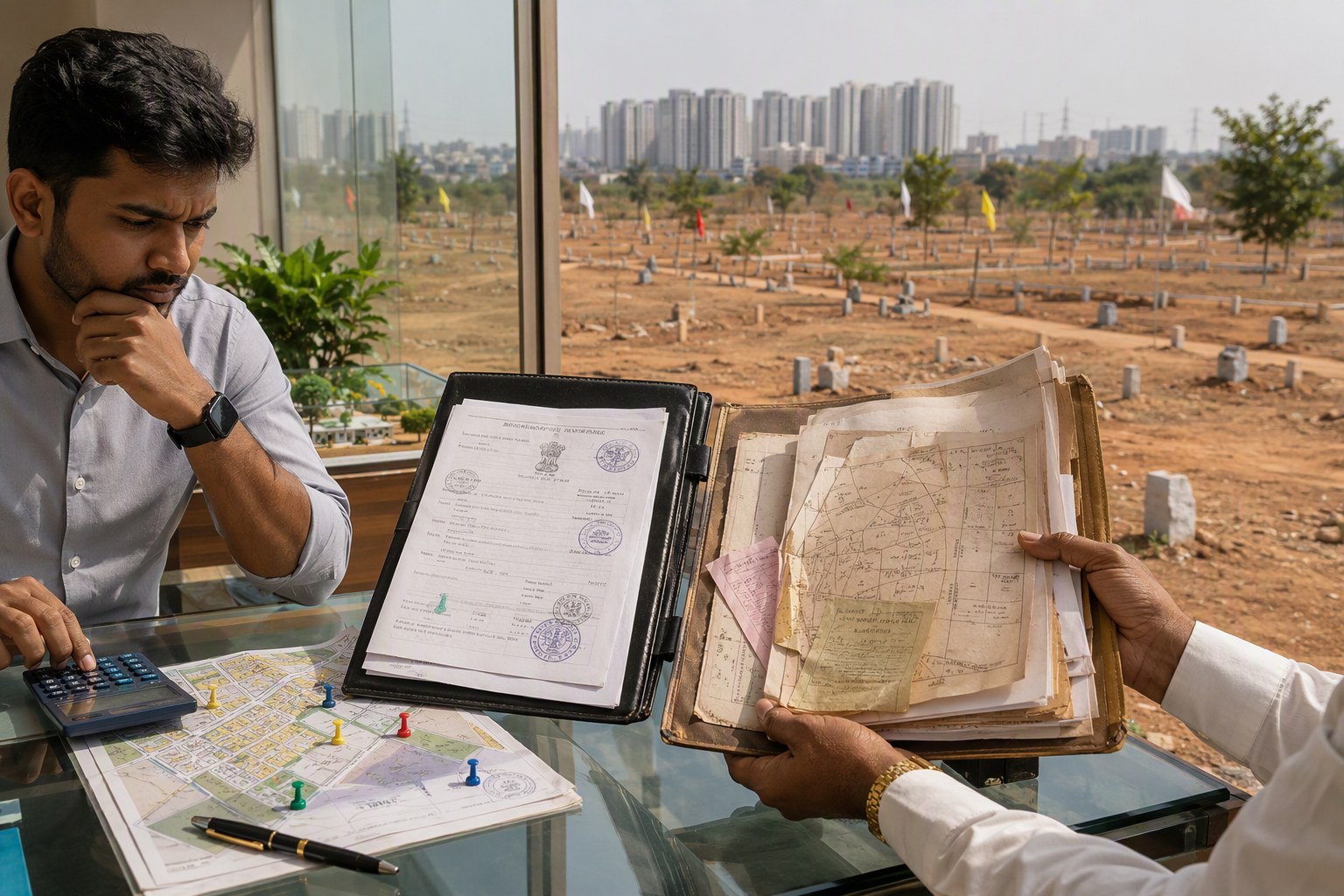
Telangana Deals Now Move Faster When Sellers Share EC Early
Telangana Deals Now Move Faster When Sellers Share EC Early is the clearest document trend we are seeing in Hyderabad, Rangareddy, Medchal-Malkajgiri and Sangareddy property conversations. Buyers are no longer waiting until token advance or agreement stage to ask for the Encumbrance Certificate, commonly called EC. They want it before the second site visit, before serious price negotiation, and in many cases before family members are brought to inspect the property.
The message from the market is simple. A seller who can share a clean EC, link document trail, survey number details, pahani or Dharani references and SRO information early is getting more attention. A seller who says documents will be shown after rate finalisation is now losing momentum, especially in plotted land and resale apartment deals.
In our experience, the first serious buyer question has shifted from final price entha? to EC clear aa? That small change is affecting negotiation speed across Hyderabad suburbs.
Why Telangana Deals Are Moving EC Checks Before Site Visits
The old Hyderabad habit was different. A buyer would visit the flat or land parcel, check approach road, ask about water, compare rate, then ask for documents. In many family-driven transactions, legal verification came after advance. That approach is reducing, particularly after buyers became more aware of Dharani entries, SRO records, HMDA approvals, Gram Panchayat layouts, and Section 22-A risks.
Across Telangana, prohibited properties under Section 22-A are not a small side issue. Our database tracks 147,934 prohibited properties. That number has changed buyer behaviour. Nobody wants to spend weekends visiting a land parcel in Moinabad, Maheshwaram, Shankarpally or Ghatkesar only to later find that the survey number is restricted, assigned land, endowment-linked, wakf-linked, government land, or caught in a registration block.
That is why early EC sharing has become a screening tool. Buyers are using an Encumbrance Certificate Search before they emotionally commit to a property. They are also checking survey numbers through the Survey Number Finder and checking whether the property falls under a registration restriction through the Section 22-A Prohibited Property Check.
This is not just a legal formality. It is now part of market positioning. A document-ready seller looks confident. A hesitant seller looks risky, even if the title is actually clean.
Telangana Deals Now Move Faster Because Buyers Have Better Tools
Earlier, many buyers depended only on a local agent, family lawyer or bank panel advocate. Now, even first-time buyers in Kukatpally, Nallagandla, Kondapur, Kompally and LB Nagar are doing their own first-level checks. They may not understand every line in an EC, but they know what to ask for: document number, SRO name, executant, claimant, property schedule, extent, plot number, survey number, and whether any mortgage or release deed appears.
We have seen this clearly in resale apartment deals in Manikonda, Puppalaguda, Narsingi, Chandanagar and Miyapur. A buyer shortlists five flats. Two owners share EC, sale deed and property tax receipts on day one. The other three say they will share after advance. The buyer naturally spends more time with the first two. Price talks start sooner, and the seller has better control over the conversation.
For land, the shift is even stronger. In Shadnagar, Kandukur, Kadthal, Chevella, Yacharam and Ibrahimpatnam, buyers are asking for EC and Dharani passbook details before visiting. Many NRIs are insisting on this because they cannot keep sending relatives to inspect doubtful parcels. For them, early document sharing saves time and embarrassment.
What Buyers Are Reading Inside An EC
An Encumbrance Certificate is not a full title certificate, but it tells a lot. It shows registered transactions recorded at the Sub Registrar Office for a selected period. If a flat or plot was sold, mortgaged, gifted, partitioned or released, the EC can reflect those registered entries. A clean-looking EC does not automatically mean perfect title, but an unclear EC is a strong warning sign.
Buyers are usually checking these points first:
- Name continuity: Whether the seller name matches the latest registered ownership chain.
- Document numbers: Whether earlier sale deed, gift deed or release deed references are available.
- Mortgage entries: Whether a bank loan, private mortgage or release deed is shown.
- Property schedule: Whether flat number, plot number, survey number, boundaries and extent match the sale deed.
- SRO location: Whether the registration was done in the correct jurisdiction.
- Gaps: Whether there are missing years or unclear transactions that need lawyer review.
For SRO jurisdiction, many buyers now use the Find Your SRO Office tool. This matters because Hyderabad property corridors often confuse people. A project marketed as Tellapur may fall under a different registration zone from what a buyer assumes. A villa called Mokila may have survey references linked to Shankarpally mandal. A plot advertised as near Tukkuguda may actually sit in Maheshwaram mandal or Kandukur side. These small differences matter during registration.
Document-Ready Sellers Are Getting A Rate Advantage
Does sharing EC early increase the sale price? Not always directly. But it improves buyer confidence, reduces delay, and protects the seller from last-minute bargaining. That itself is a financial advantage.
In Hyderabad resale apartments, we are seeing serious quoted bands such as ₹9,000 to ₹13,000 per sq ft in Kokapet and parts of Neopolis-facing stock, ₹8,000 to ₹11,000 per sq ft in Narsingi and Financial District-adjacent projects, ₹7,000 to ₹10,000 per sq ft in Kondapur and Gachibowli resale pockets, ₹5,500 to ₹8,000 per sq ft in Miyapur and Chandanagar, and ₹5,000 to ₹7,500 per sq ft in Kompally and Bachupally depending on builder, age, amenities and road access.
For plotted land, the variation is sharper. Mokila and Kollur plots near strong access roads can quote very differently from inner village parcels. Shadnagar HMDA-approved plots may sit in one band, while unapproved gram panchayat-type resale plots may be discounted heavily. In such markets, clean EC plus layout approval plus correct survey mapping can influence buyer seriousness more than a fancy entrance arch.
Buyers are also comparing government market value with asking price. Before negotiation, they check ready reckoner values through the Market Value / Guideline Value Search. After that, they calculate registration cost through the Stamp Duty Calculator. When a seller provides EC early, the buyer can complete these checks in one sitting. That shortens the deal cycle.
Indicative Buyer Behaviour By Locality
| Market | Common Buyer Question Now | Why EC Is Asked Early |
|---|---|---|
| Narsingi, Kokapet, Financial District | Is there any mortgage or builder pending issue? | High ticket resale flats need bank loan clarity and clean release entries. |
| Mokila, Kollur, Shankarpally mandal | Survey number and layout approval clear aa? | Plot buyers want to match EC, Dharani and HMDA records. |
| Shadnagar, Kandukur, Kadthal | Is this land under any restriction? | Investors are alert about Section 22-A and assigned land concerns. |
| Kompally, Bachupally, Miyapur | Will bank loan come without objections? | Families buying resale flats want quick bank legal approval. |
| Ghatkesar, Bibinagar, Yadagirigutta belt | Who is the pattadar and what is the survey extent? | Land title history and pahani matching are key for plotted investments. |
The Section 22-A Fear Is Real In Telangana Deals
Section 22-A has become part of everyday property vocabulary in Telangana. A few years back, only lawyers and document writers regularly discussed it. Now, even salaried buyers ask whether the land is in the prohibited list. That is a healthy change.
With 147,934 prohibited properties tracked in our database, buyers have reason to be cautious. The risk is not limited to remote land. In peri-urban Hyderabad, village boundaries have merged with high-value corridors. A survey number near a proposed road, ORR exit, pharma cluster, airport corridor or regional ring road discussion can attract buyers quickly. But if that survey number is prohibited, the excitement is useless for registration.
In our experience, sellers with genuine land sometimes get unnecessarily delayed because they do not organise their documents. A clean EC is one part. They should also keep Dharani passbook details, latest pahani if applicable, mutation history, link documents, layout approval, LRS or BRS references where relevant, property tax receipts, electricity bill and identity documents ready. For apartments, occupancy certificate, RERA details, association NOC, loan closure letter, share certificate if applicable and maintenance dues statement are becoming standard buyer requests.
For under-construction projects, buyers are pairing EC checks with the RERA Project Lookup. They want to see whether the project details match what the sales team is saying. For independent houses or redevelopment potential, some even check road width using the Road Width Check and land use using the Land Use Zone Finder.
Why Some Sellers Still Resist Sharing EC Early
There are genuine reasons and weak excuses. A genuine reason is privacy. Some sellers do not want to circulate sale deed copies and identity details on WhatsApp to every casual visitor. Fair point. But EC is a public registration record. It can be shared with basic caution, and sensitive personal documents can be shared later with serious buyers.
A weak excuse is saying documents will be shown only after token. That line no longer works well in educated buyer markets. If the property is in a high-value area such as Jubilee Hills, Banjara Hills, Gachibowli, Kokapet, Tellapur or Gandipet mandal, buyers are taking legal advice early. They know token advance without document review can become a headache.
Another issue is seller unpreparedness. Many owners do not know their SRO, survey number or old document number. In apartments, some owners only have a bank photocopy set and do not know where the original link documents are. In land sales, family settlement issues, unregistered agreements and missing release deeds often come out only when an EC is pulled.
My opinion is straightforward: if you are serious about selling, prepare like a bank is going to audit your property. That does not mean you must give every paper to every person. But you should have a clean document folder ready before the first buyer visit.
How Sellers Can Use Early EC Sharing Without Losing Control
Sellers need not blindly forward all documents to unknown buyers. A practical process works better. First, collect your latest EC for at least 15 to 30 years depending on property age and lawyer advice. Then keep a soft copy of the latest sale deed, link documents, tax receipts and loan closure or release deed if any. For land, keep survey number, Dharani passbook details, pahani references and layout approval copies ready.
Before sharing, mark copies as for verification only. Share EC first, then sale deed schedule pages with serious buyers, then full document set after commercial interest is clear. If the buyer is taking a bank loan, coordinate with the bank legal team quickly. Delays at this stage often reduce trust.
Sellers can also do their own check before listing. Use the Property Verification Tool to identify early red flags. If the EC shows an old mortgage, locate the release deed. If the survey number has confusion, resolve it before marketing. If the property falls under a disputed family chain, get legal clarity before quoting a premium rate.
For larger plots and redevelopment parcels, owners should also estimate built-up potential through the FSI/FAR Calculator. Builders and investors will ask these questions anyway. A seller who answers with documents, not guesswork, earns respect.
Banks And Lawyers Are Also Speeding Up The EC Culture
Bank loan processing has made buyers more disciplined. A buyer may like a flat in Kondapur, but the bank will still ask for EC, link documents, sanctioned plan, occupancy certificate, tax receipts and NOC. If the seller delays, the loan file sits. If the loan file sits, the buyer starts seeing other options.
Lawyers have also become stricter in land transactions. Around Hyderabad growth corridors, they are checking not only EC but also Dharani entries, old pahanis, mutation flow, ceiling surplus risk, assignment conditions, court cases, family tree, boundaries, physical possession and road access. That is why an EC shared early does not close the legal review, but it starts it on the right foot.
We have seen deals in Gandipet, Patancheru, Ameenpur and Adibatla move faster when the seller provided documents on day one. We have also seen deals collapse in late stages because a 20-year-old mortgage release entry was missing or the schedule in EC did not match the actual plot being shown. These are avoidable problems.
What This Trend Means For Telangana Property Prices
Early EC checks will not reduce demand for good locations. Hyderabad still has strong end-user demand in the western corridor, steady family demand in northern suburbs and investor interest around airport-side and regional growth corridors. But poor-document properties will face a wider discount.
Earlier, a seller could hide behind location excitement. Now, buyers are putting location and title side by side. A plot near a hot road alignment but with unclear survey history will not command the same confidence as a slightly less glamorous plot with clean EC, clear ownership and proper approval. This is especially true in mandals such as Shankarpally, Moinabad, Maheshwaram, Kandukur, Ghatkesar and Yacharam where land conversion and approval history can vary parcel by parcel.
For apartments, the effect is visible in negotiation. A resale flat with clean EC, no active mortgage, proper OC, paid property tax and transparent maintenance dues can hold its asking rate better. A flat where the seller says documents are with bank and cannot be shown may face buyer hesitation, even if the building is good.
The next phase of Telangana property marketing will be document-first. Photos, amenities and location videos still matter. But serious buyers are now ranking properties by legal readiness before emotional preference.
Practical Checklist Before You Share Or Accept An EC
- Check the EC period. For old land, short ECs may miss earlier transactions.
- Match seller name in EC with the latest sale deed and ID proof.
- Compare property schedule in EC with sale deed, tax record and physical property.
- Verify SRO jurisdiction and document number.
- Check if any mortgage entry has a matching release deed.
- For land, match survey number with Dharani, pahani and layout approval.
- Run a Section 22-A check before paying token advance.
- Compare asking price with guideline value and expected stamp duty.
- Take lawyer review before agreement of sale, especially for land and high-value resale.
For buyers, the lesson is clear: ask for EC early, but do not stop there. For sellers, the lesson is stronger: if your documents are clean, show that strength early. In a market where everyone claims clear title, the seller who proves it first gets the better buyer.
Frequently Asked Questions
Why are Telangana buyers asking for EC before site visits?
Buyers want to avoid wasting time on properties with title issues, mortgages, wrong survey numbers or Section 22-A restrictions. Early EC checking helps them shortlist only serious and legally safer options.
Is a clean EC enough to buy a property in Hyderabad?
No. EC is only one key document. Buyers should also verify sale deed, link documents, Dharani or pahani records for land, approvals, tax receipts, loan release deeds, RERA details where applicable and Section 22-A status.
Can a seller safely share EC early?
Yes, with caution. EC is a public registration record. Sellers can share EC first and provide sensitive documents only to serious buyers after basic commercial interest is established.
Which Telangana properties need extra EC and survey number checking?
Land parcels in growth mandals such as Shankarpally, Moinabad, Maheshwaram, Kandukur, Ghatkesar, Yacharam and Chevella need careful checking. Resale flats with past loans also need mortgage and release deed verification.
How does Section 22-A affect a property deal?
If a property falls under Section 22-A prohibited status, registration may be blocked. Since our database tracks 147,934 prohibited properties, buyers should check this before paying any token advance.