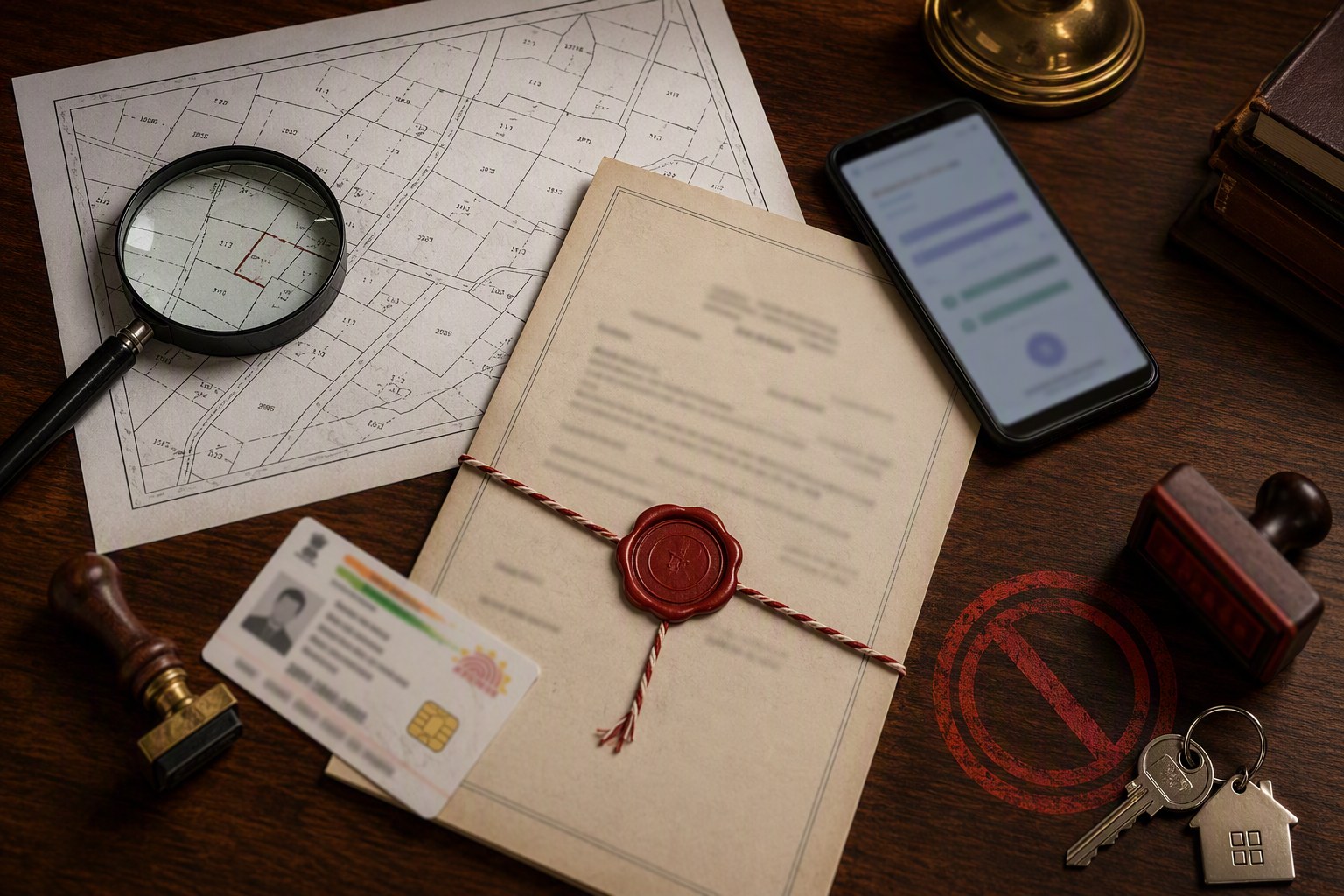



Telangana has 1,47,934 prohibited property records under Section 22-A. That single number should make every buyer slow down before paying an advance on land, a plot, or even an old house site. Telangana 22-A Removal is possible in some cases, but not every blocked property can become registerable. The answer depends on why it is blocked, which department entered it, what the pahani and old revenue records say, and whether the SRO can legally accept the document later.
In our experience, buyers usually ask the wrong first question. They ask: can the seller get it removed? The better question is: what is the nature of the block, and is there documentary evidence strong enough to remove it?
"A 22-A entry is not one single problem. It can be a clerical mismatch, a government land claim, an assigned land issue, a wakf or endowment entry, an acquisition trail, or a court-linked restriction. Each one has a different future."
Telangana 22-A Removal: the first answer for buyers
Yes, a blocked property can turn clear in Telangana, but only when the entry is wrong, outdated, overlapping, or supported by records that prove private title. If the land is genuinely government land, assigned land with transfer restriction, endowment land, wakf land, ceiling surplus land, or land covered by an acquisition notification, Telangana 22-A Removal is not a routine formality. It becomes a hard legal and revenue exercise, sometimes impossible for a private buyer.
For Hyderabad-side buyers, this issue is no longer limited to remote agricultural land. We see 22-A concerns in growth belts around Shankarpally mandal, Gandipet mandal, Maheshwaram mandal, Moinabad mandal, Shamirpet mandal, Medchal mandal, Kandukur mandal and Ibrahimpatnam mandal. These are the same areas where plot rates are moving fast. Kokapet and Narsingi are trading at premium levels, Mokila and Kollur have active villa and plotted development demand, and Shadnagar still attracts budget land buyers. That price pressure is exactly why a blocked property often gets marketed as a bargain.
Before you even discuss price, run a basic check through the Section 22-A Prohibited Property Check. Then match the survey number using the Survey Number Finder and identify the correct registration office through Find Your SRO Office. If the numbers do not match cleanly across systems, do not treat the deal as clean.
Why 1,47,934 prohibited property records matter
The figure of 1,47,934 prohibited property records is not just a statistic. It tells us how many land parcels or survey-linked entries can disturb registration, bank loan processing, layout approvals, family settlements and resale. A buyer may see a compound wall, an old sale deed, electricity connection and tax receipt, yet the SRO may still refuse registration because the survey number is blocked under Section 22-A.
In Telangana, a registration block can appear due to records received from revenue, endowments, wakf, forest, irrigation, municipal or other government departments. The Sub-Registrar is not expected to decide title like a civil court. If the property falls in the prohibited list, the SRO normally refuses to register until the competent authority removes or modifies that entry.
This is where buyers make costly mistakes. They assume that if an older sale deed exists, the next sale must be allowed. That is not how it works. A 1980s or 1990s document may exist, but if later revenue records classify the land as government, assigned, endowment, wakf, ceiling or acquired, the present registration can still get blocked.
What Section 22-A actually blocks
Section 22-A of the Registration Act, as applied in Telangana, allows the government to prohibit registration of certain categories of properties. The wording and departmental lists matter, but practically buyers should watch for these categories:
- Government land, including poramboke, shikam, kunta, road, burial ground or other public-use classifications.
- Assigned lands where transfer is restricted under assignment conditions or related law.
- Endowment lands belonging to temples or religious institutions.
- Wakf properties, including lands notified or claimed through wakf records.
- Forest land or land under environmental or departmental restriction.
- Ceiling surplus land, evacuee property or other special-category land.
- Land under acquisition, road widening, irrigation project, public purpose notification or litigation-linked restraint.
- Survey numbers wrongly included due to digitisation, sub-division mismatch or boundary overlap.
The last category is where Telangana 22-A Removal is most realistic. If Survey No. 125/AA was meant to be blocked, but Survey No. 125/E got captured due to old village map confusion, the owner may have a case. If an entire old survey number is blocked while only a portion was government land, sub-division records and field measurement can help. But if the pahani, Sethwar and departmental records consistently show non-private character, the risk is serious.
Telangana 22-A Removal checks at mandal, Dharani and SRO level
A serious buyer should not depend on a seller saying, registration will happen next month. Ask for records. Telangana 22-A Removal depends on paper trail, not verbal confidence.
1. Start with survey number accuracy
Many disputes begin with a wrong survey number, missing sub-division or old village boundary confusion. In places like Mokila, Tellapur, Kollur, Adibatla and Tukkuguda, one revenue village can have multiple fast-moving projects and old agricultural holdings side by side. A one-digit mistake can change the property from private patta land to blocked land.
Use the Survey Number Finder and cross-check the village, mandal and district. Do not check only the plot number. Plot numbers are developer-created. Section 22-A usually works at survey number or sub-division level.
2. Check the present prohibited status
Run the survey number through the Section 22-A Prohibited Property Check. If it appears blocked, capture the exact reason, department reference if available, village name, survey number, extent and SRO jurisdiction. A half-acre block inside a 10-acre survey number is different from an entire survey number block.
3. Pull the Encumbrance Certificate
An EC does not cure a 22-A entry, but it shows transaction history. Use the Encumbrance Certificate Search to see registered sale deeds, gift deeds, mortgages, release deeds and development agreements. If the last valid sale happened before the block entry, ask when and why the block came later.
4. Match pahani, ROR and old revenue records
Dharani entries, pahani, ROR-1B, old pahani, Sethwar, Khasra Pahani, Faisal Patti, Tippan and FMB sketch can all matter. In Telangana land disputes, older records often carry more weight than a recent screenshot. If the seller has only a Dharani passbook but no old title chain, be careful.
5. Visit the mandal office or get a proper revenue opinion
The Tahsildar and revenue staff at mandal level can clarify whether the block is due to government classification, assignment, court case, acquisition or data error. In many cases, the file must move from mandal to RDO to District Collector level. For high-value Hyderabad outskirts land, I would not rely on only one online printout.
6. Verify the SRO position
Identify the correct SRO using Find Your SRO Office. A seller may say that another nearby SRO registered similar land. That does not guarantee your survey number will pass. The SRO will look at the prohibited property list, market value record, document type and property description.
Which blocked properties have a realistic chance?
We usually divide 22-A cases into three buckets: possible, difficult, and avoid unless you are ready for litigation.
| Type of 22-A issue | Chance of becoming registerable | Buyer view |
|---|---|---|
| Clerical error in survey number or sub-division | Reasonable, if records clearly support private title | Consider only after correction is completed |
| Partial overlap with government land | Possible after survey, demarcation and extent correction | Need FMB, Tippan and official field report |
| Old acquisition entry but project dropped or land released | Possible, but document-heavy | Ask for release order or official clarification |
| Assigned land transfer restriction | Difficult | Do not assume regular sale is valid |
| Endowment or wakf claim | Very difficult | Needs specialist legal review; bank loan risk is high |
| Clear government land classification | Very low | Avoid private purchase |
In Hyderabad real estate, the problem is that blocked land often looks cheap compared to nearby market rates. If clean plotted land near Mokila is quoted around ₹35,000 to ₹70,000 per sq yd depending on location, approach road and layout status, a 22-A-affected parcel may be offered far below that. Around Kollur and Tellapur, proper plotted or villa-linked land can see ₹45,000 to ₹90,000 per sq yd in active pockets. Shadnagar land may be quoted from ₹12,000 to ₹25,000 per sq yd based on highway access and permissions. A large discount is not always an opportunity. Sometimes it is the cost of uncertainty.
What records decide Telangana 22-A Removal?
If a seller claims removal is under process, ask for the file trail. A genuine case should have more than a WhatsApp message from a broker.
- Old title deeds: Sale deeds, partition deeds, gift deeds, settlement deeds and link documents.
- Revenue records: Pahani, ROR-1B, Sethwar, Khasra Pahani, Faisal Patti and mutation proceedings.
- Survey records: FMB, Tippan, village map, sub-division sketch and official demarcation report.
- Dharani record: Present pattadar details, nature of land, extent and transaction history where available.
- Department letters: Clarification from revenue, endowments, wakf, forest, irrigation or acquisition authority.
- SRO refusal or status: Refusal order, objection note or prohibited list extract.
- Court orders: If any writ petition or civil suit exists, read the operative portion, not just the case number.
For apartment buyers, the issue can still matter. If the project land has a hidden 22-A issue, RERA registration alone may not answer every title question. Check the project on the RERA Project Lookup, but also ask for land title documents and approvals. For open plots, use the Property Verification Tool before you pay token advance.
Timelines: how long can removal take?
There is no one clean timeline. A simple data correction may move faster if the owner has perfect documents and the error is obvious. But a disputed land classification can take months or years. In my view, buyers should plan around these practical bands:
- Basic status clarification: 1 to 3 weeks, if the seller already has records and SRO details.
- Mandal-level record collection: 2 to 6 weeks, depending on old record availability.
- Survey and demarcation: 1 to 3 months, sometimes longer in busy mandals.
- Collector-level correction or deletion request: 2 to 6 months in simpler cases; longer if departments object.
- Wakf, endowment, assignment or government land dispute: no buyer-friendly timeline; litigation can run for years.
One practical point: do not sign an agreement of sale with a short deadline if the land is still blocked. If the seller insists, include a condition that payment beyond a small refundable token happens only after the 22-A entry is removed and the SRO confirms registerability. Better still, wait.
Rates, stamp duty and why registration value still matters
Even when the block is removed, registration cost has to be calculated properly. Telangana sale deeds commonly involve stamp duty, transfer duty and registration fee, with the total often working around 6% for a regular sale deed, subject to property type and latest government rules. Check the payable amount using the Stamp Duty Calculator.
Also compare the government market value, commonly called ready reckoner value by many buyers, with the negotiated sale price. Use the Market Value / Guideline Value Search. Around Hyderabad, market price and government value can be far apart. For example, land near Kokapet, Narsingi, Tellapur, Kollur and Mokila may trade at levels much higher than official registration value. That gap does not remove the need for clean title. In fact, when rates rise sharply, title risk becomes more expensive.
If the property is a development parcel, also check land use and road access. A land parcel may be cleared from 22-A but still face zoning, road width or layout approval problems. Use the Land Use Zone Finder, Road Width Check and FSI/FAR Calculator before assuming development potential.
Red flags buyers should not ignore
- The seller says the land is blocked only online, but gives no official record.
- The broker says registration can be managed at SRO level. A genuine 22-A entry is not solved by persuasion.
- The seller asks for a large cash advance before removal.
- Only plot number is shared, not survey number and village.
- Dharani shows one name, old link documents show another chain, and mutation papers are missing.
- The land is near a lake, nalas, shikam area, forest boundary, temple land or old village common land.
- The price is 30% to 50% lower than nearby clean land without a clear reason.
- The seller avoids written conditions in the agreement.
We have seen buyers get emotionally attached to land parcels in Moinabad, Shankarpally and Maheshwaram because the location looks future-ready. Outer Ring Road access, pharma city influence, airport connectivity or villa corridor branding can all create urgency. But a blocked survey number does not care about market sentiment. The document either becomes registerable through proper removal, or it remains a risk.
How I would handle a 22-A affected deal
If I were advising a family buying land in Telangana, I would follow a strict sequence. First, verify the survey number and SRO. Second, check 22-A status. Third, collect EC and full link documents. Fourth, compare Dharani, pahani and old revenue records. Fifth, take a written legal opinion from a lawyer who regularly handles Telangana land matters. Sixth, speak to the SRO or obtain a formal status. Only after these steps would I discuss advance payment.
For high-value parcels in Gandipet, Kokapet, Narsingi, Tellapur, Mokila, Kollur, Adibatla, Tukkuguda, Ghatkesar, Shamirpet or Shadnagar, I would also track changes for a few weeks using the Property Change Tracker. A sudden mutation, new claim or status change before registration can alter the deal.
The cleanest rule is simple: buy after removal, not on the promise of removal. If the seller is confident, let the seller complete Telangana 22-A Removal first. A buyer should not fund the seller's title correction unless the risk is priced, documented and legally protected.
Final view on Telangana 22-A Removal
Telangana 22-A Removal is not impossible. Many entries can be corrected when private title is clear and the block is due to data error, wrong extent, old department communication or survey overlap. But a buyer must separate removable defects from true prohibitions. The 1,47,934 prohibited property records show the scale of the issue. In fast-growing Hyderabad outskirts, that scale meets high land prices, aggressive selling and limited buyer patience.
My opinion is straightforward: a blocked property is not automatically bad, but it is automatically a due diligence case. Do not pay like it is clean. Do not accept oral assurances. Do not confuse possession with title. Let the records speak.
Frequently Asked Questions
Can Telangana 22-A Removal make a blocked property registerable?
Yes, if the block is wrong, outdated or limited to a mistaken survey entry. If the land is genuinely government, assigned, wakf, endowment or acquisition-affected land, removal is difficult and sometimes not realistic.
Which office decides removal from the 22-A prohibited list?
The SRO usually cannot remove the entry on its own. The file may need clarification or orders from revenue authorities, often through the Tahsildar, RDO or District Collector, and sometimes from departments like wakf, endowments, forest or irrigation.
Is an old registered sale deed enough to clear 22-A?
No. An old sale deed helps establish title history, but the present prohibited status, revenue classification, pahani, survey records and department claims also matter. The SRO can still refuse registration if the survey number is blocked.
Should I pay advance for a 22-A blocked property?
Avoid large advances. If you must proceed, use a written agreement with refund terms and make further payment conditional on official removal of the 22-A entry and confirmation of registerability.
How can I check if my survey number is prohibited?
Start with the Section 22-A prohibited property check, confirm the survey number and village, pull the EC, verify Dharani and pahani records, and identify the correct SRO before taking a legal call.