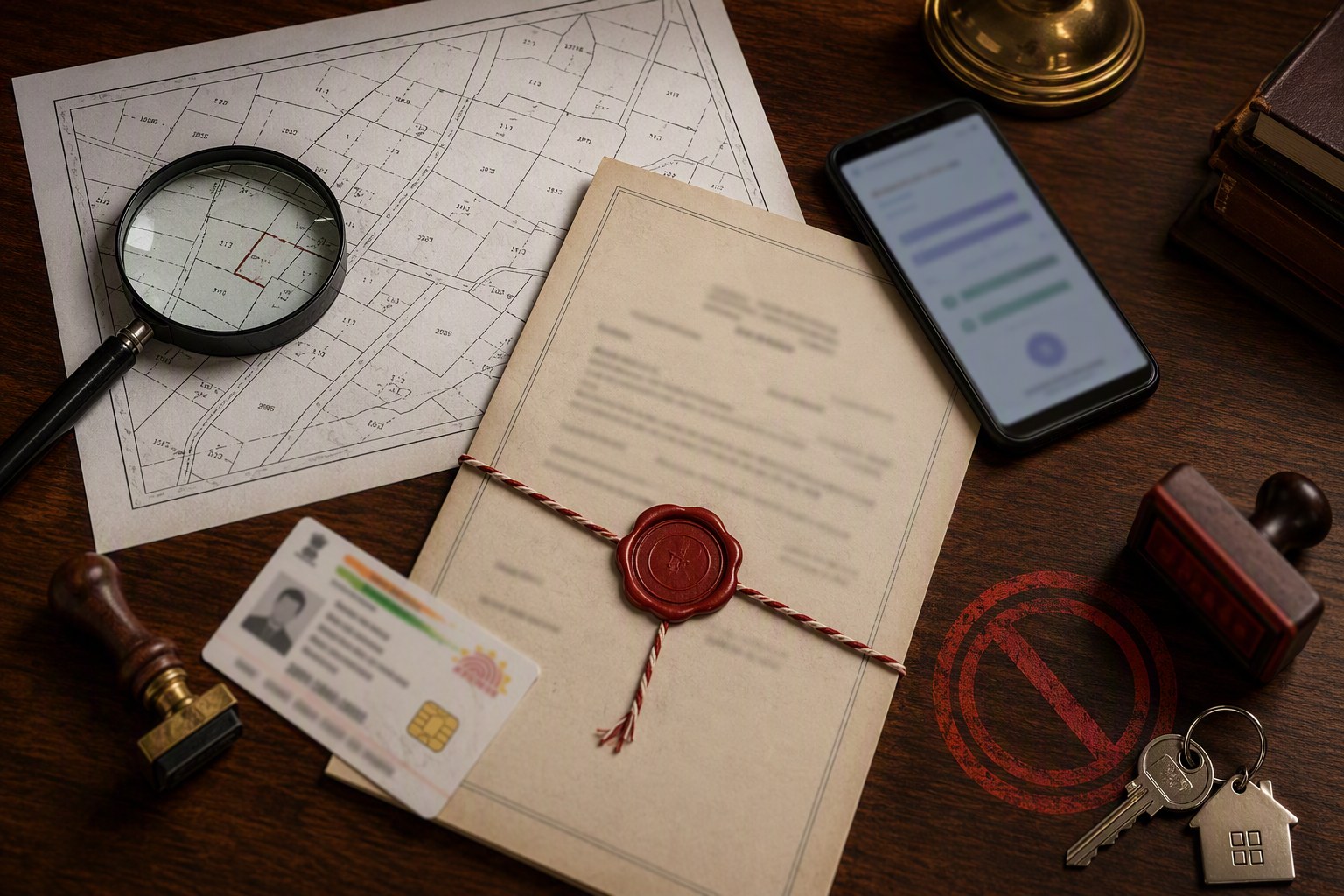



Telangana Registration Slot Failed? The 22-A Alert Explained
Telangana Registration Slot Failed is becoming one of the most serious warning signs for land buyers, especially when the reason is a Section 22-A prohibited property alert. As per latest IGRS data available with Verified.RealEstate, Telangana has 30,76,153 prohibited-property records. For a buyer, that number is not just a government database entry. It is the first legal alarm bell before paying advance, booking a registration slot, or trusting a seller’s word.
In plain terms, a 22-A alert can stop a sale deed from moving ahead at the Sub-Registrar Office. You may have token money ready, stamp duty calculated, witnesses arranged, and a slot selected. Still, if the property is mapped as prohibited under Section 22-A, the system or the SRO can block registration. This is why we keep telling buyers in Hyderabad outskirts: survey number checking is not a formality. It is the deal filter.
Our view is simple: if a property shows a 22-A flag, do not treat it as a small documentation issue. Treat it as a legal stop signal until the record is verified and corrected through proper government process.
Telangana Registration Slot Failed: What the 22-A Alert Means
Section 22-A refers to the list of properties where registration is restricted or prohibited. These records are maintained by the registration department and linked to government inputs. When a property falls into this list, the Sub-Registrar may refuse to register the document, even if both buyer and seller are willing.
This can happen in agricultural land, open plots, old gram panchayat layouts, converted land parcels, and even in urban-growth pockets where village survey numbers were never properly checked. We have seen buyers in areas around Shankarpally, Mokila, Kollur, Patancheru, Maheshwaram, Shamshabad, Ghatkesar, Medchal, and Yadagirigutta face last-minute panic because the survey number had a prohibited entry.
The key point is this: the alert is usually tied to the land identity, not to the buyer’s intention. If the survey number, sub-division, extent, village, or mandal is linked to a prohibited-property record, the system may not allow clean registration.
Before going near the SRO, start with the Section 22-A Prohibited Property Check. Then match the survey details with the Survey Number Finder and cross-check previous transactions using the Encumbrance Certificate Search. These three checks catch many avoidable mistakes before money changes hands.
Telangana Registration Slot Failed: Why It Happens Before or During SRO Registration
A registration slot can fail at different stages. Sometimes the issue appears while preparing document details online. Sometimes the payment goes through, but document presentation becomes difficult. In some cases, the SRO staff identify the prohibited-property entry only when the document is placed for scrutiny.
From a buyer’s point of view, the timing feels unfair. But from the registration department’s side, the SRO cannot register a property if the land is listed as prohibited. The officer is expected to follow the database and applicable government instructions.
Common situations where 22-A blocks registration
- Government land entry: The survey number is marked as government land in revenue records.
- Assigned land issue: Land given under assignment may carry transfer restrictions.
- Endowment or religious institution land: Some properties are linked to temple, mosque, church, dargah, or other institutional records.
- Waqf-related entry: Certain lands are claimed or recorded under Waqf-related lists.
- Ceiling or surplus land: Older land ceiling proceedings can continue to affect modern transactions.
- Tank bed, shikam, nala, or public-use land: These entries are risky, especially near expanding suburbs.
- Mismatch in village or survey subdivision: The seller may quote one number while the government record carries another.
- Old dispute reflected in public records: Even if the seller says the matter is settled, the registration system may still show the restriction.
In our experience, the most painful cases are not always fraud cases. Many are careless cases. A buyer sees a good approach road near a fast-growing location, compares nearby apartment prices, and assumes the plot is safe. Then, at the time of registration, one survey-number entry creates a full stop.
The Scale of the Problem: 30,76,153 Prohibited-Property Records
Telangana’s prohibited-property database is not a small side list. As per latest IGRS data available with Verified.RealEstate, there are 30,76,153 prohibited-property records. That is why a buyer should not depend only on a photocopy of a pattadar passbook, an old sale deed, or a layout brochure.
This number matters more in high-demand corridors. Around Hyderabad, land prices and buyer interest move faster than paperwork habits. In villages under Gandipet, Serilingampally surroundings, Narsingi belt, Kollur-Tellapur side, Patancheru industrial-side pockets, Adibatla, Kandukur, Maheshwaram, and Shamshabad, a single survey number may have multiple histories: agricultural use, conversion, layout attempt, family partition, mortgage, court dispute, or government claim.
When a buyer says, “Sir, the seller has EC and link documents,” my first reply is: EC is necessary, but it is not the whole story. The Encumbrance Certificate shows registered transactions. It does not automatically clear every revenue restriction, 22-A entry, land-use concern, or layout approval issue.
Use the EC Analyzer to read transaction patterns, but also check the 22-A list. Use the Property Verification Tool if you want a broader pre-purchase review. If you are unsure which office handles the property, use Find Your SRO Office before planning registration day.
How a 22-A Alert Reaches the Sub-Registrar Office
The SRO is not acting on gossip from the locality. A 22-A alert is usually part of government records available to the registration department. Inputs may come through revenue authorities, endowments, Waqf-related records, court-related restrictions, or other notified lists.
For agricultural land, buyers must also be careful with Dharani records, pahani details, khata, pattadar name, extent, nature of land, and village mapping. For non-agricultural plots, the land trail still matters. A plot number in a layout does not erase the mother survey number. If the mother survey number has a problem, the plot can inherit that problem.
This is common in fast-growing fringe locations. For example, a buyer may be shown Plot No. 42 in a layout near Shankarpally. The brochure looks neat. The road is visible. Nearby villas are under construction. But the legal identity still comes back to the survey number, village, mandal, and SRO jurisdiction. If that mother land is in the prohibited list, the plot registration can suffer.
What Buyers Should Do When Telangana Registration Slot Failed Due to 22-A
First, do not panic and do not pay extra money to “manage” the issue. A 22-A alert is a record problem, not a bargaining inconvenience. If someone says it can be fixed unofficially within a day, treat that as another warning sign.
Step 1: Get the exact reason from the SRO or system
Ask for the reason why the document was not accepted or why the slot process failed. You need the exact survey number, village, mandal, extent, and nature of objection. Without these details, you will only go in circles between seller, document writer, and SRO.
Step 2: Match every land identifier
Check whether the sale deed draft, pattadar passbook, pahani, Dharani entry, old link deed, layout plan, and EC all carry matching details. In Telangana land records, small differences can create big trouble: Sy.No. 120 and 120/A may not be treated the same. Village spelling differences, merged hamlets, old mandal boundaries, and subdivision changes can also confuse buyers.
Step 3: Run a prohibited-property check
Use Section 22-A Prohibited Property Check before spending on stamp papers, legal drafting, or bank processing. If the result is adverse, stop the transaction until the seller produces a clear government-backed resolution.
Step 4: Ask the seller for documentary clearance
Do not accept oral assurances. Ask for government orders, revenue proceedings, court orders, mutation records, rectification documents, or official deletion from the prohibited list, depending on the case. The correct document depends on why the land entered the 22-A list.
Step 5: Re-check market value and SRO jurisdiction only after legal clarity
Once the land identity is clear, then check ready reckoner or government market value using the Market Value / Guideline Value Search. For stamp duty planning, use the Stamp Duty Calculator. Do not reverse the order. Stamp duty calculation is useful only after legal transferability is confirmed.
Seller Says 22-A Is a Mistake. Should You Believe It?
Sometimes the seller is right. Government lists can carry old entries, partial survey issues, wrong mapping, or records that were not updated after orders. But a buyer should not finance the seller’s record-cleaning exercise blindly.
My practical advice: if the seller says the 22-A entry is wrong, ask the seller to get it corrected before agreement or registration. If you still want to proceed, keep the agreement conditional, record the exact issue, and avoid large non-refundable payments. This is where many buyers lose control. They pay advance based on trust, then the seller says clearance will take time.
In Hyderabad’s outer growth areas, demand pressure makes buyers take shortcuts. A plot near a proposed road, a villa parcel near an upcoming school, or farmland close to a pharma or logistics belt can look tempting. But a 22-A entry can freeze your plans. You cannot build confidence on a blocked record.
Why EC Alone Cannot Save You from 22-A Trouble
Many buyers ask for an EC and feel satisfied if no mortgage or recent dispute appears. That is a half-check. EC mainly reflects registered transactions for a given period. A prohibited-property flag may arise from revenue classification, government land status, institutional claim, or other notified restriction.
For example, a property may have old registered sales, but later a government department may notify the land as prohibited. Or a larger survey number may include both clear and restricted extents. The plot seller may show documents for one part, while the database flags another part. Without matching boundaries and exact survey subdivision, the buyer remains exposed.
Use EC as one layer. Use 22-A check as another layer. For apartment buyers, also use RERA Project Lookup where applicable. For plots and land, bring in survey verification, revenue record review, and layout approval checks.
Local Red Flags We See Around Hyderabad
Every locality has its own paperwork personality. In old city areas and established colonies, title chains and family partitions may be the main issue. In western growth corridors like Kokapet, Narsingi, Tellapur, Kollur, Mokila, and Shankarpally, survey-number history and conversion records become critical. In southern belts like Shamshabad, Maheshwaram, Kandukur, and Adibatla, buyers must be careful with large land parcels, assigned land claims, and layout approvals. In northern and eastern belts like Medchal, Ghatkesar, Bibinagar, and Yadagirigutta, old revenue entries and village-level records need close reading.
I am not saying every land parcel in these areas is risky. Many are perfectly clean. But high demand creates fast selling, and fast selling often creates weak verification. A 22-A check slows you down for the right reason.
What a Safe Buyer File Should Contain Before Registration
Before booking the registration slot, keep one buyer file ready. It should not be just a folder of photocopies collected from the seller. It must answer one question: can this property be legally transferred today?
| Document or check | Why it matters |
|---|---|
| 22-A prohibited property check | Confirms whether registration may be blocked due to a prohibited entry. |
| Survey number and village verification | Matches the legal land identity with the seller’s claim. |
| EC review | Shows registered sale, mortgage, release, gift, partition, or other transactions. |
| Pahani, Dharani, or revenue records | Useful for agricultural land identity, pattadar name, extent, and classification. |
| Link documents | Tracks how the seller received title from previous owners. |
| SRO jurisdiction check | Helps avoid wrong-office confusion before slot planning. |
| Guideline value check | Helps estimate government market value and duty after legal clearance. |
If even one of these checks throws a serious mismatch, pause. A clean seller will understand. A desperate seller will push you to register quickly.
How Developers and Plot Sellers Should Handle 22-A Questions
Developers, land aggregators, and plotted-layout sellers should not treat 22-A questions as buyer harassment. In Telangana, buyers are becoming sharper. Banks, legal teams, and family advisors are also asking better questions now.
If you are selling a plotted layout near an expanding mandal, keep the mother documents, survey sketch, conversion papers, layout approval, EC, tax receipts, and prohibited-property status ready. If part of the mother survey number had an old restriction and later got cleared, show the clearance trail openly. That builds trust faster than glossy marketing.
For serious buyers, transparency is now a selling point. We’ve seen transactions close faster when sellers answer survey-number questions clearly at the start.
Final Word: Treat 22-A as the First Gate, Not the Last-Minute Shock
A failed registration slot is frustrating, but a blocked registration is better than buying a legally restricted property. Telangana’s 30,76,153 prohibited-property records show why buyers cannot afford casual verification. Whether you are buying an open plot in Mokila, a land share near Maheshwaram, a resale flat in Serilingampally, or agricultural land beyond Shankarpally, start with the land record.
The correct order is simple: identify the survey number, check 22-A status, review EC, confirm SRO, verify market value, then prepare the sale deed. If the 22-A alert appears, stop and resolve it through documents. Registration day should be boring. If it becomes dramatic, your verification was late.
Frequently Asked Questions
What does a 22-A alert mean in Telangana property registration?
A 22-A alert means the property is listed as prohibited or restricted for registration under Section 22-A records. The SRO may refuse to register the sale deed until the restriction is removed or clarified through proper government records.
Can my Telangana registration slot fail because of a prohibited property entry?
Yes. If the survey number, village, mandal, or property identity matches a prohibited-property record, the registration process can stop before or during document presentation at the SRO.
Is an Encumbrance Certificate enough to avoid 22-A risk?
No. An EC shows registered transactions, but it may not clear revenue restrictions, government land entries, assigned land issues, or other 22-A notifications. Use EC along with a prohibited-property check.
What should I do if the seller says the 22-A entry is a mistake?
Ask the seller to produce official correction or deletion records before registration. Do not depend on verbal promises. Keep payments conditional until the prohibited-property issue is resolved.
Which details are needed to check 22-A status?
You should have the survey number, village, mandal, district, extent, and property type. For plots, check the mother survey number also, not just the plot number.