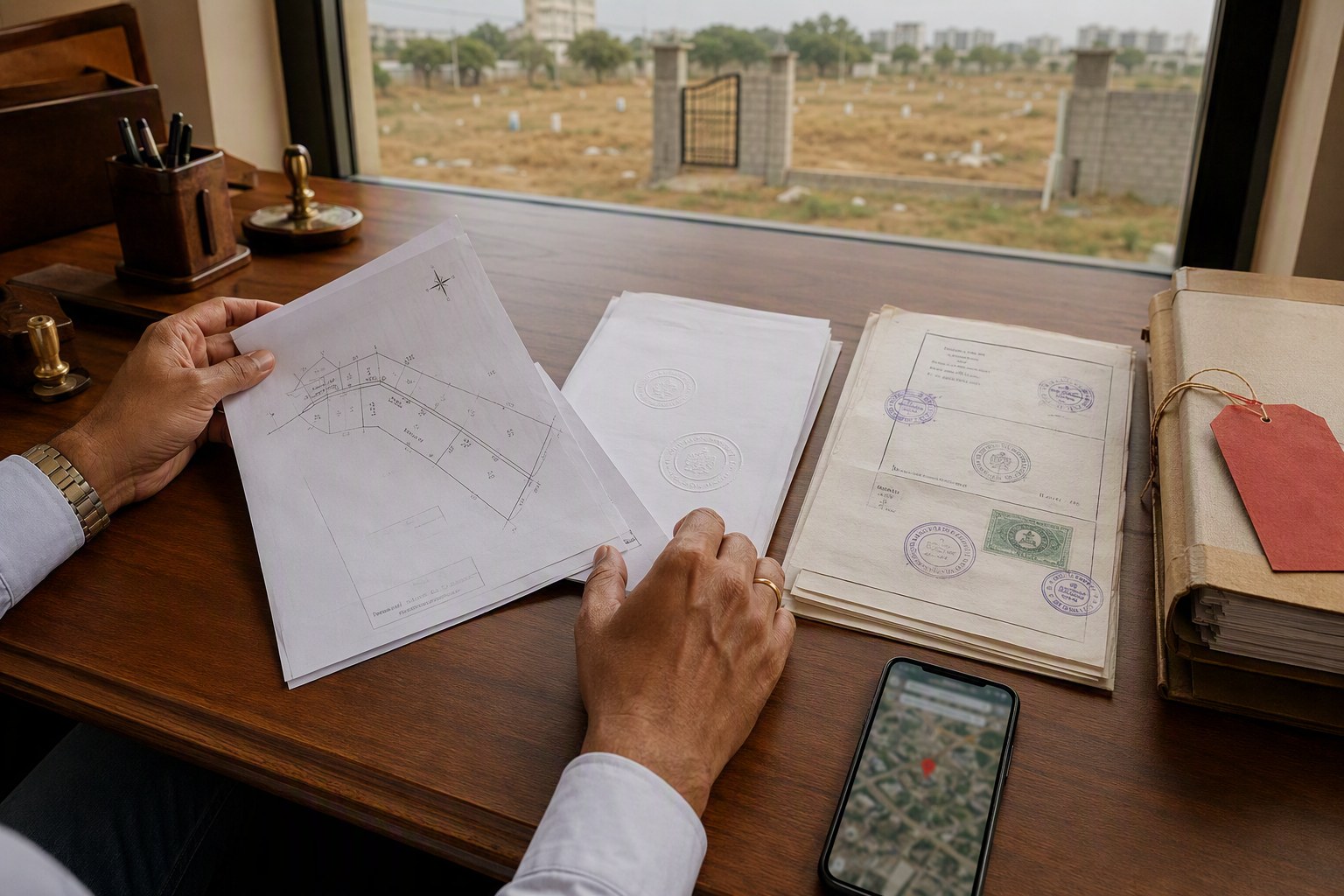
Telangana 22-A Deletion Claims: what buyers must verify first
Telangana 22-A Deletion Claims are now a regular talking point in Hyderabad land negotiations, especially when sellers say their survey number has been cleared from the prohibited list. Buyer caution is not optional here. Telangana has 3,076,153 prohibited property records under Section 22-A in the latest database context available to Verified.RealEstate, which is roughly 30.76 lakh records. That single number explains why a verbal assurance, a photocopy of proceedings, or a WhatsApp PDF from the seller should not decide your purchase.
The short answer: do not pay a major advance only because the seller claims 22-A relief. First verify the survey number, village, mandal, SRO jurisdiction, pahani entries, Dharani status, EC, mutation trail, and the exact deletion proceedings. In our experience, the risk is not only whether the land is prohibited today. The bigger risk is whether the deletion is complete, correctly mapped to the same survey/sub-division, and accepted at the Sub-Registrar Office when the sale deed is actually presented.
This matters in active Hyderabad and peri-urban belts such as Kokapet, Narsingi, Tellapur, Mokila, Shankarpally, Bachupally, Ghatkesar, Tukkuguda, Adibatla, Shamshabad, Maheshwaram, Abdullapurmet and Ibrahimpatnam. In these locations, buyers often move fast because land availability is tight. That speed is exactly where 22-A mistakes happen.
Verified.RealEstate view: Treat every 22-A deletion claim as a fresh verification file, not as a routine title check. The seller may be genuine, but the record must speak for the land.
Why Telangana 22-A Deletion Claims need extra caution
Section 22-A restrictions affect registration. If a property is on the prohibited list, the SRO may refuse registration even if the buyer and seller are ready, stamp duty is arranged, and the sale deed is drafted. The list can cover government lands, assigned lands, endowment properties, wakf-related entries, ceiling surplus lands, disputed classifications, and other categories notified for registration prohibition.
The issue with Telangana 22-A Deletion Claims is that deletion is not always clean from a buyer’s angle. A seller may have applied for deletion. A hearing may have happened. A mandal office may have given a favourable report. A court may have passed an order. Still, unless the prohibited entry is removed or suitably corrected in the registration system and connected land records, the buyer remains exposed.
We have seen cases where the seller shows one survey number, while the actual land offered is in a sub-division created later. We have also seen old village names, merged gram panchayat limits, and changed SRO jurisdiction confuse buyers. Around Hyderabad, this is common in fast-growing mandals like Gandipet, Serilingampally, Shankarpally, Patancheru, Medchal, Ghatkesar, Hayathnagar, Rajendranagar, Shamshabad, Maheshwaram and Abdullapurmet.
Start with a direct check on Section 22-A Prohibited Property Check. Then match the survey number using Survey Number Finder. If the seller’s document says one village but the current revenue record points elsewhere, pause the deal and clarify jurisdiction through SRO Village Directory or Find Your SRO Office.
Telangana 22-A Deletion Claims in Hyderabad growth corridors
The 22-A problem is not limited to remote agricultural lands. It appears in places where Hyderabad buyers are most active. In the western corridor, buyers check plots around Mokila, Kollur, Tellapur, Osman Nagar, Velimela and Shankarpally because of connectivity to Gachibowli and the Financial District. In the southern belt, Shamshabad, Tukkuguda, Maheshwaram and Adibatla attract buyers due to airport-side growth and industrial activity. On the eastern side, Ghatkesar, Pocharam, Bibinagar-side villages and Ibrahimpatnam see regular investor interest.
These are exactly the markets where a seller may say, “22-A problem is solved, registration will happen now.” Maybe true. But the buyer must ask: solved where? In Dharani? In Collector proceedings? In the SRO system? In the pahani? In the EC trail? In the layout approval file? A proper answer should connect all these records.
For flats and plotted projects, also check whether the project is registered, if applicable, through RERA Project Lookup. For independent land, do not confuse RERA visibility with land title safety. RERA can tell you about project registration; it does not automatically cure a prohibited land entry. For open plots and villas, buyers should combine Property Verification Tool, Encumbrance Certificate Search, and EC Analyzer before paying anything beyond a small refundable token.
What the 30.76 lakh prohibited property records tell buyers
The database context shows 3,076,153 prohibited property records under Section 22-A. That is not a small administrative footnote. It means the prohibited property universe in Telangana is large enough to affect routine buying behaviour, especially for land parcels with older revenue histories.
Buyers should understand one practical point: a prohibited property record is often survey-number based, but real-life land transactions are boundary-based. The buyer visits a site, sees fencing, stones, a board, a road approach, maybe even neighbouring constructions. But government records may describe the land by survey number, extent, village and classification. If these do not match, the buyer’s physical confidence is meaningless.
In peri-urban Telangana, survey numbers may have multiple sub-divisions, part extents, old pahanis, succession entries, regularisation proceedings and layout carve-outs. A deletion claim must be tested against the exact extent being sold. If the seller owns Ac. 2.00 guntas in a survey number but the deletion order refers to a smaller part, the buyer cannot assume the entire property is safe.
Buyer checklist before accepting 22-A relief
Here is the working checklist we prefer for buyers dealing with Telangana 22-A deletion claims. This is not theory. These are the checks that usually catch problems before the sale deed stage.
| Check | What buyer should verify | Why it matters |
|---|---|---|
| Survey number and sub-division | Match sale deed, pahani, Dharani, map and site location | Deletion may apply only to a specific survey or part extent |
| Village and mandal | Confirm current revenue village, mandal and SRO jurisdiction | Old village names and boundary changes can mislead buyers |
| 22-A status | Check whether the property is still shown as prohibited | Seller’s claim must match registration records |
| Deletion proceedings | Read the order number, date, authority, extent and conditions | Some orders are conditional or limited |
| EC trail | Review registered transactions and refusals if any | Past refusal or missing link deeds can create risk |
| Pahani and Dharani | Check pattadar, possession, nature of land and classification | Revenue record mismatch can delay mutation and loan |
| Mortgage or charge | Check bank charge where applicable | Title may be clear from 22-A but burdened by loan |
Use CERSAI Charge Check for mortgage-related verification where the property has a loan history or the seller mentions bank finance. Use Property Change Tracker if you want to monitor a property after initial due diligence, especially where deletion is still under process.
Do not rely only on one deletion paper
A deletion paper can be genuine and still insufficient. Buyers should read it like a legal document, not like a permission slip. Check the authority who issued it. Check whether it refers to the correct survey number. Check the extent. Check whether the order says deletion from 22-A list, correction of classification, or only disposal of a representation. These are not the same.
If the paper is from a Tahsildar, ask whether the Collector or competent authority has acted on it. If it is a court order, ask whether the department has implemented it in registration records. If it is a Dharani grievance result, check whether the SRO system reflects the same position. If there is a government memo or proceedings copy, ask for the full document, not only the first page.
For land around Gandipet mandal, where values and buyer pressure are high, this discipline is essential. The same applies in Shankarpally mandal, Patancheru mandal, Maheshwaram mandal and Shamshabad mandal, where large land parcels have gone through multiple ownership and classification changes over time.
Market value, stamp duty and the trap of rushing registration
Many buyers hear the words “22-A deleted” and immediately move to price negotiation, stamp duty planning and registration date. Slow down. First confirm registrability. After that, check the registration department’s market value or ready reckoner position using Market Value / Guideline Value Search. Then estimate government costs through Stamp Duty Calculator.
This order matters. If the property is still blocked or partly blocked, stamp duty readiness will not help. If the seller is pushing for a cash-heavy advance before these checks, that itself is a warning signal. In Hyderabad land deals, pressure language is common: “Another party is ready”, “Registration slot is available”, “Deletion came yesterday”, “Only token now”. A serious seller will allow verification.
For apartments, composite valuation may also matter at the deal assessment stage. Buyers can use Composite Value Calculator where relevant. For land with construction potential, FSI/FAR Calculator, Road Width Check and Land Use Zone Finder can help evaluate planning feasibility. These tools do not replace legal due diligence, but they stop buyers from looking only at price per square yard.
Red flags in Telangana 22-A Deletion Claims
Some claims deserve immediate caution. If any of the below situations appear, do not treat the property as cleared until a property lawyer and local records expert review it.
- The seller shows only a screenshot, not the full deletion proceedings.
- The order mentions a different survey number, village or extent.
- The land is sold through GPA without a clean title chain.
- The pahani classification does not match the seller’s story.
- The EC does not show link documents for key ownership transfers.
- The seller refuses to share pattadar passbook details or Dharani status.
- The SRO staff informally indicates registration difficulty.
- The land is part of a larger survey number with unclear boundaries.
- The seller asks for a large non-refundable advance before verification.
- The property is in a layout, but layout approval and land conversion records are missing.
One more practical point: if the seller says the land was removed from 22-A “recently”, ask for proof of implementation at the SRO level. A favourable order sitting in a file is not the same as a registration-ready property.
How buyers should structure the advance
In our experience, buyers lose money not because they failed to ask questions, but because they paid too early. The agreement of sale should clearly mention that the transaction is subject to 22-A clearance, clean EC, valid title, correct survey identification, and registration acceptance by the concerned SRO. If the seller’s claim fails, refund terms must be written in plain language.
Avoid vague lines like “seller confirms property is clear”. Instead, mention the actual survey number, sub-division, village, mandal, extent and SRO. Attach copies of the documents reviewed. If deletion is under process, write the milestone: final deletion order, update in prohibited list, SRO confirmation, and only then next payment. For high-value Hyderabad land, this is basic protection.
Buyers should also insist on a current EC close to the registration date. Old ECs are not enough in active markets. Use Encumbrance Certificate Search and then review the output through EC Analyzer. A property may be deleted from 22-A but still have a recent agreement, mortgage, attachment or litigation-related entry requiring closer review.
Local examples of where checks become tricky
Take a land parcel near Mokila or Shankarpally. The seller may have inherited land, converted part of it, and sold plots over time. The 22-A deletion may relate to the parent survey number, but the buyer is purchasing a plotted portion. Here, layout approvals, road access, extent reconciliation and link documents matter as much as the deletion entry.
In Narsingi, Kokapet-side and Gandipet mandal belts, old revenue records, high market demand and premium buyer interest create pressure to close quickly. The buyer should still verify the land classification, SRO jurisdiction and survey identity. Do not assume that because nearby projects are premium, every parcel in the area is clean.
In Maheshwaram, Tukkuguda, Shamshabad and Adibatla belts, buyers often compare land based on airport access and future development expectations. That is fine, but first check whether the land can be registered and mutated. A good location cannot cure a bad record.
In Ghatkesar, Pocharam and Ibrahimpatnam-side transactions, many buyers are first-time land investors. They see a lower ticket size compared to western Hyderabad and relax their checks. That is risky. Section 22-A does not care whether a buyer is an end user or investor.
Final buyer view on Telangana 22-A Deletion Claims
Telangana 22-A Deletion Claims should be treated as a starting point for due diligence, not the end of it. With 3,076,153 prohibited property records in the database context, the buyer’s job is to verify whether the exact property being purchased has moved out of risk in all relevant records.
My practical advice is simple: verify survey identity first, 22-A status second, title chain third, EC fourth, SRO acceptance fifth, and only then negotiate final payment. If the seller is clean, these checks will support the deal. If the seller is hiding something, these checks will expose it before your money is stuck.
Hyderabad land is valuable, but clean land is more valuable. A deletion claim may be genuine relief for the seller. For the buyer, it becomes relief only after records, documents and registration systems confirm the same story.
Frequently Asked Questions
What are Telangana 22-A Deletion Claims?
They are claims that a property has been removed or is being removed from the Section 22-A prohibited property list. Buyers must verify the exact survey number, extent, village, mandal and SRO record before accepting the claim.
Can I register a property immediately after the seller shows a deletion order?
Not blindly. The deletion order must match the property and must be reflected in the registration system. Check the SRO position, EC, pahani, Dharani status and title chain before fixing registration.
How many prohibited property records are there in Telangana?
Verified.RealEstate’s database context shows 3,076,153 prohibited property records under Section 22-A, roughly 30.76 lakh records.
Which tools should I use before buying land with a 22-A deletion claim?
Start with the Section 22-A Prohibited Property Check, Survey Number Finder, EC Search, Find Your SRO Office and Property Verification Tool. For loans or older transactions, also check CERSAI and review the EC carefully.
Should I pay advance if deletion is still under process?
If you pay anything, keep it small and refundable. The agreement should clearly say payment is subject to final 22-A clearance, clean title, correct survey identification and registration acceptance by the concerned SRO.