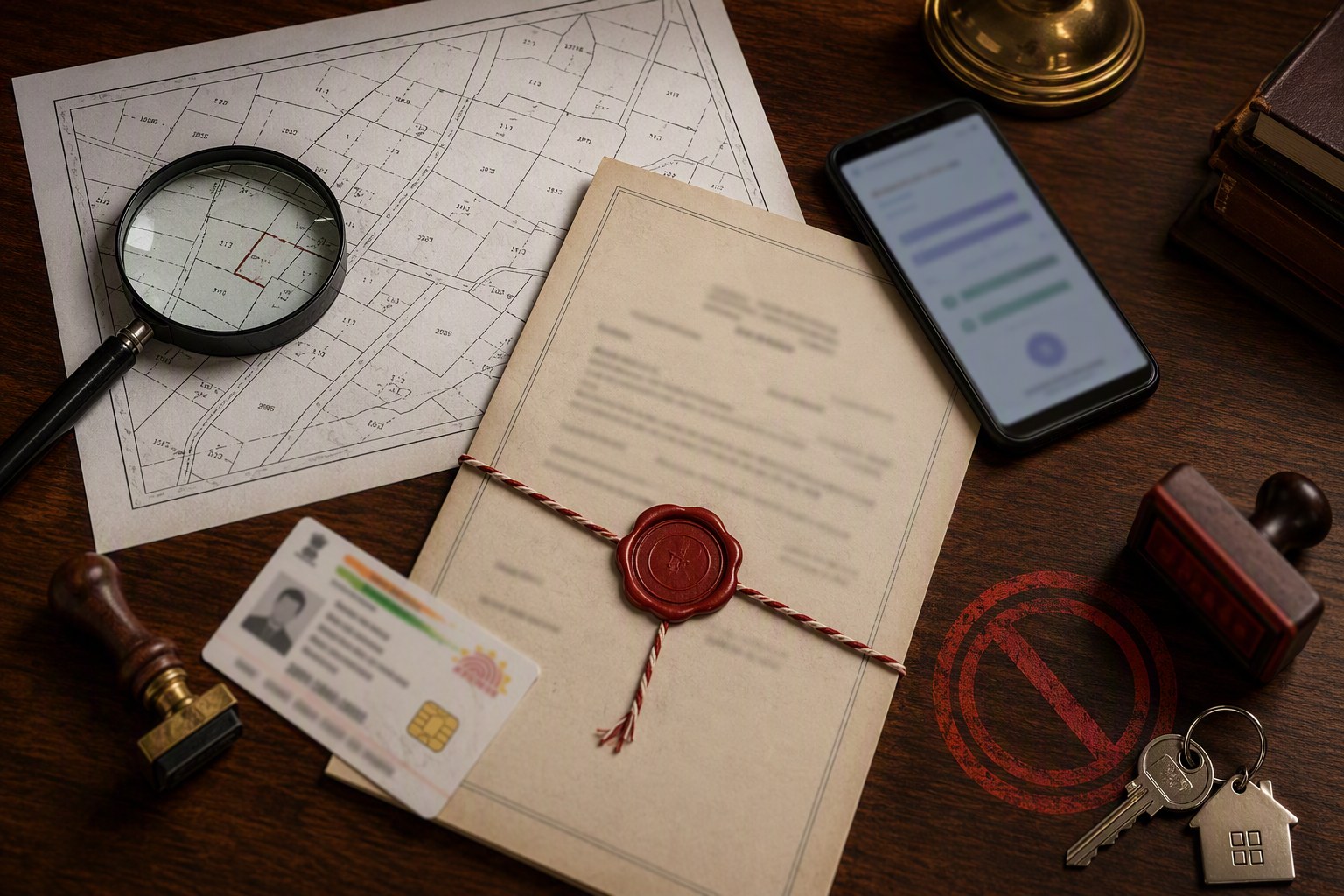



Court Stay vs 22-A Entry is one of the most misunderstood registration issues in Telangana. Both can stop a sale deed, gift deed or development agreement from getting registered, but they work in different ways. A court stay is usually case-specific and order-based. A 22-A entry is a prohibited property entry reflected in government records and used by the SRO at the registration counter.
As per latest IGRS data, Telangana has 30,3,076,153 prohibited properties recorded under Section 22-A. For a buyer in Hyderabad, Rangareddy, Medchal-Malkajgiri, Sangareddy, Yadadri-Bhuvanagiri or any growing mandal, that number is the caution point. Before you pay token advance, check both: litigation risk and 22-A status.
Court Stay vs 22-A Entry: The Short Answer
If a property has a valid court stay restraining sale, transfer or registration, the SRO can refuse or keep registration pending based on that order. If the property is listed under Section 22-A as prohibited, the SRO system itself may block registration because the land is treated as not registrable under the current government record.
In practical terms, a 22-A entry often stops registration faster at the SRO counter because it is visible in the registration workflow. A court stay stops registration when the stay order is produced, communicated, reflected in records, or discovered during legal verification. Both are serious. Neither should be taken lightly just because the seller says, “Sir, small issue only.” We have seen that line cost buyers months of stress.
| Point | Court Stay | 22-A Entry |
|---|---|---|
| Basic nature | A judicial order from a court in a specific dispute | A prohibited property entry in government/registration records |
| Who creates it? | Civil court, High Court or other competent court/authority through an order | Government department or revenue/registration record process under Section 22-A |
| How SRO sees it | Through submitted order, communication, objection, EC trace, legal file or official record | Usually through prohibited property data linked to survey number, village, mandal or property record |
| Effect at registration | Registration may be refused, paused or challenged if it violates the order | Registration is generally blocked while the entry remains active |
| Common buyer mistake | Checking only EC and ignoring pending litigation | Checking only EC and ignoring 22-A/prohibited list |
| Usual remedy route | Vacate stay, modify order, settle case or obtain court clarification | Apply for deletion/correction with supporting revenue documents and competent authority orders |
Court Stay vs 22-A Entry: Why Buyers Get Confused
Most Hyderabad buyers use one word for everything: “legal problem.” But a court stay and 22-A entry are not the same legal problem.
A court stay comes from a dispute. For example, brothers fighting over ancestral land in Narsingi, a boundary suit in Tellapur, a specific performance case in Kondapur, or a partition matter in Shadnagar. The property may look clear in one document, but a court may have restrained parties from selling or creating third-party rights.
A 22-A entry is a government-side prohibition. It may relate to government land, assigned land, endowment land, wakf land, ceiling surplus land, certain litigation-marked lands, water body issues, or other categories covered under the law and notifications. The exact reason must be verified from the relevant record. In Telangana, many buyers first discover it only when the deed is uploaded or when the document writer checks the SRO status.
Our practical view: an EC is necessary, but it is not enough. EC tells you registered transactions. It does not automatically certify that the land is free from court orders, revenue restrictions, title defects or 22-A prohibitions.
What Is a Court Stay in Property Registration?
A court stay is an order that temporarily restrains an action. In property matters, it may stop sale, alienation, construction, dispossession, mutation, registration or any act that changes the status of the property. The wording matters. A stay against “alienation” is different from a general status quo order. A direction not to create third-party rights is again different.
Take a flat resale in Gachibowli. If there is a dispute between seller and previous agreement holder, the court may restrain execution of a sale deed. In a villa plot at Mokila or a land parcel at Maheshwaram, a family partition case may carry a status quo order. The SRO will not interpret the full title like a civil court, but if a valid stay order is placed before the registration authority, it can affect registration.
How a court stay reaches the registration process
- The plaintiff or claimant submits the order to the SRO.
- The order is communicated by court or authority to registration officials.
- The buyer’s advocate finds the case during due diligence.
- The seller discloses it, rarely at the first meeting in our experience.
- The EC or prior documents show clues such as pending litigation references, injunction recitals or earlier contested transactions.
A buyer should ask for the complete case number, court name, latest order copy, party names and present case status. Do not rely on WhatsApp screenshots of an old order. Ask your advocate to check whether the stay is still operating, whether it was extended, whether it was vacated, and whether the order covers the exact property you are buying.
What Is a 22-A Entry in Telangana?
Section 22-A deals with properties prohibited from registration. In Telangana registration practice, if a property falls in the prohibited list, the SRO may refuse to register documents for that property. The block can be survey-number based, village-based, classification-based or tied to the nature of the land.
For land buyers, this is more common than many people think. As per latest IGRS data, there are 30,3,076,153 prohibited properties under Section 22-A. That figure should make every buyer slow down before paying advance for open plots, agricultural land conversion parcels, gram panchayat layouts or resale land in fast-moving corridors.
Use the Section 22-A Prohibited Property Check before you go deep into negotiation. If you do not know the survey number, start with the Survey Number Finder. For a broader pre-purchase screen, use our Property Verification Tool.
Common places where 22-A checks matter
We see buyers taking extra care in Kokapet and Narsingi under Gandipet mandal, Tellapur under Ramachandrapuram mandal, Bachupally in Medchal-Malkajgiri side, Adibatla and Tukkuguda near Maheshwaram, Shamshabad, Chevella, Shankarpally, Kandukur, Farooqnagar and Yacharam. These are active real estate belts, and land histories can be complicated. Old pahani entries, assigned land markings, pattadar passbook gaps, succession issues and village map mismatches can all create risk.
Urban flats also need care, though the 22-A issue is usually land-title linked at the project land level. In apartments, check the parent land survey numbers, RERA details where applicable, development agreement, link documents and EC. For projects, use RERA Project Lookup along with the Encumbrance Certificate Search.
Which Stops Registration First at the SRO?
If we are speaking purely from the registration counter experience, a 22-A entry is the more direct stop. The SRO system or officer sees the prohibited status and the document does not move normally. The buyer may not even reach the final registration stage.
A court stay can be equally powerful, but it depends on communication and facts. If the stay order is already on record with the SRO or brought to the officer’s notice, the document can be stopped. If nobody discloses the case and the order is not reflected anywhere, a registration may slip through, but that does not make the transaction safe. A sale made in violation of a court order can create contempt risk, civil consequences and future cancellation litigation.
Simple working rule for buyers
- 22-A entry active? Treat registration as blocked unless competent authority clears it.
- Court stay active? Treat sale as legally unsafe unless the court permits, clarifies or vacates the restraint.
- Both present? Walk away unless a strong legal team is handling the cure before payment.
In our experience, buyers lose money not because they did not know the law. They lose money because they trusted timing. “Registration next week” becomes “small clarification pending” and then “file moved to office.” By then, advance is stuck.
How to Check Court Stay vs 22-A Entry Before Paying Advance
Do these checks before signing agreement of sale. Not after. Once the seller has your money, your bargaining power drops.
1. Start with exact property identity
For land, note village, mandal, district, survey number, extent, boundaries and pattadar details. For flats, note apartment name, flat number, undivided share, parent document numbers and land survey numbers. If the seller cannot give survey number, pause the deal. Use the SRO Village Directory and Find Your SRO Office to identify the correct registration office.
2. Check 22-A/prohibited property status
Search the property in the prohibited property list using exact survey number and village. Small spelling differences in village names can mislead buyers. For example, a property marketed as “near Kollur” may actually fall in another village record. A plot sold as “Shamshabad side” may be in a different mandal jurisdiction. Verify record identity, not brochure identity.
3. Pull EC and read it properly
Use the Encumbrance Certificate Search. Then read the EC with link documents. Check whether the seller’s acquisition is visible, whether earlier mortgages were released, whether sale deeds match the same survey number, and whether any court attachment or unusual entry appears. Our EC Analyzer can help you spot patterns, but a legal opinion is still needed for high-value purchases.
4. Ask for revenue records
For land, ask for Dharani details, pahani/adangal, title deed/passbook information where applicable, mutation history, old link documents and layout approvals. In villages around Shankarpally, Chevella, Yacharam and Kandukur, old revenue history can be as important as the latest sale deed.
5. Search court case risk
Ask the seller in writing whether any suit, appeal, injunction, writ petition, family dispute, acquisition case or revenue proceeding is pending. Also ask your advocate to search party names and property references. Court stay risk is not always visible from registration records.
How Court Stay vs 22-A Entry Affects Different Property Types
Open plots
Open plots in gram panchayat or HMDA layout areas need both checks. A layout approval does not automatically cure a bad parent title. If a survey number is in 22-A, individual plots may face registration trouble. If a landowner family has a pending partition suit with stay, plot buyers can get dragged into long disputes.
Agricultural land
Agricultural land needs careful checking of pattadar, possession, pahani, Dharani history, classification and 22-A status. If land is assigned, government-classified, endowment-related or otherwise restricted, registration can be blocked. Do not buy only because the land is cheap compared to nearby plotted rates.
Apartments
For flats in Kondapur, Miyapur, Nallagandla, Manikonda or Kompally, the buyer usually checks EC of the flat. That is useful, but also check project land title, development agreement, building permission and RERA registration where applicable. If the underlying land has a legal cloud, resale buyers can face loan and title issues later.
Villas and gated communities
Villa projects in Mokila, Kollur, Tellapur, Bachupally, Bowrampet, Tukkuguda and Adibatla often involve larger land parcels assembled from multiple owners. One missing consent, one pending injunction, or one restricted survey number can affect part of the project. Ask for the complete land schedule, not only your plot or villa number.
Agreement Drafting: Protect Yourself Before the SRO Stage
Your agreement of sale should not simply say “seller has clear title.” That line is too weak. Add specific seller declarations that the property is not in 22-A prohibited list, no court stay is operating, no litigation is pending, no government claim exists, and registration is legally permissible. If any statement is false, the buyer should have refund and damages rights.
Use the Legal Document Generator for first-level drafting support, but get the final document reviewed by a local property lawyer. For stamp and registration planning, check the Stamp Duty Calculator and Market Value / Guideline Value Search. Ready reckoner value is not title verification, but it helps you understand registration value before you commit.
For buyers taking bank loans, remember this: bank legal clearance is helpful, but it is not a personal guarantee of title. Banks focus on mortgage safety. You need your own legal due diligence, especially for land and old resale properties.
If a 22-A Entry Is Found, What Should You Do?
First, do not panic and do not pay more money. Ask for the exact reason for the entry. Is it government land? Assigned land? Endowment? Wakf? Court-related prohibition? Survey mismatch? Clerical issue? Each category has a different remedy.
The seller must provide supporting records and approach the competent authority for deletion or correction, if legally valid. Buyers should not take responsibility for clearing the seller’s title defect unless the price, timeline and legal risk are fully understood. Many “temporary” 22-A issues are not temporary at all.
If a Court Stay Is Found, What Should You Do?
Get the latest certified or verified copy of the order. Read the operative portion. Check whether the stay covers the whole land, one share, one survey number or only possession. Check the current case stage. If the seller says the case is “almost over,” ask for proof. Courts work on records, not confidence.
A safe transaction can happen only after the stay is vacated, modified, clarified, or the court specifically permits the transaction. If you proceed while the order is active, you may become a party to future litigation even if you paid full market consideration in good faith.
Final Buyer Checklist for Court Stay vs 22-A Entry
- Confirm survey number, village, mandal and SRO jurisdiction.
- Check Section 22-A prohibited property status.
- Pull EC and match it with link documents.
- Verify Dharani, pahani and revenue classification for land.
- Search for court cases and ask for written seller declaration.
- Check RERA and approvals for projects.
- Do not pay major advance until title risk is cleared.
- Put refund clauses in the agreement if registration is blocked.
My opinion is simple: between a court stay and a 22-A entry, do not try to rank which one is “less dangerous.” A 22-A entry may stop you immediately at the SRO. A court stay may stop you legally even if the document somehow gets registered. Either way, the buyer carries the pain. Verify first, negotiate later.
Frequently Asked Questions
What is the main difference between a court stay and a 22-A entry?
A court stay is an order from a court restraining sale, transfer, registration or other action. A 22-A entry is a prohibited property record used by the registration department to block registration of certain properties.
Which one stops registration first at the SRO?
A 22-A entry usually stops registration more directly because it is part of the registration/prohibited property records. A court stay stops registration when the order is communicated, produced, reflected in records or found during verification.
Can an EC show a court stay or 22-A problem?
An EC may show some registered encumbrances, court attachments or clues, but it is not a full title certificate. It may not clearly show every court stay or prohibited property issue. Always check EC along with 22-A status, revenue records and legal case search.
Should I pay advance if the seller says the 22-A entry will be removed soon?
Be careful. Pay only after seeing the reason for the entry, supporting documents and a clear legal route for deletion. If you still proceed, use a tight agreement with refund clauses and timelines.
Is a registered sale deed valid if there was a court stay?
Registration alone does not make a transaction safe if it violates an active court order. The sale can be challenged, and parties may face legal consequences depending on the order and facts.