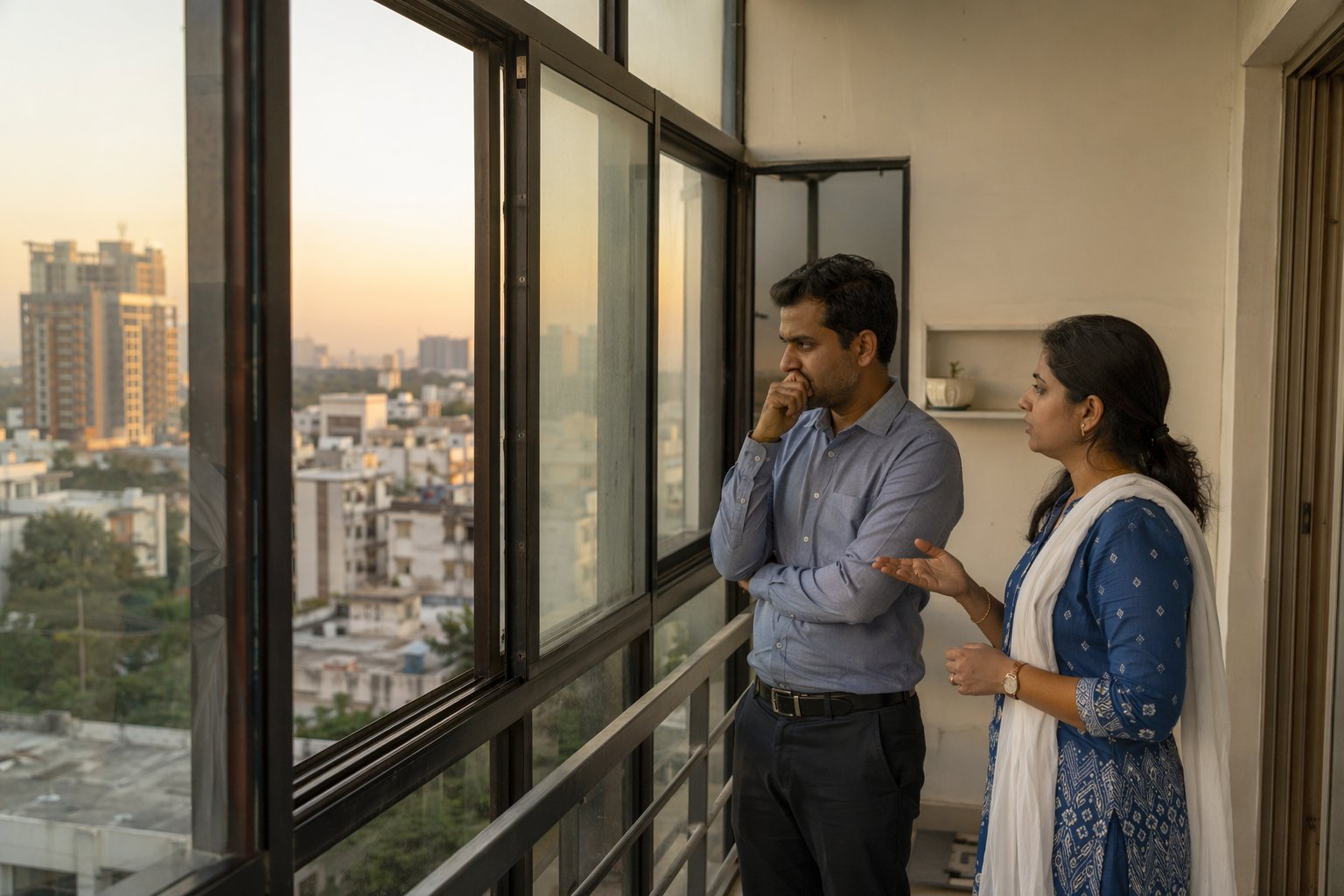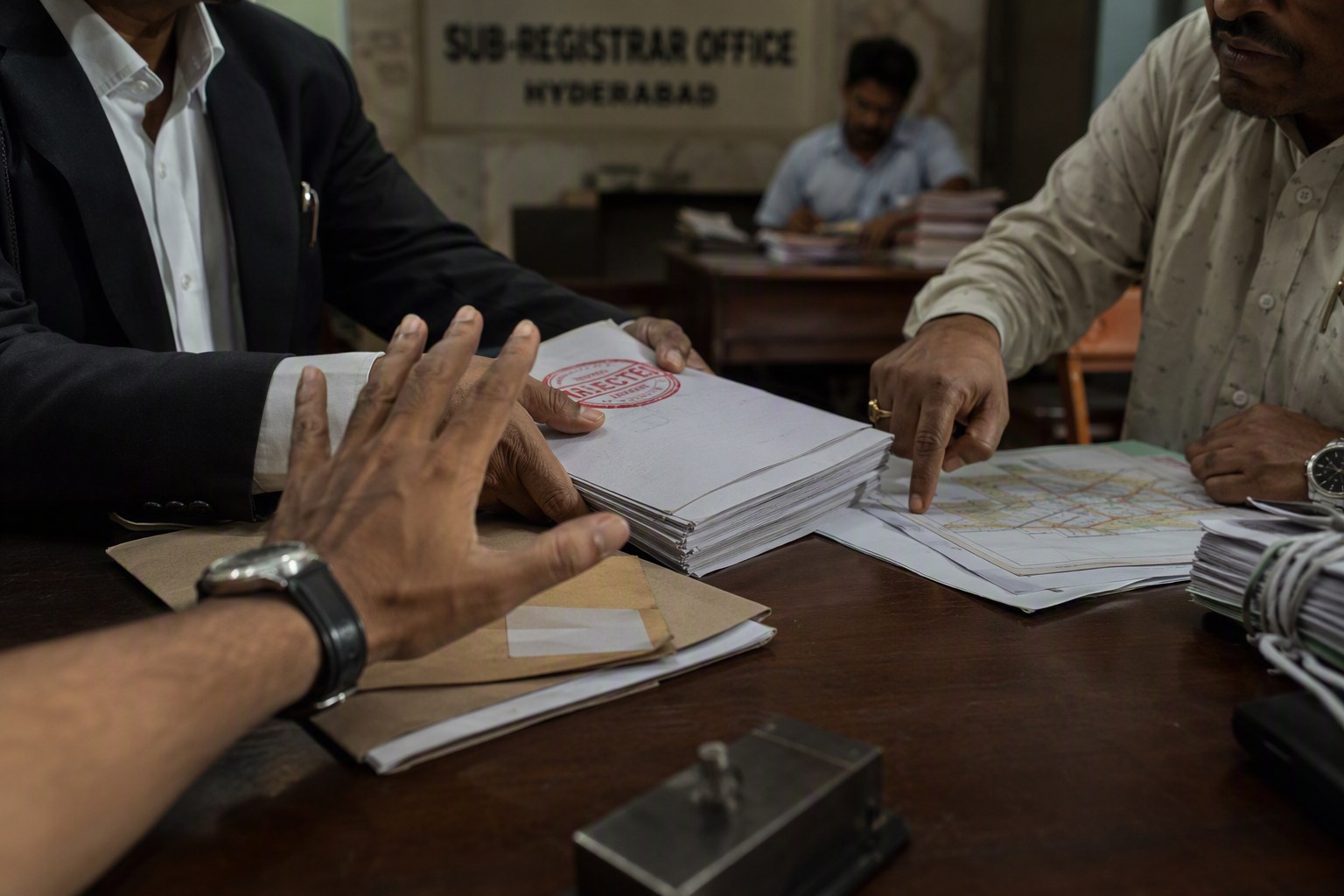
A court stay at registration can stop a Telangana property deal at the very last counter, even after token advance, loan sanction and document drafting. We saw this happen to a Hyderabad buyer who reached the SRO with the seller, challans and witnesses ready. The sale deed was prepared. The buyer had already paid a token amount. Then the sub-registrar’s office flagged a court stay linked to the property. Registration could not go ahead.
This is not a rare fear story told by cautious lawyers. It is the kind of issue that appears when buyers check only the Encumbrance Certificate and skip litigation verification, Section 22-A checks, survey number history and local SRO enquiries. In Telangana, where land records move across dharani, old revenue files, pahani extracts, court orders and SRO data, one missing check can freeze the whole transaction.
My view is simple: litigation checks must happen before token payment, not after the agreement is emotionally locked.
Court stay at registration: what actually happened
The buyer, whom I will call Rakesh, was purchasing an open plot on the western side of Hyderabad. The locality was attractive, road access was decent, and the seller had a neat folder: link documents, latest EC, tax receipt, draft sale deed and identity proofs. The plot was marketed as clear title property.
Rakesh did what many careful buyers do. He asked for an EC. He checked whether the seller’s name appeared in the link chain. He compared the survey number in the sale deed. He also checked the government market value through the local registration data before planning stamp duty. On paper, nothing looked alarming.
At the SRO, the problem surfaced. A stay order connected to the property was found. The registration could not be completed because the dispute had reached a stage where the office would not process the sale. The seller said it was an old family matter and would be cleared soon. Rakesh was not convinced. His token amount was already stuck, and the bank processing had also started.
This is where many buyers realise the gap between “documents available” and “title safe”. A property can have papers and still carry litigation risk. A property can have an EC and still have a pending civil dispute. A property can have market demand in areas like Tellapur, Mokila, Narsingi, Bachupally, Adibatla or Shamshabad, but demand does not cure defective title.
Why a court stay at registration is different from a normal document mismatch
A document mismatch is usually a correction problem. Maybe the boundaries are typed differently, the house number is old, or the father’s name has a spelling variation. These issues may delay registration, but many are curable if the parties have supporting records.
A court stay is a different matter. It is a legal restriction. It may arise from a partition suit, injunction petition, title declaration case, land acquisition dispute, government claim, bank recovery matter, Wakf or endowment claim, or a family settlement that has gone wrong. Once a court has passed an order restraining sale, transfer or alienation, the buyer cannot treat it as a small paperwork error.
In Hyderabad and surrounding mandals, many properties have layered histories. A plot in Serilingampally mandal may have passed through layout development, old panchayat permissions and later municipal records. Land near Gandipet mandal may involve older agricultural survey numbers converted into plotted layouts. In Shankarpally mandal, buyers often see sales through GPA routes and old link chains. In Ibrahimpatnam and Maheshwaram sides, conversion, layout status and revenue history need careful reading.
The SRO is not your personal title lawyer. The sub-registrar mainly checks whether the document can be registered under the law and whether any notified restriction applies. If a court stay or a prohibited entry is in the system or officially communicated, registration can stop. But if litigation exists elsewhere and has not reached the registration record, the SRO may not automatically warn you. That is why buyer-side checking matters.
Court stay at registration and the Telangana Section 22-A problem
One reason Telangana buyers must be extra alert is the scale of prohibited property records. As per latest IGRS data, there are 3,076,153 prohibited properties under Section 22-A. This figure should make every buyer pause before paying token money.
Section 22-A entries can cover different categories of restricted properties, including government lands, assigned lands, endowment lands, Wakf-related properties and other notified categories. A property appearing in a prohibited list may not be registrable, even if someone is physically in possession and even if an old sale deed exists.
For a buyer, the danger is not only losing the deal. The bigger danger is paying token advance for a property that cannot legally move in your name. Once money is paid, the conversation changes. Before payment, the seller explains. After payment, the buyer requests.
Before you commit, use the Section 22-A Prohibited Property Check and match the survey number, village, mandal and SRO jurisdiction. Do not check only the locality name. Local marketing names are often different from revenue village names. A “Kollur plot” may fall under a specific village and mandal combination. A “Mokila venture” may have survey numbers that need separate verification. A “near ORR” property is not a legal description.
Why EC alone may not reveal a court stay at registration risk
The Encumbrance Certificate is useful, but it is not a full title guarantee. It usually reflects registered transactions and certain registered encumbrances. It may show sale deeds, mortgages, gift deeds, release deeds and registered agreements if they were registered. But every court case does not automatically appear in the EC.
A pending civil suit may not show in the EC unless a related registered notice, attachment, order or entry is recorded in the registration chain. A family member may have filed a suit seeking partition. A previous owner may have challenged a sale. A bank may have a charge that is not visible in the normal EC search if not properly checked through other systems. A revenue dispute may be pending even if registration documents look clean.
Use the Encumbrance Certificate Search as your starting point, not your final comfort. Then run the document through the EC Analyzer to spot missing years, unusual transactions, repeated transfers, GPA patterns or mortgage traces. If the deal involves a flat, check the project through the RERA Project Lookup. For land or plotted property, survey number-level checks are non-negotiable.
What should be checked before token payment
In our experience, the safest time to verify a property is when the seller is still trying to convince you. Once token payment is made, even a small doubt becomes a negotiation headache. For Hyderabad buyers, I suggest a strict pre-token checklist.
Check the survey number, not only the plot number
Plot numbers are created by layouts and developers. Survey numbers come from revenue records. When litigation or 22-A restrictions arise, they usually attach to survey numbers, sub-divisions, village names and mandal records. Use the Survey Number Finder to connect the marketed property with the underlying revenue identity.
Check the correct SRO jurisdiction
Many buyers assume the nearest registration office is the correct one. That may not be true. Jurisdiction depends on the village and SRO mapping. Before paying token, identify the proper office using the Find Your SRO Office. If the seller is pushing you to register at a particular office without clarity, ask why.
Check market value and stamp duty planning
Government market value is not the same as private market price. Still, it affects registration value and stamp duty calculation. Use the Market Value / Guideline Value Search and then estimate registration costs through the Stamp Duty Calculator. This does not prove title, but it helps you avoid last-minute confusion at registration.
Check land classification and layout risk
If you are buying land in mandals like Shankarpally, Moinabad, Kandukur, Maheshwaram, Ibrahimpatnam, Medchal, Ghatkesar or Shamshabad, confirm land use and layout status. A plot may be sold as residential, but the land classification may require separate scrutiny. Use the Land Use Zone Finder and, where construction potential matters, the FSI/FAR Calculator.
Check bank and charge-related issues
A clean-looking seller may still have borrowed against the property. EC may show a registered mortgage, but buyers should not stop there. For financed property, check possible security interest through the CERSAI Charge Check. If a seller says the loan is closed, ask for bank closure letter, release deed where applicable and updated EC.
Court stay at registration: red flags buyers ignore
Rakesh later admitted that a few signals were visible, but he brushed them aside because the price and location were attractive. We have seen the same pattern across Hyderabad’s growth corridors.
- Seller says “case is there but no problem”. If there is a case, understand it before money moves.
- Only photocopies are shown. Original link documents matter, especially for land and old houses.
- Survey number keeps changing in conversations. This is common in plotted layouts carved from larger land parcels.
- Seller discourages independent lawyer review. A genuine seller may be impatient, but should not fear verification.
- Token demand is urgent. “Pay tonight or someone else will take it” is a classic pressure tactic.
- Family members are not aligned. If siblings, legal heirs or GPA holders are involved, check authority and consent.
- Possession and title are confused. Physical possession does not always mean legal ownership.
In local language, many sellers say “pahani lo peru undi” or “dharani lo clear undi”. That is useful, but not enough. Pahani, dharani, EC, old sale deeds, court search, SRO check and local enquiry together create a safer picture.
What a buyer should ask the seller before paying token
Do not feel shy to ask direct questions. A property purchase is not a social favour. It is a legal transfer. Before token payment, ask these questions in writing, even through email or WhatsApp, so there is a record.
| Question to ask | Why it matters |
|---|---|
| Is there any pending court case, notice, stay, injunction or family dispute? | The seller’s written answer helps if facts are later suppressed. |
| Is the property covered under any Section 22-A or government restriction? | Prohibited properties cannot be casually regularised by private agreement. |
| Are all legal heirs and co-owners ready to sign? | One missing claimant can create future litigation. |
| Is any loan, mortgage or private borrowing linked to the property? | Charges must be cleared before sale or through a controlled closing process. |
| Can the seller share complete link documents and revenue records? | Incomplete chains are a common source of title risk. |
| Which village, mandal and SRO does the property fall under? | Verification depends on exact administrative identity, not marketing name. |
After these answers, run the property through the Property Verification Tool. If you are still tracking a property over time before final payment, use the Property Change Tracker to watch for changes in records that may affect your decision.
Why token agreements must mention litigation clearly
Many buyers pay token money based on a one-page receipt. It says amount received, balance payable and proposed registration date. That is weak protection. If a court stay appears later, the buyer may struggle to recover money quickly unless the receipt clearly states refund terms.
A proper token or advance agreement should say that the transaction is subject to clear title verification, no litigation, no court stay, no 22-A restriction, no undisclosed mortgage and successful registration. It should also state that if any legal defect is found, the seller must refund the money within an agreed time. Avoid vague lines like “documents subject to satisfaction”. Write the specific conditions.
For drafting safer clauses, buyers can use the Legal Document Generator as a starting point, but for disputed or high-value property, take advice from a property lawyer who understands Telangana land records and local registration practice.
How court stay checks work in practice
A buyer-side legal check usually goes beyond one website search. The lawyer may examine the link documents, EC, revenue records, dharani status where applicable, mutation history, layout approvals, municipal records, tax receipts, identity of legal heirs, GPA validity and court databases. Local enquiry also matters, especially for land parcels where family disputes are common.
For example, in older parts of Hyderabad, houses may have inheritance issues. In fast-growing mandals like Gandipet, Shankarpally and Maheshwaram, land parcels may have past agreements or developer disputes. Around Ghatkesar, Medchal and Keesara, some properties require careful checking of layout permissions, survey boundaries and conversion records. In Adibatla and Ibrahimpatnam side, buyers must pay attention to revenue classification and old assignment history.
No single check is perfect. But multiple checks reduce surprise. The aim is not to become paranoid. The aim is to avoid reaching the registration table and hearing, “Sir, registration cannot proceed.”
What Rakesh should have done differently
If Rakesh had paused before paying token, he could have saved stress. The right sequence would have been: collect document copies, identify survey number and SRO, check EC, check Section 22-A, verify market value, run a litigation search, ask written seller declarations, get lawyer review, then pay a small conditional token.
He also should have avoided paying a large advance before the seller produced a no-litigation declaration. If the seller genuinely believed the old case had no effect, he should have been willing to share case details and order copies. Silence is not clarity.
In Hyderabad real estate, speed helps in a good deal, but blind speed hurts. A seller who gives you one day to decide on a plot may not give you one week to recover your money later.
Final view on court stay at registration
A court stay at registration is not just a last-minute inconvenience. It is a warning that the property’s legal history was not fully checked before money moved. Telangana buyers must treat litigation verification as a pre-token step, along with EC, 22-A, SRO, survey number and revenue checks.
We have seen buyers spend serious time comparing localities like Tellapur versus Narsingi, Mokila versus Kollur, Bachupally versus Miyapur, or Adibatla versus Tukkuguda. That comparison is useful, but title safety comes first. A slightly less glamorous property with clear title is better than a hot-location property that cannot be registered.
Before you sign, pay or book the SRO slot, verify. The registration counter should be the final formality, not the first place where the truth comes out.
Frequently Asked Questions
Can an EC show a court stay on a Telangana property?
Sometimes, but not always. EC mainly reflects registered transactions and certain recorded encumbrances. A pending court case may not appear unless the order or related entry is recorded in the registration system. Buyers should do a separate litigation check.
Should I pay token before checking Section 22-A status?
No. Section 22-A check should happen before token payment. As per latest IGRS data, Telangana has 3,076,153 prohibited properties, so buyers must confirm that the survey number and village are not restricted.
What should I do if a court stay is found at registration?
Do not proceed casually. Ask for the court order, case number, parties involved and current status. Speak to a property lawyer. If your token agreement has a clear refund clause for title defects, invoke it in writing.
Is the SRO responsible for confirming clear title?
No. The SRO checks registrability and statutory restrictions, but it is not a full title verification agency for the buyer. Clear title must be checked independently through documents, EC, revenue records, court search and legal review.