Family Settlement Deeds and the Telangana 22-A Surprise: why a family document can still get blocked
Telangana has 30,76,153 prohibited-property entries under Section 22-A as per latest IGRS data. That single number explains why family settlement deeds and the Telangana 22-A surprise are becoming a regular headache at SRO offices. Many families assume that because a settlement deed is not a sale deed, registration should be straightforward. In practice, if the land parcel, survey number, flat-linked land, or house property is flagged under Section 22-A, the Sub-Registrar can refuse or keep the document pending, even when no sale consideration is involved.
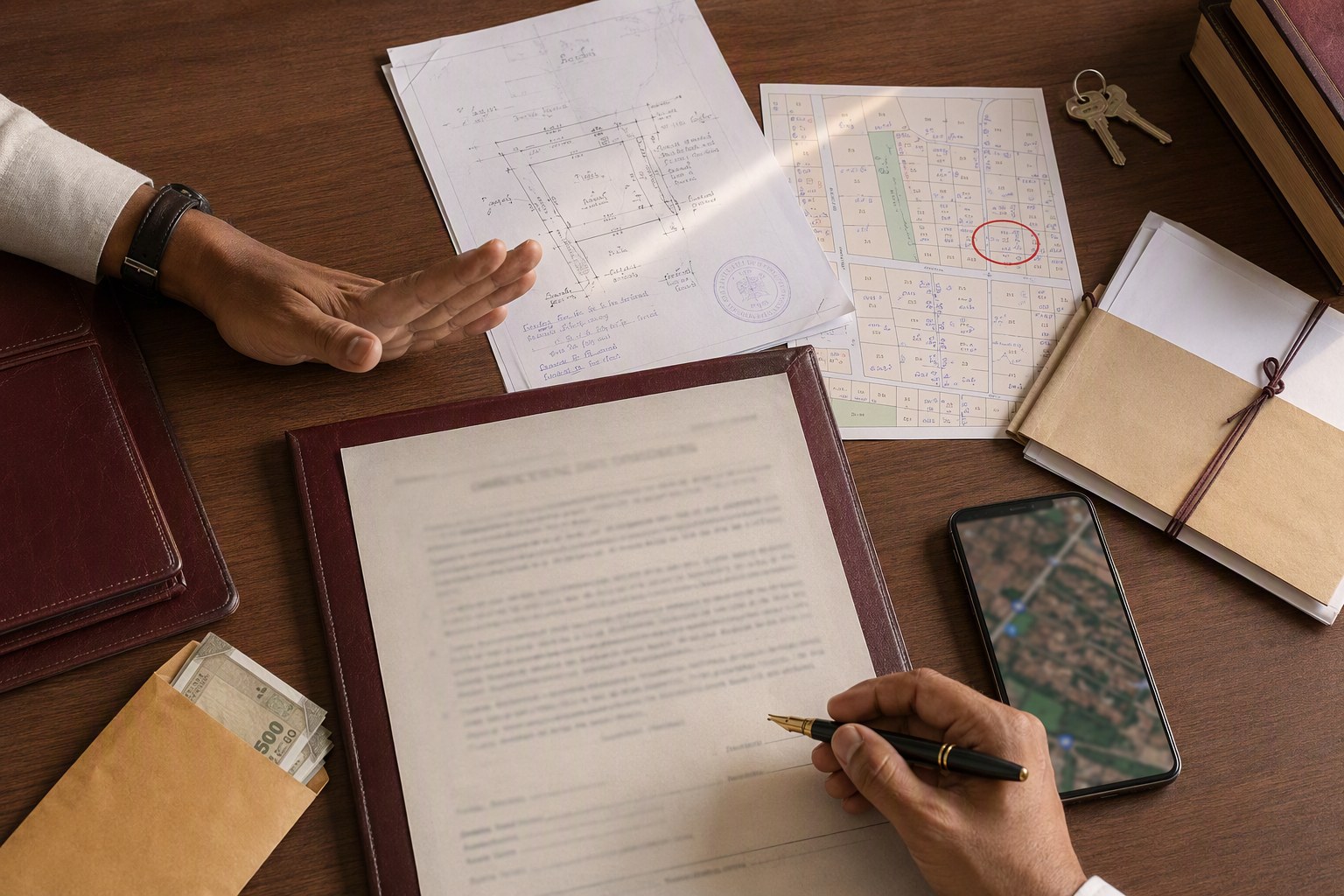
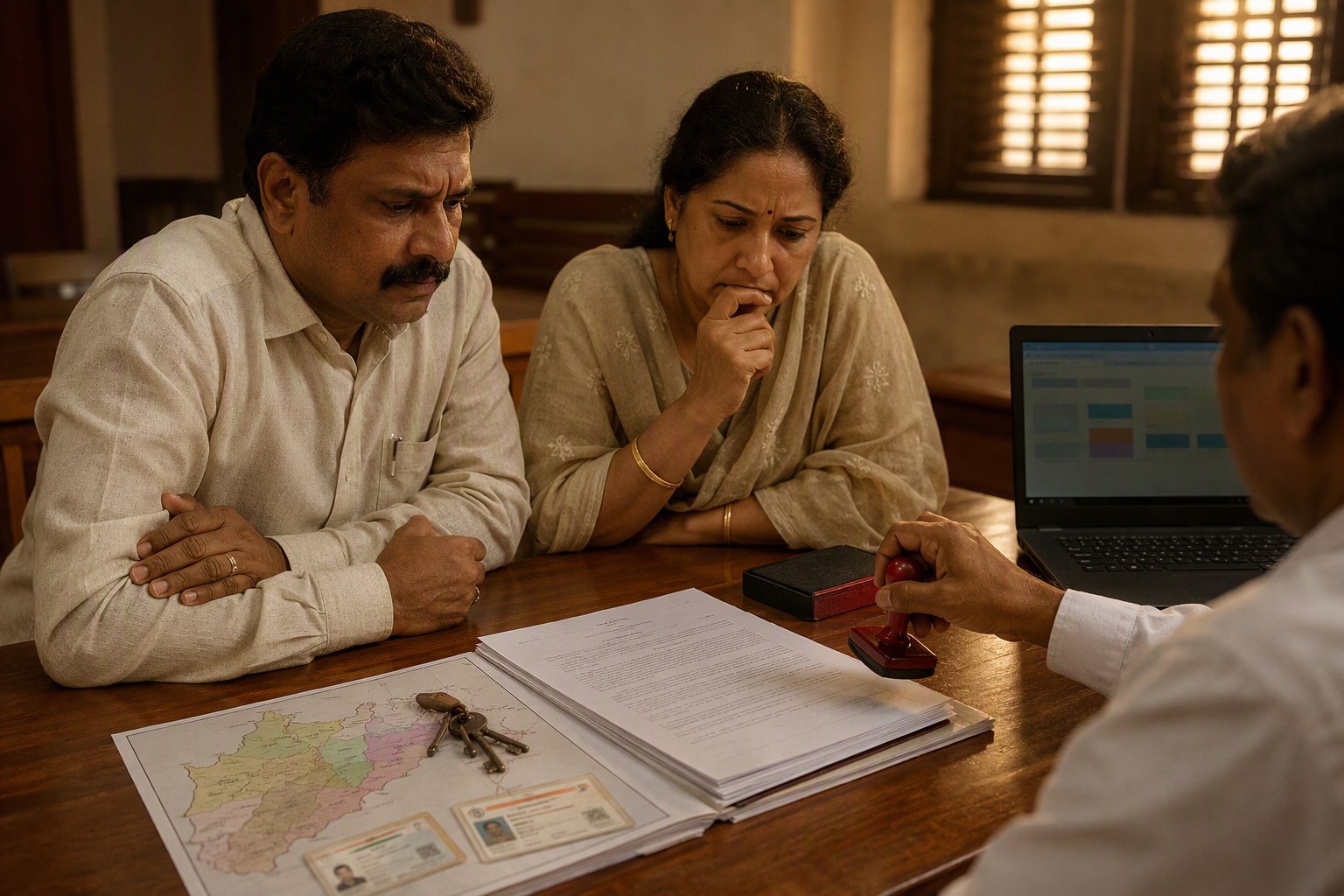
We’ve seen this play out in Hyderabad’s older family-owned pockets as well as in fast-changing outskirts. A father wants to settle a plot in Hayathnagar mandal in favour of his children. Brothers want to partition and settle ancestral land near Shankarpally. A family wants to transfer a house in Uppal or a small open plot near Medchal. The deed is emotionally settled at home, stamp papers are arranged, witnesses are ready, but the SRO system throws up a 22-A flag. That is the surprise.
This article explains why that happens, what checks a family should do before drafting the settlement deed, and how to reduce the risk of a registration-day shock.
Family Settlement Deeds and the Telangana 22-A Surprise: the short answer
A family settlement deed is a legal document used to settle property rights among family members. It may be used between parents and children, among siblings, or among legal heirs. It is generally treated differently from an outright sale because it is based on family arrangement, natural love and affection, inheritance understanding, or internal settlement.
But Section 22-A is not looking only at the type of document. It is mainly looking at the property. If the property is in a prohibited list, the registration system may stop the document, whether it is a sale deed, gift deed, partition deed, release deed, or family settlement deed.
Plain English answer: A non-sale deed can still face registration refusal if the property itself is treated as prohibited under Section 22-A.
Before paying drafting fees or fixing a registration slot, families should check the property through the Section 22-A Prohibited Property Check, verify past transactions through the Encumbrance Certificate Search, and confirm the right SRO using the Find Your SRO Office.
What is a family settlement deed in Telangana?
In Telangana property practice, families use settlement deeds for many reasons. A parent may want to avoid future disputes between children. Legal heirs may want to record who will hold which share. Siblings may want to settle possession based on long-standing family understanding. Sometimes, a family settlement deed is used after a court case or after a death in the family, when mutation and title records need clarity.
The property may be a house in Secunderabad, a flat in Miyapur, a plot in Peerzadiguda, agricultural land in Moinabad mandal, or inherited land in Maheshwaram mandal. The document may say there is no monetary consideration. It may record that the transfer is within the family. All that helps explain the nature of the deed.
Still, the Sub-Registrar’s office will check whether the property can legally be registered. That is where Section 22-A enters the discussion.
What is Section 22-A and why does it affect family settlement deeds?
Section 22-A is used to prohibit registration of certain categories of properties. The idea is to prevent registration of documents involving lands or properties that the government considers restricted, disputed by category, assigned, protected, or otherwise barred from private transfer. The exact reason depends on the classification and the record attached to that property.
For an ordinary family, the difficult part is that the 22-A issue may not be visible in the old family papers. Your grandfather’s sale deed may look clean. Your pahani may show a family member’s name. Property tax may be paid for many years. Still, if the survey number or property is tagged in the prohibited list, the SRO may not proceed with registration.
In our experience, families get caught because they check only ownership papers, not registration eligibility. Title and registrability are connected, but they are not the same thing.
The 30,76,153 entry problem: why families must check before drafting
The database count of 30,76,153 prohibited-property entries is not a small clerical matter. It shows the scale at which Telangana’s registration system is dealing with restricted property records. Some entries may relate to agricultural survey numbers. Some may relate to government land classifications. Some may overlap with village-level revenue records, assigned land histories, endowment claims, wakf-related issues, ceiling matters, or other prohibited categories.
For a family settlement deed, the risk is simple: if the property is mapped to such an entry, the SRO may say the document cannot be registered unless the prohibition is removed, clarified, or found inapplicable by the competent authority.
This matters in localities where land has changed character over the years. Hyderabad and its surroundings have many such pockets: Gachibowli, Manikonda, Narsingi, Kokapet, Puppalaguda, Tellapur, Ameenpur, Bachupally, Kompally, Patancheru, Adibatla, Shamshabad, Tukkuguda, Hayathnagar, Ghatkesar, Medchal, and Shankarpally. Some started as village lands and later became plotted layouts, apartment clusters, or mixed-use corridors. Old survey numbers still sit behind modern addresses.
So when a family says, “This is only a settlement within our family,” the SRO system may still respond, “This property has a restriction.”
Family Settlement Deeds and the Telangana 22-A Surprise at the SRO counter
At the SRO, the process is not based only on what is written in the deed. The office checks the property details against registration and prohibition records. If the document mentions a survey number, door number, plot number, flat number, village, mandal, and extent, those details can trigger system-level checks.
A common problem is mismatch. The family may describe the property using an old village name, while the current SRO mapping uses a different jurisdiction. Or the deed may mention a survey number that includes both private patta land and prohibited land in the same village. In apartment cases, the flat looks clean, but the underlying land history needs attention.
That is why we advise families to run three checks before registration day:
- 22-A status: Check whether the property or survey number appears in the prohibited list using the Section 22-A Prohibited Property Check.
- EC trail: Review previous registered transactions using the Encumbrance Certificate Search or the EC Analyzer.
- SRO mapping: Confirm the correct registration office through the Find Your SRO Office or SRO Village Directory.
Where the confusion usually starts
Most family settlement deed problems begin with one of these assumptions:
- “There is no sale consideration, so the SRO cannot object.”
- “The property tax receipt is in our name, so title is clear.”
- “The pahani has our family name, so registration will happen.”
- “My neighbour registered last year, so our document will also pass.”
- “The apartment is in a gated community, so land history is not an issue.”
These assumptions are risky. Property tax does not remove a 22-A prohibition. A pahani entry does not always settle transferability. A past transaction may not protect a fresh deed if the property is now flagged. Even in urbanised pockets, old land classification can affect present documents.
For example, a family with land near Gandipet or Narsingi may hold old documents and revenue entries. But if part of the survey number has a restriction, the settlement deed may run into trouble. In places like Ameenpur, Bachupally, and Patancheru, plotted developments and apartment projects often trace back to survey-level land records. In eastern corridors like Ghatkesar, Pocharam, and Hayathnagar, village and mandal records still matter even when the locality looks fully urban.
Documents families should check before a settlement deed
A settlement deed should not be drafted only from the latest tax receipt or an old photocopy. Families should create a proper document file. It saves time and avoids disputes later.
| Check | Why it matters | Useful tool |
|---|---|---|
| Section 22-A status | Shows whether the property may face registration prohibition | Section 22-A Prohibited Property Check |
| Survey number confirmation | Helps match old revenue records with current property description | Survey Number Finder |
| Encumbrance history | Shows registered transactions, mortgages, releases, and prior transfers | Encumbrance Certificate Search |
| Market value reference | Helps understand guideline value for stamp duty and registration planning | Market Value / Guideline Value Search |
| Stamp duty estimate | Helps plan registration costs before visiting the SRO | Stamp Duty Calculator |
For land parcels, I would also check Dharani details, pahani/adangal records where relevant, mutation history, layout approval papers, old link documents, and any court orders or family arrangements. For flats, check the mother deed, development agreement, link documents, occupancy-related papers where available, society records, and the EC for the flat as well as the underlying land if practical.
Family Settlement Deeds and the Telangana 22-A Surprise in agricultural land
Agricultural land needs extra care. In mandals like Moinabad, Shankarpally, Chevella, Yacharam, Kandukur, Maheshwaram, Medchal, and Ghatkesar, family lands may have long histories. Names may have changed through inheritance, informal possession, oral partitions, or old pahanis. The family may treat the land as ancestral, but the registration office checks present legal eligibility.
Some agricultural lands may be affected by assignment conditions, government classification, ceiling history, endowment claims, or other restrictions. If such a flag exists, a family settlement deed may not be accepted simply because it is among blood relatives.
My practical view is this: before preparing a family settlement deed for agricultural land, first settle the land identity. Confirm village, mandal, survey number, sub-division, extent, pattadar details, possession details, and whether the land is in Dharani. Then check the 22-A status. Only after that should the family decide the deed structure.
Family Settlement Deeds and the Telangana 22-A Surprise in flats and houses
Many apartment owners think Section 22-A applies only to open agricultural lands. That is not always safe thinking. A flat is built on land. If the underlying land has a problematic history, it may affect future registrations or at least raise questions during verification.
This is relevant in rapidly developed areas like Kondapur, Hafeezpet, Miyapur, Nizampet, Manikonda, Puppalaguda, Tellapur, Osman Nagar, Kollur, and Bachupally. Families may own flats in these areas and later execute settlement deeds among parents, children, or spouses. Usually, apartment registrations are routine when the project’s land title and approvals are clean. But where land records are unclear, or if a survey number is flagged, the family should not assume the flat settlement will sail through.
For houses in older colonies such as Himayatnagar, Malakpet, Amberpet, Malkajgiri, Kukatpally, Vanasthalipuram, and Uppal, the risk may come from link documents, old layouts, municipal changes, or property description mismatches. Section 22-A may not be the only issue, but it is one check that should not be skipped.
What happens if the SRO refuses registration?
If the SRO refuses or keeps the family settlement deed pending because of a 22-A flag, do not rush into a fresh deed with changed wording. That can create a bigger problem. First understand the exact reason. Ask what category of prohibition is being reflected and what property details are triggering it.
The family may need to approach the relevant revenue authority, department, or competent office for clarification or deletion if the entry is incorrect. In some cases, legal advice may be required. In some cases, the restriction may be valid, and the family has to accept that registration cannot proceed unless the law permits removal or correction.
Keep copies of the refusal memo or objection details, the draft deed, title documents, EC, Dharani or revenue extracts, tax receipts, and identity documents. A clean paper trail helps when approaching authorities or lawyers.
Stamp duty, market value and why 22-A still comes first
Families often start by asking, “How much stamp duty will be payable for a family settlement deed?” That is a fair question, but it should come after the 22-A check. If the property is prohibited, calculating duty alone will not solve the registration problem.
Use the Market Value / Guideline Value Search to understand the ready reckoner value used for registration purposes, and then use the Stamp Duty Calculator for planning. But before both, check whether the property is registrable. For larger family assets, the Property Verification Tool can help organise the verification approach.
For families dividing multiple properties, I suggest preparing a property-wise table: locality, village, mandal, survey number or flat number, present title holder, EC status, 22-A status, SRO, and pending issues. This makes family discussions more practical and reduces emotional arguments.
Practical checklist before signing a family settlement deed
- Confirm the correct names of all family members as per Aadhaar, PAN, old deeds, and revenue records.
- Match the property description across link documents, EC, tax records, pahani, Dharani entries, and layout or building papers.
- Run a Section 22-A check before finalising the deed.
- Confirm the correct SRO and village mapping.
- Check whether any loan, mortgage, court case, attachment, or family dispute exists.
- Do not hide any known restriction from other family members.
- Use clear schedules for land extent, boundaries, flat number, undivided share, and appurtenant rights.
- Take legal advice where the property is ancestral, disputed, partly sold, or inherited without clear mutation.
A family settlement deed is meant to reduce conflict. Poor verification can do the opposite. One 22-A objection at the SRO can reopen old family tensions, especially where siblings have already agreed on shares.
Our view: treat 22-A as a first-page check, not a last-minute formality
In Telangana, property verification has changed. Earlier, many families focused on link documents and EC. Those are still essential. But with a prohibited-property database of 30,76,153 entries, Section 22-A has to be checked at the beginning.
This is not about fearing every property. Many family settlement deeds register without trouble. But where the property has old revenue history, survey-number confusion, assigned land background, layout irregularity, or unclear title flow, a 22-A check is basic due diligence.
My advice is simple: before the family sits with a document writer, sit with the property papers. Check the survey number. Check the EC. Check the SRO. Check the 22-A status. Then draft the deed. That order saves money, time, and family peace.
Frequently Asked Questions
Can a family settlement deed be refused under Section 22-A in Telangana?
Yes. Even if the deed is between family members and has no sale consideration, the SRO can refuse registration if the property is flagged as prohibited under Section 22-A.
Does a pahani entry in my family name remove a 22-A restriction?
Not by itself. A pahani entry is useful revenue evidence, but registration eligibility depends on the property’s legal status and whether any prohibition applies.
Should I check Section 22-A before calculating stamp duty?
Yes. Stamp duty planning is useful only if the property is registrable. First check 22-A status, then verify EC, SRO jurisdiction, market value, and duty.
Can flats also face 22-A-related issues?
They can, especially if the underlying land has a restriction or unclear land history. Flat owners should check title flow, EC, and land background before executing a settlement deed.
What should I do if my settlement deed is stopped at the SRO?
Ask for the exact reason, collect objection or refusal details, check the property records, and approach the relevant authority or a property lawyer. Do not simply redraft the deed without understanding the 22-A issue.