

Modular Kitchen Remodel: What approvals should you check before starting work?
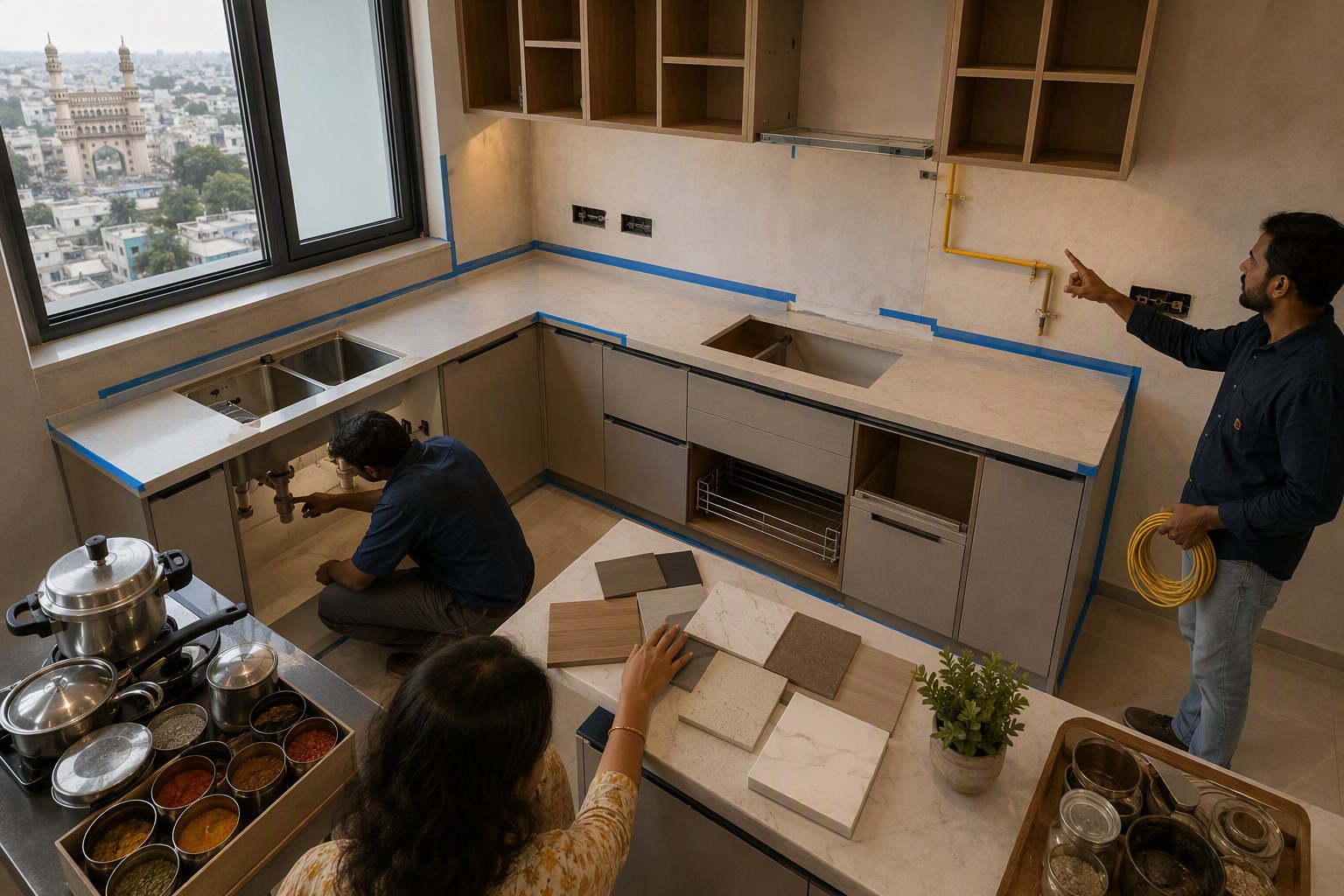
Modular Kitchen Remodel work looks like an interiors job, but in Hyderabad apartments it can quickly touch plumbing lines, gas safety, electrical load, society rules, builder warranties and even property documents. The short answer is this: if you are only changing shutters, baskets, countertop and appliances inside the same kitchen footprint, formal government approval is usually not the issue. But if you are shifting sink points, breaking walls, changing ducts, enclosing utility space, altering gas lines, or doing work in a newly handed-over RERA project, you should check society approval, builder NOC, safety clearance and your property papers before paying the interior vendor.
We have seen owners in Gachibowli, Kondapur, Narsingi, Manikonda and Kokapet spend heavily on a kitchen design first, then discover that the society will not allow core cutting, utility enclosure or wet-area changes. That is painful because modular kitchen vendors will happily take advance based on design, while the apartment association may stop work at the service lift itself.
My practical view: a modular kitchen is not just carpentry. In Telangana flats, it is a small civil, electrical, plumbing and compliance project sitting inside your sale deed and society bye-laws.
Modular Kitchen Remodel approval checklist for Hyderabad flats
Before you finalise laminates and quartz shades, run through this approval checklist. It is especially useful for flats in large gated communities in Serilingampally mandal, Gandipet mandal, Rajendranagar mandal, Kukatpally, Miyapur, Tellapur and Shamshabad side projects.
| Kitchen change | Approval or check needed | Why it matters |
|---|---|---|
| Replacing cabinets, shutters, hardware, baskets | Usually society work-intimation only | Low-risk work, but noise and labour entry rules apply |
| Changing countertop or backsplash | Society permission for debris movement | Granite/quartz cutting, lift protection and waste disposal are controlled in many communities |
| Shifting sink or water inlet | Society and plumber check | Leakage may affect the flat below and common shafts |
| Moving gas hob or changing gas pipeline | Gas agency or authorised technician check | Wrong routing can create fire and insurance issues |
| Breaking wall between kitchen and dining | Builder/structural confirmation and society NOC | Load-bearing wall, beam, duct or fire separation may be affected |
| Core cutting for chimney duct | Society, builder or facility team approval | External elevation, shaft safety and waterproofing may be impacted |
| Enclosing utility balcony | Society approval and sanction-plan check | May alter elevation, ventilation and common façade rules |
| Adding high-load appliances | Electrical load check with facility team | Trip issues, overheating and MCB capacity need review |
Modular Kitchen Remodel in a new project: check builder rules first
If your flat is newly handed over in areas like Financial District, Nanakramguda, Tellapur, Kollur, Mokila, Bachupally or Kompally, the first call should be to the builder’s handover or facility team. Many projects have a defect-liability period. If you allow your carpenter to drill randomly into a plumbing wall or remove tiles in the kitchen, the builder may refuse future leakage complaints.
Ask the builder or facility office for the interior work manual. Most large communities have written rules on working hours, lift padding, debris removal, worker IDs, fire safety, drilling locations, wet-area changes and refundable deposits. Some associations in premium towers are stricter about chimney outlets and utility enclosures because one owner’s change can spoil the full elevation.
If the project is still under registration or you are buying directly from a developer, use the RERA Project Lookup before paying for big interiors. A kitchen remodel may not need RERA approval from your side, but project status, promised amenities, sanctioned layout details and handover terms matter. In our experience, owners who read the builder agreement and RERA details early avoid arguments later.
Society NOC: the most common Modular Kitchen Remodel approval
For most apartment owners, the main permission is not from GHMC or HMDA. It is from the apartment owners association, ad-hoc committee, facility manager or builder maintenance team. In Hyderabad gated communities, this NOC is practical and enforceable. Without it, security may not allow labour entry, material unloading or lift usage.
What societies usually ask for
- Flat number, owner name and contact details
- Scope of work: carpentry, plumbing, electrical, civil breaking, tile removal
- Vendor details and worker ID proofs
- Work schedule and expected completion date
- Refundable damage deposit, if applicable
- Debris disposal plan
- Undertaking for damage to lift, corridor, shaft or neighbouring flats
In older apartments in Ameerpet, Himayatnagar, Begumpet, Tarnaka and Dilsukhnagar, the rules may be less formal, but do not assume anything. One leakage complaint from the flat below can become a long-running WhatsApp group fight. Take written approval, even if it is a simple email or signed note.
Wall removal and kitchen extension: do not treat it as normal interiors
The risky part of a remodel starts when the kitchen footprint changes. Many owners want an open kitchen, breakfast counter or extended utility. That is where approvals become serious.
Never allow a contractor to break a wall without checking whether it is load-bearing, whether a beam runs through it, whether electrical conduits are embedded, and whether the wall separates a wet area or service duct. In high-rise flats at Kokapet, Narsingi, Puppalaguda and Gachibowli, even small unauthorised changes can create structural and fire-safety concerns.
If your vendor says, “Sir, we do this in every flat,” ask for a structural confirmation from the builder or a qualified engineer. Verbal confidence is not approval. If the association asks for drawings, give them the kitchen plan before demolition, not after.
Plumbing, pahani and property documents: why legal checks still matter
You may wonder why pahani, dharani or SRO records are relevant when you are only doing a kitchen. For a flat already registered in your name, daily kitchen carpentry does not need land record verification. But if you are buying a resale flat and planning a remodel immediately after registration, document checks should happen before interior spending.
Telangana government records show 3,076,153 prohibited properties under Section 22-A. This number is a reminder that property status is not a casual matter. A flat may look ready for interiors, but land title, registration restrictions, mortgage entries or pending document issues can still affect ownership confidence.
Before committing a large interiors budget in a resale property, run the basic document checks:
- Use the Encumbrance Certificate Search to check transaction history.
- Use the EC Analyzer if you want help reading entries in the EC.
- Use the Section 22-A Prohibited Property Check where land status is relevant.
- Use the Find Your SRO Office if you need to identify the correct registration office.
- For land-linked checks in villa plots or independent houses, the Survey Number Finder can help you start with the right survey details.
In mandals like Gandipet, Serilingampally, Moinabad, Shankarpally, Maheshwaram and Shamshabad, land history can be layered. If you bought a villa or independent house and plan to remodel the kitchen by extending into open space, check the sale deed, sanctioned plan, layout approval and land records before civil work.
Kitchen remodel in independent houses and villas
Independent houses are different from flats. You have more freedom inside your own property, but you also carry more responsibility. In areas like Sainikpuri, Alwal, Nagole, LB Nagar, Manikonda, Bandlaguda Jagir and Shankarpally villa projects, owners often extend the kitchen, add a store room, shift the utility or build a service platform.
If the remodel changes built-up area, setbacks, drainage connection, external wall, window opening or roof slab, it may go beyond interiors. You should compare the proposed work with the sanctioned building plan. If there is doubt, speak to a licensed engineer or local municipal professional before construction. The FSI/FAR Calculator is useful for understanding whether extra built-up area may disturb the approved building calculation.
For villa layouts, also check community rules. Even if you own the plot, the villa association may control external elevation, exhaust ducts, service yards, compound wall changes and façade colour. We have seen disputes where the kitchen extension was technically inside the owner’s plot, but violated the gated community design code.
Electrical and gas safety checks before a Modular Kitchen Remodel
Modern kitchens are power-hungry. Chimney, hob ignition, oven, microwave, dishwasher, refrigerator, water purifier, instant geyser, mixer and under-cabinet lighting can all sit in a compact space. Do not rely on one old plug point and a multi-pin board.
Electrical checks
- Ask an electrician to check load capacity for oven, dishwasher and chimney.
- Use proper earthing for appliances with metal bodies.
- Keep sockets away from sink splash zones.
- Install separate MCBs where required by the electrician.
- Avoid hidden joints behind fixed cabinets.
- Mark wiring routes before drilling overhead cabinets.
Gas checks
- Do not shift gas lines through closed cabinets without inspection.
- Keep cylinder storage or piped gas access ventilated.
- Use authorised technicians for piped gas modifications.
- Do not place the hob directly below low-height cabinets.
- Keep chimney ducting cleanable and accessible.
Insurance claims can become messy if a fire or leakage is traced to unauthorised work. Even if no one asks for a formal certificate, keep vendor bills, electrician details and gas technician details safely.
Wet-area changes: the biggest source of neighbour disputes
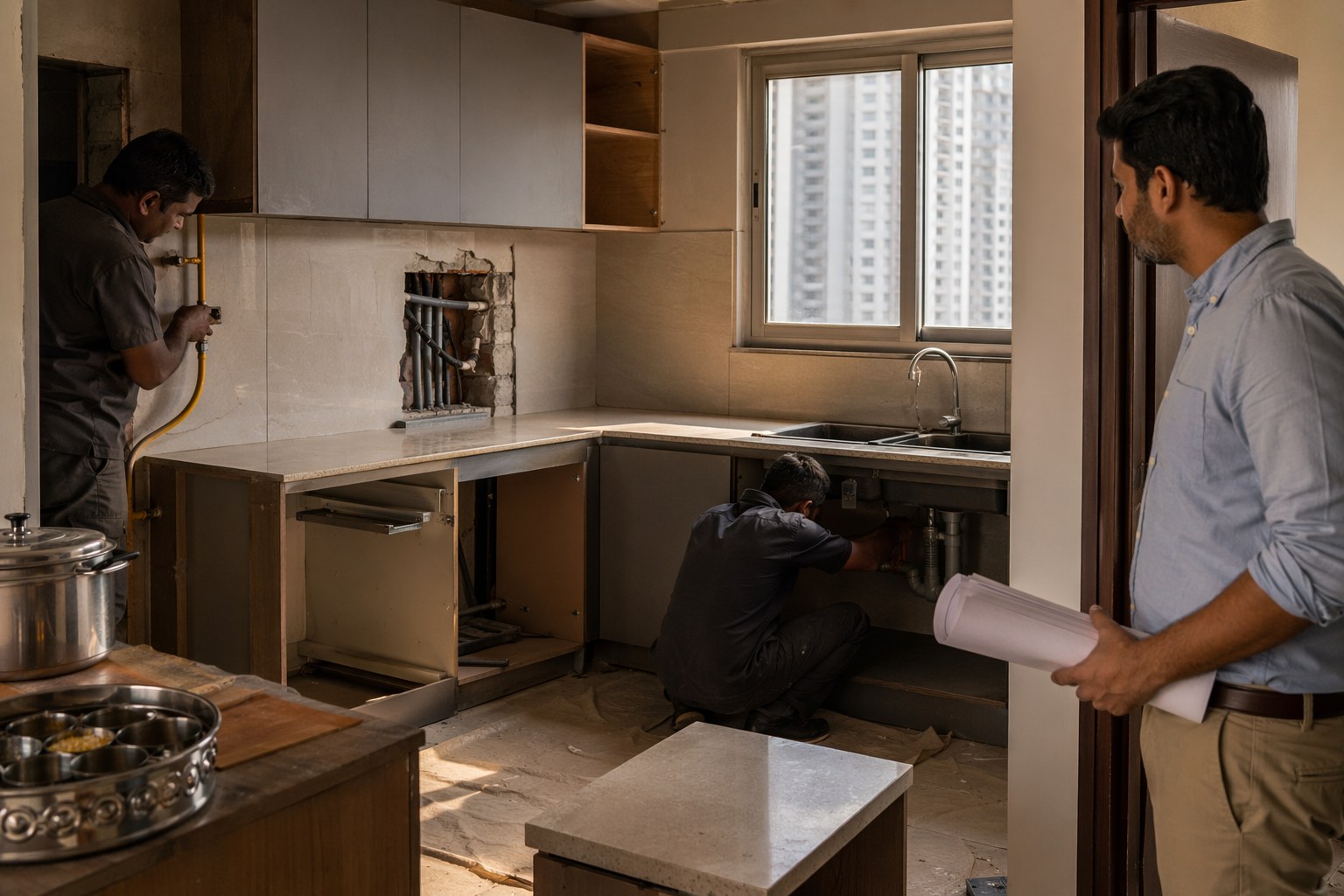
In apartments, kitchen plumbing is tied to vertical stacks and shafts. If you shift the sink, dishwasher drain or RO reject line badly, the neighbour below may face seepage. Waterproofing is not glamorous, but it is cheaper than repairing another person’s ceiling.
Ask these questions before finalising the design:
- Will the sink remain on the same plumbing wall?
- Is the dishwasher drain connected properly?
- Is the RO reject line going into the right drain?
- Will tile removal disturb waterproofing?
- Does the society allow new core cutting?
- Will access panels remain for valves and traps?
A good interior designer will discuss these points before showing 3D renders. If the designer only talks about acrylic finish and soft-close channels, slow down.
Document and value checks before spending on interiors
Interior spending does not directly change the ready reckoner value or guideline value of your registered property. Still, if you are buying a flat and planning a remodel, check the property value and registration details properly. Use the Market Value / Guideline Value Search for the official value reference and the Stamp Duty Calculator if you are still at the purchase stage.
If you are calculating the total cost of buying plus interiors, the Composite Value Calculator can help you think in a more organised way. I prefer buyers to keep interior cost separate from agreement value and registration cost in their own worksheet. It reduces confusion during loan discussions and resale planning.
For resale flats, also check if there is an existing loan or charge. The CERSAI Charge Check is useful when you want to know whether a property has a registered security interest. Kitchen work should not start before the title and possession are clear.
Builder warranty, appliance warranty and hidden clauses
Many owners forget warranties. If your flat has just been handed over, the builder may have a defect-liability commitment for plumbing, seepage, tiles or fittings. Once your interior vendor removes tiles, changes pipes or drills into walls, the builder can say the original work was disturbed.
Read the handover documents. Check the builder’s kitchen platform, sink, tiles, electrical points and exhaust provision. If anything is defective, raise a ticket before modular work begins. Take photos and videos. Keep email trails. WhatsApp is fine for speed, but email is better for record.
Appliance warranties also need correct installation. A built-in oven without ventilation, a dishwasher without proper inlet pressure, or a chimney with poor ducting can create service problems. The appliance technician and modular kitchen carpenter should coordinate, not work in isolation.
What to ask your modular kitchen vendor
Before paying the advance, ask direct questions. A professional vendor will not feel offended.
- Will you provide a plumbing and electrical drawing?
- Will you visit the site with the society facility team if required?
- Who is responsible for core cutting permission?
- Who handles debris disposal?
- Are wall tiles being removed or only covered?
- Will sink and hob locations remain unchanged?
- What happens if society stops work?
- Are gas and electrical changes done by qualified people?
- Will you give item-wise invoice and warranty terms?
Do not accept vague package quotations. Get separate line items for cabinets, hardware, countertop, sink, hob, chimney, plumbing, electrical, civil work and installation. It is easier to pause risky work when the quotation is clear.
My practical approval order for a Modular Kitchen Remodel
If you want a clean process, follow this order:
- Confirm ownership, possession and document status.
- Read builder handover manual and society rules.
- Prepare kitchen design with plumbing and electrical points marked.
- Identify any wall breaking, ducting, sink shifting or utility enclosure.
- Take society or builder NOC before paying major advance.
- Check gas and electrical safety with authorised technicians.
- Record before-work photos of walls, shafts, tiles and platform.
- Start work only after labour entry, lift use and debris rules are clear.
- Keep invoices, warranties and approvals in one digital folder.
This may sound like extra work, but it saves money. In Hyderabad communities, the costliest delay is not carpentry delay. It is stoppage due to permission issues after material reaches site.
Final word on Modular Kitchen Remodel approvals
A Modular Kitchen Remodel is safe when it stays within the existing kitchen footprint and follows society rules. It becomes approval-sensitive when you touch walls, plumbing, gas, ducts, external elevation, utility balcony or electrical load. For new flats, builder warranty and project rules matter. For resale flats and villas, document checks matter before spending on interiors.
My advice is simple: decide the design only after checking permissions. A beautiful kitchen that violates society rules or damages a shaft is not an upgrade. It is a future dispute packed in glossy laminate.
Frequently Asked Questions
Does a Modular Kitchen Remodel need GHMC approval?
Usually no, if the work is limited to cabinets, countertop, appliances and internal fittings within the same kitchen. If you change built-up area, external elevation, setbacks or structural elements, you should check the sanctioned plan and consult a qualified professional.
Do I need society permission for modular kitchen work in Hyderabad?
Yes, in most apartments you should take society or facility manager permission. Labour entry, lift use, debris removal, noise timings, plumbing changes and drilling are commonly controlled by the association.
Can I shift the sink during a kitchen remodel?
You can consider it, but take society approval and get a proper plumbing assessment. Bad drain slope or poor waterproofing can cause seepage to the flat below, so this is not just a design decision.
Should I check property documents before spending on interiors?
If you already own and occupy the flat, routine interiors may not need fresh document checks. If you are buying a resale flat or villa and planning immediate interiors, check EC, SRO records, prohibited property status where relevant, loan charge and possession documents first.
Who should approve gas pipeline changes in a modular kitchen?
Gas pipeline changes should be handled by the piped gas provider, gas agency or authorised technician. Do not allow carpenters or general plumbers to reroute gas lines without proper safety checks.