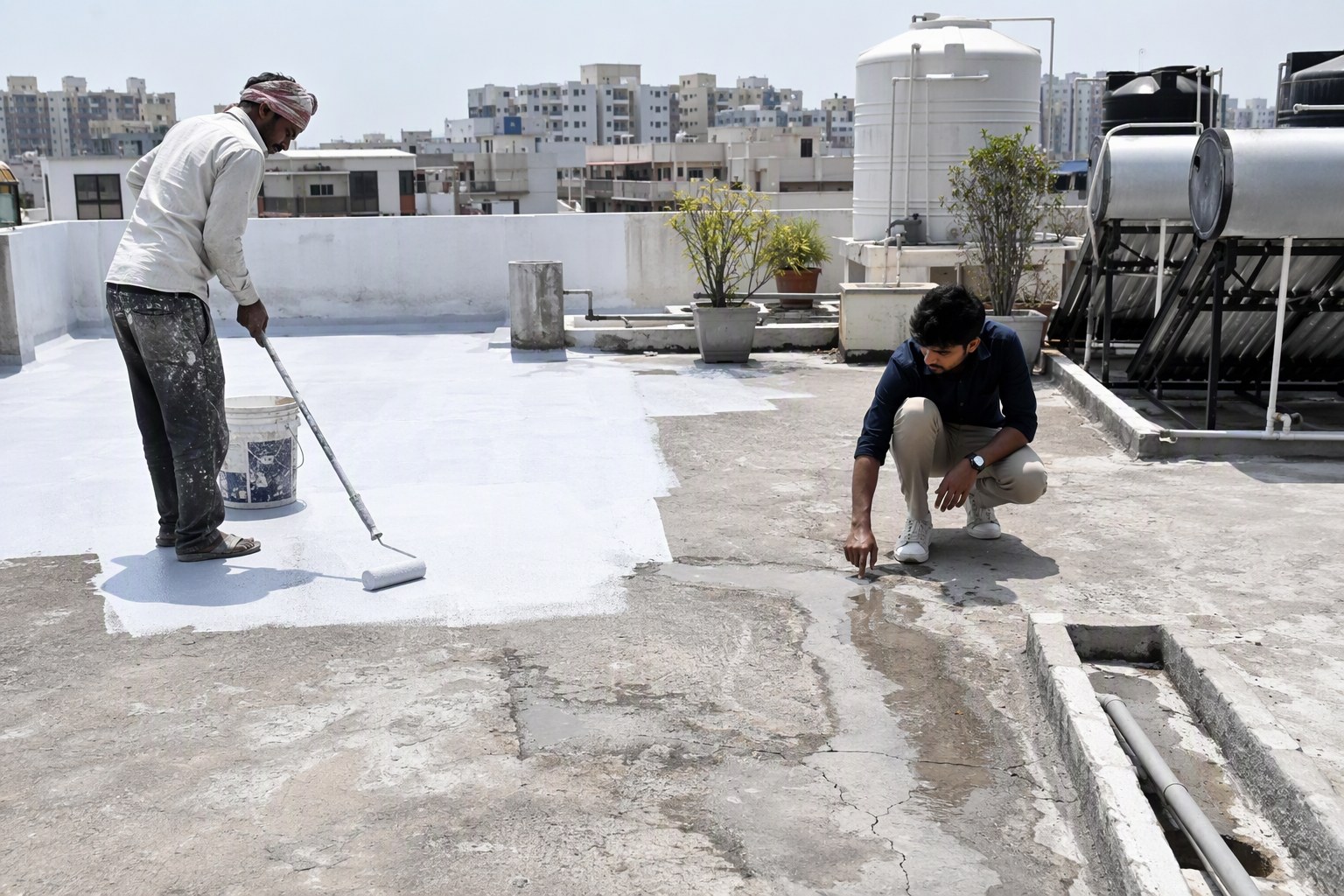
Low-VOC Paint in New Flats is becoming a visible sales pitch across Hyderabad’s apartment market, especially in projects at Gachibowli, Kokapet, Narsingi, Tellapur, Kondapur, Miyapur and Uppal. The claim sounds healthy and premium. But as buyers, we should not accept it only because it is printed in a brochure or mentioned by a sales executive. The real check is simple: ask for the paint specification, brand invoice, batch details and handover record before you treat it as a genuine low-emission interior finish.
We’ve seen this shift on site visits. Earlier, buyers asked about UDS, carpet area, clubhouse handover, corpus fund and car parking. Now, in many new flats, families also ask whether the paint smell will reduce quickly, whether children can move in immediately, and whether the builder has used low-VOC or zero-VOC products. That is a good change. But the market has also learnt to use “healthy home” language very loosely.
My view is clear: low-VOC paint is a useful feature, but it is not a substitute for legal due diligence, RERA verification, EC checking, SRO value checking and proper handover documentation.
In Telangana property checks, the scale of land-risk screening itself is huge. The state’s prohibited properties list under Section 22-A contains 3,076,153 entries as per the available database context. So, while paint quality matters for daily living, buyers should not forget the bigger verification track: title, approvals, encumbrances, land status, sanctioned plans and handover specifications.
Low-VOC Paint in New Flats: What the Claim Actually Means
VOC means volatile organic compounds. These are chemicals that can be released from certain paints, coatings, adhesives and interior materials. In simple buyer language, VOCs are one reason why a freshly painted flat may have a sharp smell and may need airing before occupation.
A low-VOC paint claim means the product is supposed to release lower levels of such compounds compared with conventional paints. Some brands also sell zero-VOC lines. But every buyer should remember one practical point: the claim belongs to the exact product used, not to the project name. A builder cannot simply say “eco-friendly paint” and close the matter. The product name, finish type, shade system, primer, putty and application method should match the promised specification.
In Hyderabad, I see this claim most often in mid-segment and premium projects where the builder wants to position the flat as child-friendly, senior-friendly or wellness-oriented. This is common in IT corridor markets like Financial District, Nanakramguda, Gachibowli, Narsingi and Tellapur. It is also appearing in compact flats around Bachupally, Miyapur, Kompally and Uppal, especially where the project is marketed to young working families.
The buyer’s problem is that “low-VOC” is not visible like tile size or balcony railing. You cannot verify it by standing in the living room for two minutes. Fresh paint smell alone is not a reliable test. A good low-VOC product can still have some odour. A poorly ventilated flat can smell even after better materials are used. So documentation is the only sensible route.
Why Low-VOC Paint in New Flats Has Become a Selling Point
The housing conversation in Hyderabad has matured. Many buyers are no longer satisfied with only elevation, amenities and location. They want details: lift make, generator backup, STP functioning, water source, waterproofing treatment, electrical wiring brand, window system and now interior finish quality.
Developers are also responding because competition is strong. In markets like Kokapet, Tellapur, Puppalaguda, Kondapur, Kollur and Nallagandla, multiple projects compete within the same buyer budget band. If two projects offer similar unit sizes and possession timelines, small specification claims can influence buyer perception. Low-VOC paint is one such claim because it connects directly with health and indoor comfort.
There is also a post-handover reality. Many families move into flats soon after registration and basic interiors. If the flat has strong chemical smell, poor ventilation or damp walls, the first impression becomes negative. Builders know this. A “healthier interior finish” claim helps reduce buyer anxiety, especially for families with small children or elderly parents.
Still, marketing language and construction execution are two different things. A brochure may mention low-VOC emulsion. The actual site may use a different primer, putty or repainting material during rectification. Sometimes the sample flat has a premium finish, while the sold flat has a standard grade finish. This is why the buyer must check the paperwork.
Low-VOC Paint in New Flats: Buyer Checklist Before Booking
Before paying the booking amount, ask the sales team for the specifications sheet that forms part of the agreement or annexure. Do not rely only on the colourful brochure. In our experience, the annexure attached to the agreement carries more weight during disputes than a verbal promise made during a site visit.
- Product category: Ask whether the wall finish is low-VOC emulsion, washable emulsion, acrylic emulsion or standard interior paint.
- Brand and product line: A brand name alone is not enough. Ask for the exact product line or equivalent specification.
- Primer and putty: Low-VOC topcoat alone does not tell the full story. Primer, putty and surface treatment also matter.
- Areas covered: Confirm whether low-VOC paint applies to living room, bedrooms, kitchen ceiling, utility, bathrooms ceiling and common corridors, or only to selected internal walls.
- Change clause: Check if the builder can substitute “equivalent material” without buyer approval. This clause is common and needs careful reading.
- Handover proof: Ask what document will be given at possession to confirm final paint material used.
If the builder says these details cannot be shared, treat that as a signal to slow down. A genuine specification should not be a secret. The buyer is paying for the flat and has the right to know what is being delivered.
Documents That Can Verify a Low-VOC Paint Claim
At handover stage, buyers should ask for records. A builder may not share every internal purchase document, but the association or a group of buyers can request a material confirmation certificate or invoice summary. For individual villas and low-rise projects, the builder may be more willing to share brand bills.
| Document | What to Check | Buyer Action |
|---|---|---|
| Agreement specification annexure | Whether low-VOC paint is written clearly | Keep a signed copy before payment milestones |
| Brand invoice or purchase summary | Product line, quantity and project reference | Ask at handover or through buyer group |
| Material approval sheet | Approved paint make and finish | Request from project CRM or site engineer |
| Handover checklist | Wall finish condition and pending repainting | Record defects before signing final acceptance |
| Snagging photos/videos | Damp patches, repaint marks, strong odour zones | Share with builder before taking possession |
The handover checklist is very useful. Many buyers sign it quickly because they are eager to get keys. Please do not do that. Take time. Open windows, check corners, wardrobes cut-out areas, ceiling edges, bathrooms, utility walls and AC drain points. Paint defects often reveal water seepage or plaster issues. A healthy paint claim cannot cover up dampness.
Legal and Property Checks Still Come First
A low-VOC finish is a lifestyle feature. Title safety is a financial protection issue. Both matter, but they are not equal. Before getting impressed by green interiors, check whether the project and flat are legally clean.
Start with the project’s registration status using the RERA Project Lookup. Then review ownership and transaction history through the Encumbrance Certificate Search or use the EC Analyzer if you already have the EC and want a cleaner reading of the entries.
For land-linked risks, especially in outskirts and fast-growing belts, use the Section 22-A Prohibited Property Check. This is not a formality. With 3,076,153 prohibited property entries in the available database context, buyers should not assume that every attractive project parcel is free from restrictions. For plotted layouts, villas and smaller apartment projects, also use the Survey Number Finder and Property Verification Tool.
If you are checking registration cost, compare the declared value with the government value using the Market Value / Guideline Value Search and estimate charges through the Stamp Duty Calculator. For SRO mapping, the Find Your SRO Office tool helps buyers identify the correct registration office. These checks may look boring compared with model flat interiors, but they save buyers from bigger trouble.
How to Ask the Builder Without Sounding Difficult
Many buyers hesitate to ask technical questions because they feel the sales team may label them as troublesome. My advice: ask politely, but ask in writing. A good developer will respect an informed buyer.
You can send a simple email or WhatsApp message to the CRM team:
Please confirm the exact paint brand and product line proposed for internal walls of my flat, including primer and putty details. The brochure mentions low-VOC paint. Kindly share the specification sheet or agreement annexure where this is recorded, and confirm what handover document will mention the final material used.
This is not aggressive. It is a normal buyer request. If the answer is vague, ask again. If the builder says “as per company standard”, request the standard in writing. If the agreement says the builder can change materials based on availability, ask whether any substitution will maintain the low-VOC specification.
For under-construction projects, visit during finishing stage if access is allowed. Paint containers at site can give clues, but do not depend only on a few buckets seen in one tower. Large projects may use different batches and contractors. Documentation is stronger than visual checking.
What Buyers in Hyderabad Should Watch During Handover
Handover is when the health claim becomes a practical living issue. Even if low-VOC paint was used, poor ventilation, fresh polishing work, adhesive-heavy interiors or pest treatment can create odour. So check the flat after it has been closed for some time and again after ventilation.
- Check whether the smell is strongest in one room. That may point to dampness, adhesive, drain issue or recent repainting.
- Look behind bathroom doors, below window sills and near AC points for bubbling or stains.
- Ask whether any rectification paint is the same product as the original paint.
- Record all wall finish defects in the possession checklist.
- Do not start wardrobes and false ceiling work before documenting builder-side defects.
In high-rise apartments at Narsingi, Kokapet, Gachibowli, Kondapur and Tellapur, buyers often coordinate through tower-wise groups. This helps because one flat owner may not get all records, but a group request carries more weight. In smaller projects at Manikonda, Alwal, Uppal, LB Nagar or Bachupally, direct discussion with the builder or site engineer may work better.
Low-VOC Paint in New Flats Is Not the Same as a Green Building
This distinction matters. A project may use low-VOC paint but may not be a certified green building. A green building claim can include several design and operational elements such as energy efficiency, water management, waste handling, ventilation and material choices. Low-VOC paint is only one interior material decision.
Buyers should ask what exactly is being claimed. Is the builder saying only the paint is low-VOC? Is the project certified under a recognised green rating system? Is there a ventilation strategy? Are common areas also using safer finishes? Are adhesives and sealants included? A single healthy material does not make the entire flat healthy.
At the same time, I do not dismiss the value of low-VOC paint. It is a sensible upgrade if properly executed. Families moving into a newly painted home will appreciate reduced odour and better indoor comfort. But the claim must survive basic verification.
Flat Buyer’s Practical Decision Rule
Here is the approach I suggest to buyers. Give weight to low-VOC paint only after three conditions are met. First, the legal and approval checks are clean. Second, the low-VOC specification is written into the agreement or signed annexure. Third, handover records or material confirmations support what was promised.
If only the brochure mentions it, treat it as a marketing claim. If the agreement mentions it but handover records are silent, keep written follow-up before accepting possession. If the builder gives a clear specification and maintains the same at site, then yes, count it as a positive feature.
Hyderabad buyers are becoming sharper, and builders know it. The best projects will not fear documentation. They will show specifications, maintain records and answer questions. The weaker ones will hide behind “standard quality” language. Your job is to separate the two before money and registration are locked.
Final Buyer Checklist for Low-VOC Paint in New Flats
- Ask for the exact product name, not just the brand.
- Check whether primer, putty and repaint material are covered.
- Make sure the specification is in the agreement annexure.
- Ask for invoice summary, material approval sheet or handover confirmation.
- Record paint defects, odour issues and damp patches before signing possession checklist.
- Do not ignore RERA, EC, SRO, survey number and Section 22-A checks because of a healthy home claim.
Low-VOC paint is a welcome trend in Telangana’s new housing market. But the buyer’s protection lies in paper trail, not promises. A healthy home starts with safe title, lawful construction and verifiable specifications.
Frequently Asked Questions
What is Low-VOC Paint in New Flats?
Low-VOC paint is paint designed to release lower levels of volatile organic compounds compared with conventional products. For buyers, the claim should be verified through the product specification, agreement annexure, invoice summary and handover record.
Can I verify low-VOC paint only by smell?
No. Smell is not a reliable test. Ventilation, fresh interiors, adhesives, dampness and repainting can all affect odour. Ask for written product details and handover confirmation.
Should low-VOC paint be mentioned in the sale agreement?
Yes, ideally it should appear in the specifications annexure or a signed written confirmation. A brochure claim alone is weaker if there is a dispute at possession stage.
Does low-VOC paint mean the project is a green building?
Not necessarily. Low-VOC paint is one material feature. A green building claim needs broader evidence covering design, energy, water, ventilation and other sustainability measures.
What property checks should I do before focusing on paint quality?
Check RERA registration, EC, SRO details, guideline value, survey number and Section 22-A prohibited property status. Interior finish matters, but title and approval safety come first.