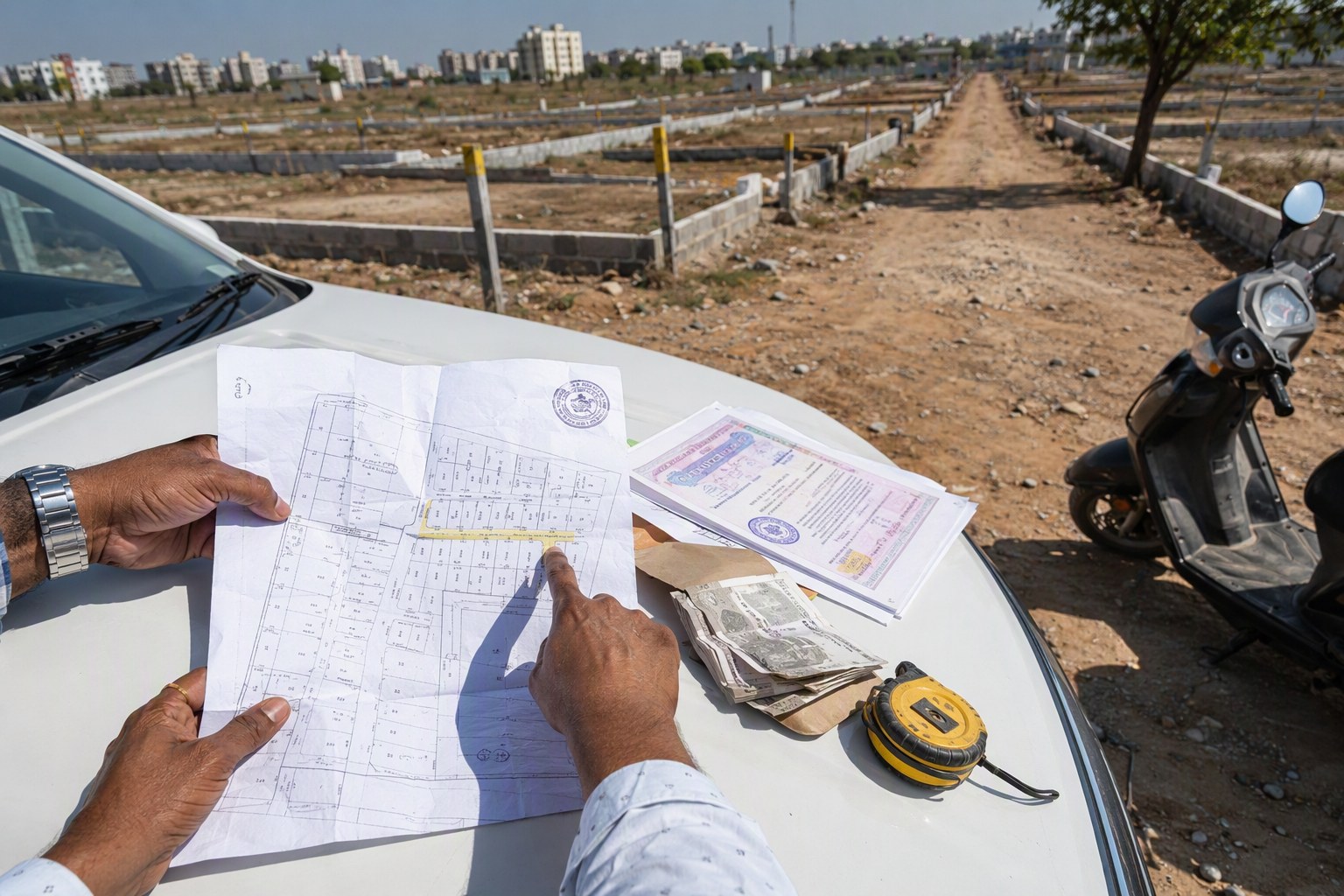
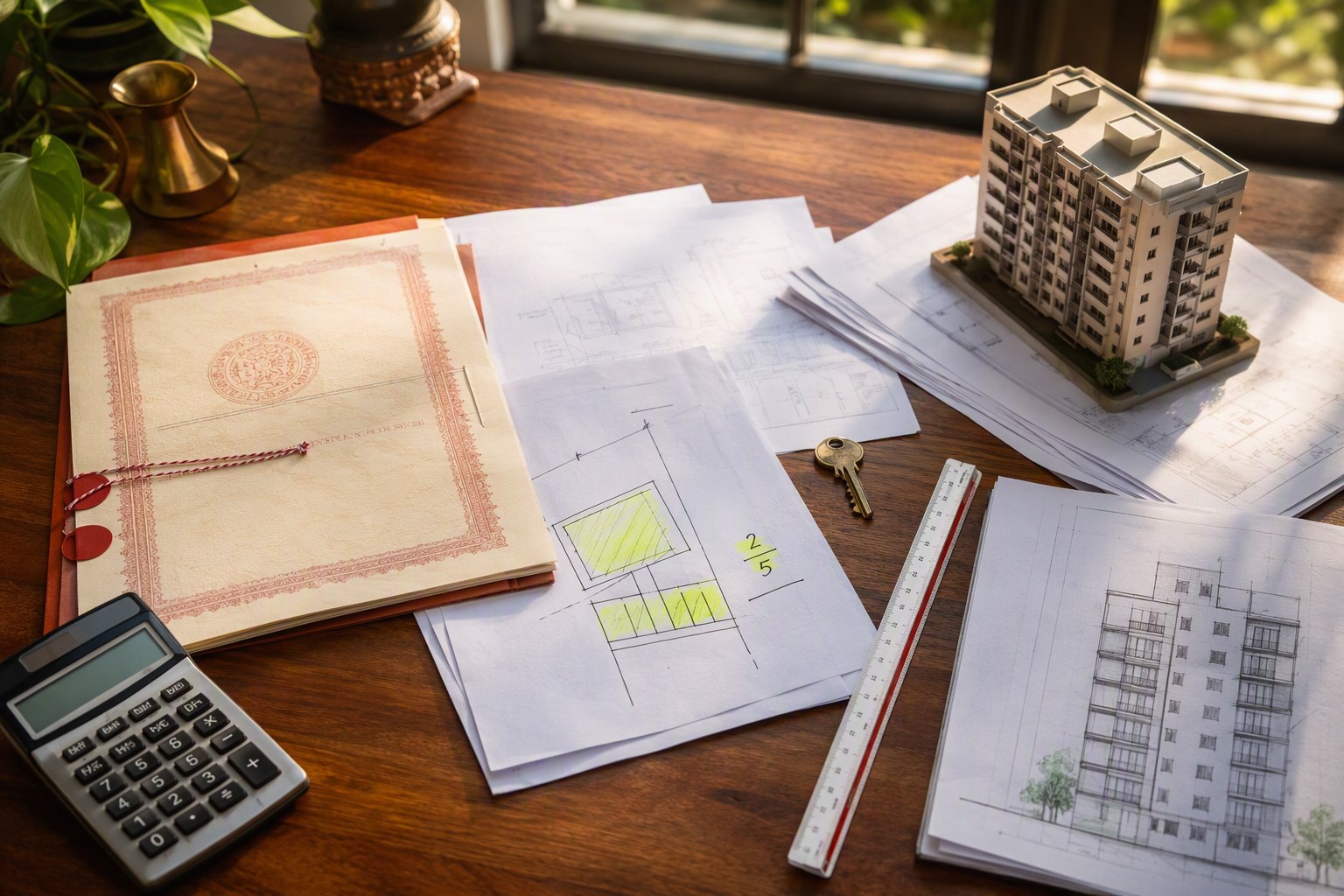
Hyderabad Site Visit Photos can save your token money because they capture small details that buyers usually forget after a happy site visit: the survey stone number, the actual access road, the property board, neighbouring boundaries, and any warning signs on the land. In our experience, one good photo taken at the right angle can raise the exact question that must be answered before you transfer Rs 50,000 or Rs 5 lakh as token.
A buyer from Nizampet recently called us after visiting an open plot near Mokila. The site was clean. The broker was confident. The road was being formed. The sales board had an attractive rate, and the owner was ready to close at around Rs 72,000 per square yard if token was paid the same evening. This is the exact moment where many Hyderabad buyers rush. The buyer, luckily, had taken three photos: one of the survey stone, one of the road approach, and one of a faded board fixed near the corner of the land. Those three photos changed the discussion from price negotiation to verification.
Our practical rule: after every site visit in Hyderabad, do not ask only ‘Did I like the property?’ Ask ‘What did my photos prove, and what did they fail to prove?’
Hyderabad Site Visit Photos: why they matter before token payment
Token money is emotional money. Once you pay it, even a small doubt becomes uncomfortable. In Hyderabad and the surrounding HMDA growth corridors, buyers are seeing fast-moving deals in Kollur, Tellapur, Mokila, Shankarpally, Bachupally, Patancheru, Kompally, Ghatkesar, Adibatla, Tukkuguda, Hayathnagar and Shadnagar. Rates differ widely. In 2025 street-level enquiries, decent plotted layouts around Mokila and Shankarpally are often quoted in the Rs 55,000 to Rs 85,000 per square yard range depending on road width, approval and exact village. Kollur and Tellapur premium pockets can cross Rs 80,000 to Rs 1.40 lakh per square yard. Apartments in Bachupally, Miyapur and Nallagandla commonly move in the Rs 6,500 to Rs 10,000 per sft band based on builder, stage and location.
Those numbers create pressure. If the broker says another buyer is ready, you may feel the plot will go. But the risk is not only price. The risk is mismatch. The property shown on ground may not match the survey number in the draft agreement. The road shown may be a temporary passage. The board may mention a different layout name from the brochure. A nearby survey stone may show a number that needs checking in Dharani or revenue records. These are not small matters.
Telangana has a large volume of restricted property entries. As per the available database fact we track, 147,934 properties are listed under prohibited properties, Section 22-A. That one number should slow down every buyer. Most properties are clean, yes. But token should be paid after basic checks, not before them.
The Mokila site visit story: three photos that stopped a rushed payment
The buyer’s first photo was of the survey stone at the edge of the land. It was not a fancy stone. Just a rough white-painted marker with a number that did not clearly match the brochure. The broker said, ‘Sir, old stone only, layout survey is different.’ That answer may be true. It may also be the beginning of confusion.
The second photo showed the access road. On the brochure, the road was described as 40 feet. On the ground, the existing approach looked closer to 25 to 30 feet for part of the stretch, then widened near the layout entrance. In Hyderabad outskirts, this is common. A proposed road, master plan road, village road and layout internal road are four different things. Buyers mix them up. Sellers sometimes mix them up too.
The third photo showed the property board. It had the venture name, a phone number, and a line about approvals. But the approval number was not readable. The buyer zoomed in later and noticed that the board name had a slight spelling difference from the PDF shared on WhatsApp. Again, not proof of fraud. But definitely a reason to verify.
We asked him not to pay token that night. First, we checked the likely survey number using the Survey Number Finder. Then we searched the indicative market value through the Market Value / Guideline Value Search. After that, we suggested an EC check through the Encumbrance Certificate Search and a 22-A check using the Section 22-A Prohibited Property Check. The buyer finally paid token only after the seller shared clearer documents and the survey number was matched properly.
Photo 1: survey stone and boundary markers
In Telangana land buying, the survey number is not a decorative detail. It is the starting point for almost every verification: pahani, Dharani entries, SRO records, EC, mutation history, prohibited property status and layout approval. A site visit photo of the survey stone helps you cross-check the land shown on ground.
When you photograph a survey stone, do not take only a close-up. Take three angles:
- One close photo where the number is readable.
- One medium photo showing the stone and the nearby boundary.
- One wide photo showing the stone, road, neighbouring land and any visible landmark.
This matters especially in villages of Shankarpally mandal, Gandipet mandal, Patancheru mandal, Keesara mandal, Shamirpet mandal, Hayathnagar mandal and Abdullapurmet mandal, where agricultural land, converted land, layouts and plotted ventures can sit side by side. If the seller says the property is in Survey No. 112, but your photo shows a boundary stone marked 118 or 119 nearby, you have a question to ask. It may be adjoining land. It may be a sub-division. It may be a simple old marking. Still, ask before token.
For apartments, the equivalent is not a survey stone but the project board, RERA board, sanctioned plan display and site address. In a fast-growing area like Tellapur or Narsingi, two projects can sit next to each other with similar names. A photo helps you verify the exact project later using the RERA Project Lookup.
Photo 2: access road, road width and actual approach
Hyderabad buyers love road-width claims. 30 feet, 40 feet, 60 feet, 100 feet approach road. These words appear in almost every plot pitch. But what matters is what exists now, what is sanctioned, and what is only proposed.
A photo of the access road should capture the full width from one edge to the other. If possible, include a car, bike or compound wall in the frame for scale. Take a video while entering the property from the main road. Note the route: ORR service road, village road, panchayat road, HMDA road, internal layout road or private passage. These labels affect value.
For example, a plot near Kollur with a genuine 40-feet blacktop approach and clear HMDA layout access is not the same as a plot behind it with a narrow temporary mud road. Both may be marketed as ‘near Kollur exit’. That phrase does not tell you road rights.
Before token, run a basic road sanity check through the Road Width Check. If you are buying for future construction, also check land use through the Land Use Zone Finder. A wide-looking road is useful only when it matches planning rules, access rights and approvals.
Photo 3: property board, approval board and contact details
The property board is often treated as background noise. I treat it as evidence. The board may show the venture name, builder name, approval number, RERA number, layout permit, LP number, contact number, pricing, payment plan and disclaimers. Many buyers take selfies at the site but forget the board. Please do the opposite.
Take a straight photo of the board. Then zoom in and take close photos of numbers. If the board says HMDA approved, note the LP number. If it is an apartment project above the RERA threshold, verify the RERA number. If the board says ‘DTCP approved’ in an area that should fall under another authority, ask for clarity. Around Greater Hyderabad, jurisdiction can shift from GHMC to HMDA to municipality to gram panchayat areas depending on the exact location.
In places like Kompally, Dundigal, Ghatkesar, Pocharam, Adibatla and Maheshwaram, boards can remain even after old marketing phases. Sometimes the board belongs to Phase 1, while the plot offered to you is in a later extension. Sometimes the rate board is old. Sometimes the phone number belongs to a channel partner, not the landowner or developer. None of this is automatically wrong. But your token agreement should name the correct party and correct property.
Hyderabad Site Visit Photos checklist before token payment
Use this checklist while you are still at the site. It takes ten minutes, and it can save weeks of regret.
| Photo to take | What it helps verify | Common Hyderabad issue |
|---|---|---|
| Survey stone or boundary stone | Survey number, sub-division, boundary position | Shown land and document land may not be same |
| Access road from main road | Road width, approach, blacktop status | Proposed 40-feet road but current access is narrow |
| Property board | Venture name, approval number, contact details | Board name differs from brochure or WhatsApp PDF |
| Neighbouring plots or buildings | Land use, encroachments, actual development | Industrial shed, nala, high-tension line or graveyard nearby |
| Electric poles, drains and water lines | Basic infrastructure stage | Layout sold as ready, but utilities are not complete |
| GPS screenshot | Exact location pin | Broker pin and actual site differ by 1-2 km |
After the visit, sit with these photos and documents together. Check whether the draft agreement, sale deed link document, EC, layout approval and property board are all speaking the same language. In many bad deals, the truth is visible only when these items are compared side by side.
How photos connect to Dharani, pahani, SRO and EC checks
A photo is not a legal document. But it points you to the right legal document. If your survey stone photo shows Survey No. 64/AA, you can ask the seller to provide pahani details, Dharani passbook details where applicable, and mutation records. If your property board shows an LP number, ask for the sanctioned layout copy. If the board shows a RERA number, verify it independently.
For SRO-level checks, start by identifying the correct registration office using the Find Your SRO Office. Hyderabad buyers often assume that a property near a known landmark falls under the nearest familiar SRO. Not always. SRO jurisdiction follows village, mandal and registration boundaries, not your Google Maps comfort.
Then check the EC. An Encumbrance Certificate can reveal registered transactions, mortgages, gifts, releases and other entries. It may not show every dispute, and it may not replace legal due diligence, but it is a non-negotiable first filter. Use the Encumbrance Certificate Search and compare names, survey numbers, document numbers and boundaries.
For Section 22-A, do not depend on verbal confidence. Use the Section 22-A Prohibited Property Check. With 147,934 prohibited property records in the tracked database, this step is not optional for serious buyers. Government lands, assigned lands, endowment lands, wakf-related entries and other restricted categories can create serious registration issues.
What your photos cannot prove
I like photos, but I do not overstate them. A site photo cannot prove clean title. It cannot prove that all heirs have signed. It cannot prove that a bank loan will be approved. It cannot prove that a future master plan road will be executed. It cannot prove that a court case does not exist.
Photos are a trigger for better questions. If the access road is narrow, ask for road documents. If the board says approval is in process, ask what exactly is approved today. If a nala or lake buffer appears nearby, check land use and buffer rules. If a high-tension line crosses the layout, ask for setback impact. If the neighbouring land is agricultural, ask whether conversion and layout approvals are complete.
For apartment buyers, photos also cannot prove carpet area, UDS, deviations or OC status. Use site photos along with RERA records, sanctioned plans, sale agreement, payment schedule and builder history. If you are calculating total cost, use the Stamp Duty Calculator before assuming your budget. For flats, the Composite Value Calculator can help estimate value better than a casual per-sft rate.
Local price signals your photos should be read against
Site visit photos are stronger when you understand the local market. A 200-square-yard plot at Rs 35,000 per square yard near Shadnagar may be normal in one pocket and suspiciously cheap in another if it claims immediate HMDA-style development. A Rs 1 lakh per square yard quote in Tellapur may be acceptable for a strong location with clean approvals, but expensive for a layout with weak access. A Bachupally flat at Rs 7,800 per sft may be fair if possession, amenities and builder reputation are strong; it may be high if the approach road and approvals are poor.
Always compare the selling price with the government market value or ready reckoner value. The official value is not the market price, but it gives a floor for stamp duty and registration calculations. Use the Market Value / Guideline Value Search for this. If the seller insists on a large cash component above registered value, step back and take advice. We have seen buyers lose bargaining power because they paid token before understanding registration value, stamp duty and loan eligibility.
For construction-focused buyers, take photos of surrounding building heights and road width. Then run a basic estimate through the FSI/FAR Calculator. A plot that looks attractive may not support the built-up area you are imagining. In some layouts, road width and zoning can limit what you can build.
How to store and label Hyderabad Site Visit Photos properly
Do not leave your site visit photos as random images in your phone gallery. Create a folder with the locality, village, survey number and date. Example: ‘Mokila_Survey112_14Feb2026’. Save the broker’s location pin, brochure, price quote and draft agreement in the same folder. Rename key photos as ‘survey-stone’, ‘road-approach’, ‘board’, ‘neighbour-north’, ‘neighbour-south’ and ‘gps-pin’.
Share the folder with your lawyer or family member before token. If you are comparing three properties, this simple habit prevents confusion. Many buyers visit Kollur, Velimela and Mokila on the same Sunday, then mix up roads, boards and rates by evening. The broker remembers his pitch. You need your own record.
For high-value transactions, use a property tracking workflow through the Property Change Tracker. If title, EC, price, owner name or approval details change during negotiation, keep a dated record. Token disputes often arise because conversations happen on calls and WhatsApp, while documents arrive later with different wording.
Before paying token: my practical 15-minute photo review
Here is the quick review I suggest to Hyderabad buyers before sending token money:
- Open the survey stone photo and compare it with the survey number in the documents.
- Open the access road photo and ask whether the road is existing, sanctioned, proposed or private.
- Open the property board photo and verify approval number, venture name and contact party.
- Check the location pin against the village and mandal mentioned in papers.
- Search EC, SRO, guideline value, RERA where applicable and Section 22-A status.
- Write token terms clearly: refundable or non-refundable, verification period, document list, seller obligations and timeline.
If the seller refuses even two working days for verification, I become cautious. A clean seller may push for speed, but will usually share documents. A risky seller pushes for emotion: ‘Sir, pay now, others are waiting.’ Hyderabad property is valuable, but your peace of mind is also valuable.
Photos will not make you a land surveyor or advocate. But they will make you a sharper buyer. In a market where localities change fast and prices move quickly, that sharpness is money. Sometimes it saves Rs 50,000 token. Sometimes it saves a lifetime of litigation.
Frequently Asked Questions
Which Hyderabad Site Visit Photos are most useful before paying token?
Take photos of the survey stone, access road, property board, neighbouring boundaries, GPS location, utilities and any warning signs like nala, high-tension line or restricted entry board.
Can site visit photos prove that a property title is clear?
No. Photos do not prove title. They help you ask better questions and compare ground reality with EC, Dharani, pahani, SRO records, RERA details and Section 22-A checks.
Should I pay token if the road is shown as proposed?
Pay only after understanding the road status. Proposed road, sanctioned road and existing usable road are different. Verify road width, approval plan and access rights before token.
How do I verify if a Hyderabad property is prohibited under Section 22-A?
Use a Section 22-A prohibited property check with the correct village, mandal and survey number. Telangana has 147,934 tracked prohibited property entries, so this check is essential.
What should my token agreement mention?
It should mention exact property details, seller name, token amount, refund terms, verification period, document list, final price, payment timeline and what happens if title or approval checks fail.