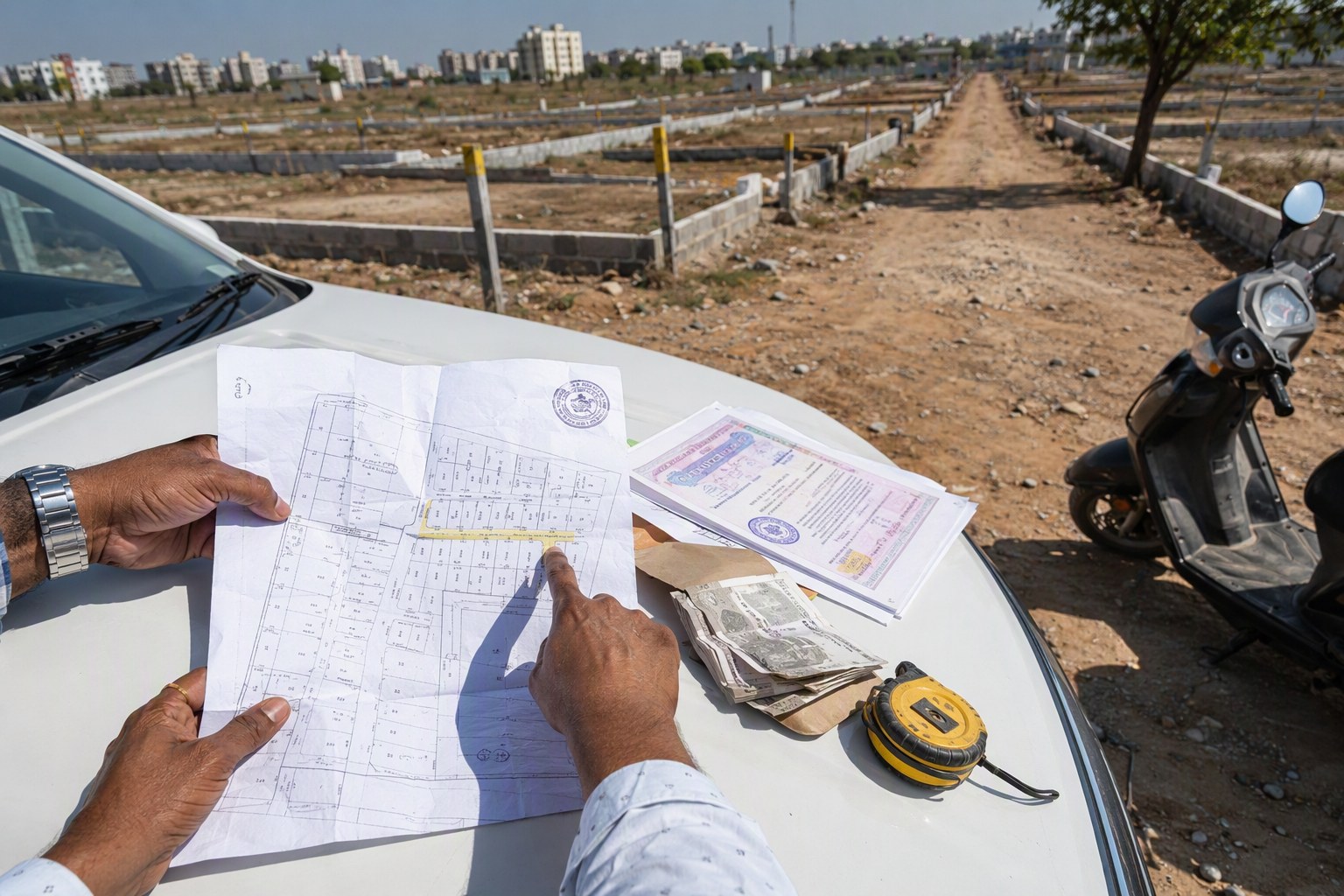
Hyderabad resale flat dues can quietly spoil a good deal. We saw this recently with Pranav and Sravani, a young couple who liked a 1,620 sft resale flat in Kondapur, Serilingampally mandal. The quoted price was ₹1.18 crore, the building looked well maintained, and the seller was pressing for a ₹2 lakh token payment by evening. Then the association office casually mentioned pending maintenance, GHMC property tax, electricity arrears and a water bill. Total shock: ₹2.43 lakh. That is exactly why a resale flat buyer must verify dues before token, not after agreement.
My practical view: in Hyderabad resale deals, unpaid dues are not small clerical issues. They are negotiation points, legal risk indicators, and sometimes warning signs about a seller in distress.
Hyderabad Resale Flat Dues: The First Things To Check Before Token Payment
In a primary sale, the builder gives a demand schedule. In a resale flat, the seller may show you interiors, parking and club house, but the real story sits in the association ledger, GHMC tax portal, electricity consumer account, water connection file, and registration records.
Before paying even a token amount, ask for written confirmation on these heads:
- Apartment maintenance dues and late payment charges
- Corpus fund balance, sinking fund dues and repair fund dues
- GHMC property tax or municipal property tax
- Electricity bill arrears under TGSPDCL or TGNPDCL, as applicable
- Water bill dues, especially in HMWSSB or society bulk connection buildings
- Gas pipeline charges, if the apartment has reticulated gas
- Club house, parking, move-in or move-out charges
- Any bank loan closure and mortgage release
- Any legal notice from association or court dispute
- Encumbrances, prohibited property risk and SRO registration value
The cleanest method is simple: seller clears all dues before sale deed, and the sale agreement records this clearly. If the buyer is agreeing to clear any amount, reduce it from the sale price and mention it in writing.
Hyderabad Resale Flat Dues Example: Kondapur Flat Case
Let us take the Kondapur example. The flat was in a gated community close to Botanical Garden Road, with IT corridor access towards Gachibowli and HITEC City. The monthly maintenance was ₹7 per sft. For a 1,620 sft unit, that came to ₹11,340 per month.
| Due head | Pending period | Approx amount | Who should clear? |
|---|---|---|---|
| Apartment maintenance | 14 months | ₹1,58,760 | Seller, unless price adjusted |
| GHMC property tax | 2 half-years | ₹48,400 | Seller |
| Electricity bill | Current plus arrears | ₹12,600 | Seller before handover |
| Water charges | Bulk share pending | ₹8,300 | Seller |
| Late fee / repair fund | Association ledger | ₹15,000 | Negotiable, but record it |
| Total | - | ₹2,43,060 | Clear before registration |
For a ₹1.18 crore transaction, ₹2.43 lakh may look manageable. But it changes the deal psychology. If the seller hid dues, what else is pending? Is there a bank loan? Is the parking properly allotted? Is the undivided share correct? Is the society NOC clean?
Maintenance Dues: Start With The Association Ledger
In Hyderabad gated communities, maintenance is not casual. In many societies at Kondapur, Nallagandla, Kokapet, Financial District, Manikonda and Gachibowli, monthly maintenance commonly falls in the ₹4 to ₹8 per sft range. Premium projects can cross ₹10 per sft. Smaller standalone apartments in Kukatpally, Miyapur, Chandanagar, Uppal, LB Nagar and Attapur may be around ₹2 to ₹4 per sft, depending on lift, generator, security and water arrangements.
Ask the apartment owners association for a ledger statement on the flat number. Do not rely only on WhatsApp messages from the seller. The ledger should show:
- Monthly maintenance paid up to which month
- Any interest or penalty
- Corpus fund contribution
- Sinking fund or repair fund
- Club house dues
- Move-in or move-out charges
- Any association legal notice
- Any restriction on transfer due to dues
In our experience, association dues become messy when a seller has rented out the flat for many years. Tenant may have paid electricity, but maintenance may be partly unpaid. Sometimes the owner paid regular maintenance but skipped special repair fund for painting, lift replacement or STP repair.
Get a no-dues certificate from the association before registration. If the association refuses to issue it, pause the deal. A resale flat without society no-dues is not ready for clean transfer.
Hyderabad Resale Flat Dues And GHMC Property Tax
For flats in GHMC limits, property tax is usually paid half-yearly. In areas like Kondapur, Madhapur, Gachibowli, Miyapur, Kukatpally, Nizampet, Manikonda, Puppalaguda, Narsingi, Attapur, Uppal and LB Nagar, buyers should verify property tax using the PTIN. The PTIN should match the flat, owner name and assessment details.
Do not accept only an old paid receipt. Ask for the latest online tax status. There may be arrears, interest or revision demand. If the flat was recently assessed after occupancy certificate or mutation, old tax may not reflect correctly.
For resale flats in municipalities outside GHMC, such as Tellapur, Kollur side pockets, Dundigal, Tukkuguda, Shamshabad, Adibatla or Ghatkesar belt, verify with the concerned municipality or gram panchayat records. Some buyers assume that only GHMC matters. That is not correct. Municipal tax dues can also follow the property.
Electricity, Water And Gas: Small Bills, Big Irritation
Electricity dues are easy to verify but often ignored. Check the consumer number, latest bill, arrears and name transfer process. If the seller has a high unpaid bill, the distribution company can insist on payment before name change or reconnection.
Water is trickier in apartments. Some societies have individual HMWSSB connections, while many gated communities run on a bulk water connection, borewell, tanker and internal billing. Ask the association whether the flat has any water share pending. In summer, tanker bills in western Hyderabad communities can be significant, especially in Manikonda, Narsingi, Kokapet and Tellapur stretches.
If the apartment has piped gas, check gas provider dues too. It may be a small amount, but during possession handover, these small gaps create unnecessary arguments.
Registration Cost And SRO Value: Do Not Guess The Final Outflow
Many buyers calculate only sale price and loan margin. Telangana registration costs must be budgeted properly. For a regular sale deed, the common cost structure is:
- Stamp duty: 4%
- Transfer duty: 1.5%
- Registration fee: 0.5%
- Total common outgo: 6% of the higher of market value or consideration, subject to applicable rules
For a ₹1.18 crore resale flat, this can be around ₹7.08 lakh if the full consideration is adopted and no special exemption applies. Use our Stamp Duty Calculator before you commit token money. Also check the official market value using the Market Value / Guideline Value Search. Hyderabad buyers often call it ready reckoner value, though in Telangana the SRO market value terminology is more common.
Also identify the correct SRO. Kondapur usually comes under the Serilingampally registration ecosystem, while Narsingi and Kokapet transactions may involve Ranga Reddy district SROs based on exact village and survey details. Use Find Your SRO Office so you do not prepare documents for the wrong office.
Encumbrance Certificate: The Non-Negotiable Check
An Encumbrance Certificate, or EC, shows registered transactions affecting the property. For flats, check the parent land documents, development agreement, sale deed chain, mortgage entries and release deeds. A seller may say loan is almost closed. Almost closed is not closed.
Use the Encumbrance Certificate Search and compare EC entries with the sale deed chain. If the flat was mortgaged to SBI, HDFC, ICICI, Axis or any housing finance company, insist on a bank closure letter and registered release deed wherever required.
For newly completed resale units in projects at Tellapur, Kollur, Bachupally, Kompally, Tukkuguda or Shankarpally side, also verify the project registration using RERA Project Lookup. Even if you are buying from an individual owner, project approvals and promoter obligations matter.
Section 22-A Prohibited Property Risk In Flat Deals
Many flat buyers think Section 22-A prohibited property applies only to open land. That is a mistake. A flat carries undivided share of land. If the underlying land has government, assigned, wakf, endowment, ceiling, dispute or prohibition issues, the apartment buyer can face registration and title problems.
Telangana has 147,934 properties listed under prohibited properties under Section 22-A. That number is too large to ignore. Before token payment, use the Section 22-A Prohibited Property Check. For extra comfort, run the details through our Property Verification Tool, especially when the project is on converted agricultural land or old village land.
For flats in growth corridors such as Kokapet, Narsingi, Puppalaguda, Tellapur, Kollur, Mokila, Shankarpally, Adibatla, Tukkuguda, Pocharam and Ghatkesar, ask for survey numbers. Cross-check village, mandal, pahani history where relevant, Dharani classification, layout approval and building permission. The flat may look urban, but the title root often sits in village revenue records.
Token Agreement: Put Dues In Writing
The biggest mistake buyers make is paying token money on trust. A proper token receipt or sale agreement should say exactly who clears old dues. Use plain language. No ambiguity.
Include clauses like these:
- Seller shall clear all apartment maintenance, corpus, sinking fund and society charges up to the date of registration.
- Seller shall provide association no-dues certificate before execution of sale deed.
- Seller shall clear property tax, electricity, water, gas and any municipal dues up to handover date.
- If any old dues arise after registration relating to the seller period, seller shall reimburse buyer within a fixed number of days.
- Token amount is refundable if title, EC, loan closure, association NOC or statutory dues are not satisfactory.
Do not feel shy to write these points. A genuine seller will not object. A seller who refuses written conditions is giving you useful information.
What Buyers Must Clear First And What Sellers Must Clear
As a rule, the seller should clear dues up to the date of registration or possession, depending on what both parties agree. Buyer should pay charges from possession date onwards. If possession is given before registration, record meter readings and maintenance cut-off date.
| Item | Normal responsibility | Buyer action |
|---|---|---|
| Old maintenance dues | Seller | Take no-dues certificate |
| Property tax arrears | Seller | Verify latest tax status |
| Electricity arrears | Seller | Check consumer bill and meter reading |
| Water and tanker dues | Seller | Confirm with association |
| Loan outstanding | Seller | Get bank closure and release proof |
| Registration charges | Usually buyer | Calculate before token |
| Society transfer fee | Negotiable | Record in agreement |
Some associations charge transfer fee. Reasonable administrative charges are common. But if a society demands a very high transfer amount without bye-law support, ask for written rule copy. Do not pay cash without receipt.
Locality-Specific Caution For Hyderabad Resale Flat Buyers
Western Hyderabad resale prices are high, so due diligence must be sharper. A 3BHK resale flat in Gachibowli, Kondapur, Kokapet, Narsingi or Financial District can easily cross ₹1 crore to ₹2.5 crore depending on project, age, carpet area, amenities and builder brand. At that ticket size, even a 1% hidden cost is serious money.
In older localities like Ameerpet, Begumpet, Himayatnagar, Tarnaka, Secunderabad, Dilsukhnagar and Mehdipatnam, check building age, UDS, lift condition, parking rights and municipal regularisation history. In expanding suburbs like Bachupally, Kompally, Mallampet, Tellapur and Kollur, check HMDA or municipal approval, RERA status where applicable, and land title chain.
For apartments close to lakes, nalas or sensitive zones, ask for layout plan and building permission. If you are buying in Puppalaguda, Manikonda, Khajaguda, Neknampur, Narsingi or Bandlaguda Jagir, location-specific land history matters because old village boundaries, lake buffers and road widening can affect value.
Documents To Collect Before Paying Token
Here is the file I would want on my table before advising a buyer to pay token:
- Seller sale deed copy
- Link documents and parent document summary
- Latest EC
- Property tax paid receipt and online status
- Association no-dues or latest ledger
- Electricity and water bill copies
- Loan outstanding letter, if mortgaged
- Draft bank closure plan if buyer loan will close seller loan
- Parking allotment proof
- Occupancy certificate or completion proof where available
- Approved building plan
- RERA details for newer projects
- Seller PAN, Aadhaar and ownership name match
If any document is missing, do not panic. But do not pay blindly. Ask why it is missing and whether it can be obtained before agreement.
Final Word On Hyderabad Resale Flat Dues
A good resale flat in Hyderabad can be a smart buy. You get a ready home, known maintenance, visible neighbourhood and sometimes better price than new launch inventory. But the deal must be clean.
My advice is direct: before token, verify association dues, property tax, utility bills, EC, SRO value, loan closure and prohibited property status. If dues exist, make the seller clear them or reduce the price. Keep every rupee documented. In Hyderabad real estate, a neat paper trail is not paperwork for the sake of it. It is your protection.
Frequently Asked Questions
Who pays old maintenance dues in a Hyderabad resale flat?
Normally, the seller pays all maintenance dues up to the date of registration or possession. Buyer should take an association no-dues certificate before sale deed.
Should I pay token before checking property tax and EC?
No. At least verify property tax status, association ledger, electricity dues and EC before token. If you still pay token, make it refundable if dues or title issues are found.
Can unpaid electricity or water bills affect flat transfer?
Yes. Pending bills can delay name transfer, reconnection or possession handover. Clear meter readings and bill status should be recorded before registration.
Is Section 22-A check needed for flats also?
Yes. A flat includes undivided share in land. Since Telangana has 147,934 prohibited properties under Section 22-A, checking the underlying land is sensible.
What is the usual registration cost for a resale flat in Telangana?
For a regular sale deed, the common total is 6%: 4% stamp duty, 1.5% transfer duty and 0.5% registration fee, calculated as per applicable value rules.