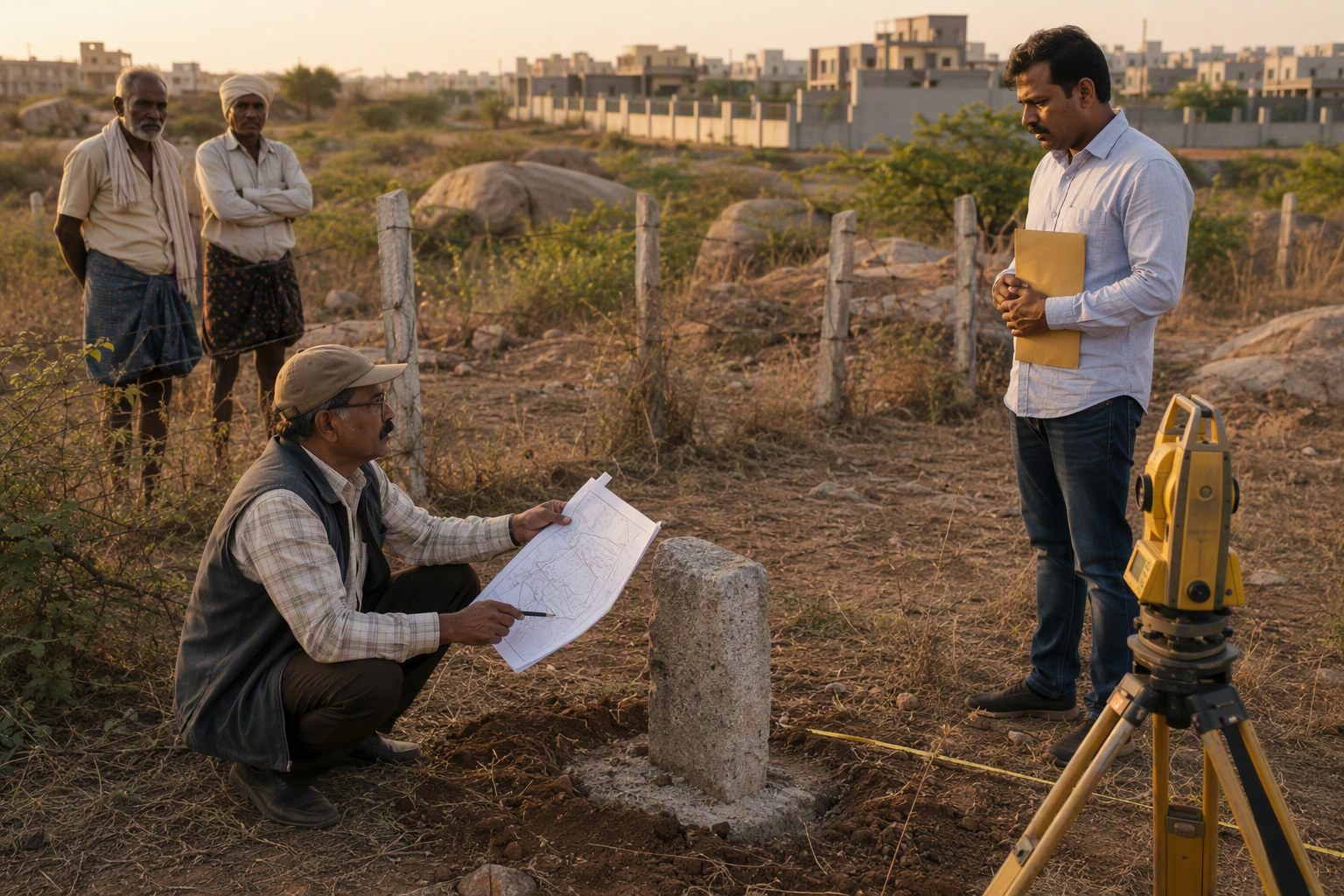



Hyderabad Redevelopment Experts Flag Telangana Title Gaps as the city’s ageing apartment blocks, co-operative society layouts and old colony plots move into a new redevelopment cycle. Architects, redevelopment consultants and title lawyers we spoke to say one number has changed the mood in many meetings: Telangana has 147,934 prohibited property records under Section 22-A. That is not a small clerical issue. For an old building in Ameerpet, Chikkadpally, Tarnaka, Himayatnagar, Dilsukhnagar, Kukatpally or Secunderabad, a title gap can now decide whether a Joint Development Agreement is bankable, delayed, or quietly dropped.
The shift is visible. Earlier, many resident associations started with FSI, rent, corpus and flat-sharing ratios. Now, senior consultants are putting title due diligence before design. Lawyers are asking for pahani extracts, old link documents, ECs, SRO records, mutation flow, survey number mapping and prohibited property checks before architects even freeze a massing study.
In our experience, the old Hyderabad redevelopment conversation was: how many extra flats can we get? The new conversation is: can this land be registered, mortgaged, sanctioned and sold without a title objection?
Hyderabad Redevelopment Experts Flag Telangana Title Gaps After 147,934 Section 22-A Records
Section 22-A of the Registration Act deals with properties where registration is prohibited or restricted. In Telangana, the prohibited pool includes several categories: government lands, assigned lands, endowment and waqf properties, court-disputed records, ceiling-related lands, and entries that have carried forward through older revenue systems. The official count of 147,934 prohibited properties is now being treated by redevelopment professionals as a risk signal, especially for colonies built over several decades through layouts, society allotments, GPAs and family partitions.
This does not mean every old apartment in Hyderabad has a problem. It does mean that one cannot treat a 1985 sale deed and a municipal tax receipt as sufficient comfort. Many old colony parcels have clean possession but weak paperwork. Some have proper municipal numbers but unclear survey number ancestry. Some have valid flats but common land portions that were never clearly conveyed. Some are located in areas where historical revenue entries, layout approvals and present Dharani data do not speak the same language.
That is why redevelopment consultants are now asking associations to run a basic digital scan early through a Section 22-A Prohibited Property Check, a Encumbrance Certificate Search and a Survey Number Finder. These do not replace a title lawyer, but they help a society avoid spending lakhs on drawings and feasibility when the underlying land has a registration block.
Why Hyderabad Redevelopment Experts Flag Telangana Title Gaps Before FSI Talks
For old apartment blocks, title is no longer a back-office item. It affects the entire redevelopment math. A developer investing in demolition, transit rent, corpus, approvals, construction finance and marketing wants a clean mortgageable title. Banks also want clarity. RERA registration will need promoter declarations and land title documents. Buyers in the new project will expect the project to stand up to due diligence, not only look attractive in a brochure.
Consider a 1,800 sq yd apartment site in Ameerpet mandal limits, close to SR Nagar or Balkampet. If the road width supports a decent FAR, the redevelopment value may look strong. Ageing flats in Ameerpet and SR Nagar commonly see resale quotes in the broad range of ₹8,000 to ₹12,000 per sq ft, depending on age, undivided share, parking and access. On paper, a new project may fetch a premium. But if the site’s older link deed refers to a survey number that now shows a partial prohibited entry, the architect’s feasibility is only half the story.
The same pattern is seen in Kukatpally, Nizampet-side layouts, Tarnaka, Habsiguda, Vidyanagar, Dilsukhnagar, Malakpet, East Marredpally and parts of Alwal. Market values and buyer demand are strong in many of these pockets. Kukatpally old apartment resale quotes often move around ₹7,000 to ₹10,500 per sq ft, while Tarnaka and Habsiguda frequently sit around ₹6,000 to ₹9,000 per sq ft. Dilsukhnagar and Malakpet old stock can range around ₹5,500 to ₹8,000 per sq ft. These are field-level market bands, not a substitute for the SRO market value. For official registration value, residents should check the Market Value / Guideline Value Search.
The issue is simple: redevelopment profit comes only after saleable title is created. If title is stuck, even a high-demand locality cannot save the deal.
What Architects Are Doing Differently In Old Colony Redevelopment
Architects in Hyderabad are becoming more cautious at the concept stage. Earlier, many would begin with road width, plot size, setbacks, parking and height. Those remain essential. But experienced architects now ask one direct question before spending too much time: has the land title been screened?
For a redevelopment site in Himayatnagar or Narayanguda, the road width may be attractive and the neighbourhood may support premium pricing. But if the old building sits on a plot carved from a private layout where approved layout drawings are missing, the architect cannot assume the full site area is sanctionable. In Secunderabad Cantonment-adjacent pockets, East Marredpally and West Marredpally, the planning context can be different from GHMC areas. In older Musheerabad, Chikkadpally and RTC X Roads pockets, plot shapes and road widening marks can reduce usable area.
Good architects are now doing three checks before giving residents a confident redevelopment number:
- Road width and access: Whether the existing road width supports the proposed building height and parking movement. A quick first check can be done through the Road Width Check.
- Land use and zoning: Whether the site falls in a residential, commercial, mixed-use, conservation, water body buffer or other restricted zone. Residents can start with the Land Use Zone Finder.
- FSI/FAR feasibility: Whether the redevelopment expectation matches the realistic built-up potential. The FSI/FAR Calculator gives a useful first estimate.
We have seen resident associations push for unrealistic sharing ratios because someone nearby got a better deal. That approach is risky. A 40-year-old block on a 60-feet road in Himayatnagar is not the same as a narrow-lane block in Chikkadpally. A corner plot in Tarnaka is not the same as an interior plot in an old Nallakunta lane. The title, road, zoning and market absorption must be read together.
Title Lawyers Are Looking Beyond The Sale Deed
Title lawyers handling redevelopment are no longer stopping at the current sale deed and tax receipts. For old buildings, they are reconstructing the ownership chain from the earliest available document. They are checking whether the land was agricultural before conversion, whether pahanis support private title, whether the layout was sanctioned, whether any GPA sale was regularised, and whether all flat owners have proper undivided share.
The word "pahani" still matters. So does Dharani. So does the SRO record. Telangana’s shift to digital land records has made searches faster, but it has also exposed mismatches. A lawyer may find one extent in the link deed, another in municipal records, and a different subdivision in revenue records. In redevelopment, that gap becomes expensive because the developer needs to register new flats and convey undivided share to future buyers.
Lawyers are paying special attention to five title gaps:
- Section 22-A entries: Any match with prohibited property records, even partial survey number overlap.
- Assigned or government land suspicion: Especially in peripheral mandals and older absorbed villages.
- Missing link documents: Breaks in ownership chain due to unregistered GPA, family arrangements or lost deeds.
- Society layout issues: Allotment letters without full conveyance, unclear common areas, or unapproved internal roads.
- UDS mismatch: Flat-wise undivided share not matching the total land extent available for redevelopment.
For residents, this can feel irritating. Nobody likes hearing that a building where families have lived for 30 years needs a fresh title audit. But redevelopment is a new transaction, not merely repair work. The old comfort of possession is not enough when a new tower, bank funding and buyer registrations are involved.
Redevelopment Consultants Are Rewriting JDA Risk Clauses
Joint Development Agreements in Hyderabad are also changing. Earlier, many JDAs focused on area sharing, rent, construction timelines, corpus, specifications and penalty clauses. Those points remain. But consultants now want title-related conditions written with more care.
A practical JDA for an old colony redevelopment should state who is responsible for clearing title objections, who pays for missing document reconstruction, what happens if a Section 22-A issue appears, how long the developer will wait, and whether the agreement automatically terminates if registration becomes impossible. Without such clauses, residents and developers can end up in a deadlock.
| Old redevelopment approach | New expert approach |
|---|---|
| Start with flat-sharing ratio and corpus demand | Start with title audit, 22-A check and SRO verification |
| Architect prepares concept based on site measurement | Architect waits for title extent, road width and land use clarity |
| Assume all flat owners have clear UDS | Check UDS schedule, sale deeds and total land reconciliation |
| Developer accepts title based on EC and tax receipt | Developer asks for full link documents, pahani trail and legal opinion |
| JDA has generic defect clauses | JDA specifies title objection process, cost and exit rights |
In our view, this is healthy. It slows the early excitement, yes. But it reduces the chance of a project getting stuck after residents vacate. A delayed feasibility report is far better than a half-demolished building with a registration dispute.
Locality Examples: Where Title Gaps Can Hurt Redevelopment Value
Hyderabad’s redevelopment market is not uniform. Central areas have strong end-user demand but smaller plots and tighter roads. Western suburbs have better absorption but some older layouts carry society documentation issues. Eastern and northern pockets have attractive prices, but survey number and revenue history checks become very relevant in absorbed village areas.
Ameerpet, SR Nagar and Balkampet
These locations attract redevelopment interest because metro connectivity, coaching centres, offices and rental demand remain strong. But many plots are old, building records may be fragmented, and parking expectations are difficult to satisfy. SRO value and market value can differ sharply, so residents should check stamp duty exposure through the Stamp Duty Calculator before agreeing on transfers or equalisation arrangements.
Himayatnagar, Narayanguda and Chikkadpally
These are mature city pockets with high emotional value for owners. Developers like them because resale demand is steady. The main issues are road width, old municipal permissions, setback feasibility and link documents. In narrow lanes, the promised built-up area may not survive scrutiny.
Tarnaka, Habsiguda and Vidyanagar
These areas have good education, metro and employment access. Many old apartments sit on plots that look ideal for redevelopment. But some parcels need careful survey mapping because older records may refer to village names and survey numbers that residents rarely discuss today.
Kukatpally, Nizampet and Miyapur belt
Demand is strong, and market pricing supports redevelopment in many colonies. Still, society layouts, old GPAs, HMDA/GHMC approval history and road handover details must be checked. A good consultant will not treat every old block as automatically redevelopment-ready.
Dilsukhnagar, Malakpet and LB Nagar side
These markets are price-sensitive but deep. Families want better parking, lifts and larger flats. Title checks are crucial where older plots changed hands through multiple family partitions. A missing link deed can delay the JDA far more than residents expect.
How Resident Associations Should Start A Safe Redevelopment Process
A residents’ association does not need to become a law firm. But it should collect documents in a disciplined way before inviting developers. The first file should include sale deeds of all flats, link documents of the land, sanctioned plan, occupancy or completion documents if available, property tax receipts, water and electricity records, society registration papers, EC, mutation records and any court case details.
Then the association should run a three-layer check. First, a digital screening: prohibited property, EC, SRO and guideline value. Second, a professional legal opinion from a title lawyer who understands Telangana land records. Third, a technical feasibility by an architect or redevelopment consultant covering FSI, setbacks, road width, parking and land use.
Residents should also identify their correct SRO early through the Find Your SRO Office. In old city and central Hyderabad properties, people often assume the wrong registration office based on postal address. For legal searches, the SRO jurisdiction matters.
If a developer is already in talks, ask for the proposed RERA path. Once a new project is launched, buyers will check the promoter and project details. The association can monitor this through the RERA Project Lookup. A serious developer will not object to transparent checks.
Hyderabad Redevelopment Experts Flag Telangana Title Gaps, But The Market Is Not Weak
The title caution should not be misunderstood as a negative call on Hyderabad redevelopment. The opportunity is real. Many 25 to 45-year-old buildings in central and inner-ring localities are functionally outdated. Lifts are old or absent. Parking is poor. Plumbing lines are tired. Families want larger balconies, better security and safer structures. Developers want land in built-up neighbourhoods where demand is proven.
What has changed is the standard of proof. Telangana’s 147,934 prohibited property records have reminded the market that land history matters. A clean redevelopment file will command better developer interest. A messy file will get discounted, delayed or avoided.
My opinion is blunt: resident associations should spend money on title and feasibility before negotiating corpus. It is not glamorous, but it saves time. If the land is clean, the association negotiates from strength. If there is a gap, it can be addressed before promises are made to senior citizens, tenants and homebuyers.
Hyderabad’s next redevelopment wave will not be won only by builders offering higher ratios. It will be won by teams that can connect Dharani, pahani, SRO, GHMC/HMDA planning, RERA and market reality into one workable project file. That is where the better architects, consultants and lawyers are already moving.
Frequently Asked Questions
What does Section 22-A mean for Hyderabad redevelopment?
Section 22-A covers properties where registration is prohibited or restricted. If an old apartment site has a full or partial match in prohibited records, the redevelopment JDA, bank funding, RERA process and future flat registrations can be affected.
Can an old building with clear property tax receipts still have a title gap?
Yes. Property tax proves municipal assessment and possession history, but it does not by itself prove clean land title. Lawyers still check link deeds, EC, SRO records, pahani trail, Dharani data, UDS schedules and any prohibited property entries.
Which Hyderabad localities need extra caution before redevelopment?
Old colony areas such as Ameerpet, SR Nagar, Himayatnagar, Chikkadpally, Tarnaka, Habsiguda, Kukatpally, Dilsukhnagar, Malakpet and Secunderabad pockets need careful checks because many buildings have older documents, tight roads and layered ownership histories.
Should residents check FSI first or title first?
Do both early, but title should not be postponed. A strong FSI number has little value if the land cannot be registered, mortgaged or sold cleanly. Start with 22-A, EC, SRO and survey number checks, then finalise the architectural feasibility.
What documents should an association collect before inviting developers?
Collect all flat sale deeds, land link documents, sanctioned plans, tax receipts, EC, society papers, mutation records, UDS schedules, court case details if any, and old layout approvals. A title lawyer can then prepare a proper redevelopment legal opinion.