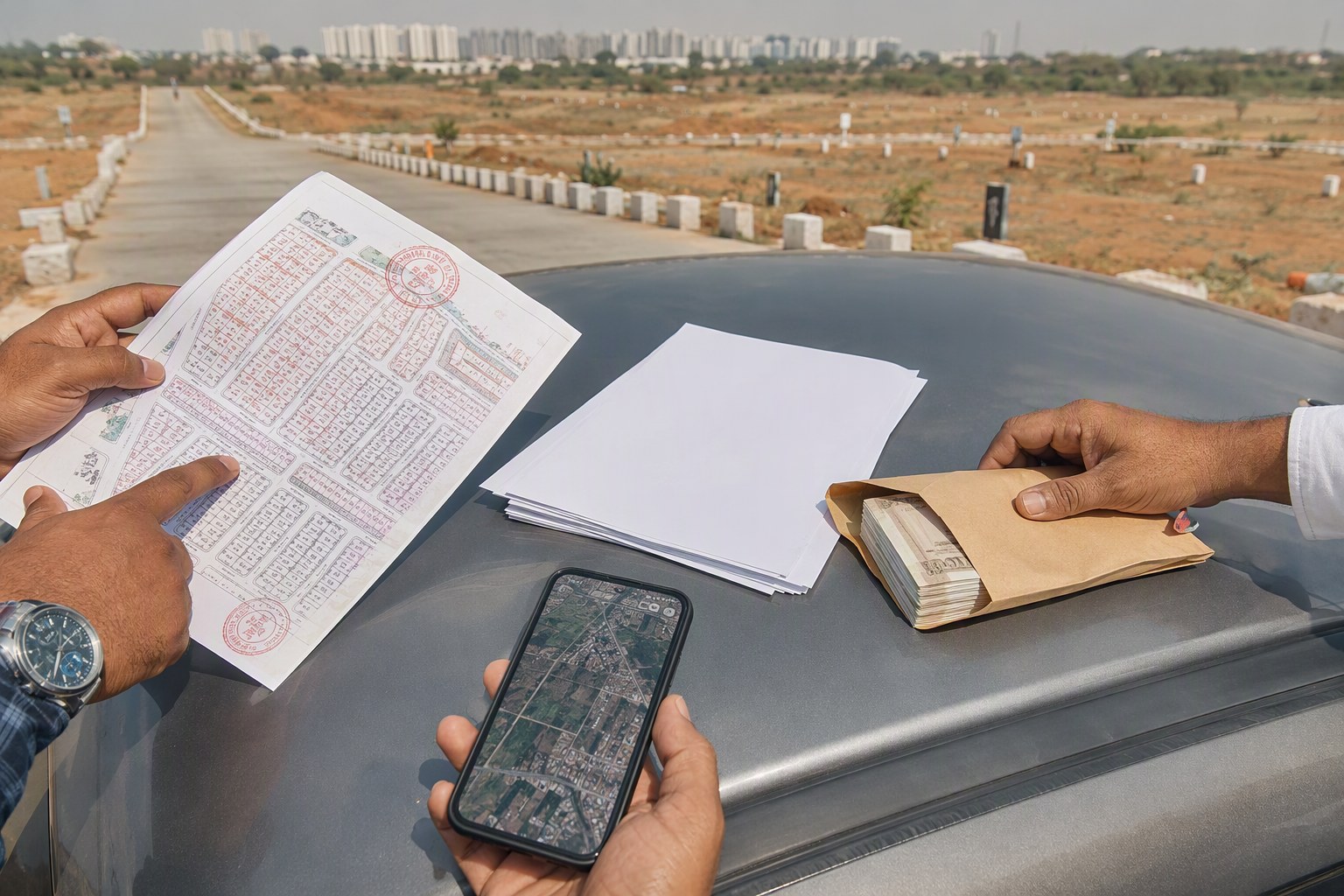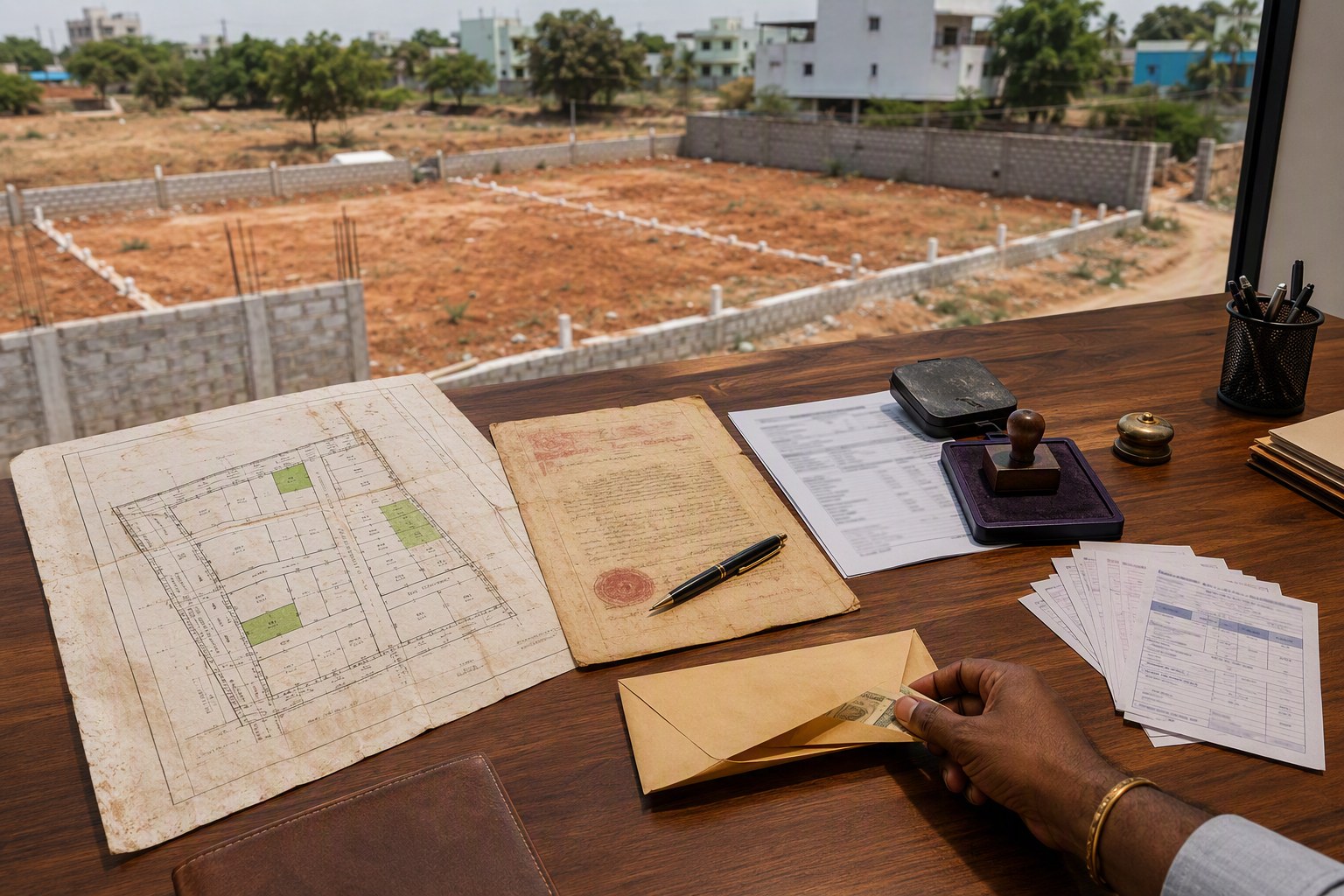



Telangana Fractional Property: Safer Than Buying a Flat?
Telangana Fractional Property can be safer than buying a full flat only when the underlying title is clean, the ownership structure is documented properly, the Encumbrance Certificate is reviewed, and the asset is not exposed to Section 22-A prohibition. If any of these are weak, fractional investment can become riskier than a regular flat purchase because your exit depends on other co-owners, platform terms, buyer appetite, and legal clarity.
That is the direct answer. Now let us look at it like Telangana investors should: not as a fancy investment idea, but as a property transaction where pattadar passbook, pahani, Dharani records, SRO registration, EC, RERA status, ready reckoner value, and 22-A status decide the real safety.
In our experience, a small share in a clean property is better than full ownership of a disputed property. But a small share in a poorly checked asset can trap your money more quietly than a bad flat purchase.
Telangana Fractional Property: What are you actually buying?
Fractional property investment means multiple investors own or economically participate in one property. In Hyderabad and nearby districts, these deals usually come in three broad formats:
- Direct co-ownership: Your name is registered as one of the co-owners in the sale deed, with a defined undivided share.
- Entity-based ownership: A private limited company, LLP, trust, or SPV owns the property, and you hold shares, units, or contractual rights.
- Revenue-share model: You may not directly own the property; you participate in rental income or future sale proceeds based on an agreement.
This distinction is not academic. It decides whether you can search your name in property records, whether you can independently sell, whether your right is visible at the SRO, and whether a bank or buyer will respect your interest later.
For a flat in Kondapur, Narsingi, Manikonda, Miyapur, Tellapur, Kokapet, Uppal, or LB Nagar, the ownership path is familiar. You check the builder, RERA, sale deed, link documents, EC, approved plan, occupancy certificate, and then register. With fractional property, the property may be a commercial floor in Gachibowli, a warehouse near Shamshabad, a plotted land parcel in Shankarpally mandal, or an agricultural conversion case near Chevella. The checks become wider.
Telangana Fractional Property safety starts with title clarity
The biggest safety question is simple: who owns the asset today, and how exactly do you become part of that ownership?
If your name enters the registered sale deed as a co-owner, your position is clearer. The SRO record shows you. The EC should reflect the registered transaction. Your share can be defined. But even then, you cannot behave like the sole owner. Sale, mortgage, redevelopment, lease renewal, and litigation decisions may need consent from other co-owners.
If you are buying through an SPV or platform, ask whether you are getting property ownership or only securities, units, or contractual income rights. Many investors hear the word property and assume land-style ownership. That is a mistake. In entity-based structures, your claim is usually against the entity or as per the investment agreement, not necessarily a direct right over the survey number or flat number.
For Telangana, title clarity must be checked at three levels:
- Property level: survey number, sub-division, boundaries, extent, land nature, approvals, and link documents.
- Owner level: present owner, past owners, legal heirs, GPA holders, company authority, board resolution, and pending disputes.
- Investor level: your exact rights, voting power, exit terms, revenue share, transfer restrictions, and dispute resolution.
Before even comparing fractional property with a flat, use the Property Verification Tool, run a Encumbrance Certificate Search, and check if the land is hit by Section 22-A Prohibited Property Check. These three checks catch many early warning signs.
Is fractional property safer than buying a flat in Hyderabad?
Sometimes, yes. Often, no. It depends on what risk you are trying to reduce.
If your budget is ₹10 lakh to ₹25 lakh, buying a full flat in prime Hyderabad is not practical. A decent 2BHK in many active micro-markets may need a much bigger ticket size. Fractional property allows exposure to assets that individual buyers may not access, like leased commercial spaces in HITEC City, Gachibowli, Financial District, or warehouses around Shamshabad and Medchal.
But safety is not only about entry price. A full flat gives you control. You can live in it, rent it, mortgage it, sell it, gift it, or settle it through a family arrangement. Fractional property gives limited control. The asset may be stronger, but your personal control may be weaker.
| Factor | Fractional Property | Full Flat Purchase |
|---|---|---|
| Entry amount | Lower ticket size, often attractive for small investors | Higher ticket size, especially in West Hyderabad |
| Title visibility | Clear only if your share is registered or structure is transparent | Usually direct in your name after registration |
| Control | Shared control; platform or co-owner rules matter | High control as individual owner |
| Exit | Can be difficult if secondary market is weak | Easier if locality has buyer demand and bankable title |
| Due diligence | Needs property plus structure checks | Needs property, builder, and approval checks |
| 22-A risk | High damage if ignored, especially in land-backed assets | Also serious, but flats in approved projects are easier to screen |
My opinion is this: fractional property is not automatically safer. It is only more affordable. Safety comes from documentation, title, legal enforceability, and exit route.
Section 22-A exposure is the Telangana risk many investors underestimate
Telangana has a serious prohibited property risk. As per the database fact used by Verified.RealEstate, there are 147,934 prohibited properties under Section 22-A. That number should make every investor pause before putting money into any land-backed deal.
Section 22-A properties may include government lands, assigned lands, endowment lands, wakf-related properties, certain ceiling surplus lands, and other categories where registration can be prohibited or restricted. If a fractional platform or seller is offering a land parcel near Shadnagar, Kandukur, Maheshwaram, Ibrahimpatnam, Yadadri belt, Medchal, or Chevella, the first question should not be expected return. The first question should be: is this survey number clean for registration?
In agricultural and converted land cases, check the survey number properly. Do not rely only on a brochure name like Highway County, Pharma City View, or Airport Growth Zone. Marketing names do not matter at the SRO. Survey number, village, mandal, extent, and owner history matter.
Use the Survey Number Finder to identify the correct survey number, then check the property through the Section 22-A Prohibited Property Check. If the asset is a flat or commercial unit, check the project and land details through the RERA Project Lookup where applicable.
One practical warning: if a seller says registration cannot happen now but will happen later after regularisation, be very careful. In Telangana, many investors have lost time and money because they accepted future promises instead of present legal clarity.
EC checks: Fractional property needs a deeper Encumbrance Certificate review
An Encumbrance Certificate is not just a formality. It shows registered transactions affecting the property for the selected period. In Telangana, EC review is essential for flats, plots, agricultural land, and commercial assets.
For a flat, we usually check the parent land EC, development agreement, GPA, sale deeds, mortgage releases, builder transfers, and your final sale deed. For fractional property, add one more layer: whether the transaction giving you rights is itself registered or only privately contracted.
Ask these questions:
- Does the EC show the present seller as owner?
- Are there mortgages, charges, court attachments, or agreements of sale?
- Is the development agreement registered?
- If it is commercial property, are lease deeds registered?
- If it is co-ownership, will your share appear in the EC after registration?
- If an SPV owns it, does the EC show the SPV as owner?
Run an Encumbrance Certificate Search before paying any booking amount. If the deal is above your comfort level, take a lawyer's title opinion for at least 30 years of link documents. For older city areas like Secunderabad, Abids, Himayatnagar, Narayanguda, and parts of Begumpet, document chains can be messy. For newer growth zones like Kokapet, Narsingi, Tellapur, Kollur, Mokila, and Shankarpally, land history and conversion records matter more.
Ready reckoner value and real market price: do not ignore the gap
Fractional property pitches often talk about valuation. Investors should compare three values: Telangana market value or guideline value, actual transaction value, and expected resale value.
The government ready reckoner value is used for stamp duty and registration calculations. It may be lower than actual market price in strong localities like Jubilee Hills, Banjara Hills, Madhapur, Gachibowli, Kondapur, Kokapet, and Financial District. In emerging plotted corridors, the gap can swing sharply depending on road width, zoning, access, and approvals.
Before accepting any valuation, check the base value through the Market Value / Guideline Value Search and estimate duties through the Stamp Duty Calculator. For apartments, use the Composite Value Calculator to understand how land share and construction value may be viewed.
Here is a simple Hyderabad example. A leased commercial unit in Gachibowli may look attractive because rental yield is higher than a residential flat. But if the purchase price is already at a premium and the lease has lock-in risks, your actual exit value may be lower than the platform projection. On the other side, a flat in Miyapur or Nallagandla may give lower rental yield but better retail buyer demand when you want to sell.
Exit risk: the biggest weakness in fractional property
Many investors ask about safety at the time of buying. I prefer asking about safety at the time of selling.
A full flat has a wider resale market. If the title is clean and pricing is realistic, you can approach brokers, online portals, banks, NRIs, families, and investors. A fractional share is harder. The buyer has to understand the structure, accept shared control, trust the co-owners or platform, and agree to the transfer process.
Check the exit terms before investing:
- Can you sell your share independently?
- Do other co-owners have first right of refusal?
- Is there a platform-managed resale window?
- What fees apply on exit?
- Can the platform block transfer?
- What happens if the property is not sold within the expected period?
- Are rental payouts guaranteed or only projected?
In our experience, exit risk is where glossy fractional property presentations become thin. A promised annual return is not the same as a legally enforceable exit. If the document says exit is subject to finding a buyer, treat it as market risk, not fixed-income safety.
When a full flat is safer than Telangana fractional property
A full flat is usually safer when you want control, family use, bank finance, predictable resale, and visible ownership. This is especially true in RERA-registered apartment projects in established localities.
For example, a RERA-registered flat in Narsingi, Kondapur, Tellapur, Miyapur, Kompally, Uppal, or Bachupally may be easier for a normal buyer to understand. Banks do their own due diligence. The sale deed is in your name. The flat number is identifiable. Maintenance, association rules, and occupancy are visible.
Still, flats are not risk-free. We have seen cases of delayed occupancy certificates, deviation issues, pending landowner shares, mortgage non-release, and wrong UDS calculation. So flat safety also needs checks. Use the RERA Project Lookup, verify EC, check SRO jurisdiction through Find Your SRO Office, and review the sanctioned plan.
A flat is safer than fractional property when:
- You need an asset you can occupy or rent directly.
- You want easier home loan eligibility.
- You are not comfortable with SPV agreements.
- You want a clear resale market.
- You prefer a registered sale deed in your individual name.
When Telangana Fractional Property can be safer or smarter
Fractional property can make sense when the asset quality is high, the documentation is transparent, and the investor understands limited control. A professionally leased Grade A commercial asset in Hyderabad's IT corridor may offer steadier rental income than a small flat bought in a weak rental pocket. A warehousing asset near Outer Ring Road access may perform well if title, permissions, and lease terms are strong.
It may be suitable for investors who already own a primary home and want exposure to commercial property without buying an entire floor. It may also suit NRIs who do not want tenant handling issues. But the structure must be clean.
Good fractional property deals usually have:
- Registered title in the name of the selling entity or SPV.
- Clear EC with no unexplained charges.
- No Section 22-A hit.
- Proper land use and building permission.
- Registered long-term lease, where rental income is the main pitch.
- Audited payout statement or transparent rental collection mechanism.
- Clear exit clause and transfer process.
For land-backed opportunities, check zoning through the Land Use Zone Finder, road access through the Road Width Check, and development potential through the FSI/FAR Calculator. These checks matter because land value is not only about location. It is about usable, approvable, transferable land.
Telangana Fractional Property due diligence checklist before paying
Use this checklist before you transfer even a token amount. Token money is where many buyers become emotionally locked.
1. Identify the exact property
Get the survey number, village, mandal, district, door number if any, municipal number, plot number, flat number, and boundaries. For Hyderabad assets, identify whether it falls under GHMC, HMDA, municipality, gram panchayat, or another authority.
2. Check ownership and link documents
Ask for 30 years of link documents, current sale deed, mutation entries, Dharani extract where relevant, pahani, passbook details for agricultural history, conversion orders, and building permissions.
3. Verify EC and SRO records
Match the EC with link documents. If there is a missing transaction, ask why. If the seller changed name through inheritance, partition, merger, company transfer, or court order, get supporting documents.
4. Screen Section 22-A
Do not skip this for land. With 147,934 prohibited properties under Section 22-A in the database fact, Telangana investors cannot treat this as a rare issue.
5. Understand the investment structure
Ask whether you are a co-owner, shareholder, unit holder, lender, or revenue participant. Each has different rights.
6. Read exit and dispute clauses
Check lock-in, resale fee, transfer restrictions, arbitration venue, jurisdiction, default rules, and platform shutdown clauses.
7. Check tax impact
Rental income, capital gains, TDS, GST on commercial rentals, and entity-level taxation can change your real return. Before selling, estimate tax through the Capital Gains Tax Calculator.
Final verdict: safer than a flat, or not?
Telangana Fractional Property is not automatically safer than buying a flat. It is safer only when the asset title is stronger than the average flat, the ownership structure is transparent, the EC is clean, Section 22-A is ruled out, and the exit mechanism is practical.
If you are a first-time property buyer in Hyderabad, a clean RERA flat may be easier to understand and safer to control. If you are an experienced investor with legal support, fractional property can be a useful way to access commercial or high-value assets. But treat it as real estate, not as a simple app-based investment.
My working rule is simple: if your name, rights, exit, and title cannot be explained in plain English within ten minutes, do not invest. Telangana property rewards patience. It punishes assumptions.
Frequently Asked Questions
Is Telangana fractional property legally safe?
It can be legally safe if title is clear, EC is clean, Section 22-A risk is ruled out, and your ownership or investment rights are properly documented. Safety depends on the structure, not the label fractional.
Is fractional property better than buying a flat in Hyderabad?
For control and resale, a full flat is usually better. For lower entry amount and access to commercial assets, fractional property may work. Compare title, exit, rental certainty, and legal rights before deciding.
What is the biggest risk in fractional property investment?
The biggest risk is exit. Selling a fractional share can be harder than selling a flat because buyers must accept shared ownership, platform rules, and transfer restrictions.
Why is Section 22-A check critical in Telangana?
Section 22-A covers prohibited properties where registration may be restricted. Telangana has 147,934 prohibited properties as per the database fact, so every land-backed investment should be checked before payment.
Which documents should I check before investing?
Check sale deed, link documents, EC, Dharani or pahani records where relevant, mutation, conversion orders, building permissions, RERA details if applicable, lease deeds, and the investor agreement.