

Case Study: Inherited Plot vs Builder Share Flat Risks
Token money is usually paid when the buyer is emotionally convinced but legally underprepared. That is where many Telangana property mistakes start. One buyer says, “Sir, plot is ancestral, family is known.” Another says, “Flat is builder share, project is almost ready.” Both sound safe in casual discussion. On paper, they carry very different risks.
For this case study, let us compare two realistic Hyderabad-area transactions before token money is paid. The first is an inherited open plot in a developing gram panchayat-to-municipal belt. The second is a builder share flat in a RERA-registered apartment project. Both can be good purchases. Both can also become headache properties if the buyer checks the wrong things in the wrong order.
My view is simple: do not treat every property verification like a standard checklist. A plot, a flat, a builder share unit, an inherited asset, an assigned land parcel, and a redevelopment share all ask different questions.
The Two Buyer Situations
| Point | Case A: Inherited Plot | Case B: Builder Share Flat |
|---|---|---|
| Property type | Open plot inherited by siblings from their father | Apartment allotted to builder as part of landowner-builder sharing |
| Buyer attraction | Clear location, lower price than nearby layouts, direct family sellers | Ready-to-occupy feel, branded project, builder offering discount |
| Main legal worry | Title flow, succession, partition, prohibited land, layout approval | RERA status, sharing agreement, builder’s right to sell, mortgage, approvals |
| Common token trap | Paying based on family reputation and old pattadar passbook copies | Paying based on sample flat, brochure, and builder salesperson assurance |
| Best first check | Survey number, EC, prohibited property check, revenue history | RERA, sanctioned plan, builder share documents, EC and CERSAI |
Case A: The Inherited Plot
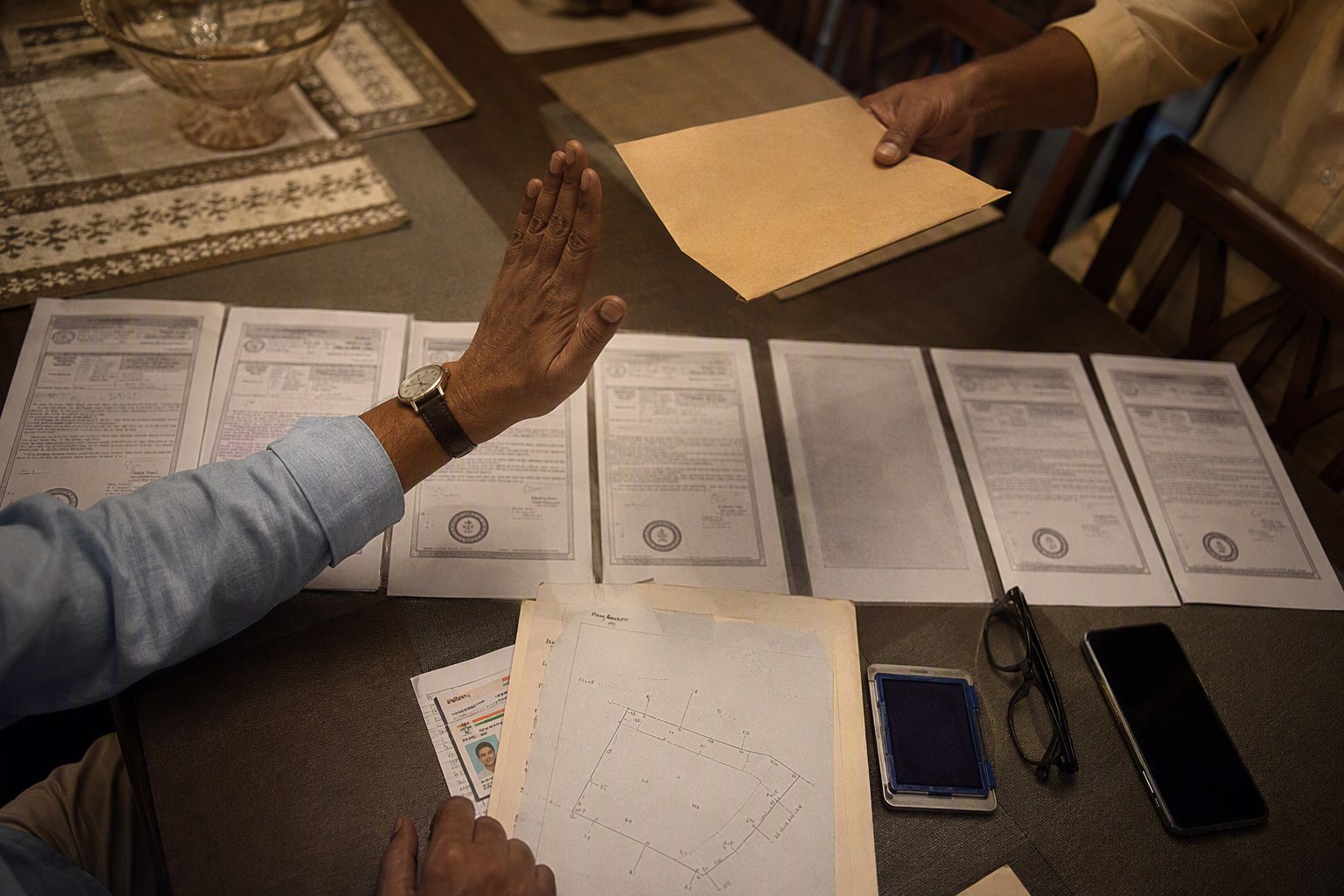
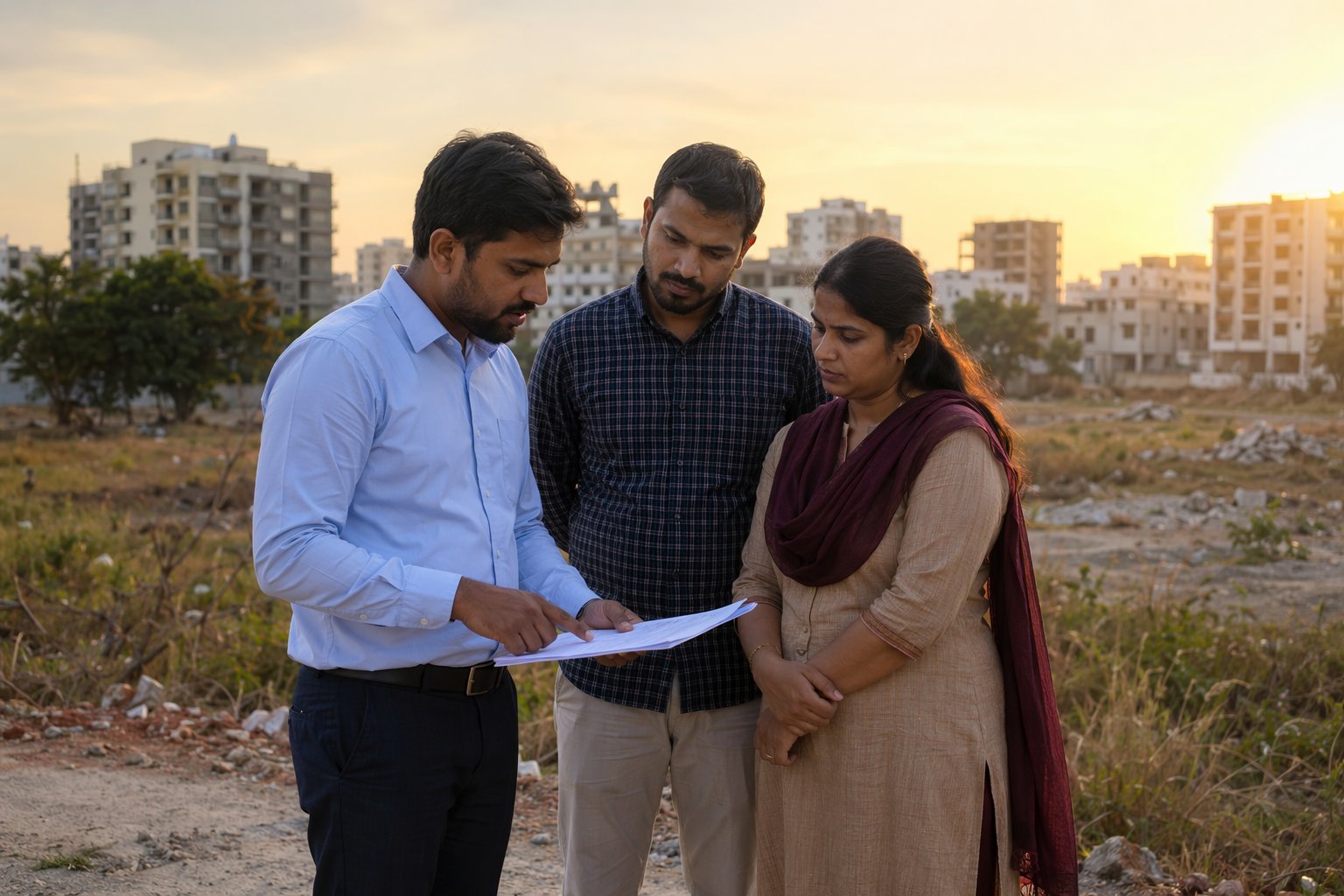
Our first buyer is looking at a 300 square yard plot on the outskirts of Hyderabad. The sellers are three siblings. They say the land came from their father, who purchased it long back. The plot has compound stones, nearby houses, and a road in front. The price is slightly attractive. The buyer is asked to pay token money quickly because another party is supposedly ready.
This is a classic inherited plot situation. The risk is not only whether the father owned the land. The bigger question is whether the present sellers have full legal capacity to sell the exact plot, with clean boundaries, without claims from other heirs, revenue restrictions, or layout defects.
Risk 1: Title May Be Clear in the Past but Weak in the Present
Many buyers check the old sale deed and relax. That is not enough. If the original owner has died, the buyer must confirm who inherited the property. Was there a registered partition deed? Was there a family settlement? Did the mother have a share? Are any daughters living abroad? Was any minor involved at the time of partition? Did any legal heir sign a release deed?
In Telangana, family property cases often look friendly until money enters. A brother may say, “All are agreed.” Fine. Then let all legal heirs sign the sale deed or give proper registered authorisation where legally acceptable. Oral understanding is not title verification.
Risk 2: Survey Number Confusion
Open plots can suffer from location-title mismatch. The document may mention one survey number, while the physical plot shown on ground may fall partly in another survey number. This happens in old layouts, unapproved plotting, village boundary edges, and areas where roads were informally created.
Before paying token money, the buyer should use a Survey Number Finder and cross-check the village, mandal, extent, and plot location. A site visit with document boundaries is better than only seeing Google location pins shared on WhatsApp.
Risk 3: Prohibited Property and Revenue Restrictions
This is where plot buyers must be extra cautious. A land parcel can be affected by restrictions that do not appear in a casual sale deed discussion. It may be government land, assigned land, endowment land, wakf-related land, ceiling surplus land, court-attached land, or land falling under a restriction list.
Verified.RealEstate maintains a database context of 3,076,153 prohibited property records for checks. That number itself shows why open land verification cannot be casual. Before token money, run a Prohibited Property Check. If the result flags an issue, do not depend on seller explanations alone. Ask for documentary clearance and take legal opinion.
Risk 4: Layout Approval and Road Access
A plot may have a document, but that does not automatically mean it is a bankable or buildable plot. Check whether the layout has approval from the correct authority. Is it HMDA, DTCP, municipality, gram panchayat legacy approval, or regularised layout? Is the road width suitable for the buyer’s planned construction? Are there open space or road widening impacts?
For practical review, the buyer can use Road Width Check, Landuse Zone Finder, and Fsi Calculator. These tools do not replace official approvals, but they help the buyer ask sharper questions before paying.
Risk 5: Encumbrance Certificate Is Necessary but Not Sufficient
An EC is a must. Use Ec Search and review transactions for the available period. If the EC shows mortgages, agreements, court orders, development agreements, or unexplained gaps, pause. An empty EC is also not a full safety certificate. Some family claims, revenue restrictions, and possession disputes may not reflect in a simple EC.
For plot cases, I prefer pairing EC review with revenue record review, prohibited property check, physical boundary verification, link document review, and heirship confirmation. If the seller resists basic documentation before token, that itself is a signal.
Case B: The Builder Share Flat
Now look at the second buyer. She wants a 2BHK flat in a mid-size apartment project near Hyderabad’s growth corridor. The flat is not from the landowner share. It is from the builder share. The builder says the project is approved, construction is nearly complete, and registration can be done shortly. The unit price is attractive because the builder wants quick cash flow.
Builder share flats are common in Telangana. A landowner gives land to a developer. The developer constructs the project. Flats are divided between landowners and builder as per a development agreement or supplementary sharing document. The builder can sell only the units that legally fall to his share, and only subject to project approvals, mortgages, RERA compliance, and agreement terms.
Risk 1: Builder Must Have Sale Right Over That Exact Flat
The first question is not whether the project is nice. The first question is whether the builder has the right to sell that specific flat number, floor, car parking, and undivided share of land. Ask for the development agreement, GPA if applicable, supplementary sharing agreement, allocation statement, and any registered document showing builder share.
A verbal statement like “this is builder quota” is too weak. The buyer must match the flat number in the sale offer with the builder allocation document. If the landowner and builder have internal disputes, buyer money can get stuck even if construction looks good.
Risk 2: RERA Status and Project Disclosures
If the project requires registration, check it on Rera. Confirm project name, promoter name, survey numbers, approved built-up details, proposed completion date, uploaded approvals, and any changes. If the builder uses a slightly different project name in marketing, ask why.
RERA check is not only for big gated communities. Even smaller projects can fall under registration requirements depending on the project size and legal threshold. A buyer should not assume that “local apartment” means no RERA concern.
Risk 3: Sanctioned Plan vs Actual Flat
In builder share flat cases, buyers often focus on interiors. False ceiling, tiles, modular kitchen, and balcony view distract from the main issue: is the flat built as per sanctioned plan? Check the sanctioned plan, permission proceedings, floor plan, common areas, setbacks, and parking marking.
If the offered flat has deviations, the risk travels with the buyer. Banks may hesitate. Occupancy certificate issues may arise. Future resale may suffer. If a builder says, “Small deviation is common,” do not accept that as legal comfort.
Risk 4: Project Mortgage and CERSAI
Builders often take project finance. That is not automatically bad. But the buyer must know whether the land, project, or specific flats are mortgaged. If yes, the buyer needs a release letter or no-objection from the lender for that unit before registration and before major payment.
Use Cersai Check and also inspect the EC. Project finance entries may appear in different ways. Ask for bank NOC for the exact flat. Do not accept a generic “loan will be cleared” promise when your money is going out.
Risk 5: UDS, Parking, Amenities and Handover
In Hyderabad apartments, buyers frequently discuss carpet area and saleable area but ignore UDS. Undivided share of land must be properly mentioned. Parking must be legally and practically identifiable. Amenities promised in marketing should be part of the agreement where possible.
Use Composite Value and Stamp Duty Calculator to understand registration value and cost impact. If the builder offers a low document value and high cash component, be careful. Apart from legality, it creates future tax and resale problems.
Side-by-Side: What to Check Before Token Money
| Verification Step | Inherited Plot | Builder Share Flat |
|---|---|---|
| Seller identity | All legal heirs, death certificate, family member certificate or succession support, release deeds if any | Promoter entity, authorised signatory, board resolution or authority letter where needed |
| Title root | Parent deed, link documents, partition or inheritance trail | Land title, development agreement, GPA, sharing/allocation document |
| Property identity | Survey number, plot number, boundaries, village, extent | Flat number, floor, block, UDS, parking, sanctioned plan reference |
| Government restriction | High priority: prohibited property, land nature, revenue classification | Check land title and restrictions behind the project land |
| Approval risk | Layout approval, road width, land use zone | Building permission, RERA, sanctioned plan, OC status where applicable |
| Finance risk | Past mortgages, private agreements, family loans | Project mortgage, flat release, CERSAI, lender NOC |
| Physical risk | Encroachment, boundary mismatch, access road dispute | Deviation, incomplete amenities, parking mismatch, handover delay |
How Token Money Should Be Handled
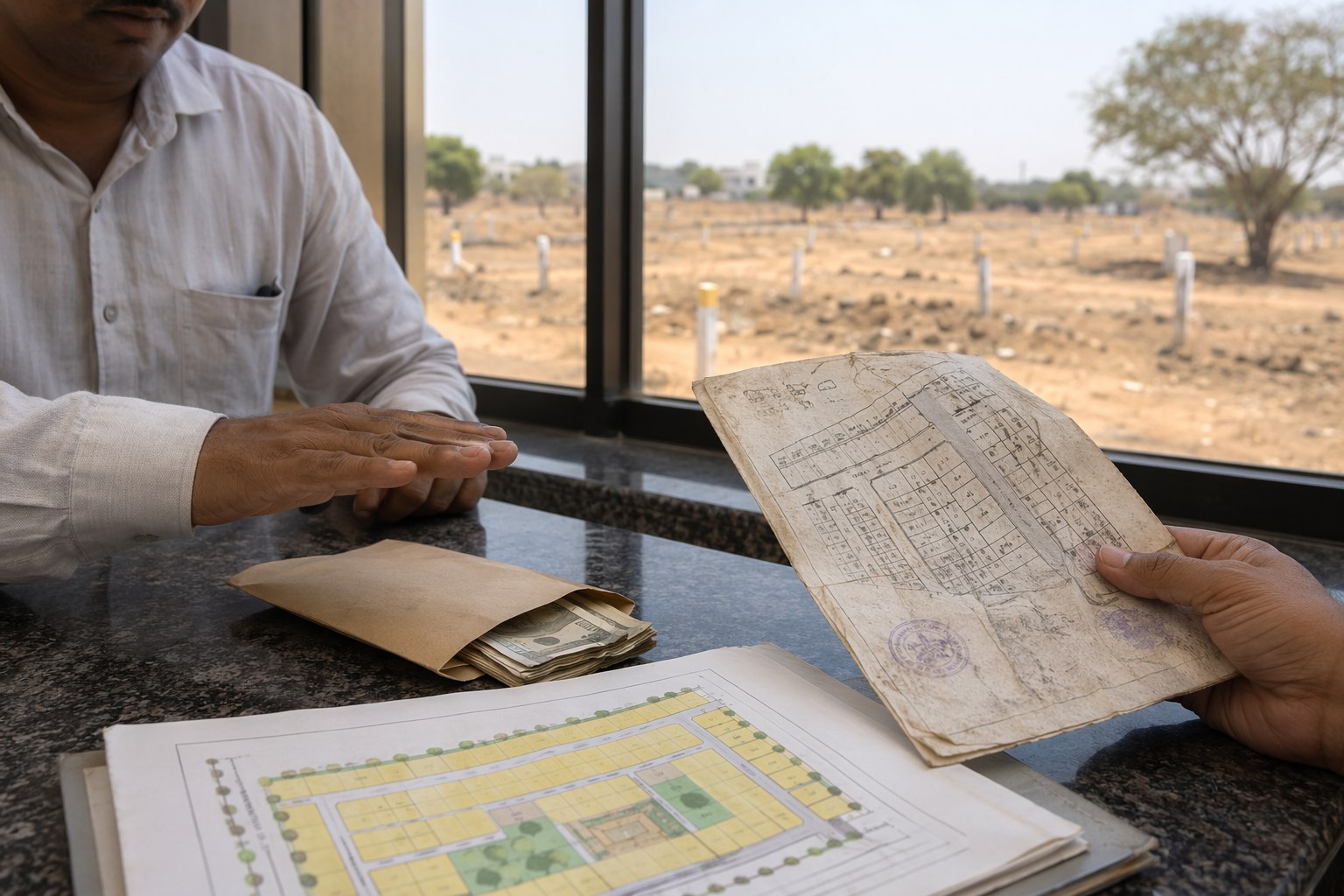
Token money is not a festival advance. It is a legal and commercial step. Whether the property is an inherited plot or builder share flat, pay token only after minimum screening. If the seller insists on immediate payment, keep the amount small and record conditions clearly.
A safe token receipt or MoU should mention the property description, seller details, amount paid, payment mode, time given for document verification, refund condition if title or approval defects are found, and list of documents to be provided. Use a proper draft through Document Generator or a lawyer-reviewed format. Never pay cash just because the other side says it is normal market practice.
For the Inherited Plot, Token Conditions Should Say:
- All legal heirs must join the sale deed or give legally valid registered authorisation.
- Sale is subject to clean title verification, EC, revenue record review, and prohibited property check.
- Seller must provide parent documents, death certificate, family member details, partition or release documents if any.
- Boundaries and survey number must match physical possession.
- Any objection from legal heirs or government records allows refund of token.
For the Builder Share Flat, Token Conditions Should Say:
- Builder must prove right to sell the exact flat through sharing/allocation documents.
- Sale is subject to RERA, sanctioned plan, EC, CERSAI, and lender NOC review.
- Flat number, UDS, parking, carpet or built-up details, and payment schedule must be clear.
- Any mortgage release must be completed before registration or as per bank-approved process.
- Delay, deviation, or title dispute should trigger refund or buyer exit rights.
Which Property Is Riskier?
There is no single answer. The inherited plot carries heavier title and land classification risk. The builder share flat carries heavier approval, allocation, mortgage, and delivery risk. In my experience, plot buyers underestimate old land issues, while flat buyers overtrust builder branding.
An inherited plot can be excellent if the title chain is clean, heirs are properly aligned, land is not restricted, layout status is acceptable, and boundaries are clear. A builder share flat can be a smart buy if the project has proper approvals, the builder has clear sale rights, lender releases are in place, and agreement terms protect the buyer.
The wrong approach is to ask only, “Is registration possible?” Registration is not the same as clean ownership. Sub-registrar processing does not certify every private title issue, every family dispute, every plan deviation, or every hidden commercial understanding.
Practical Verification Flow I Would Follow
Inherited Plot Flow
- Confirm village, survey number, plot number, extent, and boundaries.
- Run Prohibited Property Check.
- Check EC through Ec Search and review link documents.
- Verify land use with Landuse Zone Finder.
- Check road and buildability using Road Width Check and Fsi Calculator.
- Confirm SRO through Find Your Sro.
- Take legal opinion on succession and seller capacity.
Builder Share Flat Flow
- Check project and promoter details on Rera.
- Review land title, development agreement, GPA, and sharing statement.
- Match flat number, UDS, parking, and floor plan with approved documents.
- Check EC through Ec Search.
- Run Cersai Check for mortgage clues.
- Estimate registration costs using Stamp Duty Calculator.
- Track document collection with Property Tracker.
Final Professional Take
If I were advising a buyer before token money, I would not ask whether the property is a plot or flat first. I would ask: who has the right to sell, what exactly is being sold, what government or lender restrictions exist, and what happens if verification fails?
For inherited plots, the danger is often hidden behind family familiarity. For builder share flats, the danger is hidden behind construction progress and sales office confidence. A buyer should respect both risks. Hyderabad and Telangana property markets reward speed, but only after basic verification. Fast payment without documents is not smart negotiation; it is avoidable exposure.
Pay token only when your exit route is written, your document list is pending in a controlled way, and your first-level checks do not show red flags. That one discipline can save months of legal follow-up and lakhs of rupees in blocked money.
Frequently Asked Questions
Is an inherited plot safe to buy in Telangana?
It can be safe if the title chain, legal heirs, revenue records, prohibited property status, layout approval, and boundaries are properly verified. Do not rely only on an old sale deed.
What is the biggest risk in a builder share flat?
The builder must have clear right to sell that exact flat. Buyers should check the development agreement, sharing document, RERA details, sanctioned plan, EC, and mortgage release status.
Should I pay token money before document verification?
Avoid it where possible. If token is unavoidable, keep it small, pay through bank mode, and record refund conditions if title, approval, mortgage, or legal heir issues are found.
Does EC prove that a property has no legal problem?
No. EC is necessary, but it does not capture every family claim, land restriction, plan deviation, possession issue, or private dispute. It must be read with other records.
Which checks should come first for an open plot?
Start with survey number confirmation, EC, prohibited property check, title documents, legal heir verification, land use, layout approval, road access, and physical boundary inspection.