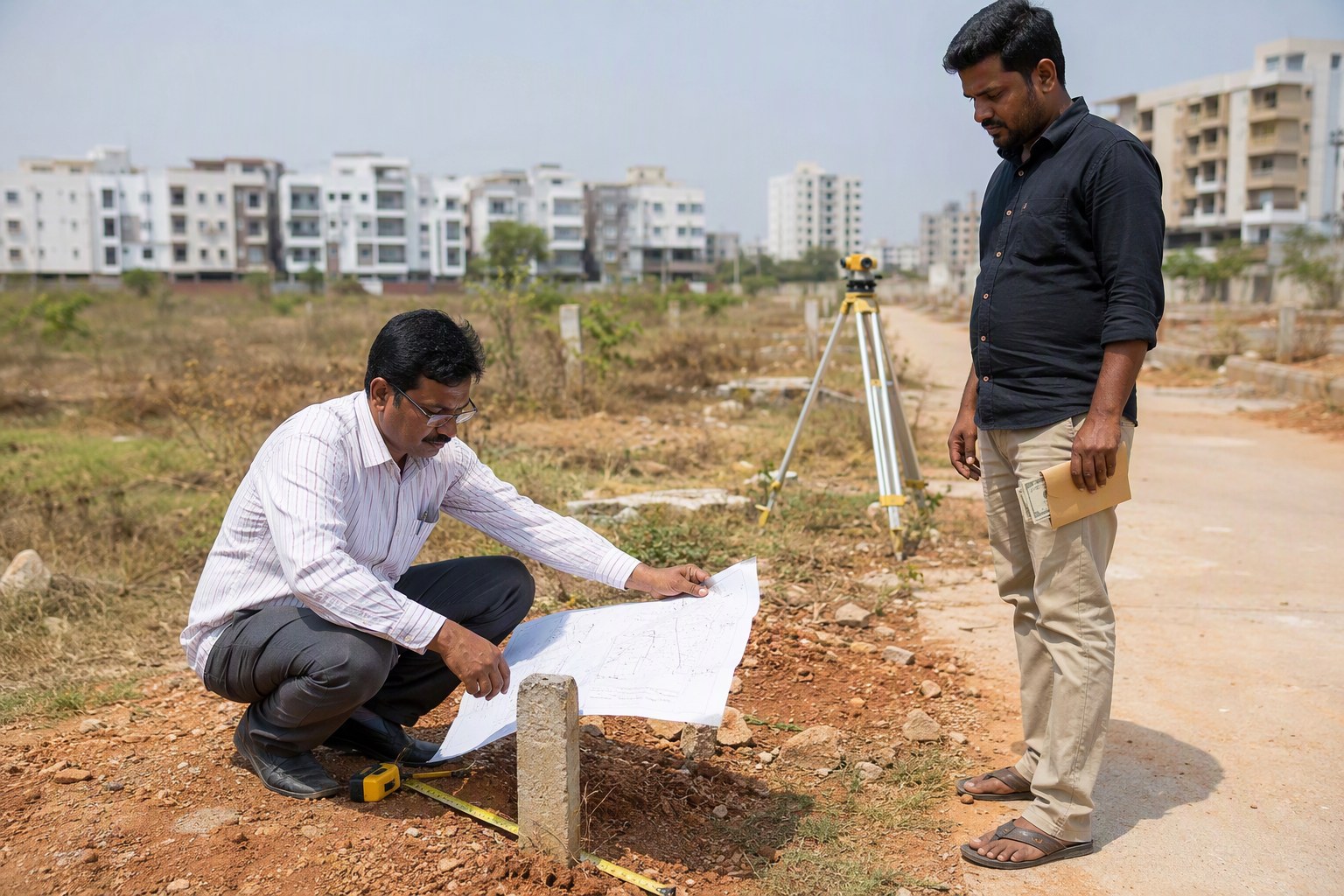



Can a Bank Loan Sanction Prove a Hyderabad Property Is Safe?
Can a bank loan sanction prove a Hyderabad property is safe? Short answer: no. It proves the bank is willing to lend under its risk policy. It does not prove the title is clean, the survey number is free from government restriction, the building has every approval, or the seller can never be challenged later. We’ve seen buyers in Gachibowli, Narsingi, Miyapur, Kompally and Shadnagar relax the moment a bank says “approved”. That is exactly when extra caution is needed.
For this piece, I spoke to three working professionals who see property files from different angles: a retail credit banker, a Hyderabad property lawyer, and an independent valuer. Their message was surprisingly similar. A loan sanction is useful, but it is not a substitute for buyer-side title verification in Telangana.
“A bank checks whether it can lend and recover. A buyer has to check whether he can own, use, sell and sleep peacefully,” said a Hyderabad-based property lawyer who reviews sale deeds and Dharani records for buyers.
Bank Loan Sanction Hyderabad Property: What It Actually Means
A bank loan sanction normally means three things. One, the borrower’s income and CIBIL profile have passed the bank’s credit test. Two, the property value broadly supports the loan amount. Three, the bank’s legal and technical teams did not find an issue serious enough to reject the file at that point.
That sounds comforting, but it is still a lender’s view. The bank is not giving you a lifetime guarantee on title. The bank’s advocate may review link documents, the latest sale deed, EC, tax receipts and approvals. The technical valuer may inspect the site, measure the flat or land, and estimate market value. But the bank is not doing a full forensic audit of every family claim, every unregistered understanding, every boundary dispute, or every future government objection.
In Hyderabad, this distinction matters. A flat in Kondapur, Serilingampally mandal may have a clean registered sale deed but still need checks on occupancy certificate, RERA status, undivided share, mortgage release and builder handover papers. A plot in Mokila, Shankarpally mandal may look fine in a layout brochure, but the survey number, pahani history, land use zone and approach road need separate verification. A villa near Narsingi, Gandipet mandal may get a loan because the project is known, yet the individual buyer must still read the sale agreement, UDS share, common area rights and club house charges.
Bank Loan Sanction Hyderabad Property: Why Buyers Still Get Caught
The most common mistake is assuming that a bank has checked “everything”. It has not. Banks work with defined checklists. Their legal team usually focuses on whether the property can be mortgaged and whether the chain of title is acceptable for lending. Their technical team focuses on value and construction status. Neither team is acting as your personal property detective.
Telangana has a large volume of sensitive land records. As per the available database fact used by our team, there are 147,934 prohibited properties under Section 22-A. That number itself should make any buyer pause. Section 22-A entries can include government lands, assigned lands, endowment lands and other restricted categories. A bank may catch many such issues, but no buyer should depend only on that comfort.
Before paying token advance, use a Section 22-A Prohibited Property Check for the survey number. If you are not sure about the exact survey number, start with the Survey Number Finder. For a registered flat or plot, pull the Encumbrance Certificate Search and compare it with the documents given by the seller.
“The loan file may have one version of documents. The buyer may receive another version from the broker. I always compare both. Small differences in survey number, extent, boundaries or seller name can become costly,” said the lawyer.
The Banker’s View: Sanction Is Conditional, Not a Clean Chit
The banker I spoke with was direct. A sanction letter is not the final disbursement. Even after sanction, the bank can hold disbursement if legal, technical or documentation conditions are not met. In under-construction flats, disbursement also depends on construction stage, builder NOC, tripartite agreement and project approval status.
Many big builders in Hyderabad have what buyers call “bank approval” or APF, meaning Approved Project Finance or Approved Project Facility. This makes loan processing faster. It does not mean every flat, floor, modification, mortgage release and buyer agreement is automatically perfect.
“People treat APF as a title certificate. It is not. It only means the project has passed our internal project-level checks. Individual unit checks still matter,” the banker said.
In our experience, this confusion is common in high-demand corridors like Nanakramguda, Financial District, Kokapet, Tellapur and Kollur. Buyers are in a hurry because prices move quickly. In Kokapet and Neopolis-side conversations, apartment quotes often sit around ₹9,000 to ₹14,000 per sq ft depending on builder, stage and view. In Gachibowli and Nanakramguda, established gated communities can go higher, often ₹10,000 to ₹16,000 per sq ft in resale discussions. When the ticket size is ₹1.5 crore to ₹3 crore, a one-week verification delay feels irritating. Still, that delay is cheaper than a title headache.
What a Bank Legal Report May Miss
A bank legal report can be good, average or rushed. It depends on the bank, advocate, property type and document quality. Here are gaps buyers must understand:
- Unregistered family claims: A brother, sister or legal heir dispute may not appear in EC.
- Old revenue issues: Pahani, mutation and Dharani history may show changes that need explanation, especially for land and plotted layouts.
- Partial survey number problems: One part of a survey number may be clean, another part may be restricted or disputed.
- Layout deviations: A bank may lend on a plot, but road width, open space, park area and layout approval must still be checked.
- Pending civil suits: Not every court dispute is obvious from the sale deed or EC.
- Builder mortgages: In flats, the project land may have a mortgage. A unit-level NOC and release process matter.
- Approval mismatch: The sanctioned plan, actual construction and saleable area may not match perfectly.
For flats, search the project on the RERA Project Lookup. For land and plotted properties, check market value through the Market Value / Guideline Value Search and identify the correct registration office using Find Your SRO Office. The SRO record is still central for registered ownership and encumbrance checks.
The Lawyer’s View: Title Verification Is Wider Than Loan Verification
A buyer-side title lawyer usually looks at the file with a different mindset. The lawyer is not asking only, “Can a bank mortgage this?” The better question is, “Can this buyer safely purchase, occupy, inherit, sell and defend this property?”
For open land, the lawyer will generally ask for parent documents, link documents for at least 30 years where available, pahani/adangal extracts, Dharani passbook details, mutation records, EC, tax receipts, layout approval, conversion orders if applicable, land use confirmation, and Section 22-A check. For flats, the list changes: land title, development agreement, GPA if any, building permission, sanctioned plan, RERA registration, occupancy certificate, UDS calculation, builder NOC, mortgage NOC and association handover papers.
We’ve seen issues in older colonies of Kukatpally and Ameerpet where family settlement history was not clean. We’ve also seen plot buyers near Shankarpally, Moinabad and Maheshwaram become casual because the seller had a bank loan earlier. An old loan closure only proves one lender was once satisfied. It does not prove the present transaction is risk-free.
“If the buyer comes after paying 10% advance, my job becomes harder. If he comes before token, I can protect him better,” the lawyer said.
The Valuer’s View: Value Is Not the Same as Valid Title
The valuer’s role is often misunderstood. A technical valuer estimates the property’s market value and checks basic physical details. For example, is the flat actually in Tower B, 12th floor? Is the built-up area close to what is declared? Is the road access proper? Is the construction stage suitable for disbursement? Is the locality saleable?
Valuers track local rate movement closely. A good valuer in Hyderabad will know that Tellapur and Kollur have moved sharply after ORR connectivity and large gated community launches. He will know that Kompally and Suchitra attract end-users at comparatively lower apartment rates, often around ₹5,000 to ₹8,000 per sq ft depending on project and age. He will know that Shadnagar plotted layouts can range widely, roughly ₹15,000 to ₹35,000 per sq yd in active market discussions depending on exact location, approvals and road access.
But valuation is not title certification. A valuer may flag visible risks, but he is not expected to solve inheritance law, assigned land restrictions or court litigation. That is why a high valuation report should never be treated as a clean legal opinion.
Where Hyderabad Buyers Should Be Extra Careful
Every locality has a different risk pattern. In core Hyderabad, the issue is often old title chain, GPA transactions, family partitions and building deviations. In western Hyderabad, the issue may be builder documentation, high pricing, UDS clarity and mortgage release. In the city outskirts, the risk shifts to land classification, survey boundaries, layout approval, road access and future land use.
| Area | Mandal / Zone | Common buyer risk | Practical check |
|---|---|---|---|
| Kokapet, Narsingi | Gandipet mandal | High-value flats, builder mortgages, plan changes | RERA, OC, unit NOC, UDS, sanctioned plan |
| Gachibowli, Kondapur | Serilingampally area | Resale chain, association dues, older approvals | EC, sale deed chain, tax receipts, occupancy proof |
| Tellapur, Kollur | Ramachandrapuram / nearby growth corridor | Under-construction commitments, possession timelines | RERA milestones, agreement clauses, bank disbursement terms |
| Mokila, Shankarpally | Shankarpally mandal | Plot layout approval, survey mismatch, road width | Survey number, HMDA/DTCP approval, land use zone |
| Maheshwaram, Tukkuguda | Maheshwaram mandal | Land conversion, approach roads, future zoning | Dharani, pahani, layout approval, zone check |
Use the Land Use Zone Finder before buying land on the outskirts. If the plot depends on a narrow approach, the Road Width Check is useful. For apartments, estimate total registration outgo through the Stamp Duty Calculator before finalising your budget. Many buyers negotiate rate well, then get surprised by stamp duty, registration charges, corpus, GST where applicable and interiors.
What Buyers Should Do Before Trusting a Loan Sanction
Here is my practical view after tracking Hyderabad transactions for years: treat bank sanction as one positive signal, not the full answer. If a reputed bank is lending, it may reduce some risk. But your verification should run independently.
1. Match names, numbers and boundaries
Check seller name, father’s name, document number, survey number, flat number, extent, boundaries and SRO details across sale deed, EC, tax receipt and loan papers. Small spelling differences are normal in old records, but survey or extent mismatch needs explanation.
2. Pull your own EC
Do not rely only on the EC shared by the seller or broker. Pull a fresh EC. Check mortgages, releases, agreements of sale, court attachments if reflected, and transaction sequence. EC is not perfect, but it is a basic filter.
3. Check Section 22-A for land
For plots and villas with land share, run a prohibited property check. If the survey number appears in any restricted category, stop and get a lawyer’s written opinion. Do not accept verbal comfort.
4. Verify RERA and approvals
For ongoing apartment projects, RERA is not optional. Check project registration, promised completion date, approved plans and quarterly updates. A glossy brochure has no legal value compared with sanctioned approvals.
5. Compare market value and deal value
If a property is far cheaper than nearby sales, ask why. Distress sale is possible, but legal issues also hide behind attractive pricing. Use guideline value as a floor reference and local market rate as a reality check.
6. Take independent legal opinion
Spend a small amount on your own lawyer before paying a large advance. Do not depend only on the bank’s panel advocate. The bank’s lawyer works for the bank. Your lawyer works for you.
So, Can a Bank Loan Sanction Prove a Hyderabad Property Is Safe?
No. A bank loan sanction cannot prove a Hyderabad property is safe. It can support your confidence, but it cannot replace title due diligence, EC review, Dharani and pahani checks, Section 22-A screening, RERA verification and approval review. This is especially true in Telangana, where land records, SRO records and project approvals must be read together.
My opinion is simple: if you are buying a ₹80 lakh flat in Miyapur or a ₹3 crore apartment in Kokapet, do not outsource your peace of mind to a sanction letter. Use the bank’s process as one layer. Add your own lawyer, your own document checks and your own common sense. Hyderabad property can be a strong asset, but only when the paperwork is as solid as the location.
Frequently Asked Questions
Does bank approval mean the property title is clear in Hyderabad?
No. Bank approval means the lender is willing to finance the property under its internal policy. It is not a legal guarantee that the title is free from all disputes, restrictions or future claims.
Can I rely on the bank’s legal opinion instead of hiring my own lawyer?
It is risky. The bank’s advocate protects the bank’s lending interest. A buyer-side lawyer checks whether you can safely purchase, occupy, sell and defend the property later.
What is the biggest risk in buying land around Hyderabad outskirts?
Common risks include Section 22-A prohibition, survey number mismatch, lack of approved layout, unclear road access, wrong land use zone and old revenue record issues in Dharani or pahani.
Should I check RERA even if a bank has approved the project?
Yes. For under-construction projects, check RERA registration, completion timeline, approved plans and project updates. Bank project approval is not a replacement for RERA verification.
What should I verify before paying token advance?
Verify seller identity, sale deed chain, EC, survey number, Section 22-A status, RERA or layout approval, SRO details, tax receipts and basic market value. Pay token only after the first round of checks.